
News
FAO Emphasizes Urgency of Land Restoration in Nigeria for Sustainable Development
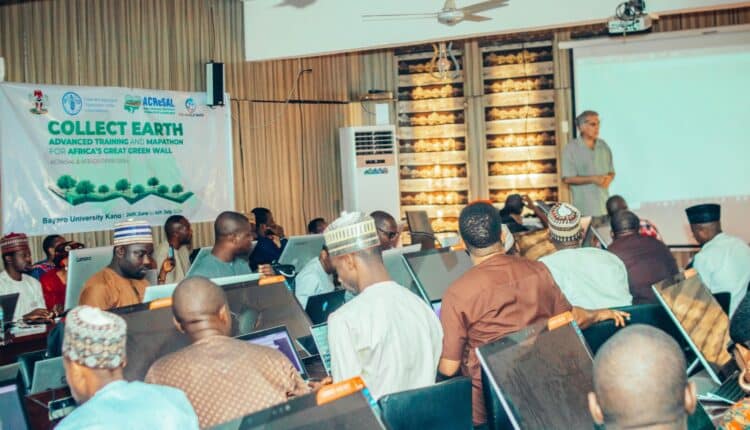
The Food and Agriculture Organisation (FAO) of the United Nations has emphasized the importance of land restoration efforts in achieving sustainable development and food security in Nigeria.
The organisation emphasized that land degradation and desertification are pressing issues that require immediate attention and action
FAO Country Representative in Nigeria and ECOWAS, Mr. Koffy Dominique stated this at the opening of Collect Earth Training and Biophysical Data Collections for Africa’s Great Green Wall, ACReSAL and Africa Open DEAL held at the Centre for Dryland Agriculture.
He emphasized that land degradation and desertification are pressing issues that require immediate attention and action.
Dominique emphasized that land degradation and desertification are pressing issues that require immediate attention and action.
Citing statistics and research, he pointed out that land degradation affects not only the environment but also the livelihoods of millions of people, particularly in Africa,’’ Agbesor said.
Koffy Dominique represented by Focal Point for the FAO’s ACReSAL Project, Mr. Precious Agbesor went on to underscore the importance of monitoring and evaluation in ensuring the success of land restoration initiatives.
He stressed that without proper monitoring and evaluation, it is difficult to assess progress, identify areas of improvement, and make necessary adjustments. He encouraged participants to think critically about the importance of data collection, analysis, and reporting in informing decision-making.
Agbesor encouraged participants to make the most of this unique opportunity to participate in the hands-on “Collect Earth Advanced Training and Mapathon for Africa’s Great Green Wall” program. He emphasized that this was a chance to gain valuable skills and knowledge in using digital mapping technology to address land degradation issues. He also highlighted that this was a critical step towards achieving the African Union’s Agenda 2063 goal of revitalizing Africa’s ecosystems.
In a remark, Associate Professor Murtala Badamosi, the Coordinator of the Centre for Dry Land Agriculture at Bayero University of Kano, Nigeria, expressed delight at hosting the ACReSAL Collect Earth training at the Centre.
Badamosi emphasized the commitment of the Centre to the ACReSAL agenda, highlighting the importance of monitoring and evaluation in ensuring the success of land restoration efforts.
He noted that monitoring and evaluation were critical components of any project, as they allowed for assessing progress, identifying areas for improvement, and making informed decisions.
Badamosi emphasized that land restoration was an urgent issue that required immediate attention. He noted that the degradation of land was having devastating effects on the environment, ecosystems, and human communities.
He urged participants to take their responsibilities seriously and to utilize the technical knowledge and resources provided during the training to make a positive impact in their communities.
The CDA Director also highlighted the importance of collaboration and partnership in achieving land restoration goals.
He acknowledged the role of international organizations like FAO in supporting national efforts towards sustainable land management. He emphasized that partnerships were crucial in sharing knowledge, expertise, and resources to achieve common goals.
On his part, the Kano State ACReSAL Project Coordinator, Dr. Dahir M. Hashim expressed commitment and support to the success of the training, emphasizing the significance of the Collect Earth Advanced Training for the pioneers of monitoring and evaluation processes in their respective states.
Dr. Hashim noted that the training was a crucial step towards ensuring the sustainability of the ACReSAL Land Restoration project.
He noted that the project would not only benefit the environment but also contribute significantly to the economic growth and development of Kano State.
He praised the participants for their dedication and commitment to their work, noting that they would be playing a vital role in implementing the project’s objectives.
The Project Coordinator acknowledged the efforts of the FAO team in organizing the training, emphasizing that the collaboration between ACReSAL and FAO would be crucial in achieving the project’s goals.
ACReSAL National Project Coordinator, Mr Umar Abdulhamid said that this partnership between Nigeria and the FAO would be a valuable asset, hoping that the Federal Government representatives would translate this collaboration into tangible implementation results.
The Director General, National Agency for the Great Green Wall (GWW) , Dr. Yusuf Maina-Bukar underscored the importance of sustaining the monitoring and evaluation aspect of land restoration projects.
He stressed that effective monitoring would enable accurate tracking of progress, identify areas for improvement, and ensure that project goals were being met and that this was not only essential for achieving tangible results but also for building trust and credibility among stakeholders.
The Director General, National Agency for the Great Green Wall (GWW) , Dr. Yusuf Maina-Bukar underscored the importance of sustaining the monitoring and evaluation aspect of land restoration projects.
He stressed that effective monitoring would enable accurate tracking of progress, identify areas for improvement, and ensure that project goals were being met and that this was not only essential for achieving tangible results but also for building trust and credibility among stakeholders.
Reports indicate that certificates were presented to participants after the week-long training session.










News
ADC crisis rooted in legal process, not external influence — lawyers explain
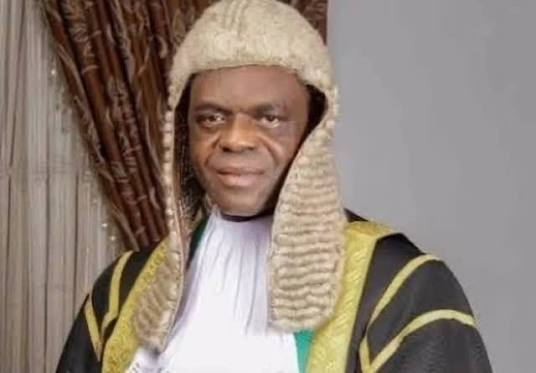
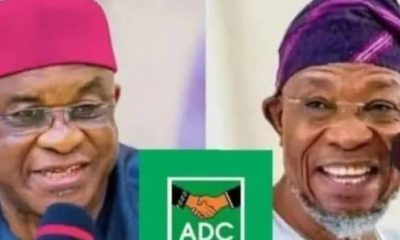
Two Nigerian lawyers, Inibehe Effiong and Bodunde Opeyemi, have offered detailed legal explanations of the ongoing leadership crisis within the African Democratic Congress (ADC), pointing to procedural decisions and binding court rulings as the root of the dispute.
Their interventions come amid growing public debate over the role of the electoral commission and speculation about possible political interference.
Mr Effiong, a public interest and human rights lawyer, criticised the legal approach taken by the faction led by former Senate President David Mark, describing it as procedurally questionable.
He said the Federal High Court did not issue any restraining order against the leadership, but instead directed that all parties be put on notice — a standard legal step requiring both sides to present their arguments.
According to him, the appropriate response would have been to contest the case at the trial court rather than file an interlocutory appeal.
“It became a motion on notice. They should have filed processes in opposition,” he said, adding that the decision to appeal at that stage was “unusual” and “untidy”.
He warned that pursuing further appeals could complicate the matter further instead of resolving it.
*Court ruling shapes situation*
Legal practitioner Mr Opeyemi traced the dispute to a leadership contest that followed a party meeting in July 2025, which produced a new executive.
The situation escalated when a party official challenged the process in court, asking the Federal High Court to stop both the new leadership and the electoral body from recognising the outcome.
While the court declined to grant an interim order, the case later reached the Court of Appeal.
In March 2026, the appellate court directed all parties to maintain the status quo ante bellum — meaning the situation must remain as it was before the case was filed.
Mr Opeyemi said this order is clear and binding.
“It requires a strict preservation of the state of affairs before the dispute,” he explained, adding that no party is allowed to take actions that could influence the outcome of the case.
Why the electoral body acted
The lawyers say this court order explains the position taken by the electoral commission, which has declined to recognise any faction of the party.
According to Mr Opeyemi, the commission is legally bound to comply with the directive and cannot take sides while the case is still before the court.
He said any attempt to recognise a leadership or engage with party activities under dispute could amount to a violation of a valid court order.
*Focus on internal legal process*
Both lawyers suggest that the situation is the result of internal disagreements and legal strategy within the party.
Their analysis indicates that the current impasse is being shaped by court processes rather than actions from outside the party.
The dispute is expected to remain unresolved until the Federal High Court delivers a final judgment on the substantive case.
News
APC Dismisses ADC’s Claims, Calls Leadership Crisis ‘Self-Inflicted’
By Yusuf Danjuma Yunusa
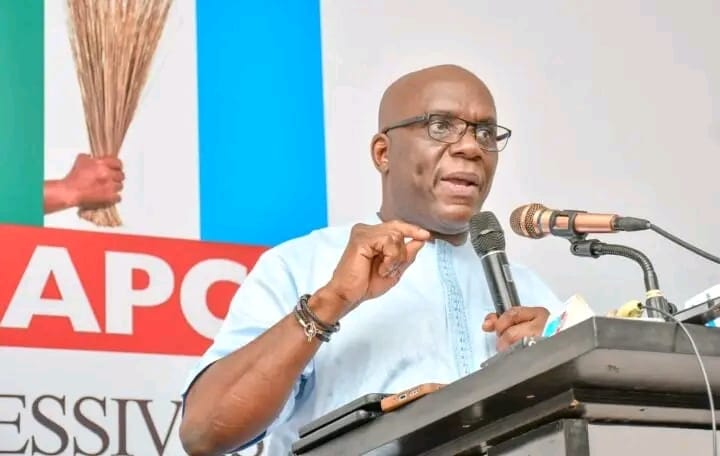
The All Progressives Congress (APC) has described the Independent National Electoral Commission’s (INEC) recent removal of the African Democratic Congress (ADC) National Working Committee (NWC) members from its portal as a problem entirely of the opposition party’s own making.
Speaking on News Central on Thursday, APC spokesperson Felix Morka rejected allegations that the ruling party was behind INEC’s decision to stop recognising David Mark as ADC national chairman and former governor Rauf Aregbesola as national secretary.
“We are only concerned about our level of preparation and the effort we are making. We’re concerned about ourselves. It is the opposition that is obsessed about what the APC does,” Morka said.
He added: “Even the most recent development that everyone is talking about—INEC’s decision to derecognise the David Mark executive—was utterly self-inflicted. The APC didn’t do that. We did not orchestrate the hijack of the ADC by that executive.”
INEC removed the Mark-led NWC from its portal on Wednesday, citing a March 12 ruling by the Court of Appeal. The commission also delisted the factional chairman, Nafiu Bala Gombe. INEC stated it would no longer recognise any factional activities until the Abuja Division of the Federal High Court resolves the party’s leadership dispute.
In response, the ADC, through its national publicity secretary Bolaji Abdullahi, accused the ruling party of hijacking its leadership and pressuring INEC to sack the Mark-led NWC. “The electoral body acted under pressure from a government panicked by the opposition momentum, despite its efforts to destroy all opposition parties and foist a one-party rule on Nigeria,” the ADC alleged.
Morka dismissed the accusation, arguing that INEC withdrew recognition from Mark and Aregbesola because they disregarded the ADC’s constitution and the rule of law.
“They did that, completely ignoring the rule of law and the party’s constitution on succession. When you parachute into a party and take over without following constitutional stipulations on leadership succession, this is the consequence,” he said.
“This was manufactured by the same people now complaining and pointing fingers at the APC. We are not concerned about all that.”
The leadership crisis in the ADC—a coalition of opposition politicians positioning to challenge President Bola Tinubu in the 2027 elections—began following the resignation of Ralph Nwosu as national chairman. David Mark was subsequently ratified as chairman, a move Gombe contested, arguing that he was entitled to the position under the party’s constitution.
Gombe then approached the Federal High Court in Abuja, challenging the legality of Mark’s leadership and seeking an order to stop the NWC members from parading themselves as party leaders.
Mark’s faction appealed to the Court of Appeal on December 18, 2025, arguing that the lower court lacked jurisdiction. However, the appellate court dismissed the appeal, allowing the case to proceed at the Federal High Court.
News
INEC Dismisses Calls for Chairman’s Removal, Clarifies Voter Revalidation Decision
By Yusuf Danjuma Yunusa
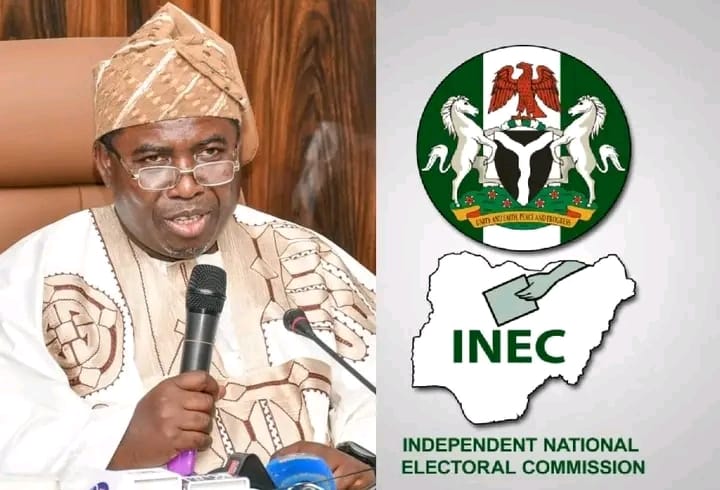
The Independent National Electoral Commission (INEC) has rejected mounting calls for the resignation or removal of its Chairman, Professor Joash Amupitan (SAN), while also moving to clarify what it termed widespread misconceptions about its planned nationwide voter revalidation exercise.
In a statement issued late Thursday in Abuja and signed by the Chairman’s Chief Press Secretary, Adedayo Oketola, the Commission said it was aware of “recent public statements by political actors alleging partisan bias” and demanding the Chairman’s removal over the Commission’s decision to obey a recent Court of Appeal judgment.
INEC acknowledged the right of stakeholders to voice their opinions, but stressed that its operations and leadership structure are constitutionally protected.
“It is imperative to clarify that INEC is a creation of the Constitution of the Federal Republic of Nigeria. The appointment, tenure, and removal of the Chairman and National Commissioners are strictly governed by Section 157 of the 1999 Constitution (as amended),” the statement read.
The Commission further underlined the independence of its leadership, noting that “the Chairman does not hold office at the pleasure of any political party or interest group.” It warned that “any call for removal outside the established constitutional process is not only a distraction but a direct assault on the independence of the nation’s electoral umpire.”
Explaining its compliance with the recent Court of Appeal judgment, INEC said the decision was necessary to avoid a repeat of past electoral crises. The Commission stated that it acted “to avert a situation that occurred in Zamfara State and Plateau State, where elected officials were removed by election tribunals on account of disobedience of court judgments.”
The Commission also clarified that monitoring the activities of the David Mark-led faction of the African Democratic Congress (ADC) would amount to disobedience of the court order. It added, “It was only on the 9th of September 2025 that INEC accepted and approved David Mark’s Exco, which was seven days after the matter was filed at the Federal High Court.”
Addressing allegations that it was undermining the multi-party system, INEC dismissed such claims, pointing to its recent registration and recognition of three political parties—the Democratic Leadership Alliance, the Nigeria Democratic Congress, and the National Democratic Party. This brings the total number of active political parties in the country to 22, which the Commission said demonstrates its neutrality.
Reaffirming the binding authority of appellate court rulings, INEC cited Section 287(2) of the 1999 Constitution, which “mandates every person and authority in Nigeria not only to obey the judgment of the Court of Appeal but also to enforce such judgment.”

ADC crisis rooted in legal process, not external influence — lawyers explain

APC Dismisses ADC’s Claims, Calls Leadership Crisis ‘Self-Inflicted’

INEC Dismisses Calls for Chairman’s Removal, Clarifies Voter Revalidation Decision

INEC, David Mark, And Coming Abachaian Coronation
Jonathan Urges National Assembly to Overhaul Electoral Litigation Process, Create Specialised Court

Governor Abba Kabir Yusuf Holds Exclusive Prerogative to Choose Deputy – Malam Inuwa Waya

The Governor Who Chose His People Over His Politics: Abba Yusuf and the Moral Courage Behind Kano First
Restoring the Glory That Was Always There: Governor Abba Kabir Yusuf and the Historical Vision Behind Kano First

NDLEA Clarifies: Drug Case Against Abba Kyari Still Active After Court Discharge

Nigeria’s Education Minister Tunji Alausa Weighs Resignation to Run for Lagos Governor
ADC crisis rooted in legal process, not external influence — lawyers explain
APC Dismisses ADC’s Claims, Calls Leadership Crisis ‘Self-Inflicted’
INEC Dismisses Calls for Chairman’s Removal, Clarifies Voter Revalidation Decision
INEC, David Mark, And Coming Abachaian Coronation
Jonathan Urges National Assembly to Overhaul Electoral Litigation Process, Create Specialised Court
Governor Abba Kabir Yusuf Holds Exclusive Prerogative to Choose Deputy – Malam Inuwa Waya
The Governor Who Chose His People Over His Politics: Abba Yusuf and the Moral Courage Behind Kano First
Restoring the Glory That Was Always There: Governor Abba Kabir Yusuf and the Historical Vision Behind Kano First
NDLEA Clarifies: Drug Case Against Abba Kyari Still Active After Court Discharge
Nigeria’s Education Minister Tunji Alausa Weighs Resignation to Run for Lagos Governor
-

 Opinion4 years ago
On The Kano Flyovers And Public Perception
-

 Features5 years ago
How I Became A Multimillionaire In Nigeria – Hadiza Gabon
-

 Opinion5 years ago
Kano As future Headquarters Of Poverty In Nigeria
-

 History5 years ago
Sheikh Adam Abdullahi Al-Ilory (1917-1992):Nigeria’s Islamic Scholar Who Wrote Over 100 Books And Journals
-

 Opinion4 years ago
My First Encounter with Nasiru Gawuna, the Humble Deputy Governor
-

 History5 years ago
The Origin Of “Mammy Market” In Army Barracks (Mammy Ochefu)
-

 History4 years ago
The History Of Borno State Governor Professor Babagana Umara Zulum
-

 News4 years ago
Federal University Of Technology Babura To Commence Academic Activities September