
News
IWD: ‘Women play crucial roles in Dangote Group success story’- Fatima Aliko Dangote
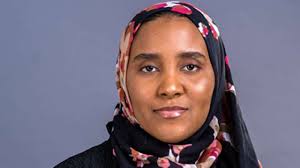
Executive Director, Commercial, NASCON Allied Industries, Fatima Aliko Dangote has revealed that the Dangote Group has invested in innovative technologies and processes to achieve gender equality and empowerment of all women in the organisation.
Besides, Fatima disclosed that women are playing pivotal roles in the success story of the Dangote Group. To drive transformative change, she said the company is implementing the policy of continuous improvement in its production processes with state-of-the-art production facilities, which are already being managed by women.
Speaking while opening the International Women’s Day Conference in Lagos and Dangote Cement Plc, Obajana Plant, Fatima noted that the company, through its Learning Management System (LMS), offers employees a variety of resources and opportunities that help them advance their professional and personal development.
According to her, these learning and development offerings cover vast focus areas and are provided via on-the-job, classroom, and online learning platforms, to both permanent and temporary employees across all cadres, in the Group’s Nigerian and Pan-African operations.
“At the plants, we have the Gamma Neutron Activation Analysis (PGNAA) for online analysis, robotic laboratory, and fully automated central control room system equipped with Human Machine Interface technology (HMI) and innovative solutions to drive resource efficiency, process optimisation and mitigate the environmental footprints of our products while delivering quality products that meet the needs of our esteemed customers,” she added.
Fatima explained that Dangote Women’s Network through this year’s theme has provided a unique opportunity to holistically examine the theme of innovation and technology from a gender perspective.
“We are inspired by our superheroes in STEM, and we hope this session increases your awareness of innovation, technology, and digital education, driven by women for women, and learn advancements in digital technology that address how we rethink our daily lives and achieve our personal and professional goals.
“I would like to encourage our women with a few tips on leveraging technology, Equipping yourselves academically and technically, be inspired and inspire others by creating opportunities for regular interactions with female STEM champions and leaders and tapping into opportunities for hands-on experience in the form of volunteering”, she added.
Speaking also, Co-Founder/COO Piggy/Vest NG, Odunayo Eweniyi said technology plays a key role and can support women in their daily responsibilities either as a mother or as a worker. She said it’s never too early to introduce girls to technology and that supporting their passion early can lead to meaningful careers in the future.
She urged the Dangote Cement Group not to relent in its Gender Balance Policy, especially as it relates to encouraging qualified women in the business of cement production.
Chief Enterprises Business Officer, MTN Nigeria Mrs. Lynda Saint said women’s condition can be improved through innovative technology. She encouraged parents to expose their female children to science and technology as the world has embraced technology and innovation in every aspect of the organisation.
Giving a vote of thanks at the end of the conference, Group Chief Human Resources Officer at Dangote Industries Limited, Nglan Niat commended the speakers for sharing their valuable thoughts and insights with the Dangote team.
“Today marks International Women’s Day 2023, a day set aside to take stock and reflect on how far we have come in tackling gender disparity and also to recognise how much we must go to achieve equality and equity in our workplace. Having female representation at all levels of the company is essential as it contributes to a good working environment and better quality of work. That is what we are striving to achieve. The technology industry has been male-dominated, so we need to work harder to ensure that women are properly supported,” she added.
Chairperson of the Dangote Women Network at the DCP Obajana, Mrs. Fatima Kabir Ikunaiye said the Network began operation in 2017, and since then it has carried out several interventional programmes in the cause of women. Some of the programmes, Mrs. Ikunaiye said include: support for orphanages and vulnerable homes, sensitisation and empowerment of women as well as training them on skill acquisition.











News
PCACC Arrests Man Over Alleged ₦4.5m Sale, Illegal Leasing of Kano Government Horse Stable

The Kano State Public Complaints and Anti-Corruption Commission (PCACC) has arrested one Tasiu Adamu Maje over the alleged illegal sale and leasing of a government-owned Horse Stable at the Race Course, popularly known as Filin Sukuwa, in Kano.
The Commission disclosed this in a statement signed by its Acting Chairman, Hafsat Ada’u Kutama, Esq., where it said the arrest followed complaints lodged by Muhammad Amir Yunusa and Usman Bala Yakasai, popularly known as Sharif, over alleged unauthorised dealings involving the government property.
According to the PCACC, the complainants alleged that Maje transferred and offered the Horse Stable to private individuals despite having no lawful authority to sell, lease or otherwise dispose of the government-owned property.
The Commission said its investigation established that the Kano State Sports Commission, which is the statutory body responsible for the allocation and management of Horse Stables in the state, had no knowledge of or involvement in the purported transactions.
The PCACC said it invited and interviewed individuals connected with the transactions as part of its investigation into the allegations.
According to the Commission, the investigation revealed that the Kano State Sports Commission did not authorise any transaction involving the Horse Stable and that the property had never been officially allocated to any individual either through sale or lease.
The anti-corruption commission further said the document allegedly relied upon by the suspect to facilitate the transaction was not an approved or recognised document of the Kano State Sports Commission.
The Commission added that the same unapproved document was allegedly used in transactions involving two different individuals, raising further concerns about the legitimacy of the dealings.
According to the PCACC, the sale, lease or transfer of government-owned Horse Stables to private individuals without the requisite approval is contrary to established government policy and applicable administrative procedures.
The Commission alleged that Maje agreed to sell the Horse Stable to Muhammad Amir Yunusa for ₦4.5 million while simultaneously collecting rent from Usman Bala Yakasai.
The PCACC said ₦180,000 was demanded as rent from Yakasai, out of which ₦150,000 was reportedly paid in connection with the purported transaction.
Following its investigation, the Commission declared the purported transactions involving the Horse Stable unauthorised and invalid.
The Commission maintained that the property remains the property of the Kano State Government and is under the control and management of the Kano State Sports Commission.
According to the PCACC, no individual has the authority to sell, lease, transfer or otherwise dispose of government property without the appropriate legal and administrative approval.
The Commission said it had commenced steps to recover the Horse Stable and return it to the Kano State Sports Commission.
The PCACC further disclosed that the suspect is expected to be arraigned before a court of competent jurisdiction, where the allegations against him will be subjected to due process.
The Commission said it would also pursue all appropriate administrative and legal measures in accordance with the law in connection with the case.
The Acting Chairman warned individuals who may attempt to convert government property into private assets or sources of personal profit that such conduct would not be tolerated.
According to Kutama, government property is not meant for private sale, unauthorised leasing or personal financial gain.
The Commission said it would continue to investigate allegations involving the unlawful disposal, transfer or commercialisation of public assets and would take appropriate action against anyone found to have violated the law, regardless of status.
The PCACC also advised members of the public to exercise caution before entering into transactions involving government property.
The Commission urged prospective buyers, tenants and investors to verify the ownership, allocation and legal status of any government property directly with the relevant government authority before making payments or entering into agreements.
The anti-corruption commission reaffirmed its commitment to safeguarding government property, preventing abuse of public assets and promoting accountability, transparency and responsible management of public resources.
The PCACC also called on members of the public to report suspected corruption, abuse of office, illegal disposal of government property and other forms of misconduct through its official reporting channels.
News
Rep. Abubakar Bichi Employs 100 New Islamic School Teachers in Bichi
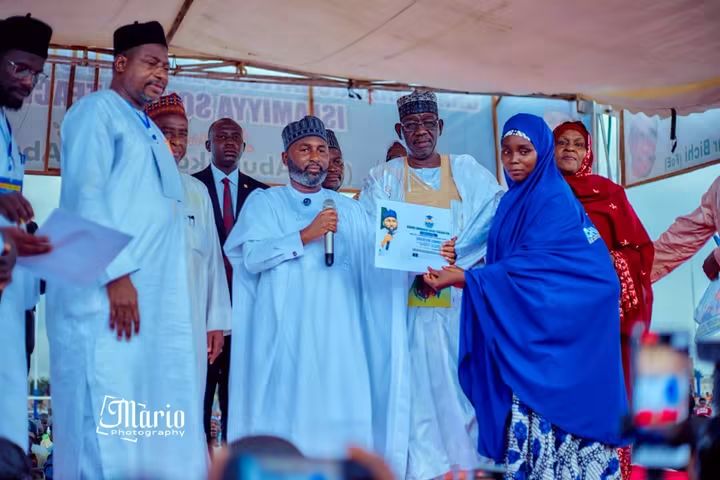
The Federal lawmaker representing the Bichi Federal Constituency, Hon. Abubakar Kabir Abubakar Bichi, has inaugurated 100 new Islamic school teachers as part of efforts to strengthen Islamic education in the Bichi Local Government Area of Kano State.
The inauguration ceremony was held on Sunday, 27 September 2026, and marked the fourth batch of School Teachers employed under the lawmaker’s initiative bringing the total of number of teachers engaged through the programme to 600.
Before their employment, the 100 teachers underwent a special examination conducted at the directive of the lawmaker. Those who obtained the highest scores across the 11 wards of Bichi Local Government Area were selected for the teaching positions.
The lawmaker had previously supported the teachers by paying their monthly allowances as volunteers before formally employing them as full-time teachers in Islamic schools across the local government area.
Prominent Islamic scholars and dignitaries attended the inauguration ceremony, including Sheikh Habibu Dan Almajiri, Chairman of the Kano State Zakkah Commission; Dr. Nazifi Ishak, former Kano State Commissioner for Religious Affairs; Dr. Zahrau Muhammad Umar, former Commissioner for Women Affairs; and Sheikh Sanusi Sharif Bichi.
Also in attendance were the Chairman of Bichi Local Government Area, Alhaji Hamza Sule Maifata; the Director-General of the APC Campaign Council in Bichi, Alhaji Sani Mukaddas, and the Kano State APC Secretary, Prof. Yusuf Muhammad Sabo.
The Islamic scholars and other dignitaries commended Hon. Abubakar Kabir Abubakar Bichi for his efforts towards improving both Islamic and modern education in the Bichi Local Government Area.
Hon. Abubakar Kabir Abubakar has also previously engaged several youths in various sectors, including healthcare, environmental services, education and other community development activities, as part of his efforts to create opportunities for young people across Bichi Federal Constituency and Kano State.
The lawmaker, who serves as the Chairman of the House Committee on Appropriation, has consistently expressed his commitment to youth development and community empowerment through various initiatives across the constituency.
News
FG Seeks Fresh $1.5bn World Bank Loans As Nigeria’s Debt Hits N166.79tn

By Yusuf Danjuma Yunusa
The Federal Government is in discussions with the World Bank for three new loans worth a combined $1.5 billion, even as Nigeria’s total public debt climbed to a record N166.79 trillion by June 2026.
The proposed facilities consist of three $500 million loans targeting climate resilience, social protection and early childhood development.
The first is an additional $500 million for the Agro-Climatic Resilience in Semi-Arid Landscapes (ACReSAL) project, which would increase its total financing to $1.2 billion. The funds are expected to support land restoration, flood and erosion control, irrigation, water management and other climate-resilience measures across northern Nigeria.
Another $500 million facility is proposed for the Household Prosperity and Empowerment-Social Protection (HOPE-SP) project. It is designed to support poor and vulnerable households through cash transfers, an improved social registry and stronger social protection systems.
The third $500 million loan would finance the Nigeria Early Childhood Development programme, covering all 36 states and the Federal Capital Territory. The programme aims to improve access to healthcare, nutrition, early learning, childcare, water and sanitation for children aged zero to five.
Meanwhile, figures from the Debt Management Office show that Nigeria’s public debt increased by N14.39 trillion , from N152.40 trillion in June 2025 to N166.79 trillion in June 2026. Domestic debt stood at N91.59 trillion, while external debt was N75.20 trillion.
Nigeria’s debt to the World Bank Group also rose to $20.73 billion by June 2026, accounting for about 38 per cent of the country’s $54.52 billion external debt.
Economist Adewale Abimbola said concessional loans could support development if properly structured and effectively utilised, stressing that the key issue was how the borrowed funds were deployed.

PCACC Arrests Man Over Alleged ₦4.5m Sale, Illegal Leasing of Kano Government Horse Stable

Goje’s Electoral War:The Confrontation With Tinubu,Governor Inuwa,Usman Kumo And APC candidates Ahead Of 2027

Dry Taps Gone, Kano Flows Again: The Abba Yusuf Water Comeback By Abba Anwar

Rep. Abubakar Bichi Employs 100 New Islamic School Teachers in Bichi

The Tinubu Health Reset: A Consultant Examines Nigeria’s Healthcare Reforms

Zamfara Varsity ASUU Threatens Warning Strike Over FG-ASUU Agreement, Promotion Arrears

Bello Sharada: A Great Writer, A Bookish Soul, Gone Too Soon

Kano Chemists Threaten Warning Strike Over Alleged PCN Pressure

Per Ishaq Samaila: “Waziri” for Strategy. “Mai Jama’a” for Service. One Man. One Mission. Ibrahim Kabir Masari

Education Stakeholders, SBMC Train Students on Skills for Self-Reliance
PCACC Arrests Man Over Alleged ₦4.5m Sale, Illegal Leasing of Kano Government Horse Stable
Goje’s Electoral War:The Confrontation With Tinubu,Governor Inuwa,Usman Kumo And APC candidates Ahead Of 2027
Dry Taps Gone, Kano Flows Again: The Abba Yusuf Water Comeback By Abba Anwar
Rep. Abubakar Bichi Employs 100 New Islamic School Teachers in Bichi
The Tinubu Health Reset: A Consultant Examines Nigeria’s Healthcare Reforms
Zamfara Varsity ASUU Threatens Warning Strike Over FG-ASUU Agreement, Promotion Arrears
Bello Sharada: A Great Writer, A Bookish Soul, Gone Too Soon
Kano Chemists Threaten Warning Strike Over Alleged PCN Pressure
Per Ishaq Samaila: “Waziri” for Strategy. “Mai Jama’a” for Service. One Man. One Mission. Ibrahim Kabir Masari
Education Stakeholders, SBMC Train Students on Skills for Self-Reliance
-

 Opinion5 years ago
On The Kano Flyovers And Public Perception
-

 Features5 years ago
How I Became A Multimillionaire In Nigeria – Hadiza Gabon
-

 Opinion6 years ago
Kano As future Headquarters Of Poverty In Nigeria
-

 History5 years ago
Sheikh Adam Abdullahi Al-Ilory (1917-1992):Nigeria’s Islamic Scholar Who Wrote Over 100 Books And Journals
-

 Opinion5 years ago
My First Encounter with Nasiru Gawuna, the Humble Deputy Governor
-

 History5 years ago
The History Of Borno State Governor Professor Babagana Umara Zulum
-

 History6 years ago
The Origin Of “Mammy Market” In Army Barracks (Mammy Ochefu)
-

 News4 years ago
Federal University Of Technology Babura To Commence Academic Activities September