
News
Terror Alert: Group Knocks U.S , U.K, Others For Going Public
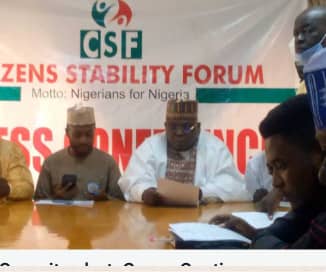
A Civil Society Organization under the aegis of Citizens Stability Forum (CSF) has berated the United States of America (USA), United Kingdom (UK) and the Canadian over their recent public terror alerts that the trio raised that went viral.
The group questioned the motive behind the three countries going public instead of notifying the Nigerian government, establishing that Nigeria as a country have been enjoying long diplomatic relationship with them.
In a press conference to journalists in Kano state, the group frowned that it is expected that when a foreign mission like the US is faced with such intelligence to channel such warnings and intelligence through diplomatic channels where adequate plans and provisions will be made to not only avert the situations but to also apprehend the planners and sponsors of such act.
The group lamented that such warnings from from the trio of the US,UK and Canadian embassies had endeared Denmark and Australia to follow suit, the warnings it said had plunged the entire Nigerian capital into perpetual fairs where businesses and schools have started closing down because of the fairs of terror attacks.
“The recent happenings surrounding the terror alert raised by the United States, the United Kingdom and Canadian embassies in Nigeria have left a bad taste on the side of Nigerians, putting into question the sort of diplomatic relationship vis-à-vis rules of diplomacy that currently exist between the said countries and Nigeria.
” As Nigerians, we the Citizens Stability Forum (CSF) would like to ask the following questions: Why did the US act in such a manner to Nigeria? Also, will the US act in such a manner in other countries such as Saudi, UAE, Turkey, Egypt etc? Most importantly, does US act in such a manner in its own soil when faced with such security intelligence? We all know answers to the last two questions is an absolute No”.
“It is thus very unfortunate that the US went public with intelligence type of warning without sharing any solid or useful information with the Nigerian government, thus deliberately creating widespread speculation and panic and creating undue anxiety among Nigerians.
The group also noted that no countries in the world is impeccable of one security challenge or the other, adding that the US has the peculiarities of gun violence and mass shooting, that many school children usually victims of.
It said that there is a report that the security challenge of gun shooting have put many children and teens into serious mental health crisis, steadily eroding their sense of wellbeing and safety.
” Every country around the world has its own security challenges, which of course can be in different forms. The US for example has serious challenges of gun violence and mass shooting which is epidemic that school children are not spared. It has been reported that the security challenge due to gun violence and shootings have put many children and teens into serious mental health crisis, steadily eroding their sense of wellbeing, safety and efficacy known to be essential for development. According to published statistics from the Centre for Disease Control and Prevention (CDC)there was 19,384 deaths in 2020 due to gun violence and mass shooting “.
Paradigmatic Shift in Literary Ignorance: Ajami on Naira Reloaded-Adamu
Echoing the sentiments of the group is its lead convener, Muktar Lawal who also expressed his displeasure over the public security alerts by the US,UK and Canadian embassies.
He noted that the issuance of the security alerts has endeared a lot of trepidations, fears and anxieties amongst the Nigerians living in the federal capital territory.
He wondered why these country had refused to relay such intelligence to the Nigerian government since there are favourable diplomatic ties amongst the country.
” The reason why we convene this press conference is for them to understand that issues like this, issues of security are very important and critical.
“They should channel it to the appropriate unit of the Federal Republic of Nigeria instead of going public and viral, and by doing this our security agencies will rise to the occasion and do the needful”, Muktar said.









News
Rep. Abubakar Bichi Employs 100 New Islamic School Teachers in Bichi
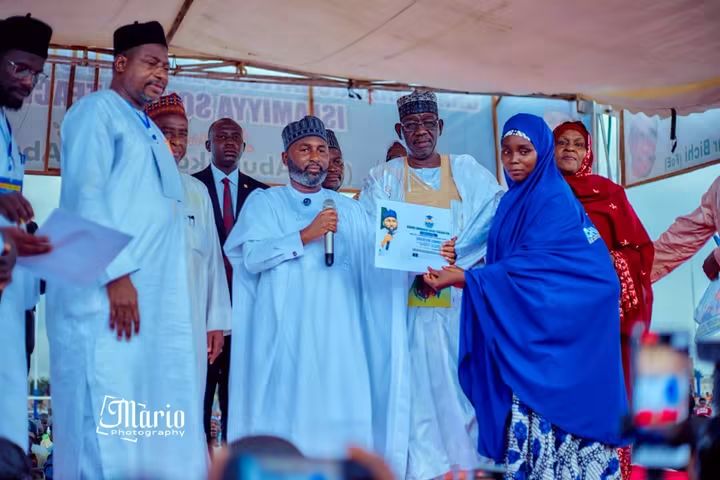
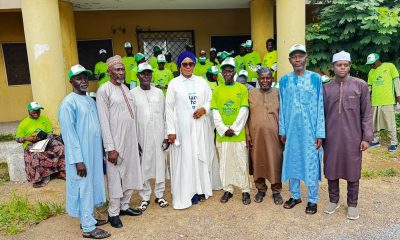
The Federal lawmaker representing the Bichi Federal Constituency, Hon. Abubakar Kabir Abubakar Bichi, has inaugurated 100 new Islamic school teachers as part of efforts to strengthen Islamic education in the Bichi Local Government Area of Kano State.
The inauguration ceremony was held on Sunday, 27 September 2026, and marked the fourth batch of School Teachers employed under the lawmaker’s initiative bringing the total of number of teachers engaged through the programme to 600.
Before their employment, the 100 teachers underwent a special examination conducted at the directive of the lawmaker. Those who obtained the highest scores across the 11 wards of Bichi Local Government Area were selected for the teaching positions.
The lawmaker had previously supported the teachers by paying their monthly allowances as volunteers before formally employing them as full-time teachers in Islamic schools across the local government area.
Prominent Islamic scholars and dignitaries attended the inauguration ceremony, including Sheikh Habibu Dan Almajiri, Chairman of the Kano State Zakkah Commission; Dr. Nazifi Ishak, former Kano State Commissioner for Religious Affairs; Dr. Zahrau Muhammad Umar, former Commissioner for Women Affairs; and Sheikh Sanusi Sharif Bichi.
Also in attendance were the Chairman of Bichi Local Government Area, Alhaji Hamza Sule Maifata; the Director-General of the APC Campaign Council in Bichi, Alhaji Sani Mukaddas, and the Kano State APC Secretary, Prof. Yusuf Muhammad Sabo.
The Islamic scholars and other dignitaries commended Hon. Abubakar Kabir Abubakar Bichi for his efforts towards improving both Islamic and modern education in the Bichi Local Government Area.
Hon. Abubakar Kabir Abubakar has also previously engaged several youths in various sectors, including healthcare, environmental services, education and other community development activities, as part of his efforts to create opportunities for young people across Bichi Federal Constituency and Kano State.
The lawmaker, who serves as the Chairman of the House Committee on Appropriation, has consistently expressed his commitment to youth development and community empowerment through various initiatives across the constituency.
News
FG Seeks Fresh $1.5bn World Bank Loans As Nigeria’s Debt Hits N166.79tn
By Yusuf Danjuma Yunusa
The Federal Government is in discussions with the World Bank for three new loans worth a combined $1.5 billion, even as Nigeria’s total public debt climbed to a record N166.79 trillion by June 2026.
The proposed facilities consist of three $500 million loans targeting climate resilience, social protection and early childhood development.
The first is an additional $500 million for the Agro-Climatic Resilience in Semi-Arid Landscapes (ACReSAL) project, which would increase its total financing to $1.2 billion. The funds are expected to support land restoration, flood and erosion control, irrigation, water management and other climate-resilience measures across northern Nigeria.
Another $500 million facility is proposed for the Household Prosperity and Empowerment-Social Protection (HOPE-SP) project. It is designed to support poor and vulnerable households through cash transfers, an improved social registry and stronger social protection systems.
The third $500 million loan would finance the Nigeria Early Childhood Development programme, covering all 36 states and the Federal Capital Territory. The programme aims to improve access to healthcare, nutrition, early learning, childcare, water and sanitation for children aged zero to five.
Meanwhile, figures from the Debt Management Office show that Nigeria’s public debt increased by N14.39 trillion , from N152.40 trillion in June 2025 to N166.79 trillion in June 2026. Domestic debt stood at N91.59 trillion, while external debt was N75.20 trillion.
Nigeria’s debt to the World Bank Group also rose to $20.73 billion by June 2026, accounting for about 38 per cent of the country’s $54.52 billion external debt.
Economist Adewale Abimbola said concessional loans could support development if properly structured and effectively utilised, stressing that the key issue was how the borrowed funds were deployed.
News
Report: Nigeria Records N166trn Public Debt
By Yusuf Danjuma Yunusa
The Debt Management Office (DMO) says Nigeria’s total public debt rose to N166.79 trillion as of June 30, 2026.
The DMO published the latest public debt portfolio report on Friday.
The figure represents a 9.4 percent or N14.39 trillion increase from the N152.4 trillion recorded at the end of June 2025.
It also represents an increase of N7.44 trillion or 4.7 percent compared with the N159.35 trillion recorded at the end of the first quarter (Q1) of 2026.
According to the latest report, the debt stock comprises N91.59 trillion in domestic debt, which accounts for 54.91 percent of the total debt stock, and N75.2 trillion in external debt, representing 45.09 percent.
The debt office said domestic debt increased by N11.04 trillion (13.7 percent) from N80.55 trillion recorded in June 2025.
The office said external debt also rose by N3.35 trillion (4.7 percent) from N71.85 trillion in the same period.
According to the DMO, the federal government accounted for N152.77 trillion of the total debt stock, comprising N86.99 trillion in domestic debt and N65.77 trillion in external debt.
On the other hand, states and the Federal Capital Territory (FCT) accounted for the remaining N14.01 trillion — N4.59 trillion in domestic debt and N9.42 trillion in external debt.
In dollar terms, the agency said Nigeria’s total public debt stood at $120.93 billion as of June 30, 2026 — up from $99.66 billion recorded in June 2025.
The DMO said the Central Bank of Nigeria (CBN) official exchange rate of N1,379 per dollar as of June 30 was used to convert the external debt to naira.

Dry Taps Gone, Kano Flows Again: The Abba Yusuf Water Comeback By Abba Anwar

Rep. Abubakar Bichi Employs 100 New Islamic School Teachers in Bichi

The Tinubu Health Reset: A Consultant Examines Nigeria’s Healthcare Reforms

FG Seeks Fresh $1.5bn World Bank Loans As Nigeria’s Debt Hits N166.79tn

RE:WE ARE UNDER SIEGE: TARABA MONARCH BREAKS SILENCE AS FULANI BANDITS OVERRUN THE ANCIENT KWARARAFA KINGDOM:

Zamfara Varsity ASUU Threatens Warning Strike Over FG-ASUU Agreement, Promotion Arrears

Bello Sharada: A Great Writer, A Bookish Soul, Gone Too Soon

Kano Chemists Threaten Warning Strike Over Alleged PCN Pressure

Per Ishaq Samaila: “Waziri” for Strategy. “Mai Jama’a” for Service. One Man. One Mission. Ibrahim Kabir Masari

Education Stakeholders, SBMC Train Students on Skills for Self-Reliance
Dry Taps Gone, Kano Flows Again: The Abba Yusuf Water Comeback By Abba Anwar
Rep. Abubakar Bichi Employs 100 New Islamic School Teachers in Bichi
The Tinubu Health Reset: A Consultant Examines Nigeria’s Healthcare Reforms
FG Seeks Fresh $1.5bn World Bank Loans As Nigeria’s Debt Hits N166.79tn
RE:WE ARE UNDER SIEGE: TARABA MONARCH BREAKS SILENCE AS FULANI BANDITS OVERRUN THE ANCIENT KWARARAFA KINGDOM:
Zamfara Varsity ASUU Threatens Warning Strike Over FG-ASUU Agreement, Promotion Arrears
Bello Sharada: A Great Writer, A Bookish Soul, Gone Too Soon
Kano Chemists Threaten Warning Strike Over Alleged PCN Pressure
Per Ishaq Samaila: “Waziri” for Strategy. “Mai Jama’a” for Service. One Man. One Mission. Ibrahim Kabir Masari
Education Stakeholders, SBMC Train Students on Skills for Self-Reliance
-

 Opinion5 years ago
On The Kano Flyovers And Public Perception
-

 Features5 years ago
How I Became A Multimillionaire In Nigeria – Hadiza Gabon
-

 Opinion6 years ago
Kano As future Headquarters Of Poverty In Nigeria
-

 History5 years ago
Sheikh Adam Abdullahi Al-Ilory (1917-1992):Nigeria’s Islamic Scholar Who Wrote Over 100 Books And Journals
-

 Opinion5 years ago
My First Encounter with Nasiru Gawuna, the Humble Deputy Governor
-

 History5 years ago
The History Of Borno State Governor Professor Babagana Umara Zulum
-

 History6 years ago
The Origin Of “Mammy Market” In Army Barracks (Mammy Ochefu)
-

 News4 years ago
Federal University Of Technology Babura To Commence Academic Activities September