
News
ABCOAD Bids Farewell to Prof. Wailare, Unveils Sci-Tech Journal, Hands Over Leadership
Written by Abdu Saidu
Eight-Year Tenure Marked by Stability, Expansion, and Institutional Reforms
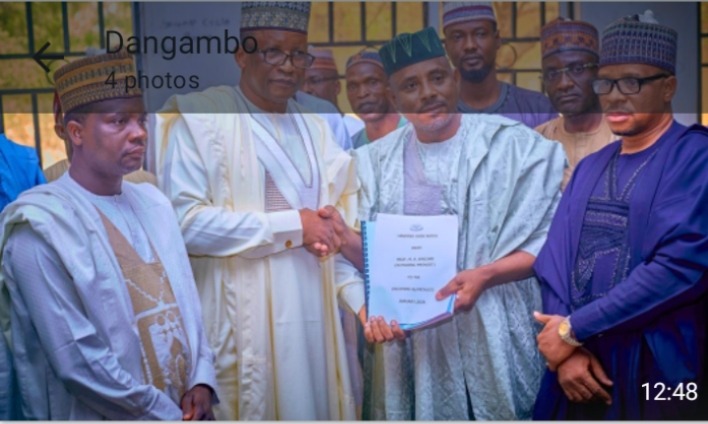
The Audu Bako College of Agriculture, Dambatta (ABCOAD), Kano State, on Thursday, January 15, 2026, held a send-forth ceremony, formally unveiled the ABCOAD Sci-Tech Journal, and conducted a handover ceremony in honour of its outgoing Provost, Professor M. A. Wailare, who concluded a successful eight-year tenure.
The event, attended by members of management, staff, students, and invited guests, also featured the formal transfer of leadership to the Deputy Provost, Dr. Hassan Ibrahim, marking a smooth and orderly transition in the College’s administration.
In separate remarks, speakers described Professor Wailare’s tenure as a defining era in the institution’s history, crediting him with restoring peace and stability on campus and steering the College through sustained academic, infrastructural, and institutional growth. Throughout his time in office, the College recorded no major crisis, protest, or disruption—an achievement that fostered unity, confidence, and a renewed sense of belonging among staff and students.
A major milestone of the administration was the expansion of the College’s academic scope with the establishment of 15 new departments, including Fisheries Technology, Horticultural Technology, Agribusiness Management, Cyber Security, Artificial Intelligence, Environmental Science and Management Technology, and Networking and Cloud Computing, among others. Speakers noted that this development positioned ABCOAD as a multi-disciplinary institution aligned with emerging global trends in science, technology, and agriculture.
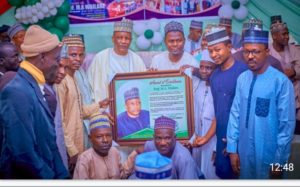
The handover
Professor Wailare was also commended for strengthening transparency and accountability through the introduction of a cashless financial policy in 2018, as well as for establishing key directorates such as Quality Assurance, Strategic Planning, Renewable Energy and Climate Change, Guidance and Counselling, and Research and Development.
Under his leadership, the College deepened community and international engagement, notably through collaboration with Wageningen University in the Netherlands under the Seed for Change programme, which boosted horticultural development. Annual Farmers’ Field Days, tree-planting campaigns, and the distribution of improved seedlings further reinforced the institution’s impact on neighbouring communities.
In the area of regulation and quality assurance, ABCOAD successfully hosted multiple NBTE accreditation exercises in 2018, 2022, and twice in 2025, alongside achieving SIWES and full institutional accreditation in 2025. The introduction of free education at the ABCOAD Staff School for children from disadvantaged neighbouring communities was also cited as part of the administration’s social responsibility drive.
Infrastructure and ICT development featured prominently during the tenure, including the renovation of classrooms, laboratories, hostels, offices, vehicles, and tractors, as well as the rehabilitation of the College clinic. The institution also benefited from ICT interventions such as the establishment of an NCC E-Learning Centre, the donation of laptops and tablets, the modernization of the e-library, the launch of the official website, and the upgrade of the ICT Centre to host JAMB CBT examinations over several years.
Agricultural innovation was strengthened through the introduction of high-yielding cassava varieties in collaboration with IITA and ATASP, the restoration of 33 hectares of farmland, the establishment of commercial seedling production, and the fabrication of prototype agricultural machinery. Hundreds of youths and women were trained under programmes supported by the World Bank, KSADP, TVET, and the French-sponsored WATEA initiative.
Other milestones recorded during the period include the construction of a Leather Enterprises Innovation Centre and a Water Treatment Plant, the adoption of renewable energy solutions through solar installations, perimeter fencing and general renovation of the College by the Kano State Government in 2025, and national recognition with the 2025 Ministry of Science, Technology and Innovation Award (Tertiary Category).
As part of staff welfare and administrative efficiency, Professor Wailare introduced free daily shuttle bus services, provided at no cost, for management staff, Heads of Departments, and Directors commuting from Kano to Dambatta.
During the handover ceremony, Professor Wailare received several awards and gifts from various departments and units in recognition of his exceptional leadership and for providing staff with opportunities to contribute meaningfully to the growth and development of the institution. Presenters noted that the gesture reflected widespread appreciation for his inclusive and empowering leadership style.
Professor Wailare also led efforts to reposition the institution for the future, initiating processes for its transformation into the Audu Bako College of Agriculture, Science and Technology, and actively participating in legislative engagements aimed at upgrading the College to a Federal University of Agriculture.
In his farewell remarks, Professor Wailare expressed gratitude to the management, staff, and students for their cooperation and support, noting that collective commitment was central to the achievements recorded. He urged the College community to sustain unity, discipline, and dedication, while wishing the institution continued growth and success.
Furthermore, Professor Wailare commended the Kano State Government under the leadership of Governor Engr. Abba Kabir Yusuf for the support and educational development initiatives implemented to advance the College, emphasizing that such assistance has greatly contributed to strengthening teaching, research, and the overall development of the institution.
The ceremony concluded with the formal unveiling of the ABCOAD Sci-Tech Journal, described by stakeholders as a landmark platform for advancing research, innovation, and scholarly engagement within and beyond the College.










News
INEC Urges Broadcasters to Uphold Fairness Ahead of 2027 Elections

By Yusuf Danjuma Yunusa
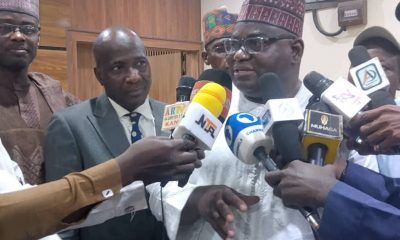
The Independent National Electoral Commission has underscored the critical role of broadcast media in safeguarding electoral integrity, urging broadcasters to uphold fairness, professionalism, and accuracy ahead of the 2027 general elections.
Addressing the 81st General Assembly of the Broadcasting Organisations of Nigeria on Wednesday in Abuja, the INEC chairman, Prof. Joash Amupitan, stressed that the management of the airwaves under the Electoral Act 2026 would be decisive in shaping public trust and democratic outcomes.
Amupitan noted that the growing influence of broadcast platforms has made it central to political communication.
He warned, saying, “Your airwaves have become the primary infrastructure of our democracy. If they are clear, the nation sees the truth; if they are clouded by misinformation, the sovereign will of the people is threatened.”
Amupitan highlighted key provisions of the Electoral Act 2026, particularly those mandating equal access to media platforms and prohibiting the misuse of state-owned media.
He explained that “state apparatus, including the media, shall not be employed to the advantage or disadvantage of any political party or candidate at any election”.
He also emphasised that media time shall be allocated equally among the political parties or candidates at similar hours of the day.
Amupitan further cautioned against inflammatory political messaging, citing the law, which states that “a political campaign or slogan shall not be tainted with abusive language directly or indirectly likely to injure religious, ethnic, tribal or sectional feelings.”
The commission also reiterated restrictions on campaign broadcasts close to election day, noting that “any person, print or electronic medium that broadcasts, publishes, advertises or circulates any material within 24 hours immediately preceding or on polling day commits an offence under this Act.”
While acknowledging the reforms introduced by the new law, the INEC chairman raised concerns over enforcement gaps, regulatory overlap, and the growing influence of digital media, warning that these challenges could undermine the effectiveness of the legal framework.
He called for stronger collaboration between regulators and industry players, proposing an alliance involving INEC, BON, security agencies, and the judiciary to ensure compliance and accountability.
With the countdown to the 2027 elections underway, the Commission disclosed that “283 days remain until the Presidential and National Assembly Elections on January 16, 2027,” and “304 days to go” before the governorship and state assembly polls.
News
Isoko Traditional Rulers Divided Over 250 Million Offer To Confer Chieftaincy Title On Senatorial Aspirant
Isoko Traditional Rulers Divided Over 250 Million Offer To Confer Chieftaincy Title On Senatorial Aspirant
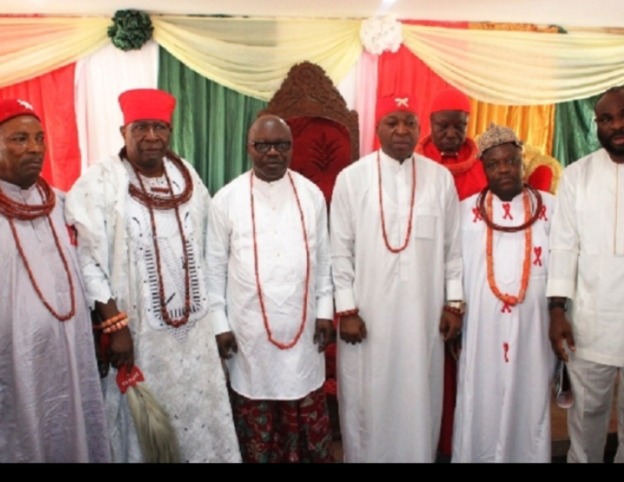
A Delta South Senatorial candidate in a desperate bid to garner endorsements has made an offer of a whopping N250 million to Isoko Traditional Rulers for conferment of an omnibus Chieftaincy Title on him, insisting that he had never had one.
The offer is however been rebuffed by some of the notable Kings, who view the offer as a “Greek gift”, and vowed to stonewall it, while the other group is desperate to have their hands in the bounty.
A traditional ruler, who crave for anonymity said: “you are offering a hefty N250 million for a chieftaincy title at the eleventh hour when in normal circumstances it should be free based on your performances while in office.
Frantic efforts are being made to get the integrity group of traditional rulers on board to grant the Senatorial Candidate his wish through intensive lobbying.
The traditional rulers are said to be consulting amongst themselves whether to accept the offer.
Isoko is made up of 17 autonomous clans, each with its own authority to confer chieftaincy on deserving sons and daughters.
Last week Saturday, Senator Joel Onowakpo Thomas, representing Delta South gathered some traditional rulers, politicians and Isoko Development Union (IDU) at his country home, Emede in Isoko South and got an endorsement for a second term come 2027.
The endorsement had not gone down well with the generality of Delta South, especially the people of the two local governments in Isokoland as it has been heavily criticized.
News
Kwankwaso, Atiku, Amaechi, Obi, Others Match-Out in Peaceful Protest at INEC’s Headquarters

By Yusuf Danjuma Yunusa
A coalition of chieftains from the African Democratic Congress (ADC), led by the party’s interim Chairman, David Mark, staged a peaceful protest at the headquarters of the Independent National Electoral Commission (INEC) in Abuja. The demonstration was in response to INEC’s recent withdrawal of recognition from the David Mark-led faction as the legitimate leadership of the party.
Prominent figures in the protest included former Vice President Atiku Abubakar, former Governors Rabiu Musa Kwankwaso and Peter Obi, as well as former Ministers Rotimi Amaechi and Rauf Aregbesola.
The leadership crisis within the ADC has deepened in recent times, with the emergence of yet another faction backed by state chairmen of the party. This group claims legitimacy over the two existing factions—one led by Nafiu Bala and the other by David Mark.
Amid this increasingly undemocratic atmosphere, the David Mark-led faction had scheduled its national convention for April 14. However, with today being April 8, questions are being raised over whether the faction can meet that deadline or if the leadership dispute will be resolved before the date.
Meanwhile, INEC has set May 10 as the final deadline for all political parties to submit the names of their flag bearers for the 2027 general election.

INEC Urges Broadcasters to Uphold Fairness Ahead of 2027 Elections

Isoko Traditional Rulers Divided Over 250 Million Offer To Confer Chieftaincy Title On Senatorial Aspirant

A Remarkable Homecoming: Kano Unites in Support of Abba Kabiru Yusuf, Signaling a Strong Endorsement for Bola Ahmed Tinubu in 2027

Kwankwaso, Atiku, Amaechi, Obi, Others Match-Out in Peaceful Protest at INEC’s Headquarters

ADC Crisis: Kwankwaso Seeks Intervention of Gombe Emir

ADC Leadership Crisis: State Chairmen to Elect Caretaker Committee on Tuesday

Governor Abba Kabir Yusuf Holds Exclusive Prerogative to Choose Deputy – Malam Inuwa Waya

The Governor Who Chose His People Over His Politics: Abba Yusuf and the Moral Courage Behind Kano First
Restoring the Glory That Was Always There: Governor Abba Kabir Yusuf and the Historical Vision Behind Kano First

Table Water Producers Increase New Price for Sachet Water in Kano
INEC Urges Broadcasters to Uphold Fairness Ahead of 2027 Elections
Isoko Traditional Rulers Divided Over 250 Million Offer To Confer Chieftaincy Title On Senatorial Aspirant
A Remarkable Homecoming: Kano Unites in Support of Abba Kabiru Yusuf, Signaling a Strong Endorsement for Bola Ahmed Tinubu in 2027
Kwankwaso, Atiku, Amaechi, Obi, Others Match-Out in Peaceful Protest at INEC’s Headquarters
ADC Crisis: Kwankwaso Seeks Intervention of Gombe Emir
ADC Leadership Crisis: State Chairmen to Elect Caretaker Committee on Tuesday
Governor Abba Kabir Yusuf Holds Exclusive Prerogative to Choose Deputy – Malam Inuwa Waya
The Governor Who Chose His People Over His Politics: Abba Yusuf and the Moral Courage Behind Kano First
Restoring the Glory That Was Always There: Governor Abba Kabir Yusuf and the Historical Vision Behind Kano First
Table Water Producers Increase New Price for Sachet Water in Kano
-

 Opinion4 years ago
On The Kano Flyovers And Public Perception
-

 Features5 years ago
How I Became A Multimillionaire In Nigeria – Hadiza Gabon
-

 Opinion5 years ago
Kano As future Headquarters Of Poverty In Nigeria
-

 History5 years ago
Sheikh Adam Abdullahi Al-Ilory (1917-1992):Nigeria’s Islamic Scholar Who Wrote Over 100 Books And Journals
-

 Opinion4 years ago
My First Encounter with Nasiru Gawuna, the Humble Deputy Governor
-

 History5 years ago
The Origin Of “Mammy Market” In Army Barracks (Mammy Ochefu)
-

 History4 years ago
The History Of Borno State Governor Professor Babagana Umara Zulum
-

 News4 years ago
Federal University Of Technology Babura To Commence Academic Activities September