
News
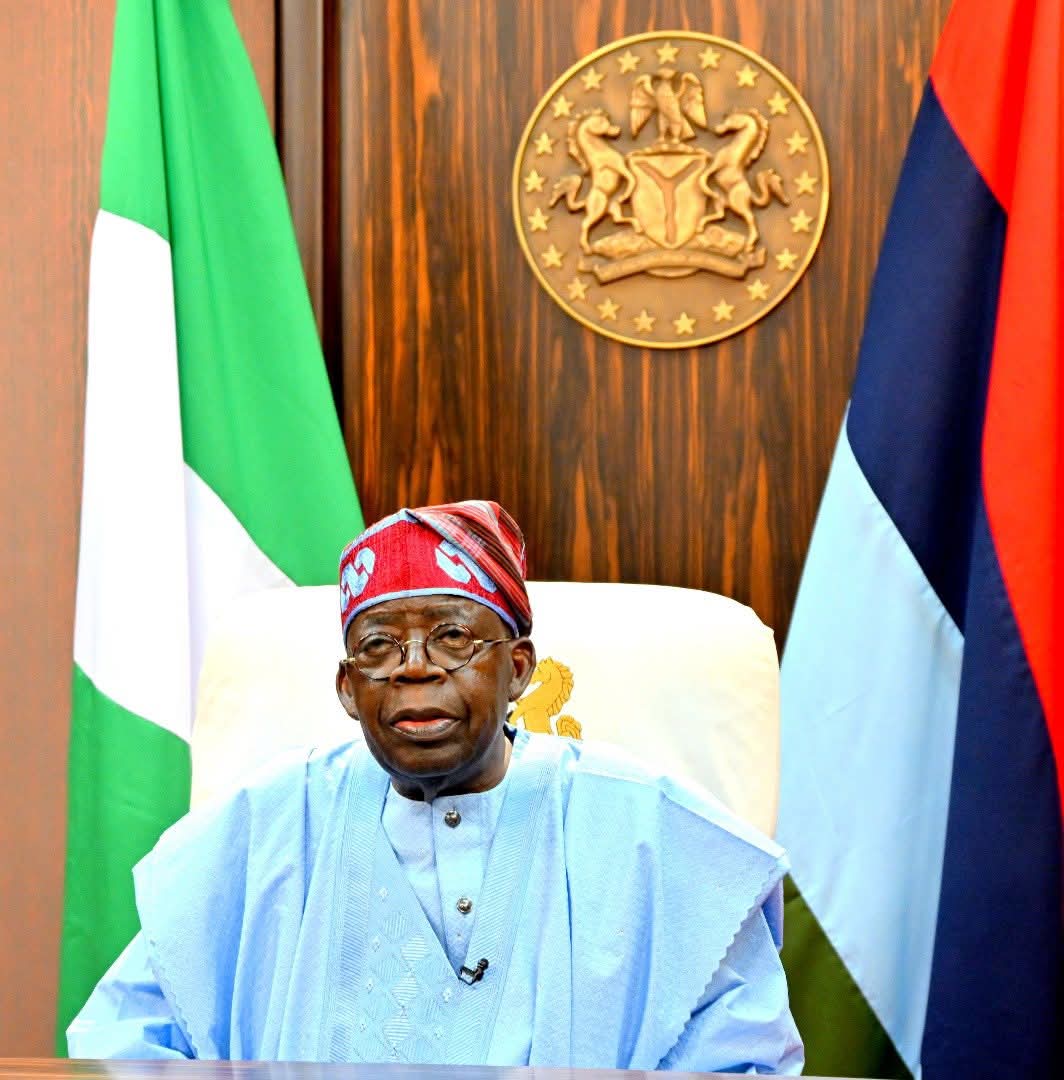
Text Of The National Broadcast By President Bola Ahmad Tinubu On The Occasion Of Nigeria’s 65th Independence Anniversary
Fellow Nigerians,
Today marks the 65th anniversary of our great nation’s Independence. As we reflect on the significance of this day and our journey of nationhood since October 1, 1960, when our founding fathers accepted the instruments of self-government from colonial rule, let us remember their sacrifice, devotion, and grand dream of a strong, prosperous, and united Nigeria that will lead Africa and be the beacon of light to the rest of the world.
2. Our founding heroes and heroines—Herbert Macaulay, Dr Nnamdi Azikiwe, Sir Abubakar Tafawa Balewa, Chief Obafemi Awolowo, Sir Ahmadu Bello, Margaret Ekpo, Anthony Enahoro, Ladoke Akintola, Michael Okpara, Aminu Kano, Funmilayo Ransome-Kuti, and other nationalists—believed it was Nigeria’s manifest destiny to lead the entire black race as the largest black nation on earth.
3. For decades, the promise of our Independence has been tested by profound social, economic, and political challenges, and we have survived. While we may not have achieved all the lofty dreams of our forebearers, we have not strayed too far from them. In 65 years since our Independence, we have made tremendous progress in economic growth, social cohesion, and physical development. Our economy has experienced significant growth since 1960.
4. Although, it is much easier for those whose vocation is to focus solely on what ought to be, we must recognise and celebrate our significant progress. Nigerians today have access to better education and healthcare than in 1960. At Independence, Nigeria had 120 secondary schools with a student population of about 130,000. Available data indicate that, as of year 2024, there were more than 23,000 secondary schools in our country. At Independence, we had only the University of Ibadan and Yaba College of Technology as the two tertiary institutions in Nigeria. By the end of last year, there were 274 universities, 183 Polytechnics, and 236 Colleges of Education in Nigeria, comprising Federal, State, and private institutions. We have experienced a significant surge in growth across every sector of our national life since Independence – in healthcare, infrastructure, financial services, manufacturing, telecommunications, information technology, aviation and defence, among others.
5. Our country has experienced both the good and the bad times in its 65 years of nationhood, as is normal for every nation and its people. We fought a bitter and avoidable civil war, experienced military dictatorships, and lived through major political crises. In all these, we weathered every storm and overcame every challenge with courage, grit, and uncommon determination. While our system and ties that bind us are sometimes stretched by insidious forces opposed to our values and ways of life, we continue to strive to build a more perfect union where every Nigerian can find better accommodation and find purpose and fulfilment.
6. Fellow Compatriots, this is the third time I will address you on our independence anniversary since I assumed office as your President on May 29, 2023. In the last 28 months of my administration, like our founding fathers and leaders who came before me, I have committed myself irrevocably to the unfinished nation-building business.
7. Upon assuming office, our administration inherited a near-collapsed economy caused by decades of fiscal policy distortions and misalignment that had impaired real growth. As a new administration, we faced a simple choice: continue business as usual and watch our nation drift, or embark on a courageous, fundamental reform path. We chose the path of reform. We chose the path of tomorrow over the comfort of today. Less than three years later, the seeds of those difficult but necessary decisions are bearing fruit.
8. In resetting our country for sustainable growth, we ended the corrupt fuel subsidies and multiple foreign exchange rates that created massive incentives for a rentier economy, benefiting only a tiny minority. At the same time, the masses received little or nothing from our Commonwealth. Our administration has redirected the economy towards a more inclusive path, channelling money to fund education, healthcare, national security, agriculture, and critical economic infrastructure, such as roads, power, broadband, and social investment programmes. These initiatives will generally improve Nigerians’ quality of life. As a result of the tough decisions we made, the Federal and State governments, including Local Governments, now have more resources to take care of the people at the lower level of the ladder, to address our development challenges.
9. Fellow Nigerians, we are racing against time. We must build the roads we need, repair the ones that have become decrepit, and construct the schools our children will attend and the hospitals that will care for our people. We have to plan for the generations that will come after us. We do not have enough electricity to power our industries and homes today, or the resources to repair our deteriorating roads, build seaports, railroads, and international airports comparable to the best in the world, because we failed to make the necessary investments decades ago. Our administration is setting things right.
10. I am pleased to report that we have finally turned the corner. The worst is over, I say. Yesterday’s pains are giving way to relief. I salute your endurance, support, and understanding. I will continue to work for you and justify the confidence you reposed in me to steer the ship of our nation to a safe harbour.
11. Under our leadership, our economy is recovering fast, and the reforms we started over two years ago are delivering tangible results. The second quarter 2025 Gross Domestic Product grew by 4.23%—Nigeria’s fastest pace in four years—and outpaced the 3.4 per cent projected by the International Monetary Fund. Inflation declined to 20.12% in August 2025, the lowest level in three years. The administration is working diligently to boost agricultural production and ensure food security, reducing food costs.
12. In the last two years of our administration, we have achieved 12 remarkable economic milestones as a result of the implementation of our sound fiscal and monetary policies:
i. We have attained a record-breaking increase in non-oil revenue, achieving the 2025 target by August with over N20 trillion. In September 2025 alone, we raised N3.65 trillion, 411% higher than the amount raised in May 2023.
ii. We have restored Fiscal Health: Our debt service-to-revenue ratio has been significantly reduced from 97% to below 50%. We have paid down the infamous “Ways and Means” advances that threatened our economic stability and triggered inflation. Following the removal of the corrupt petroleum subsidy, we have freed up trillions of Naira for targeted investment in the real economy and social programmes for the most vulnerable, as well as all tiers of government.
iii. We have a stronger foreign Reserve position than three years ago. Our external reserves increased to $42.03 billion this September—the highest since 2019.
iv. Our tax-to-GDP ratio has risen to 13.5 per cent from less than 10 per cent. The ratio is expected to increase further when the new tax law takes effect in January. The tax law is not about increasing the burden on existing taxpayers but about expanding the base to build the Nigeria we deserve and providing tax relief to low-income earners.
v. We are now a Net Exporter: Nigeria has recorded a trade surplus for five consecutive quarters. We are now selling more to the world than we are buying, a fundamental shift that strengthens our currency and creates jobs at home. Nigeria’s trade surplus increased by 44.3% in Q2 2025 to ₦7.46 trillion ($4.74 billion), the largest in about three years. Goods manufactured in Nigeria and exported jumped by 173%. Non-oil exports, as a component of our export trade, now represent 48 per cent, compared to oil exports, which account for 52 per cent. This signals that we are diversifying our economy and foreign exchange sources outside oil and gas.
vi. Oil production rebounded to 1.68 million barrels per day from barely one million in May 2023. The increase occurred due to improved security, new investments, and better stakeholder management in the Niger Delta. Furthermore, the country has made notable advancements by refining PMS domestically for the first time in four decades. It has also established itself as the continent’s leading exporter of aviation fuel.
vii. The Naira has stabilised from the turbulence and volatility witnessed in 2023 and 2024. The gap between the official rate and the unofficial market has reduced substantially, following FX reforms and fresh capital and remittance inflows. The multiple exchange rates, which fostered corruption and arbitrage, are now part of history. Additionally, our currency rate against the dollar is no longer determined by fluctuations in crude oil prices.
viii. Under the social investment programme to support poor households and vulnerable Nigerians, N330 billion has been disbursed to eight million households, many of whom have received either one or two out of the three tranches of the N25,000 each.
ix. Coal mining recovered dramatically from a 22% decline in Q1 to 57.5% growth in Q2, becoming one of Nigeria’s fastest-growing sectors. The solid mineral sector is now pivotal in our economy, encouraging value-added production of minerals extracted from our soil.
x. The administration is expanding transport infrastructure across the country, covering rail, roads, airports, and seaports. Rail and water transport grew by over 40% and 27%, respectively. The 284-kilometre Kano-Kastina-Maradi Standard Gauge rail project and the Kaduna-Kano rail line are nearing completion. Work is progressing well on the legacy Lagos-Calabar Coastal Highway and Sokoto-Badagry Highway. The Federal Executive Council recently approved $3 billion to complete the Eastern Rail Project.
xi. The world is taking notice of our efforts. Sovereign credit rating agencies have upgraded their outlook for Nigeria, recognising our improved economic fundamentals. Our stock market is experiencing an unprecedented boom, rising from an all-share index of 55,000 points in May 2003 to 142,000 points as of September 26, 2025.
xii. At its last MPC meeting, the Central Bank slashed interest rates for the first time in five years, expressing confidence in our country’s macroeconomic stability.
SECURITY:
13. We are working diligently to enhance national security, ensuring our economy experiences improved growth and performance. The officers and men of our armed forces and other security agencies are working tirelessly and making significant sacrifices to keep us safe. They are winning the war against terrorism, banditry and other violent crimes. We see their victories in their blood and sweat to stamp out Boko Haram Terror in North-East, IPOB/ESN terror in South East and banditry and kidnapping. We must continue to celebrate their gallantry and salute their courage on behalf of a grateful nation. Peace has returned to hundreds of our liberated communities in North-West and North-East, and thousands of our people have returned safely to their homes.
YOUTH:
14. I have a message for our young people. You are the future and the greatest assets of this blessed country. You must continue to dream big, innovate, and conquer more territories in your various fields of science, technology, sports, and the art and creative sector. Our administration, through policies and funding, will continue to give you wings to fly sky-high. We created NELFUND to support students with loans for their educational pursuits. Approximately 510,000 students across 36 states and the FCT have benefited from this initiative, covering 228 higher institutions. As of September 10, the total loan disbursed was N99.5 billion, while the upkeep allowance stood at N44.7 billion.
15. Credicorp, another initiative of our administration, has granted 153,000 Nigerians N30 billion affordable loans for vehicles, solar energy, home upgrades, digital devices, and more.
16. YouthCred, which I promised last June, is a reality, with tens of thousands of NYSC members now active beneficiaries of consumer credit for resettlement.
17. Under our Renewed Hope Agenda, we promised to build a Nigeria where every young person, regardless of background, has an equitable opportunity to access a better future—thus, the Investment in Digital and Creative Enterprises (iDICE) programme. The Bank of Industry is driving the programme, in collaboration with the African Development Bank, the French Development Agency, and the Islamic Development Bank. This initiative is at the cusp of implementation. Over the last two years, we have collaborated with our partners to launch the programme, supporting our young builders and dreamers in the technology and creative sectors.
A MESSAGE OF HOPE
18. Fellow Nigerians, I have always candidly acknowledged that these reforms have come with some temporary pains. The biting effects of inflation and the rising cost of living remain a significant concern to our government. However, the alternative of allowing our country to descend into economic chaos or bankruptcy was not an option. Our macro-economic progress has proven that our sacrifices have not been in vain. Together, we are laying a new foundation cast in concrete, not on quicksand.
19. The accurate measure of our success will not be limited to economic statistics alone, but rather in the food on our families’ tables, the quality of education our children receive, the electricity in our homes, and the security in our communities. Let me assure you of our administration’s determination to ensure that the resources we have saved and the stability we have built are channelled into these critical areas. Today, the governors at the state level, and the local government autonomy are yielding more developments.
20. Therefore, on this 65th Anniversary of Our Independence, my message is hope and a call to action. The federal government will continue to do its part to fix the plumbing in our economy. Now, we must all turn on the taps of productivity, innovation, and enterprise, just like the Ministry of Interior has done with our travel passports, by quickening the processing. In this regard, I urge the sub-national entities to join us in nation-building. Let us be a nation of producers, not just consumers. Let us farm our land and build factories to process our produce. Let us patronise ‘Made-in-Nigeria’ goods. I say Nigeria first. Let us pay our taxes.
21. Finally, let all hands be on deck. Let us believe, once more, in the boundless potential of our great nation.
22. With Almighty God on our side, I can assure you that the dawn of a new, prosperous, self-reliant Nigeria is here.
23. Happy 65th Independence Anniversary, and may God continue to bless the Federal Republic of Nigeria.
Amen.
Bola Ahmed Tinubu, GCFR
President and Commander-In-Chief of the Armed Forces
of the Federal Republic of Nigeria,
Presidential Villa,
Abuja.







News
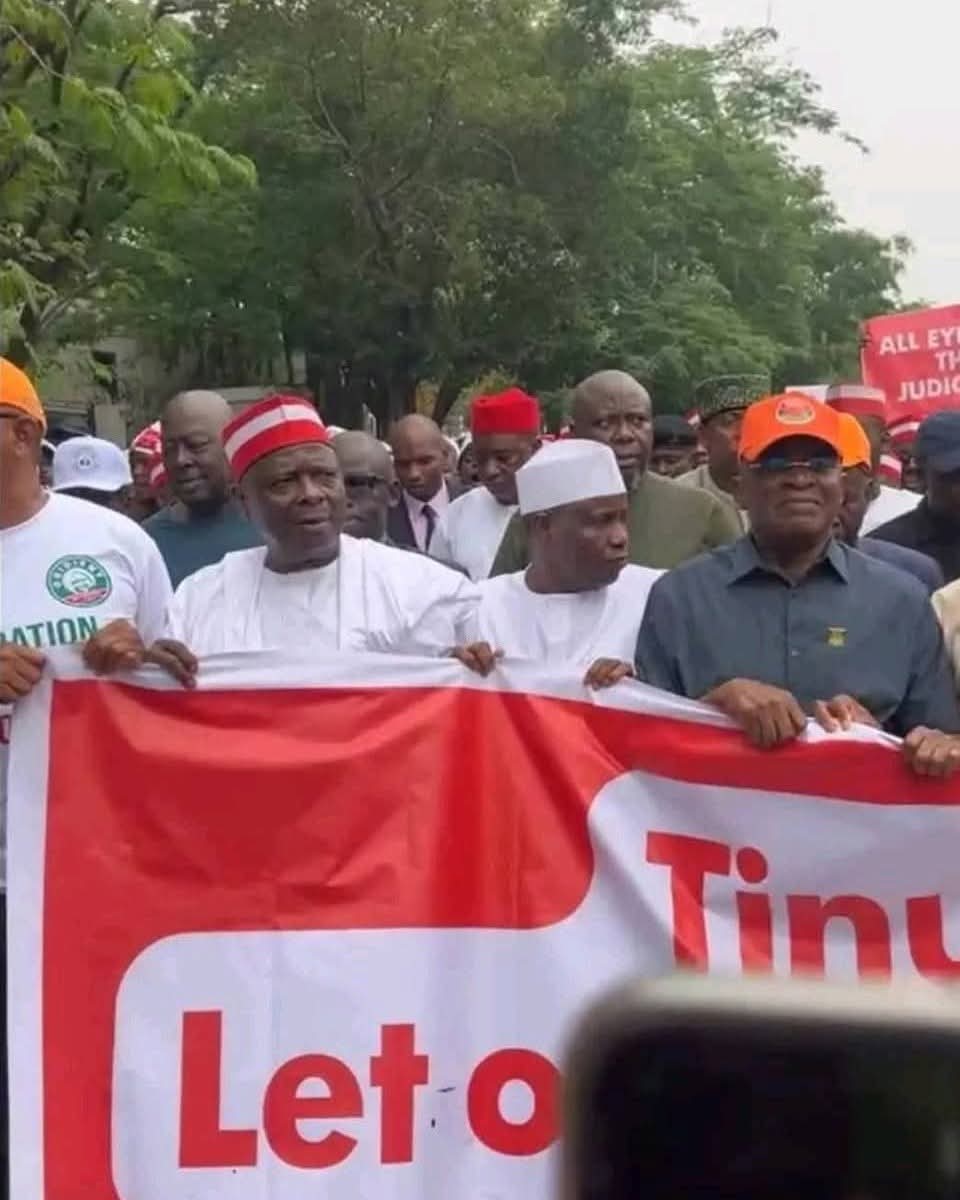
Kwankwaso, Atiku, Amaechi, Obi, Others Match-Out in Peaceful Protest at INEC’s Headquarters
By Yusuf Danjuma Yunusa
A coalition of chieftains from the African Democratic Congress (ADC), led by the party’s interim Chairman, David Mark, staged a peaceful protest at the headquarters of the Independent National Electoral Commission (INEC) in Abuja. The demonstration was in response to INEC’s recent withdrawal of recognition from the David Mark-led faction as the legitimate leadership of the party.
Prominent figures in the protest included former Vice President Atiku Abubakar, former Governors Rabiu Musa Kwankwaso and Peter Obi, as well as former Ministers Rotimi Amaechi and Rauf Aregbesola.
The leadership crisis within the ADC has deepened in recent times, with the emergence of yet another faction backed by state chairmen of the party. This group claims legitimacy over the two existing factions—one led by Nafiu Bala and the other by David Mark.
Amid this increasingly undemocratic atmosphere, the David Mark-led faction had scheduled its national convention for April 14. However, with today being April 8, questions are being raised over whether the faction can meet that deadline or if the leadership dispute will be resolved before the date.
Meanwhile, INEC has set May 10 as the final deadline for all political parties to submit the names of their flag bearers for the 2027 general election.
News
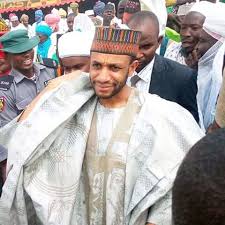
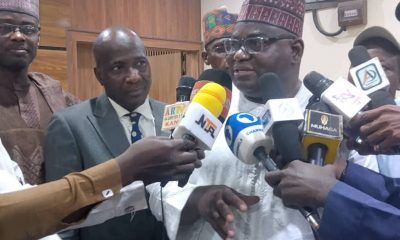
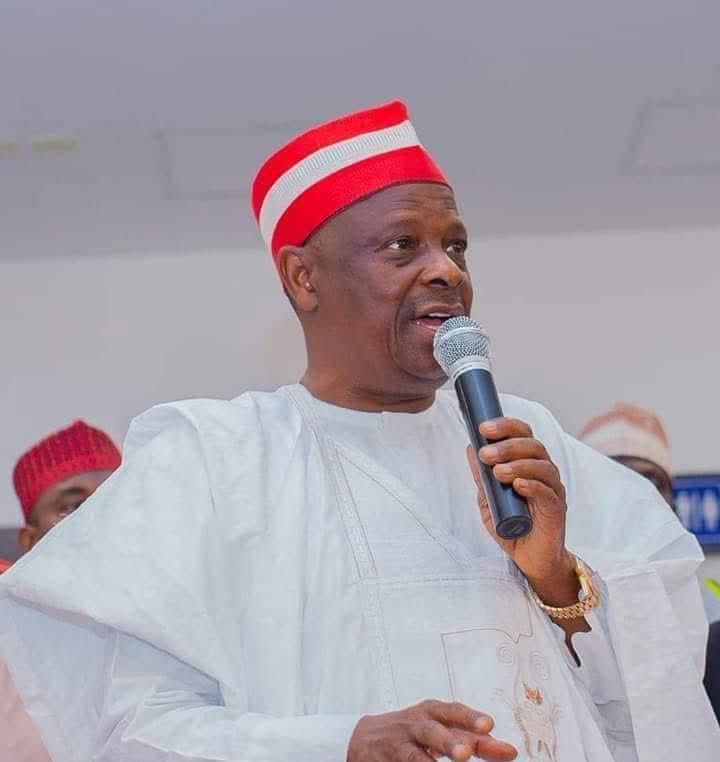
ADC Crisis: Kwankwaso Seeks Intervention of Gombe Emir
By Yusuf Danjuma Yunusa
Senator Rabiu Kwankwaso, a chieftain of the African Democratic Congress (ADC), has accused Nafiu Bala, the party’s factional chairman, of acting against democratic principles.
In an interview with DCL Hausa on Tuesday, Kwankwaso revealed that he had invited Bala for a meeting aimed at resolving the party’s crisis amicably, but Bala failed to show up.
“We scheduled to meet yesterday, but despite waiting until morning, he did not come. I had been warned he wouldn’t show up, and his absence is deeply disappointing. I want to pass my message through you now, so that if you meet him, you can deliver it on my behalf,” Kwankwaso said.
He added, “Given the current situation in our country, our party and our democracy cannot afford someone who behaves like the lizard at the mouth of the water pot—blocking progress. As a leader of this movement in Nigeria, I believed that when I invited him, he would honour the request so I could advise him, as a father would a son.”
Kwankwaso noted that Bala was born in 1990 and still needs guidance as a youth. “His current actions are not only harmful to his own future, but also to the ADC and Nigerian democracy as a whole.”
He further warned, “He must recognise that millions have registered with our party. What was once a small party has grown significantly because prominent leaders joined with a mission to do what is right for this country. If he continues to stand in the way of that progress, it will become a very serious problem for him.”
The senator also called on the Emir of Gombe, other traditional rulers, and Islamic scholars (Ulamas) to intervene in the dispute.
“This is a serious matter, and he must realise his mistakes so we can resolve it. I offer this advice freely because I know it is for everyone’s benefit,” Kwankwaso concluded.
News
NCC to Enforce Subscriber Compensation for Poor Telecom Service
By Yusuf Danjuma Yunusa
The Nigerian Communications Commission has announced that its directive mandating telecommunications operators to compensate subscribers for poor service quality will take effect from this month.
The Commission disclosed this in a Frequently Asked Questions document released on Tuesday, offering clarity on how the compensation framework will work and which subscribers qualify.
According to the NCC, the directive applies specifically to Mobile Network Operators that fail to meet the required Key Performance Indicators for Quality of Service. These operators include major players such as MTN Nigeria, Airtel Nigeria, Globacom, and 9mobile, although the Commission did not specify which of them fell short of the standards.
The NCC noted that a separate compensation framework already exists for Internet Service Providers.
Under the new directive, compensation will cover service failures affecting voice calls, data services, and SMS. To qualify, subscribers must have experienced poor network service in an affected Local Government Area and must have carried out at least one revenue-generating activity—such as a billed call, SMS, or data session—within the period in question.
The Commission added that both individual and corporate subscribers are eligible for compensation.
Importantly, the NCC stated that subscribers will not need to apply to receive compensation. Instead, telecom operators are mandated to automatically identify affected customers and compensate them directly.
“The compensation framework will take effect from April 2026.
“No. The directive does not replace existing consumer protection mechanisms. It adds a direct compensation mechanism for affected subscribers. It aligns with measures set in existing legislation, such as the Consumer Code of Practice Regulations 2024 and the Quality of Service Regulations 2024,” NCC said
“Operators are required and mandated to identify affected subscribers and provide compensation directly. Only service failures that fall below the defined thresholds set by the Quality of Service Regulations will qualify,” NCC said.
However, the regulator clarified that minor or short-lived network disruptions that are quickly resolved may not meet the threshold for compensation.
The move is part of the NCC’s broader efforts to improve service delivery and hold telecom operators accountable for consistent network performance across the country.

Kwankwaso, Atiku, Amaechi, Obi, Others Match-Out in Peaceful Protest at INEC’s Headquarters

ADC Crisis: Kwankwaso Seeks Intervention of Gombe Emir

Shekarau In APC, Morale Booster For Governor Abba

NCC to Enforce Subscriber Compensation for Poor Telecom Service

ADC Leadership Tussle Worsens as Third Faction Emerges, Rejects Nafiu Camp, Mark’s Coalition

ADC Leadership Crisis: State Chairmen to Elect Caretaker Committee on Tuesday

Governor Abba Kabir Yusuf Holds Exclusive Prerogative to Choose Deputy – Malam Inuwa Waya

The Governor Who Chose His People Over His Politics: Abba Yusuf and the Moral Courage Behind Kano First
Restoring the Glory That Was Always There: Governor Abba Kabir Yusuf and the Historical Vision Behind Kano First

Table Water Producers Increase New Price for Sachet Water in Kano
Kwankwaso, Atiku, Amaechi, Obi, Others Match-Out in Peaceful Protest at INEC’s Headquarters
ADC Crisis: Kwankwaso Seeks Intervention of Gombe Emir
Shekarau In APC, Morale Booster For Governor Abba
NCC to Enforce Subscriber Compensation for Poor Telecom Service
ADC Leadership Tussle Worsens as Third Faction Emerges, Rejects Nafiu Camp, Mark’s Coalition
ADC Leadership Crisis: State Chairmen to Elect Caretaker Committee on Tuesday
Governor Abba Kabir Yusuf Holds Exclusive Prerogative to Choose Deputy – Malam Inuwa Waya
The Governor Who Chose His People Over His Politics: Abba Yusuf and the Moral Courage Behind Kano First
Restoring the Glory That Was Always There: Governor Abba Kabir Yusuf and the Historical Vision Behind Kano First
Table Water Producers Increase New Price for Sachet Water in Kano
-

 Opinion4 years ago
On The Kano Flyovers And Public Perception
-

 Features5 years ago
How I Became A Multimillionaire In Nigeria – Hadiza Gabon
-

 Opinion5 years ago
Kano As future Headquarters Of Poverty In Nigeria
-

 History5 years ago
Sheikh Adam Abdullahi Al-Ilory (1917-1992):Nigeria’s Islamic Scholar Who Wrote Over 100 Books And Journals
-

 Opinion4 years ago
My First Encounter with Nasiru Gawuna, the Humble Deputy Governor
-

 History5 years ago
The Origin Of “Mammy Market” In Army Barracks (Mammy Ochefu)
-

 History4 years ago
The History Of Borno State Governor Professor Babagana Umara Zulum
-

 News4 years ago
Federal University Of Technology Babura To Commence Academic Activities September