
News
IsDB Approves US$ 2.12 Billion for Development Projects in Member Countries
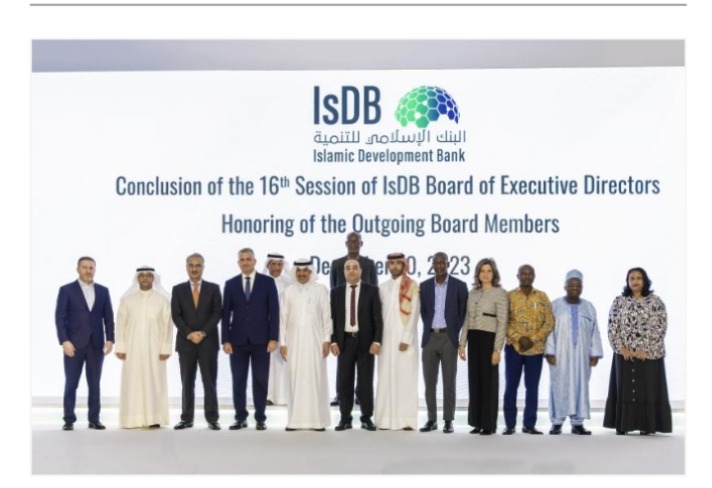
The Board of Executive Directors of the Islamic Development Bank (IsDB), today, approved US$ 2.12 billion to finance new development projects in member countries.
Chaired by IsDB President and Group Chairman, H.E. Dr. Muhammad Al Jasser, the 353rd board meeting approved 16 projects that support socio-economic development and promote sustainability in member countries in key strategic sectors such as transport, energy, health and education, in addition to youth development/entrepreneurship-employment.
In his remarks, the IsDB President highlighted the significance of the approved projects, and their transformative impacts on improving transportation, health, education, and energy, as well as fostering regional economic integration.
Dr. Al Jasser told the Board members that IsDB is working to deepen the Sukuk (Islamic bonds) market to enable the Bank to finance more projects, be they green, sustainability, or ordinary Sukuk.
Top among the approvals is IsDB’s EUR 803.3 million (US$ 845.57 million) financing to Indonesia to contribute to “Strengthening Indonesia’s Health Care Referral Network Project”. The objective of the project is to enhance the physical and service capacity of the health referral system in Indonesia, ensuring that everyone has equal access to quality healthcare services in all districts, cities, and provinces.
The IsDB Board also approved financing of EUR 187.84 million (US$ 204.00 million) to Morocco for the “Construction of Guercif-Nador Highway Project” in the Kingdom of Morocco. The project aims to contribute to improving the connectivity of the Oriental region and the Nador West Med port complex by completing the construction 104 km of highway including 17 bridges and 53 flyovers by 2029.
Also, among the key approved projects are IsDB’s financing contribution of EUR 136.86 million (US$ 144.00 million) to Burkina Faso and US$ 106 Million to Uganda to improve the living environment of the populations and support the transport sector in the two beneficiary countries.
Additionally, the Board approved the following projects:
EUR 55 million (US$ 58.0 million) to the Republic of Mali to help enhancing the country’s electricity transmission grid via modernization and expanding of the high voltage transmission infrastructure;
Euro 64.30 million (US$ 70.0 million) for the Republic of Chad and EUR 25.24 million (US$ 27.13 million) to the Republic of Togo to support the higher education sector in these two African member countries.
US$ 16.90 million in slums Upgrading and Integrated Urban Development Project in Bouloas, Djibouti to improve the livelihoods of people living in slum areas through developing basic economic infrastructure.
US$ 79 million to improve access to affordable, resilient, and energy-efficient housing for the underserved population, as well as to support the Shariah mortgage development in the Kyrgyz Republic.
US$ 40.00 million to contribute towards supporting sustainable and green economic transformation of the Maldivian economy through improved access to Islamic finance while embracing social and environmental responsibilities.
US$ 200 million to deliver beneficiary‐driven, multi‐hazard resilient, reconstruction of core housing units to the populace affected by the 2022 floods in Sindh province in Pakistan.
US$27 million to improve the quality of life of the people living along the project road as well as contribute to the development of the international transit traffic potential of Tajikistan.
The IsDB Board approved US$ 300 million in financing for two projects for Türkiye earthquake-affected areas:
US$100 million to support the economic recovery of earthquake-affected industrial firms in various sectors and thereby contribute to enhancing the resilience of productivity and economic growth of the country.
US$ 200 million to support Türkiye’s efforts towards the rapid delivery of health facilities and services to improve the quality of life of the earthquake-affected population.
Furthermore, the IsDB Board reviewed several technical reports including the progress report of the IsDB Group Food Security Response Program (FSRP) which aims at supporting member countries in better averting the ongoing food crisis and further strengthening their resilience to future food security shocks. The Board was also updated on “Various Initiatives to Enhance IsDB’s Products and Services”.







News
ADC Reports Surge in Membership Following Kwankwaso’s Defection, Calls Him ‘Game Changer’
By Yusuf Danjuma Yunusa
The African Democratic Congress (ADC) has officially welcomed former Kano State Governor and 2023 presidential candidate Senator Rabiu Musa Kwankwaso into its fold, touting his defection as a pivotal move that strengthens a growing coalition for political realignment in Nigeria.
In a statement released for immediate effect, the party described Kwankwaso as a “game-changer,” announcing that he has directed his network of supporters nationwide to join the ADC. According to the party, this call has already triggered a significant uptick in registrations on its online platform over the past 24 hours.
The ADC’s National Publicity Secretary, Mallam Bolaji Abdullahi, framed the defection as part of a broader recognition among Nigerians of the need for a credible political alternative. The statement emphasized Kwankwaso’s experience in governance, grassroots influence, and capacity to unify as assets to the party’s ambition to “rebuild Nigeria.”
Notably, the ADC highlighted the presence of several high-profile leaders at the defection event, including the party’s National Chairman, Senator David Mark; National Secretary, Ogbeni Rauf Aregbesola; and leading presidential aspirants such as former Vice President Atiku Abubakar, Mr. Peter Obi, and Rt. Hon. Rotimi Amaechi. Their attendance, the party stated, reflects a united front and growing momentum.
The party characterized the surge in online registrations as evidence that Nigerians are aligning with what it called a “different path forward.” In its appeal to Kwankwaso’s supporters and the broader public, the ADC positioned itself as a vehicle for restoring dignity, opportunity, and public trust in governance.
“Change does not happen by chance,” the statement concluded. “It happens when people come together with purpose.”
The development marks a significant realignment in Nigeria’s opposition political landscape, with the ADC seeking to position itself as a converging point for influential politicians and their followings ahead of future elections.
News
Foreign Affairs Minister Resigns to Pursue Bauchi Governorship Election
By Yusuf Danjuma Yunusa
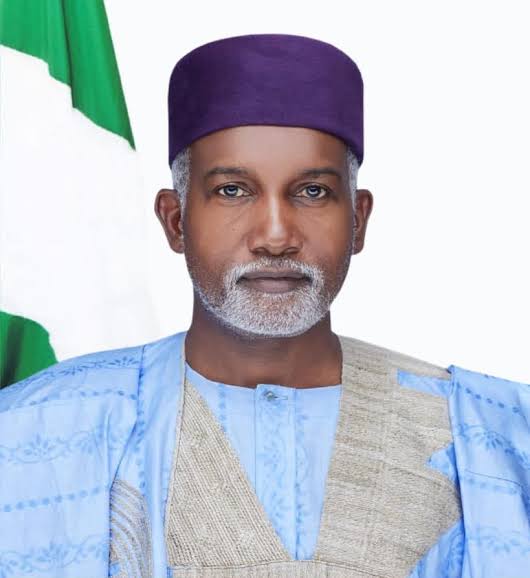
The Minister of Foreign Affairs, Yusuf Maitama Tuggar, has resigned from his position in the administration of President Bola Ahmed Tinubu to pursue the governorship of Bauchi State in the 2027 election.
Tuggar submitted his resignation on Monday, in compliance with a presidential directive requiring all political appointees with electoral ambitions to vacate their posts by the March 31, 2026, deadline.
The directive, issued through the office of the Secretary to the Government of the Federation, George Akume, aligns with Section 88(1) of the Electoral Act, 2026, and the timetable released by the Independent National Electoral Commission (INEC). It affects ministers, advisers, and heads of federal agencies intending to contest in the 2027 general elections.
Reports have it that his resignation positions him to seek the ticket of the All Progressives Congress (APC) for the Bauchi State gubernatorial race.
Tuggar’s entry is expected to significantly reshape the state’s political landscape, intensifying an already competitive contest for the APC nomination. His background as a career diplomat and serving minister is seen by political observers as a potential advantage, offering national visibility and extensive political networks.
With less than 24 hours remaining before the deadline, additional resignations from the Federal Executive Council are anticipated as other appointees move to formalize their electoral ambitions.
News
Kwankwaso Officially Joins ADC
By Yusuf Danjuma Yunusa
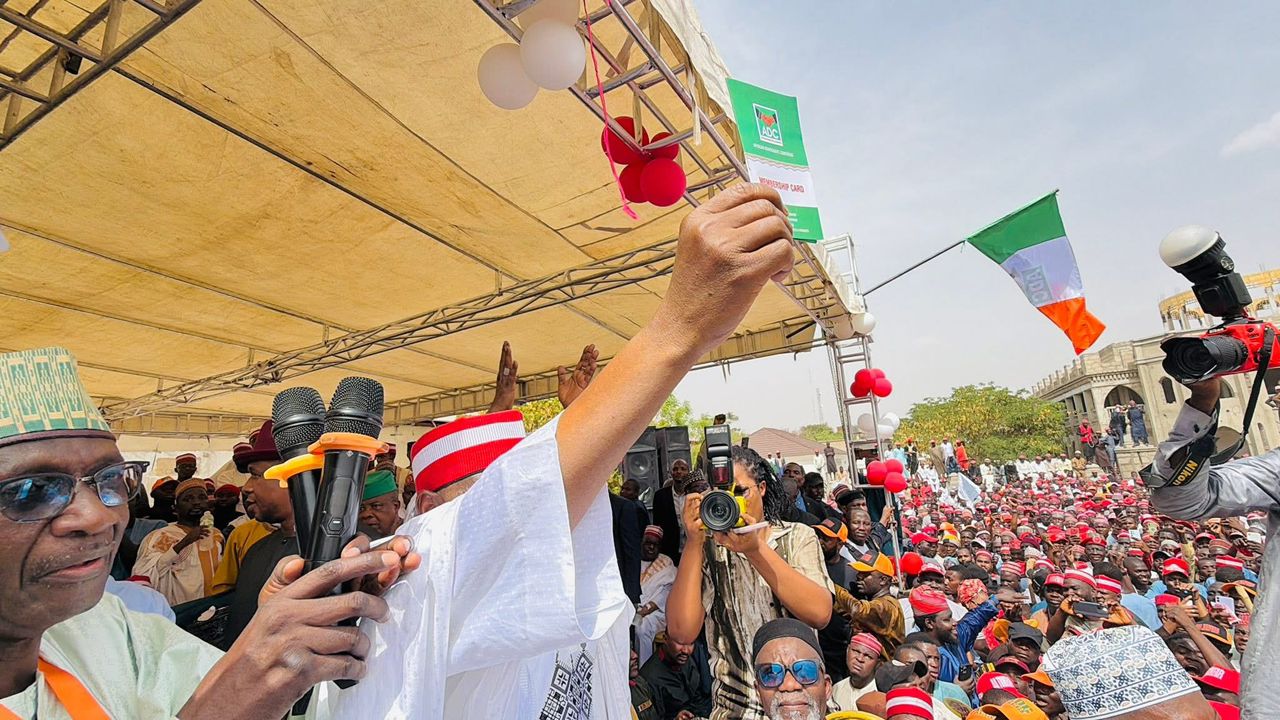
Former presidential candidate of the New Nigeria Peoples Party and ex-Governor of Kano State, Senator Rabiu Kwankwaso, has officially joined the African Democratic Congress.
The former Minister of Defence also registered with the party and received his membership card on Monday at Gidan Kwankwasiyya, Miller Road, Bompai, Kano.
Present at the event include ADC National Chairman and former Senate President, David Mark; former Sokoto State Governor, Senator Aminu Tambuwal; former Minister of Transportation, Rotimi Amaechi; former Labour Party presidential candidate, Peter Obi; Senator Dino Melaye; and former National Chairman of the All Progressives Congress, John Odigie-Oyegun, among others.

ADC Reports Surge in Membership Following Kwankwaso’s Defection, Calls Him ‘Game Changer’

Foreign Affairs Minister Resigns to Pursue Bauchi Governorship Election

Kwankwaso Officially Joins ADC

El-Rufai/Uba Sani And Pantami’s Perceived Peace Of The Graveyard

Defection: Kwankwaso’s Legacy Under Scrutiny; A Critical Look at his Political Journey Since 1999

The Governor Who Chose His People Over His Politics: Abba Yusuf and the Moral Courage Behind Kano First

FREEDOM OF SPEECH, NOT FREEDOM FROM CONSEQUENCE: A CITIZEN’S CALL FOR RESPONSIBLE PUBLIC COMMENTARY
Restoring the Glory That Was Always There: Governor Abba Kabir Yusuf and the Historical Vision Behind Kano First

Tinubu to Swear in Olatunji Disu as Inspector-General of Police on Wednesday

NDLEA Clarifies: Drug Case Against Abba Kyari Still Active After Court Discharge
ADC Reports Surge in Membership Following Kwankwaso’s Defection, Calls Him ‘Game Changer’
Foreign Affairs Minister Resigns to Pursue Bauchi Governorship Election
Kwankwaso Officially Joins ADC
El-Rufai/Uba Sani And Pantami’s Perceived Peace Of The Graveyard
Defection: Kwankwaso’s Legacy Under Scrutiny; A Critical Look at his Political Journey Since 1999
The Governor Who Chose His People Over His Politics: Abba Yusuf and the Moral Courage Behind Kano First
FREEDOM OF SPEECH, NOT FREEDOM FROM CONSEQUENCE: A CITIZEN’S CALL FOR RESPONSIBLE PUBLIC COMMENTARY
Restoring the Glory That Was Always There: Governor Abba Kabir Yusuf and the Historical Vision Behind Kano First
Tinubu to Swear in Olatunji Disu as Inspector-General of Police on Wednesday
NDLEA Clarifies: Drug Case Against Abba Kyari Still Active After Court Discharge
-

 Opinion4 years ago
On The Kano Flyovers And Public Perception
-

 Features5 years ago
How I Became A Multimillionaire In Nigeria – Hadiza Gabon
-

 Opinion5 years ago
Kano As future Headquarters Of Poverty In Nigeria
-

 History5 years ago
Sheikh Adam Abdullahi Al-Ilory (1917-1992):Nigeria’s Islamic Scholar Who Wrote Over 100 Books And Journals
-

 Opinion4 years ago
My First Encounter with Nasiru Gawuna, the Humble Deputy Governor
-

 History5 years ago
The Origin Of “Mammy Market” In Army Barracks (Mammy Ochefu)
-

 History4 years ago
The History Of Borno State Governor Professor Babagana Umara Zulum
-

 News4 years ago
Federal University Of Technology Babura To Commence Academic Activities September