
News
President Buhari To Igbo Leaders:Your Demand For Nnamdi Kanu’s Release Is Heavy
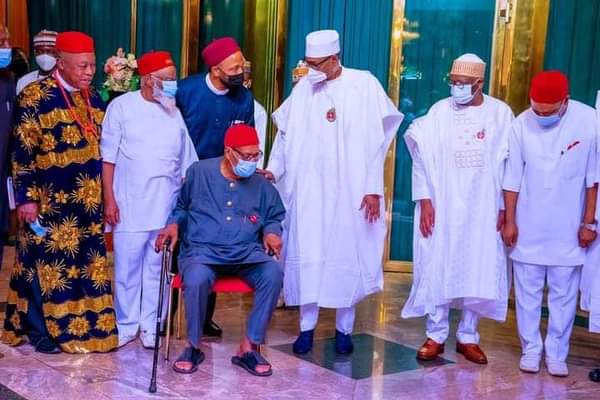
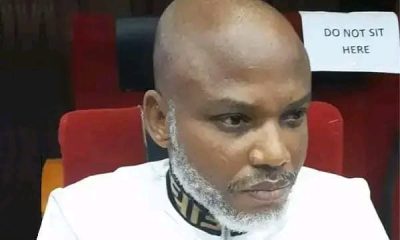
An unconditional release of Nnamdi Kanu, leader of the outlawed Indigenous People of Biafra (IPOB), currently standing trial, runs contrary to the doctrine of separation of powers between the Executive and Judiciary, President Muhammadu Buhari has said.
Receiving a group under the aegis of Highly Respected Igbo Greats, led by First Republic parliamentarian and Minister of Aviation, Chief Mbazulike Amaechi, at State House, Abuja, the President told the 93-year-old statesman:
“You’ve made an extremely difficult demand on me as leader of this country. The implication of your request is very serious. In the last six years, since I became President, nobody would say I have confronted or interfered in the work of the Judiciary. God has spared you, and given you a clear head at this age, with very sharp memory. A lot of people half your age are confused already. But the demand you made is heavy. I will consider it.”
Donation Of 100 Million Naira To Davido And The Lost Of Humanity
Stressing his policy of non-interference with the Judiciary, President Buhari said when Kanu jumped bail, got arrested and brought back to the country, “I said the best thing was to subject him to the system. Let him make his case in court, instead of giving very negative impressions of the country from outside. I feel it’s even a favour to give him that opportunity.”
The President condoled with Chief Amaechi, who recently buried his wife, praying that her soul would rest in peace.
The nonagenarian had described the situation in the Southeast as “painful and pathetic,” lamenting that businesses have collapsed, education is crumbling, and there is fear everywhere.
He pleaded for a political, rather than military solution, requesting that if Kanu was released to him as the only First Republic Minister still alive, “he would no longer say the things he had been saying,” stressing that he could control him, “not because I have anything to do with them (IPOB), but I am highly respected in Igbo land today.”
Chief Amaechi said twice he had interfaced with Nnamdi Kanu in the past, and the latter rescinded orders earlier given on civil disobedience.
He concluded: “I don’t want to leave this planet without peace returning to my country. I believe in one big, united Nigeria, a force in Africa. Mr President, I want you to be remembered as a person who saw Nigeria burning, and you quenched the fire.”
Other people in the visiting delegation were; His Excellency Chukwuemeka Ezeife, former Governor of Anambra State, Bishop Sunday Onuoha of the Methodist Church, Chief Barrister Goddy Uwazurike, former President of Igbo socio-cultural group, Aka Ikenga, and Mr Tagbo Mbazulike Amaechi.











News
BREAKING: INEC Postpones Nationwide Voter Revalidation Till After 2027 Elections
By Yusuf Danjuma Yunusa
The Independent National Electoral Commission (INEC) has postponed its planned nationwide voter revalidation exercise till after the 2027 general election.
In a statement on Friday, Mohammed Haruna, INEC’s national commissioner and chairman of the information and voter education committee, said the decision was made at a meeting between the commission and resident electoral commissioners (RECs).
“Following deliberations, the commission resolved to postpone the exercise until after the 2027 General Election,” the statement reads.
Since the Commission’s resolve to embark on the revalidation exercise, reactions have trailed, especially from the opposition coalition camp, the ADC.
It cited an allegation of wanting to sabotage eligible electorates in favour of the ruling party.
News
World Bank Urges Nigeria to Break Petrol Monopoly, Reopen Market to Imports
The World Bank has urged the Nigerian government to reopen the petrol market to competition by reinstating import licences in an effort to reduce the inflationary pressures caused by the fallout of the Middle East conflict.
In its latest Nigeria Development Update released , the Washington-based lender says the suspension of petrol import licences since January 2026 “has reduced competition, allowing prices to exceed import-parity levels”.
Word Bank further says
“Allowing qualified marketers to resume imports would restore competition, reduce pricing distortions and better align domestic prices with global benchmarks,” it says. “Greater market contestability would also strengthen supply security by reducing reliance on a single refinery and broadening sourcing options, while remaining consistent with domestic refining objectives.”
The World Bank recommends reinstating petrol import licences to dismantle a supply monopoly, aiming to lower domestic fuel costs that currently sit 12% above global benchmarks.
“Allowing qualified marketers to resume imports would restore competition, reduce pricing distortions and better align domestic prices with global benchmarks,” it says. “Greater market contestability would also strengthen supply security by reducing reliance on a single refinery and broadening sourcing options, while remaining consistent with domestic refining objectives.”
The World Bank points out that following the recent surge in global oil prices, the Dangote refinery – the main supplier of refined petrol after the regulator ceased issuing import licences in early 2026 – raised its ex-depot petrol price to about ₦1,275 ($0.92) per litre as of 23 March 2026.
That compares to an estimated import-parity price of around ₦1,122 per litre, implying a cost differential of roughly 12%, according to the report.
On 13 March, The Africa Report reported that the battle for survival among Nigeria’s traditional fuel importers had intensified in the first quarter of 2026 following the non-issuance of petrol import licence .
With the Africa report on the World Bank’s stand on Nigeria’s petroleum market, Nigerians continued to express their mixed feelings, noting that other company owners have staff to pay, they were not given the opportunity to import, Nigeria is a big country and a single company and refinery cannot supply sufficient fuel to the teeming millions of Nigerians. It is the nation’s economy; it cannot be handled by a single individual, and if there is a problem, he cannot handle it alone.
Source:Africa Report
News
Online Media Now Shapes Public Opinion Faster Than Traditional Platforms — Inuwa Waya
Abbas Yushau Yusuf
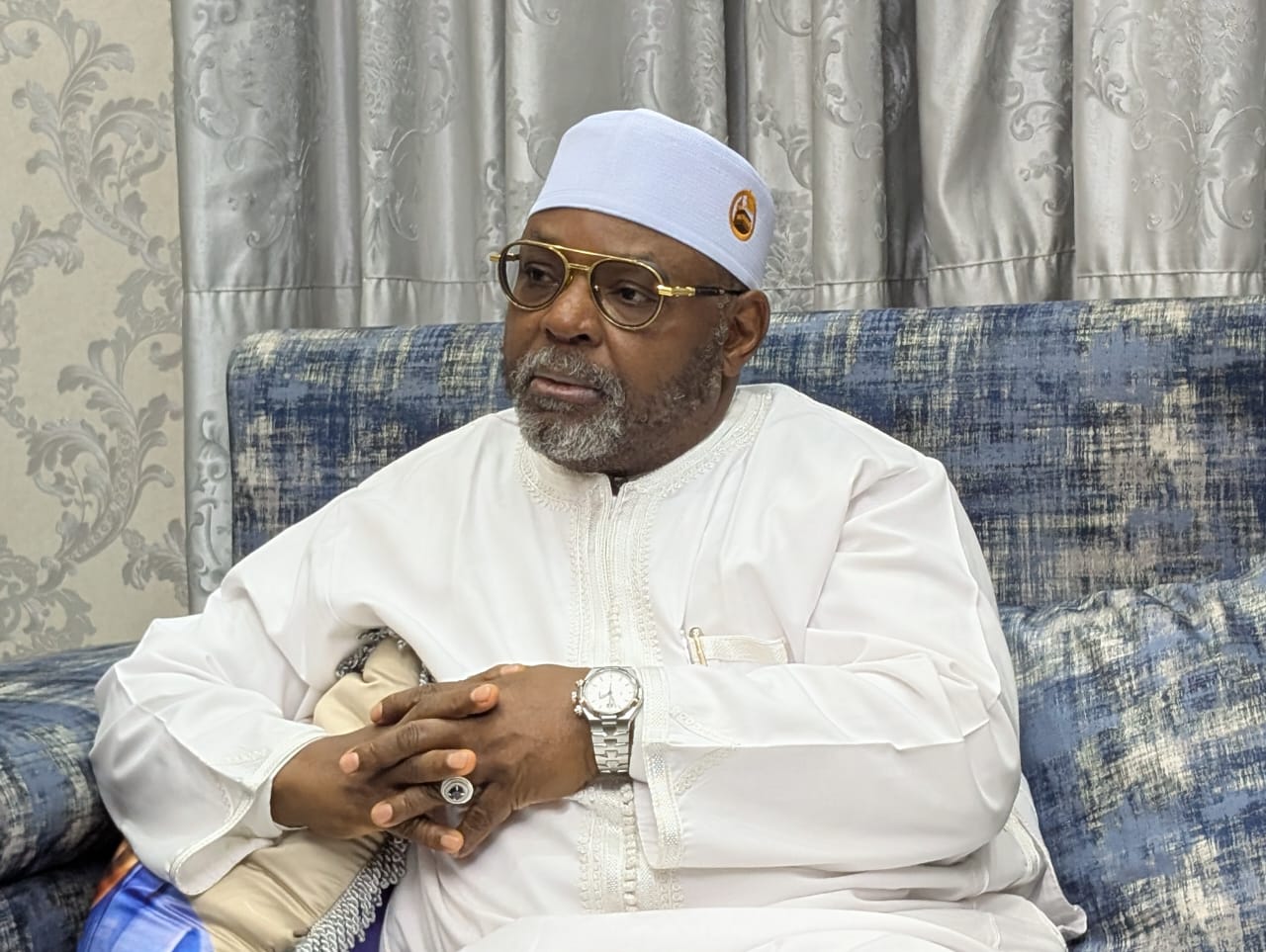
An All Progressives Congress (APC) chieftain, Malam Inuwa Waya, has emphasized the growing influence of digital journalism, noting that online media now plays a dominant role in shaping public opinion ahead of traditional platforms.
Waya made this known while receiving members of the Kano Online Media Chapel of the Nigeria Union of Journalists (NUJ), where he highlighted how the speed of information dissemination has transformed the media landscape.
According to him, in the past, there was often a significant delay between events and when the public became aware of them. “Before, by the time news filtered through, people had already moved on,” he said. “Now, with the emergence of online media, the gap between newsmakers and the public is no more than three minutes.”
The APC stalwart stressed that digital platforms have effectively taken over all segments of the media industry. He observed that audiences increasingly consume online news multiple times before turning to traditional outlets such as radio, television, or newspapers.
“Today, readers go through online reports repeatedly before considering traditional media,” Waya stated. “This places a greater responsibility on online journalists to eliminate negativity and uphold professionalism in their reporting.”
He further described online media as a critical tool for maintaining checks and balances between the government and the public. However, he cautioned practitioners to operate strictly within ethical standards, noting that the media serves as a mirror of society.
Waya warned that while libel was previously more associated with conventional electronic media, online platforms are now increasingly vulnerable to similar legal risks due to the speed and volume of publication.
He urged journalists to prioritize fairness, accuracy, and objectivity in their work to avoid legal consequences. “You must ensure your reports are balanced and factual,” he advised. “This will provide you with a strong defence should you ever be called upon to answer in a court of law.”

BREAKING: INEC Postpones Nationwide Voter Revalidation Till After 2027 Elections

World Bank Urges Nigeria to Break Petrol Monopoly, Reopen Market to Imports

Online Media Now Shapes Public Opinion Faster Than Traditional Platforms — Inuwa Waya

EXCLUSIVE: How DSP Barau Douses Tension In Kano’s Noisy Politics

The Final Betrayal Of A Red Neck?-Martin Yakwo

ADC Leadership Crisis: State Chairmen to Elect Caretaker Committee on Tuesday

Governor Abba Kabir Yusuf Holds Exclusive Prerogative to Choose Deputy – Malam Inuwa Waya

DSP Barau As A Global Citizen, His Recent Global Engagements

NUJ Kano Online Chapel Tightens Membership Standards, Approves 31 Applicants After Rigorous Screening

APC National Convention : How DSP Barau Displays Political Sagacity, Deep Knowledge of Democracy Before President Tinubu, Others
BREAKING: INEC Postpones Nationwide Voter Revalidation Till After 2027 Elections
World Bank Urges Nigeria to Break Petrol Monopoly, Reopen Market to Imports
Online Media Now Shapes Public Opinion Faster Than Traditional Platforms — Inuwa Waya
EXCLUSIVE: How DSP Barau Douses Tension In Kano’s Noisy Politics
The Final Betrayal Of A Red Neck?-Martin Yakwo
ADC Leadership Crisis: State Chairmen to Elect Caretaker Committee on Tuesday
Governor Abba Kabir Yusuf Holds Exclusive Prerogative to Choose Deputy – Malam Inuwa Waya
DSP Barau As A Global Citizen, His Recent Global Engagements
NUJ Kano Online Chapel Tightens Membership Standards, Approves 31 Applicants After Rigorous Screening
APC National Convention : How DSP Barau Displays Political Sagacity, Deep Knowledge of Democracy Before President Tinubu, Others
-

 Opinion4 years ago
On The Kano Flyovers And Public Perception
-

 Features5 years ago
How I Became A Multimillionaire In Nigeria – Hadiza Gabon
-

 Opinion5 years ago
Kano As future Headquarters Of Poverty In Nigeria
-

 History5 years ago
Sheikh Adam Abdullahi Al-Ilory (1917-1992):Nigeria’s Islamic Scholar Who Wrote Over 100 Books And Journals
-

 Opinion4 years ago
My First Encounter with Nasiru Gawuna, the Humble Deputy Governor
-

 History5 years ago
The Origin Of “Mammy Market” In Army Barracks (Mammy Ochefu)
-

 History4 years ago
The History Of Borno State Governor Professor Babagana Umara Zulum
-

 News4 years ago
Federal University Of Technology Babura To Commence Academic Activities September