
Politics
How Kwankwaso Fought Phone Snatchers And Thugs In Kano
By Ibrahim Adam
In 2011 when Sen. Rabiu Musa Kwankwaso returned as the Executive Governor of Kano State, he met a frightening rise of drug abuse, thuggery, and joblessness among the youths in the state.
The youths were only used as political thugs by politicians and many were mingling as political touts and beggars at government offices.
Right at the premises of the Government House then, there was a permanent base of political thugs where they abused drugs and praise-sing, or even harass, visitors and officials to get money.
Worried by the ugly and socially dangerous condition, then governor Kwankwaso formed a high powered task force committee that fought illicit drug dealers and drug abusers in Kano. The committee was given all the financial and moral support to discharge its duties effectively and efficiently.
The government made effort in regulating the Yanmagani traders in Sabon Gari market, by ejecting them out of the market and forcing them to strictly adhere to all the regulations guiding the sales of drugs to the public. All of which is aimed at curtailing easy access to illicit drugs by the youth.
Also, Governor Kwankwaso established a Kano Reformatory Institute in Kiru Local Government and Corporate Security Institute in Gabasawa Local Government all with the aim of curtailing drug abuse, thuggery, and joblessness of the uneducated and undereducated youth in Kano State.
Kano Reformatory Institute was established with the sole intention of rehabilitating and building the capacities of drug addicts so that they can become responsible and productive citizens. This in turn will ultimately reduce drug abuse and the attendant high rate of crimes in Kano.
In the institute, the students were medically and psychologically rehabilitated as well as given training on vocational skills such as leather works, garment production, metal works and fabrication, and many more. The goal is to make them self-reliant and productive.
Upon graduation, the then government of Kwankwaso empowered them with capital to start up their businesses.
Hundreds of these youths are now prosperous business owners taking care of their families and contributing their quota to the development of the state and the nation in general as responsible and productive citizens.
On the other hand, at the Corporate Security Institute, the many jobless youths that would otherwise be nuisance were trained on modern security techniques and —like their counterparts at the reformatory Institute— were certified upon graduation.
This makes them professional security service providers fit to be employed as security guards by both government and private organizations.
A substantial number of them were absorbed by KAROTA as its staff.
Rather than use them as political thugs for sinister political deals as is common with many political leaders in Nigeria, Governor Kwankwaso considered them as his sons and daughters. And therefore, as a responsible father, he ensured that they were rehabilitated and empowered.
He took them off the streets and offices where they roam about as thugs wasting their lives and disturbing the peace of the society. They were no more liabilities to society. They became self-defendant and real people.
Undoubtedly, this has put smiles on the faces of many parents, spouses, relatives, and children of the reformed youth, having been converted from socio-security time bombs to the productive and responsible populace.
Through these initiatives, the state witnessed significant socio-economic and security improvements. As a result, people go about their daily activities hitch-free without any fear of intimidation or harassment by jobless youth. Peace and tranquility reigned.
It is sad that today in Kano despite all these efforts made by Kwankwaso’s administration from 2011 to 2015, there is the return of thuggery, thievery, and brutal attacks on unsuspecting passersby in our streets. Just a few days ago, a promising young man was stabbed to death by phone snatchers.
One will ask, what is the present government doing to bring an end to all these illicit and dangerous activities? Are they empowering the youths in order to discourage them from all these dangerous activities? Is the Kano Reformatory Institute still in existence? What is the fate of the School of Entrepreneurship Studies that was established by Kwankwaso at Dawakin-Tofa? I heard it has been closed by the current Ganduje-led administration.
Are the speculations that the government is using the youths as political dogs to attack opposition the reason why the government is leasing out the School of Tourism and Hospitality that was established by Kwankwaso (former Daula) for the purpose of building a mall?
Could it be that it is as a result of the ‘I don’t care attitude’ of the Government that the Corporate Security Institute was also closed? Only those in government can answer these pertinent questions.
While waiting for the answers, it is good to remind those in power that history and posterity will not be fair to them if they allow Kano State through acts of omission or commission to slip back to the ugly state it was before Kwankwaso’s return in 2011 or even worse in terms of thuggery and drug abuse.
Furthermore, they should also bear in mind that those who live in glass houses shouldn’t throw stones. Nobody knows who the next victim(s) will be. Power is transient. Everybody becomes a ‘nobody’ ultimately.
We seriously don’t feel safe anymore!
Ibrahim Adam
PA to former Kano PDP Gubernatorial Candidate in the 2019 elections Engr. Abba K. Yusuf wrote from Kano.
Politics
Goje’s Electoral War:The Confrontation With Tinubu,Governor Inuwa,Usman Kumo And APC candidates Ahead Of 2027
By Engr. Ibrahim Suleiman Kashere
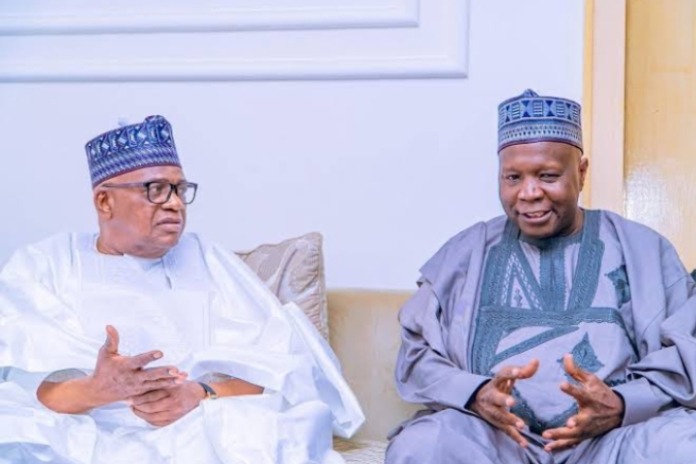
Political survival in a robust democracy demands loyalty, shared ideals and adherence to institutional discipline. Political parties are not mere vehicles for contesting elections; they are institutions built on trust, collective sacrifice and mutual accountability. Yet, the All Progressives Congress (APC) in Gombe State continues to grapple with a recurring internal challenge centred on the actions and public posturing of Senator Muhammad Danjuma Goje, a ranking Senator and one of the most senior political figures in the state.
When personal political expectations diverge from collective party decisions and progress, the resulting friction can compromise electoral cohesion and weaken organisational unity. Recent public statements attributed to Senator Goje—most notably the widely circulated video in which he reportedly directed his followers not to support certain official APC candidates—have brought the long-running disagreement within the Gombe APC back into sharp focus. To those who have followed the internal politics of the party over the years, these developments appear to reinforce concerns repeatedly expressed about his political posture, particularly during the 2023 general elections. What was largely discussed in whispers and allegations in 2023 is increasingly becoming an open political confrontation in 2026.
The friction between Senator Goje and the mainstream APC structure in Gombe State did not start today. It manifested clearly and painfully during the 2023 general elections. Despite flying the flag of the ruling party and benefiting from its platform, serious questions were raised by stakeholders regarding voting patterns across his immediate political base in Gombe Central. Party stakeholders and agents in Akko and Yamaltu/Deba Local Government Areas pointed to noticeable electoral gaps between presidential, senatorial and House of Representatives votes in a number of polling areas as possible evidence of internal political cross-currents and selective voting.
The concern was straightforward: how could candidates of the same political party, contesting simultaneously before substantially the same electorate, record significantly different levels of support in areas where the party maintained a strong organisational presence? For many stakeholders, those discrepancies were not simply numbers to be ignored. They raised legitimate political questions about internal coordination, mobilisation and whether every component of the party machinery worked equally for all APC candidates. Post-election reviews and discussions among party stakeholders consequently alleged that internal coordination had faltered in ways that undermined some official party standard-bearers. The party entered a major election while managing serious internal contradictions when its energy should ordinarily have been concentrated on confronting opposition parties.
The electoral consequences for the APC in Gombe State in 2023 were enormous. Out of the six House of Representatives seats in the state, the APC secured only one—the Akko Federal Constituency seat won by Rt. Hon. Usman Bello Kumo—while it lost the remaining five. At the senatorial level, the APC similarly secured only one of the three seats: Gombe Central, retained by Senator Muhammad Danjuma Goje himself. Gombe North and Gombe South were lost to the opposition.
For many APC stakeholders, these figures remain a painful reminder of the consequences they associate with the internal divisions, selective political support and alleged anti-party activities that characterised the 2023 elections. The political irony is difficult to overlook: while Senator Goje successfully retained his own senatorial seat, the APC suffered substantial losses elsewhere in the state. What should therefore concern every committed party member is whether the lessons of 2023 have genuinely been learned or whether the party is being dragged towards another cycle of internal confrontation ahead of 2027.
It was against this background that grassroots organs of the party initiated disciplinary proceedings against Senator Goje over allegations of anti-party activities. The process began in Kashere Ward, his own ward, where party officials announced disciplinary action against him in April 2023. The matter subsequently generated actions and reactions within other levels of the party structure. For those who initiated the process, it was presented not as witch-hunting but as an attempt to enforce party discipline and protect what they regarded as party supremacy. But the political questions that produced the controversy did not disappear. If 2023 was characterised by allegations of subtle political subversion and selective support, what we are witnessing today is far more open.
The political space in Gombe State has recently been jolted by a widely circulated video in which Senator Goje reportedly directed his followers not to vote for certain candidates whom he accused of working against his political interest. In my considered view, the message goes beyond an ordinary disagreement over individual candidates: it amounts to an open declaration of electoral war against those he perceives as having played a role in denying him another APC senatorial ticket.
The political figures and interests caught within this confrontation include President Bola Ahmed Tinubu, GCFR; Governor Muhammadu Inuwa Yahaya; Rt. Hon. Usman Bello Kumo; and other candidates of the APC, except for the few individuals Senator Goje specifically identified as exceptions deserving his support. For many of us who witnessed the internal disagreements of 2023, the present situation therefore appears to represent a transition from allegations of anti-party activities by implication to a much more explicit political confrontation with those he considers responsible for frustrating his senatorial ambition.
For a political figure who has been a major beneficiary of the APC platform from 2015 to date, such a posture is, in my view, deeply alarming and politically unpatriotic. Senator Goje has enjoyed the support, opportunities and electoral platform of the APC for more than a decade, including successive opportunities to represent Gombe Central in the Senate. To now turn against the party and its candidates barely four months to the 2027 general elections because the political calculations surrounding another senatorial ticket did not favour him raises profound questions about loyalty, reciprocity and commitment to the collective interest of the party.
At a time when every committed party leader should ordinarily be working to consolidate the APC, mobilise its supporters and strengthen its candidates ahead of the general elections, an open campaign against the party’s candidates risks deepening internal divisions and weakening the very political platform from which he has benefited for years.
For a man of Senator Goje’s standing, experience and stature—a former Governor, former Minister and ranking Senator—this development cannot be treated as an ordinary disagreement among grassroots politicians. His relationship with the APC since 2015 has provided him with a powerful political platform through which he has contested and retained his senatorial seat in successive elections, including 2019 and 2023. It therefore raises a fundamental political and institutional question when a serving Senator elected on the platform of a political party openly withholds support from candidates officially sponsored by that same party.
This is not merely about Senator Goje as an individual; it concerns the meaning of party membership, party discipline, loyalty and collective responsibility.
Even more troubling to many stakeholders is the political campaign against the member representing Akko Federal Constituency, Rt. Hon. Usman Bello Kumo, a principal officer of the House of Representatives and an influential APC figure within the constituency. Kumo has been associated with numerous federal interventions and constituency projects in Akko, including road and infrastructure projects, educational interventions, empowerment programmes and other federal initiatives. The establishment of the Federal Medical Centre, Kumo, has similarly become one of the most significant federal institutional developments in the area, although its actualisation involved the Federal Government, Gombe State Government and other institutional and political actors.
Whatever personal political differences may exist, the interests of Akko Federal Constituency and the APC should remain larger than disagreements between individual political leaders. It becomes particularly consequential when a senior member of the same political party campaigns against another member representing his own constituency while continuing to occupy elective office on the platform of that party.
The APC cannot afford to treat these developments with levity. A political party that cannot enforce its constitution and disciplinary standards consistently among its most influential members will find it increasingly difficult to demand discipline from ordinary members at ward and polling-unit levels. Public disagreements, selective endorsements and campaigns against officially nominated candidates can create avoidable divisions within the party framework. They can expose loyal APC members in Gombe Central, Akko and Yamaltu/Deba to fragmentation, confusion and demoralisation at a time when party cohesion should ordinarily be strengthened.
What is at stake, therefore, is not merely who flies the APC flag in Gombe Central, Akko or Yamaltu/Deba. The deeper question is whether party decisions, the party constitution, party hierarchy and collective responsibility continue to command respect irrespective of the status of the individual involved. No political party can sustainably operate two standards of discipline—one for ordinary members and another for political heavyweights.
Senator Goje’s enormous contributions to Gombe politics and his long years of public service cannot reasonably be denied. Neither should his political experience and influence be underestimated. But political stature should ordinarily impose greater responsibility rather than provide exemption from institutional discipline.
The path forward for the APC in Gombe State therefore requires a firm commitment to party rules, institutional strength, internal consultation and collaborative political leadership. The leadership of the party—from the national leadership through the state, local government and ward structures—must ensure that grievances are addressed through recognised constitutional mechanisms and that the collective mandate of the party is protected above individual interests and personal political feuds.
At the same time, due process must remain fundamental. Any allegation of anti-party activity must be handled in accordance with the APC Constitution and applicable law. But due process must not become an excuse for institutional paralysis.
History repeatedly demonstrates that when political indiscipline is ignored because the individual involved is powerful, influential or electorally valuable, such conduct gradually becomes normalised. Once normalised, institutional authority becomes increasingly difficult to restore.
Gombe APC therefore stands at an important political crossroads. The questions raised in 2023 have returned, but this time under circumstances in which political positions are becoming considerably more explicit. The party must determine whether its collective decisions are binding on all its members or whether individual political interests can supersede officially adopted party positions. That determination should not be based on personality, faction or political convenience. It should be based on the APC Constitution, established party procedures, due process and the principle that no individual is greater than the institution to which he voluntarily belongs.
For those of us who believe in the supremacy, stability and continued progress of the APC, the lesson is unmistakable: internal disagreements must be resolved, legitimate grievances must be addressed, and institutional discipline must apply fairly and consistently.
The APC must remain greater than any individual. History has shown that when indiscipline is left unchecked, it becomes a culture. The time to address it is now.
Politics
Kano Politics: The Rise of Verbal Immorality-Adamu Aminu
By Adamu Aminu
Political disagreement is not the problem. Nigeria’s democracy was built on the expectation that citizens and their representatives would argue, differ, and contest ideas openly. What is happening in Kano today is something else entirely. It is not debate. It is decay.
In recent weeks, the public exchange between two political proxies in Kano has crossed every line that should separate legitimate criticism from outright character assassination.
What began, ostensibly, as political rivalry has degenerated into insults, curses, and personal attacks that now extend beyond the individuals involved to their families. Parents, spouses, and children — people who hold no office and made no political claim — have been dragged into a contest that was never about governance in the first place.
It is with genuine concern that this must be said plainly: the recent exchange between Alhaji Usman Sharu Baban Lungu, an elderly statesman in his eighties, and Alhaji Nagoda, an aide to Governor Abba Kabir Yusuf, descended into accusations too grave and too dishonorable to repeat here — accusations that dragged innocent family members into territory no political disagreement should ever reach. “Inna lillahi wa inna ilaihi raji’un”
Whatever their differences, two men of public standing — one of them elderly enough to command respect by age alone — have involved their own households in conduct that neither politics nor personal grievance can justify.
Is this the legacy they intend to leave for their children, and for their children’s children, long after they are gone? A name is the one thing a person carries beyond death.
This is not politics. It is a scramble for relevance, dressed up as loyalty. By all appearances, both men are not fighting for ideas or for the people of Kano. They are fighting for attention, for patronage, for whatever crumbs might fall from a political table they hope to remain seated at.
None of this happens in a vacuum. Social media pages and radio stations are institutions that ought to apply editorial discipline and ethical restraint, have instead become amplifiers. A radio interview is meant to test a politician’s ideas, not to provide a stage for insults. Yet politicians whose speech is more familiar with vulgarity than with policy have found that behavior rewarded with airtime and circulation, because outrage travels faster than substance.
The mudslinging is no longer whispered in private. It is broadcast and shared, in the hope of impressing political godfathers who measure loyalty by how loudly their proxies can humiliate a rival.
This raises questions Kano cannot afford to postpone. Where is Kano’s political direction heading when public office is pursued through insult rather than ideas?
Is this the inheritance we intend to leave the next generation, a political culture where vulgarity is normal and dignity is optional?
Has character assassination become a shortcut to relevance, a way of chasing clout rather than earning trust?
And where are the gatekeepers in all of this?
The Kano State Governor, political leaders, religious clerics, and other well-meaning individuals who command moral and civic authority in this state cannot claim ignorance of what is unfolding on air and online.
Their silence is not neutrality — it is consent by omission. Religious clerics who ordinarily do not hesitate to speak on matters of public morality owe the state a word on this matter.
A society that leaves moral guardianship to chance will, sooner or later, find that vulgarity has filled the space their silence left behind.
Constructive criticism holds power accountable. It sharpens argument and improves governance. What Kano is witnessing instead is the normalization of verbal immorality. Left unchecked, this trend does more than embarrass the individuals involved. It teaches a generation of young people in Kano that vulgarity is a legitimate substitute for vision.
Kano’s institutions, political, religious, and media alike, must now decide whether they are custodians of public discourse or accomplices to its collapse.
Adamu Aminu writes from Kano.
Politics
Defamation Against DSP Barau, Institutional
By Abba Anwar
Any act of defamation of character against His Excellency the Deputy President of the Senate and First Deputy Speaker of ECOWAS Parliament, Distinguished Senator Barau I Jibrin, PhD, CFR, more of allegations of terrorism and aiding the national tragedy, is automatically a defamation against democratic institutions.
I know DSP knows glaringly clear that, the current malicious and defamatory allegation against his personality goes beyond his own self as a Distinguished Senator representing Kano North alone. To me, dropping petition against the perpetrators of such act is not only unnecessary, it is deconstruction of democratic institutions and processes.
I came across a petition from DSP’s Solicitors, West-Wig Attorneys, to the Inspector General of Police, dated 22nd July, 2026 and singed by S. Y. Gama Esq and Sani Ibrahim Esq, requesting for “… the immediate investigation, identification and prosecution of persons appearing in the viral video for the alleged, false, malicious and defamatory publication against His Excellency Senator Barau I Jibrin, Deputy President of the Senate of the Federal Republic of Nigeria, and for related offences including cyberstalking.”
As the petition concurs with my understanding of the case at hand, that defamation against Senator Jibrin is defamation against institutions, it says, “The gravity of this matter is further accentuated by the constitutional office occupied by our Client as the Deputy President of the Senate of the Federal Republic of Nigeria.
False allegations of terrorism directed against the holder of such a high public office possess the capacity to undermine public confidence in democratic institutions, diminish the integrity of constitutional governance and unjustifiably expose the occupant of that office to avoidable security concerns.”
The core content of the issue at hand as explained by the petition typifies that, “Our Client’s attention has been drawn to a video presently in widespread circulation across various social media platforms wherein a group of adult women are seen and heard repeatedly referring him as “terrorist” in what appears to be a coordinated public rendition.
The publication has since attracted considerable public attention and has exposed our Client to public odium, ridicule, contempt, opprobrium and immeasurable reputational injury both within and outside the Federal Republic of Nigeria.”
With Senator Jibrin’s position as a global citizen, such grave allegation against his personality sends bad signal to the world against the entire democratic process and institutions in the country. I understand that any decision he takes, if it falls below the protection of his image, which ultimately means protecting our democratic values and institutions, could be a negation of bravery, self-esteem and entrenched democratic mind and might.
I don’t give a damn to the states of origin of those who appeared in the said video or their sponsors, the fact remains, offence is offence wherever perpetrated, hatched or birthed. So discussing about the origins of those people, seen, suspected and invisible for now, is secondary. But I am confident that DSP’s political opponents perceived and real, from Kano state would not engage in this high level defamation of character.
It is only in Kano where you see people from other places coming to the state to castigate their elders, religious, political, traditional etc and go scot-free with the full cooperation of the indigenes. I’m not a proponent of state-of-origin chauvinism, but it hurts and is highly pathetic. It is only in Kano where you see trash being treated as pure or honey. Too pathetic and unfortunate!
Some years back, I have a friend, who is also a journalist, from a popular radio station, who was transferred to Katsina state, during his first political programmes, as he started new rounds of political programmes in Katsina, he met with the serious anger of the then Governor of Katsina state. I think it was either Ibrahim Shema or Aminu Bello Masari. The Governor made it categorically clear to him that, in Katsina they would not take that trash, as obtained in Kano.
But in Kano, when some democratic liabilities, who migrated to Kano, were castigating former Governor Malam Ibrahim Shekarau, the supporters of His Excellency Rabi’u Musa Kwankwaso and His Excellency Abdullahi Umar Ganduje were clapping hands. After Shekarau, the same noisemakers faced Kwankwaso calling him names, Ganduje’s supporters were clapping and smiling. After abuses on Kwankwaso reached peak and subsided, Ganduje’s turn came on board. The same illiterate nuisance who abused Shekarau and Kwankwaso, jumped down harshly on Ganduje. For God sake, what is wrong with Kano people?!
Half of what is obtained in Kano cannot, by any standard, be tolerated elsewhere. The illiterate migrants to Kano, (reader forgive my expression, it isn’t deliberate) always preserve their elders back home. Why Kano is indifferent?
I’m not an advocate of Kano Alone, or the superiority of Kano, all I’m saying is, why it is only in Kano, elders are not seen as elders? Elders from all walks of life. Not only political elders or leaders, anyway.
I know for sure Kano reached its peak, because of her hospitality and receptive atmosphere. In Kano all people are welcomed. This is a good sign of pride and trustworthiness. I will always be happy when more and more people that are non-indigenes and not citizens of Nigeria continue to troop Kano. Wisdom behind Kano’s greatness and development. Without non-indigenes Kano wouldn’t have achieved that feat of commercial hub for the North and sub-Saharan Africa.
Coming back to the main issue at hand, DSP’s Solicitors called the attention of the IGP that, “While the identities and present locations of the persons appearing in the video are presently unknown to our Client, we firmly believe that the investigative, forensic, cyber intelligence and technological capabilities of the Nigeria Police Force are more than sufficient to uncover the identities of every person appearing in the video together with every individual who conceived, sponsored, financed, coordinated, produced, published, transmitted, promoted or otherwise facilitated the dissemination of the offending publication.”
If we believe that DSP’s seek for justice and redress is elegantly needed, to better our today and reshape the integrity of our democratic values and institutions, we should encourage him to pursue this issue to its logical conclusion.
Some of the demands of the petition request the good office of the IGP to, “Commence an immediate, comprehensive and impartial investigation into the viral video and every circumstance surrounding its production, publication and dissemination, and invite, interview and investigate all persons connected with the publication and obtain all relevant electronic and digital evidence necessary for a comprehensive investigation.”
Other requests among others are, “Determine whether the publication and dissemination of the viral videos disclose offences under the Cybercrimes (Prohibition, Prevention, etc) Act, 2015 as amended, the Criminal Code Act, the Penal Code, or any applicable law, and take every other lawful measure considered necessary to preserve, the integrity of public discourse, uphold the rule of law, Cyberstalking and malicious online publications and ensure that the allegation of terrorism are never trivialized or weaponised against any citizen without lawful justification.”
His Excellency DSP should kindly understand that, this defamation is beyond him alone, therefore shelving it aside has serious consequences on democratic institutions. Sir injury on you is injury on institutions. Putting this grave allegation under the carpet, is minus and abhorable. Many of your people, supporters and well wishers are standing by, watching your steps Sir. Is not about you alone Sir. It is also about our institutions.
Anwar writes from Kano
Thursday 23rd, July 2026

WHC Solar Trains 300 Youths in Kano to Prevent Installation Errors, Fire Outbreaks

Emir Sanusi Seeks Compensation, Reallocation of Demolished Eid Ground Stalls

Gombe flags off the disbursement of the second batch of the AGILE Conditional Cash Transfer

Why Gov Abba Deserves Another Tenure

China, Nigeria Mark Friendship with Joint Cultural Mural

Zamfara Varsity ASUU Threatens Warning Strike Over FG-ASUU Agreement, Promotion Arrears

PCACC Arrests Man Over Alleged ₦4.5m Sale, Illegal Leasing of Kano Government Horse Stable

Goje’s Electoral War:The Confrontation With Tinubu,Governor Inuwa,Usman Kumo And APC candidates Ahead Of 2027

Prof Yusuf Adamu Delivers BUK’s 63rd Professorial Inaugural Lecture, Reflects on Medical Geography and Academic Legacy

Kano Monitors ₦48.9bn Projects Across Six LGAs
WHC Solar Trains 300 Youths in Kano to Prevent Installation Errors, Fire Outbreaks
Emir Sanusi Seeks Compensation, Reallocation of Demolished Eid Ground Stalls
Gombe flags off the disbursement of the second batch of the AGILE Conditional Cash Transfer
Why Gov Abba Deserves Another Tenure
China, Nigeria Mark Friendship with Joint Cultural Mural
Zamfara Varsity ASUU Threatens Warning Strike Over FG-ASUU Agreement, Promotion Arrears
PCACC Arrests Man Over Alleged ₦4.5m Sale, Illegal Leasing of Kano Government Horse Stable
Goje’s Electoral War:The Confrontation With Tinubu,Governor Inuwa,Usman Kumo And APC candidates Ahead Of 2027
Prof Yusuf Adamu Delivers BUK’s 63rd Professorial Inaugural Lecture, Reflects on Medical Geography and Academic Legacy
Kano Monitors ₦48.9bn Projects Across Six LGAs
-

 Opinion5 years ago
On The Kano Flyovers And Public Perception
-

 Features5 years ago
How I Became A Multimillionaire In Nigeria – Hadiza Gabon
-

 Opinion6 years ago
Kano As future Headquarters Of Poverty In Nigeria
-

 History6 years ago
Sheikh Adam Abdullahi Al-Ilory (1917-1992):Nigeria’s Islamic Scholar Who Wrote Over 100 Books And Journals
-

 Opinion5 years ago
My First Encounter with Nasiru Gawuna, the Humble Deputy Governor
-

 History5 years ago
The History Of Borno State Governor Professor Babagana Umara Zulum
-

 History6 years ago
The Origin Of “Mammy Market” In Army Barracks (Mammy Ochefu)
-

 News5 years ago
Federal University Of Technology Babura To Commence Academic Activities September