
News
e-Health Africa graduates women, youths trained on software engineering
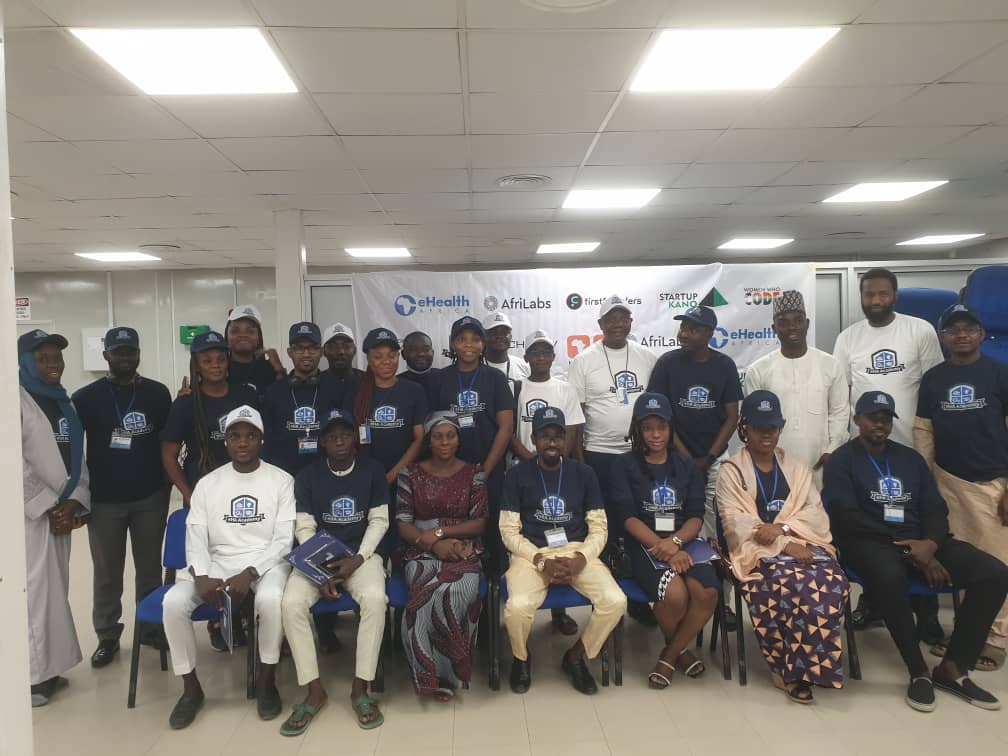
A Non-Governmental Organization (NGO), E-Health Academy (EHA) has graduated its 4th cohort of fellows who received free training and mentorships on software engineering in Kano.
The NGO, which is a subsidiary of E-Health Africa, said the fellowship is in their efforts to bridge the gap in the Information Communication Technology (ICT), especially in the area of software engineering.
Speaking during the graduation ceremony, Senior Manager Software Engineering Unit and lead for the implementation of EHA Academy, Jamil Galadanci said the 10-week intensive program is offered to underprivileged youth to provide them with the skills and resources necessary to succeed in the technology industry.
According to him, the graduation ceremony will mark the end of the classroom sessions and the beginning of the internship program for successful graduates.
“The program, offered at no cost, targeted high school students and young unemployed graduates from low-income communities and trained them in HTML, CSS, and Javascript. The academy has so far graduated 155 students and some of them were recruited to work in the academy.
“The whole idea of this academy is to bridge the gap of software engineers that we have in the space. We have realized that over the years that getting qualified software engineers that have the practical skills is always a challenge. That is why we came up with this academy.
“Our hope in the future is to have this getting bigger so that we can be able to have over 100 participants at a time considering the needs to have software engineers across Africa. Our biggest hope is to see those participants coming back as mentors coming back to be mentors just like we have started seeing now.”
Speaking shortly after the ceremony, one of the students, Aisha Mujahid Kabir, who just graduated from secondary school and willing to study computer engineering, said the training has opened her eyes into the field and that she is motivated to do more.
She added that “I am passionate about this and I am happy to say that now I am a web developer. I learned it through this Academy and I really appreciate them. I’m very sure that I can depend on what I learned here.”














News
Emir Sanusi Seeks Compensation, Reallocation of Demolished Eid Ground Stalls
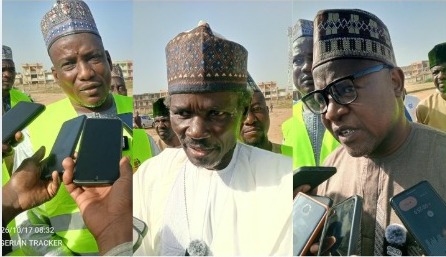
The Emir of Kano, Muhammadu Sanusi II, has appealed to the Kano State Government to compensate traders affected by the demolition of shops at the Filin Idi market in Kofar Mata, Kano, and reallocate stalls to enable them to resume their businesses.
Professor Ibrahim Muazzam Mai Bushira disclosed this during a special prayer session organised by traders affected by the demolition at the Eid Ground in Kofar Mata, where participants prayed for divine intervention and government assistance to alleviate their hardship.
According to Mai Bushira, the Emir has written to Governor Abba Kabir Yusuf, requesting compensation for the affected traders and appealing for measures to address the economic losses they have suffered following the demolition.
He expressed hope that Almighty Allah would reward the Emir for his intervention and urged Governor Yusuf to consider the demands of the traders to enable them to rebuild their businesses and restore their livelihoods.
Mai Bushira said the demolition had caused severe hardship among traders, many of whom depended on their shops as their primary sources of income. He added that some affected individuals had reportedly died, while others had developed high blood pressure following the destruction of their businesses and the resulting economic difficulties.
He explained that the prayer session was organised to seek Allah’s intervention in their predicament and pray for the restoration of their livelihoods, noting that the destruction of the shops had adversely affected the lives of many families who depended on the market for survival.
Speaking at the gathering, Professor Ahmad Muhammad of the Federal University, Dutse (FUD), described Kano as a major commercial centre and called on the Kano State Government to pay attention to the plight of the affected traders and the economic implications of the demolition.
Professor Muhammad also appealed to international entrepreneurs and investors to explore opportunities to support the development of the market, stressing that the destruction of the shops had resulted in substantial financial losses running into billions of naira.
He urged the government to consider establishing a modern market at the location, arguing that the Filin Idi market was not merely a trading centre for Kano but also an important commercial destination for traders from different parts of Nigeria and across Africa.
According to him, the market provides livelihoods for more than one million people, directly and indirectly, making its reconstruction and rehabilitation important to the economic well-being of Kano and its trading community.
The professor further stressed the need for a sustainable solution that would enable displaced traders to return to business, restore commercial activities and protect the economic interests of the large population that depended on the market.
In his remarks, the Chairman of the affected traders’ association, Auwal Said Umar, expressed appreciation to Almighty Allah and Emir Sanusi II for their support and intervention in the traders’ situation.
Umar said many of the affected traders were currently unable to engage in their usual commercial activities because their shops had been demolished, leaving them without the means to sustain their businesses and families.
He disclosed that the market previously had about 700 blocks of shops before the demolition, adding that many traders lacked the financial capacity to reconstruct their businesses without assistance from the government.
The association chairman said the government had allocated 75 stalls for reconstruction but appealed for an increase in the number to accommodate more affected traders and enable them to return to their businesses.
Umar called on the Kano State Government to provide additional support, stressing that the existing allocation was insufficient to address the needs of the large number of traders who lost their shops during the demolition.
The traders urged the government to work with their association and other relevant stakeholders to develop a lasting solution that would provide adequate trading spaces, restore commercial activities and ease the economic hardship caused by the demolition.
News
Gombe flags off the disbursement of the second batch of the AGILE Conditional Cash Transfer
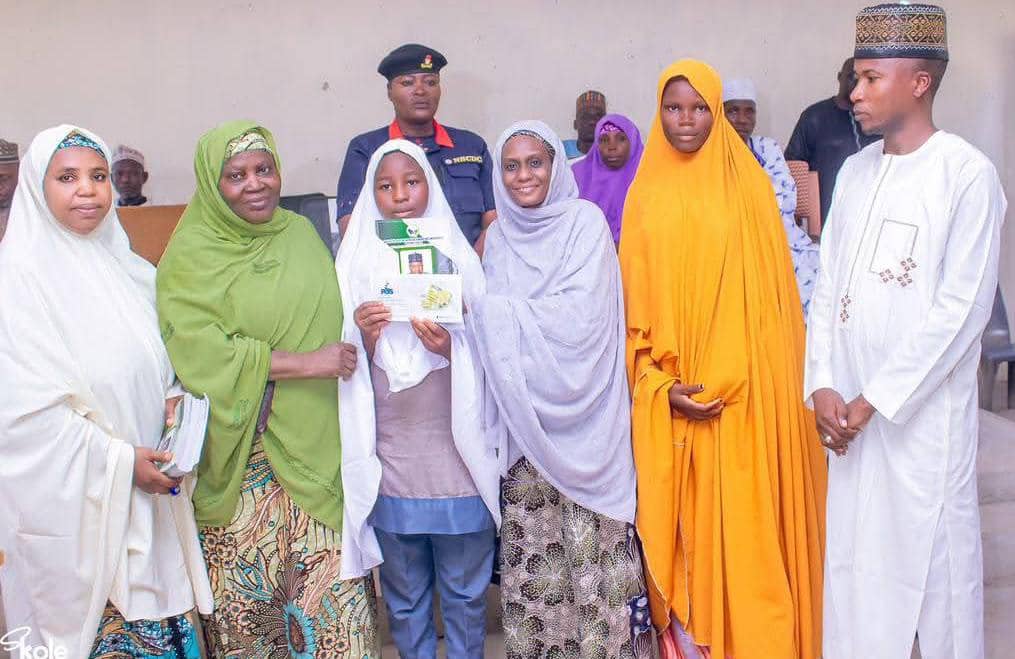
Gombe State Government has flagged-off the distribution of ATM cards to Adolescent Girls in public schools under the Conditional Cash Transfer,CCT of the Adolescent Girls Initiative for Learning and Empowerment, AGILE Project.
Speaking at the flagging off of the disbursement at Government Junior Secondary School Malamsidi central in Kwami Local Government area, the Honourable Commissioner of Education, Associate Prof Aishatu Umar Maigari said the disbursement of the CCT is part of the Governor Muhammadu Inuwa Yahaya’s zeal and passion for the girl child education in the state.
She said the concept is also geared towards supporting parents to cater for their children to remain in schools up to completion of their secondary education.
Associate Prof Aishatu Umar Maigari then assured the students that the government will continue to bring more educational policies that will further support students to pursue education with ease.
Earlier, the project coordinator of the AGILE, Dr. Amina Abdul noted that with the disbursement of the second cohort of the conditional cash transfer, the project was able to record significant improvement in enrollment and retention of students in schools across the state.
The project coordinator therefore urged parents to utilize the funds judiciously through supporting the education of their children.
News
China, Nigeria Mark Friendship with Joint Cultural Mural
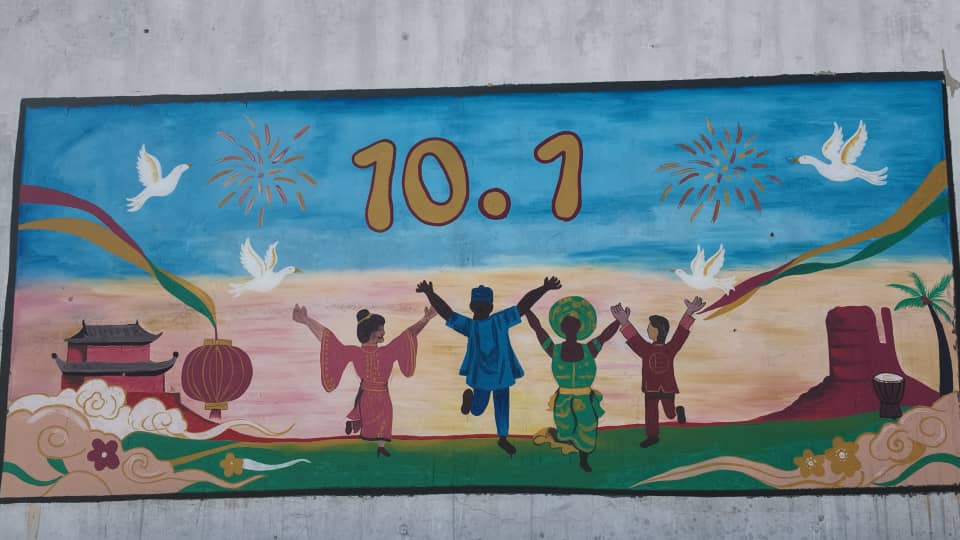
A colourful mural celebrating both China’s National Day and Nigeria’s Independence Day has been unveiled at an overseas project site, serving as a vivid symbol of the enduring friendship between the two nations.
The artwork, jointly produced by Chinese and Nigerian staff, features builders dressed in traditional Chinese costumes and Nigerian ethnic attire holding hands and dancing together.
Above them, fireworks and white doves of peace illuminate the sky, while the inscription “10.1” highlights the dual significance of October 1, the China’s National Day and Nigeria’s Independence Day.
On the left side of the mural, ancient Chinese architecture, red lanterns and auspicious cloud motifs showcase Chinese heritage.
On the right, red earth, coconut palms and African drums reflect Nigeria’s cultural identity. Flowing ribbons weave across the painting, symbolising unity and shared destiny.
Project officials described the mural as a “living testament” to cooperation at the frontline of development. They said it embodies mutual trust and support as workers from both countries overcome challenges together.
The initiative underscores cultural integration and partnership, with both sides pledging to continue working hand in hand to strengthen ties.
“Celebrating two festivals as one, we march forward with one heart,” a statement read, emphasising the commitment to write new chapters of friendship along the path of cooperation.
The mural, rooted in the overseas project site, stands as a reminder of the brotherly bond between China and Nigeria, and the shared vision of building together for a brighter future.

Emir Sanusi Seeks Compensation, Reallocation of Demolished Eid Ground Stalls

Gombe flags off the disbursement of the second batch of the AGILE Conditional Cash Transfer

Why Gov Abba Deserves Another Tenure

China, Nigeria Mark Friendship with Joint Cultural Mural

Musa Illiyasu Kwankwaso Celebrates Senator Lado @60, Says Is A Political Dogma

Zamfara Varsity ASUU Threatens Warning Strike Over FG-ASUU Agreement, Promotion Arrears

PCACC Arrests Man Over Alleged ₦4.5m Sale, Illegal Leasing of Kano Government Horse Stable

Goje’s Electoral War:The Confrontation With Tinubu,Governor Inuwa,Usman Kumo And APC candidates Ahead Of 2027

Prof Yusuf Adamu Delivers BUK’s 63rd Professorial Inaugural Lecture, Reflects on Medical Geography and Academic Legacy

Kano Monitors ₦48.9bn Projects Across Six LGAs
Emir Sanusi Seeks Compensation, Reallocation of Demolished Eid Ground Stalls
Gombe flags off the disbursement of the second batch of the AGILE Conditional Cash Transfer
Why Gov Abba Deserves Another Tenure
China, Nigeria Mark Friendship with Joint Cultural Mural
Musa Illiyasu Kwankwaso Celebrates Senator Lado @60, Says Is A Political Dogma
Zamfara Varsity ASUU Threatens Warning Strike Over FG-ASUU Agreement, Promotion Arrears
PCACC Arrests Man Over Alleged ₦4.5m Sale, Illegal Leasing of Kano Government Horse Stable
Goje’s Electoral War:The Confrontation With Tinubu,Governor Inuwa,Usman Kumo And APC candidates Ahead Of 2027
Prof Yusuf Adamu Delivers BUK’s 63rd Professorial Inaugural Lecture, Reflects on Medical Geography and Academic Legacy
Kano Monitors ₦48.9bn Projects Across Six LGAs
-
 Opinion5 years ago
On The Kano Flyovers And Public Perception
-

 Features5 years ago
How I Became A Multimillionaire In Nigeria – Hadiza Gabon
-

 Opinion6 years ago
Kano As future Headquarters Of Poverty In Nigeria
-
 History6 years ago
Sheikh Adam Abdullahi Al-Ilory (1917-1992):Nigeria’s Islamic Scholar Who Wrote Over 100 Books And Journals
-

 Opinion5 years ago
My First Encounter with Nasiru Gawuna, the Humble Deputy Governor
-

 History5 years ago
The History Of Borno State Governor Professor Babagana Umara Zulum
-
 History6 years ago
The Origin Of “Mammy Market” In Army Barracks (Mammy Ochefu)
-

 News5 years ago
Federal University Of Technology Babura To Commence Academic Activities September