
Opinion
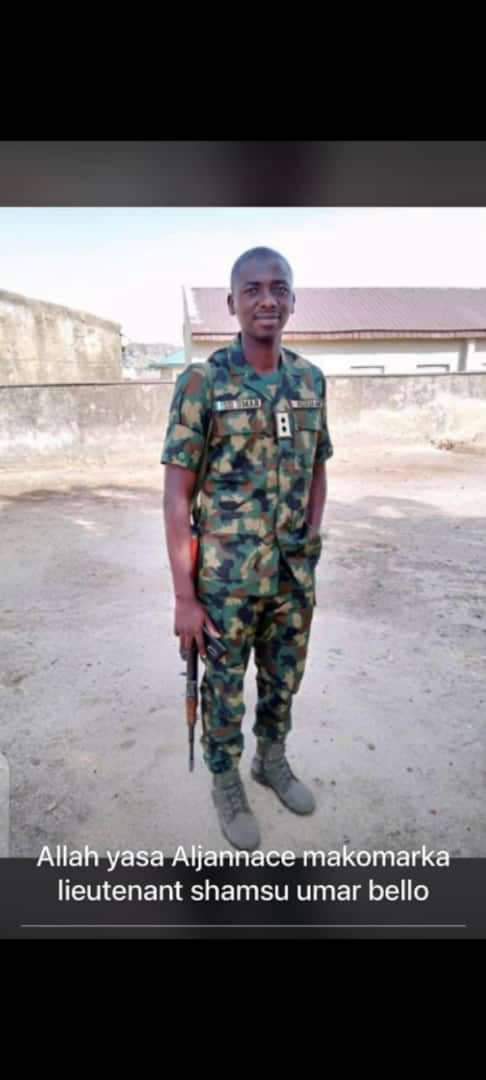
Tribute To LT. Shamsuddeen Umar Bello
By Mahmoud Ibrahim Bako
I have lost a friend, Lt. Shamsuddeen Umar Bello, a bosom friend, the most truely God-fearing youth I know. A very brilliant Academic and a military officer.
Right from the start in Primary school, he was calm and intelligent. We were all surprised when he said he will be going to the Nigerian Military School (NMS), as we thought the military was not for gentle men. Indeed he did not just remain a gentleman, but he became the most gentle of us all. Immediately we finished primary school. Himself and Auwal Isah (Daddy) got the highest score in our National Common Entrance Examination.
We all finished Secondary School and secured admission at ABU Zaria. He was a very hard-working student. We met everyday at Sulaiman Hall mosque and recited the Qur’an together for about two years, until I graduated, having studied a four year course. He was the best graduating student in his class and returned immediately for his M. Eng. Upon the completion of his masters degree, he was given appointment as a Lecturer at the Department of Water Resources, ABU Zaria but his boss at the Nigerian Army refused to release him because he liked him and adviced him to go to NDA and be regularized as an officer instead, having secured admission into the Nigerian Defence Academy around the same time.
Indeed I, and many others who receive his daily WhatsApp admonition messages will greatly miss him. It’s less than a year now that we attended his wedding at Yantumaki, Danmusa Local Government Area of Katsina State.
It was about two months ago that I saw him last, passing in his car, I called out his name and he stopped, his wife was sitting beside him in the front seat. We greeted very affectionately, as it was the first time we met, ever since he got married, as he was given pass of less than seven days to do his wedding preparation and ceremony. I never knew that it would be the last time I will meet with him in this mortal world.
Last night as I slept, I had a dream where I saw my late father, I was happy that I saw him but I woke up mournful. I never knew that by 7 am I will receive the news of the second most shocking death in my entire life but I am consoled that just like during the mourning of my father when everyone, either young or old who spoke about him would say: they have never seen someone who everyone, either friend or other wise agreed was a good man. like my late father, I bear witness that Shamsuddeen will receive similar testimony.
Last night before I went to bed, I saw a BBC Hausa news that said that some soldiers were attacked at the boarder between Katsina and Zamfara States. I never knew that I will be directly affected by the attack. Nigeria is loosing a lot of brilliant young men, whom parents and the government has spent so much to train. . We know there is nothing we can do to avert what Allah has destined to happen and we take solace in his mercy, we also know that in a war soldiers die but we know that alot of these casualties are directly the consequences of corrupt and incompetent leadership. Hundreds of billions are spent annually on security, yet there seems to be no end to the insecurity. Our military and police complain of having inferior weaponry compared to some non state actors. We have potbellied, clueless leaders that line their pockets with billions, as the young brilliant youth that represent the future of this country get masscred in droves.
Indeed, your life was a short but well lived one. Your fear of God, humility and hard-work have inspired many people to strive to be better. I for one, always admonished myself to be a better person by simply reminding you, even as you walked this Earth.
We are consoled even more when we remember the saying of the prophet Muhammad (SAW): once upon a time a group of people passed by him and his companions carrying a corpse. His companions praised the deceased and said how good he was, so the messenger of God said, Ameen. Another group passed by carrying a corpse and they derided the deceased as being a very bad person, and the messager of God said Ameen. So he informed his companions that when a person dies, Allah the almighty accepts what people say about them (as that represent who they were while on earth). I testify that you were the very best amongst us. When your time was finally up, you paid the supreme price in the service of humanity, for the sake of the hundreds of villages that have been sacked by bandits, for the sake of hundreds of thousands of people, young and old, women and children that have been made homeless, for the sake of mothers that have been made widows and children that have been made orphans. Indeed you are a matyr! and what a noble way to depart this world!
I pray Allah accepts your prayer in your final WhatsApp update where you prayed and said ” Oh Allah! I seek your pardon. Forgive my transgressions and take my life only when you are pleased with me. Amin ya Hayyu ya Qayyum” Ameen.
May Allah forgive you, my father and all the faithfull till the end of time.
Mahmud Ibrahim Bako,
An admirer and a true friend.













Opinion
Begging in Northern Nigeria: What Future Are We Preparing for Our Society?
By: Anas Idris Hassan
Street begging has become an increasingly familiar sight across Northern Nigeria. From busy markets and major roads to public spaces and mosque entrances, children, young people, elderly persons and even able-bodied adults can be seen asking passers-by for money and food. What was once largely associated with extreme hardship and temporary distress is gradually becoming a way of life for some families and communities.
This development raises an important question: What kind of society are we preparing for the next generation if begging becomes a normal means of survival?
This is not an argument against helping the poor or showing compassion to people facing difficult circumstances. Poverty, disability, illness, unemployment and displacement are genuine problems. People experiencing these challenges deserve support, dignity and understanding. However, we must also recognize the danger of allowing street begging to become a permanent occupation, particularly for children and young people who should be in school, learning a trade or developing skills that will help them become independent.
One of the greatest concerns is the effect of prolonged dependence on people’s attitudes towards work, responsibility and self-reliance. A child who grows up watching adults earn money through begging may eventually accept it as a normal way of life. Similarly, a young person who becomes accustomed to receiving daily handouts without access to education, vocational training or employment opportunities may find it increasingly difficult to pursue other means of earning a living.
Over time, this situation can weaken the desire to acquire skills, establish a business, seek employment or take responsibility for one’s future. Not everyone who begs is unwilling to work. Many people are victims of circumstances beyond their control. But when begging becomes normalized among those who could otherwise be supported into productive activities, society must ask whether it is providing solutions or simply allowing dependency to continue.
The situation is particularly troubling when children are involved. Childhood should be a period of learning, protection and development. Yet many children spend their days moving between streets, markets and public places in search of money. This exposes them to abuse, exploitation, physical danger, harmful influences and health risks. It also deprives them of valuable time that should be spent receiving formal education, learning practical skills and developing under proper parental supervision.
No child should be expected to provide for their own upkeep through street begging when parents, guardians and relevant institutions have a responsibility to protect their welfare.
Another concern is the increasing number of young people who appear physically capable of working but depend on begging as their primary means of survival. Northern Nigeria has a large population of energetic and talented young people. Many could develop useful skills in carpentry, welding, tailoring, electrical installation, motorcycle repairs, modern agriculture, construction and digital technology.
Not everyone will secure a government appointment or find employment in a corporate organization. However, the absence of formal employment does not mean there are no other opportunities to earn an honest living. What is needed is greater investment in vocational education, mentorship, access to tools, small-business support and practical training that prepares young people for economic participation.
Governments, private businesses, traditional institutions and community leaders must work together to create these opportunities. Rather than allowing young people to depend indefinitely on charity, we should help them acquire the skills and resources needed to support themselves and their families.
The consequences of ignoring this problem could be serious. Children who grow up without adequate education or vocational skills may struggle to escape poverty and eventually pass the same conditions on to their own children. The economy also loses when large numbers of young people remain outside productive activities. More importantly, a society that fails to prepare its young people for meaningful work risks losing future entrepreneurs, professionals, innovators and community leaders.
Islam offers important guidance on this issue. It encourages honest labour, self-respect, generosity and responsibility towards people in genuine need. The Prophet Muhammad (peace be upon him) taught that the giving hand is better than the receiving hand and discouraged asking others for assistance without genuine necessity.
In a narration recorded in Sahih Muslim, Hadith 1044, the Prophet (peace be upon him) explained to his Companion Qabisa ibn Mukhariq that seeking assistance is permissible in three particular circumstances: when someone takes on a financial obligation to reconcile a dispute, when a person’s wealth is destroyed by a calamity, and when someone experiences extreme poverty that credible members of the community can confirm.
The lesson is not that society should abandon people who need help. Rather, Islam recognizes genuine hardship while discouraging the exploitation of public generosity. Charity remains an important act of worship, but it should be guided by wisdom and directed towards people who genuinely need it.
There is also a need to clarify a common misunderstanding surrounding Almajirci in Northern Nigeria. Almajirci and begging are not the same thing. Almajirci is traditionally associated with the pursuit of Qur’anic education under the guidance of an Islamic scholar, while begging involves soliciting money or food from others.
Seeking Qur’anic knowledge is a noble undertaking and should not be treated as a social problem in itself. Many Almajiri students receive proper support from their parents and guardians and do not depend on street begging. Likewise, not every child found begging on the streets is an Almajiri.
The problem arises when children are sent away for religious education without adequate arrangements for their food, clothing, accommodation, healthcare and general welfare. When such children are left to fend for themselves through street begging, the issue becomes one of neglect and child protection.
We must therefore stop blaming the entire Almajiri system for every instance of street begging. At the same time, religious education must never become an excuse for neglecting children’s basic needs.
Parental responsibility is another important part of this discussion, particularly the responsibility of fathers. Fatherhood involves much more than bringing children into the world. It includes providing food, clothing, shelter, healthcare, education and moral guidance.
Allah says in the Qur’an, Surah At-Tahrim, verse 6:
“O you who have believed, protect yourselves and your families from a Fire…”
In Surah Al-Baqarah, verse 233, Allah also emphasizes the father’s responsibility for provision and clothing according to what is reasonable.
These teachings remind us that raising children is a serious responsibility. It is difficult to justify a situation in which an able-bodied father remains idle while his young children spend their days begging on the streets. Similarly, sending a child to a Qur’anic teacher without making arrangements for the child’s basic needs raises serious concerns.
Children should not be made responsible for financing their own upkeep through begging, and money collected by children on the streets should never become a regular source of household income.
Of course, not every struggling parent is irresponsible. Many families face unemployment, rising living costs, illness and other difficult circumstances. Such families deserve understanding and support. However, parents who are capable of providing for their children must not transfer that responsibility to the public.
Addressing street begging requires more than criticism. It requires practical action from governments, parents, religious leaders, traditional rulers, civil society organizations and ordinary citizens.
First, governments in Northern Nigeria should invest more in vocational training centres where young people can learn practical trades and receive the tools and support needed to establish themselves. Training should not end with the acquisition of certificates. Graduates need access to equipment, mentorship, funding and opportunities to earn an income.
Second, authorities and community leaders should establish proper welfare arrangements for Qur’anic students. Such arrangements should guarantee access to food, clothing, safe accommodation, healthcare and protection from exploitation.
Third, local governments, religious institutions and charitable organizations should develop reliable systems for identifying people facing genuine hardship. Orphans, people living with disabilities, elderly persons without support, widows and families experiencing extreme poverty should receive targeted assistance.
Fourth, charitable giving should be better organized. Rather than limiting assistance to handing money to children on the streets, individuals and organizations can sponsor education, support vulnerable families, provide vocational equipment and contribute to properly managed welfare programmes.
Fifth, government agencies must strengthen child protection measures, investigate cases of child exploitation and develop rehabilitation programmes for vulnerable children. Simply removing beggars from major streets without addressing the reasons they are there will not solve the problem.
Religious scholars also have an important role to play. Their influence in Northern Nigerian communities gives them an opportunity to educate people about the dignity of work, parental responsibilities, the proper treatment of children and the Islamic distinction between seeking assistance in genuine hardship and making begging a permanent occupation.
The wider community must also rethink how it supports people in need. Helping the poor is a responsibility we should never abandon. However, our assistance should go beyond temporary relief wherever possible. We should help people acquire education, skills and opportunities that enable them to live with dignity and independence.
Young people must also be encouraged not to surrender their future to dependency. Those who have the ability to learn, work and develop useful skills should be supported to do so. Their circumstances today should not determine the rest of their lives.
Ultimately, the kind of Northern Nigeria we should aspire to is one where children are in classrooms rather than spending their days begging on the streets; where young people acquire skills, establish businesses and create employment; where Qur’anic students receive proper care and education; and where parents take pride in their children’s learning, character and achievements.
We need a society that supports people facing genuine hardship while creating opportunities for those capable of working. These two responsibilities should never be treated as competing priorities.
Begging itself is not the only problem. Our greater challenge is the failure to address the conditions that allow it to become a permanent way of life. We must fight poverty without humiliating the poor, protect children without undermining religious education, and encourage self-reliance while ensuring that genuine opportunities exist.
Northern Nigeria does not need a society that turns its back on the poor. It needs one that protects the vulnerable, educates its children, equips its young people and gives everyone a fair opportunity to earn a living with dignity.
The future of our society will depend on the choices we make today.
Anas Idris Hassan
Kano, Nigeria
Email: binmalikh@gmail.com
Phone: +234 803 414 0637
Opinion
Kano’s War On Drugs: How Barr. Muhyi’s Taskforce Is Changing The Game
By Muhammad Abubakar Suleiman
When Governor Abba Kabir Yusuf declared a public health emergency on drug abuse on July 22, 2026, and inaugurated the Multi-Agency Task Force on Drug Abuse and Illicit Trafficking, many in Kano saw it as another committee. Three months later, the committee led by Barrister Muhyi Magaji Rimin Gado is dominating security headlines in the state.
The Taskforce was constituted as a multi-agency platform bringing together NDLEA, Police, DSS, Consumer Protection Council, Pharmaceutical Society, Ministry of Health, Anti-Daba Unit and other stakeholders. Dr. Ibrahim Garba Muhammad serves as Secretary.
From Raids to Results: Over 400 Arrests
According to briefings by the Chairman, within the first two months the Taskforce arrested more than 380 suspects and secured over 230 convictions. By September 29, when Barr. Muhyi spoke at the Kano Network of NGOs (KANET) Monthly Lecture at Nasarawa GRA, the figure had risen to over 400 arrests.
Presenting its scorecard to the State Executive Council in late September, the Taskforce reported a 35% reduction in drug-related crimes in the last three months, attributing it to intensified enforcement, seizures and over 500 convictions as of October 22.
Operations have focused on identified hotspots: Race Course, Filin Idi, Filin Mahaha, Tashar Rami, Kawo, Tashar Rimi, Jakara, Madigawa, Yalwa, Sanka, Kul Kul, Dogon Nama and Kukar Bulukiya.
Recoveries include Cannabis Sativa, Tramadol, Diazepam, Pentazocine, Pregabalin, Exol-5 and a Methamphetamine-based designer drug. In one case, 870,000 capsules of Pregabalin were seized from a pharmaceutical company over suspected diversion. Local weapons – knives, daggers, cutlasses and clubs – used by gangs were also recovered.
The Taskforce also recorded high-profile arrests. On August 18, it announced the arrest of a former Chairman of Rogo Local Government for allegedly selling and administering fentanyl injections to youths, after a victim who spent over N2 million on injections identified him.
Latest: Gang Sponsor Tracked to Port Harcourt
In its most recent operation, the Taskforce announced on October 30 the arrest of a 27-year-old suspected gang violence sponsor, Ishaq Lawan Ibrahim, popularly known as Malam Keya, from Yalwa in Dala LGA.
According to the committee, Malam Keya was allegedly financing violent clashes by rival Daba gangs in Dala that claimed lives. He fled to Port Harcourt, Rivers State, after crackdown intensified, but was tracked and arrested in an operation led by Head of Operations, CSP Bashir Gwadabe, and brought back to Kano. He is now in police custody pending prosecution.
Chairman Muhyi said the arrest outside Kano shows the Taskforce will pursue suspects beyond state boundaries.
Beyond Enforcement: Children, Rehabilitation and Technology
The committee says its mandate is not just enforcement. It reported rescuing 43 underage children allegedly exposed to intoxicants and convicting two dealers – Kabiru Isa and Usman Hamisu – for the offence. About 125 persons were referred to the Kano Reformatory Institute in Kiru for rehabilitation. With Kiru overstretched, government has provided an additional facility in Tofa.
The Taskforce has set an ambitious target of taking 10,000 youths off the streets for rehabilitation, skills acquisition and reintegration.
On August 21, Barr. Muhyi inaugurated nine sub-committees to professionalize the fight: Finance; Media and Publicity; Advocacy and Sensitisation; Licences, Inventory and Verification; Compliance, Inspection and Electronic Tracking; Monitoring and Implementation; Intelligence; Reformative and Traditional Council; and Anti-Drug Coordination.
Tech Turn: AI, 24-Hour Line and NDLEA Support
In the last two weeks, the Taskforce unveiled a new approach. On October 22, Barr. Muhyi, on behalf of Governor Yusuf, donated operational equipment to the NDLEA Kano Strategic Command led by Commander Dahiru Yahaya Lawan, to boost operations.
He also disclosed that Kano is deploying Artificial Intelligence for surveillance and tracking of suspected dealers, and equipping a rapid-response centre with ICT and a 24-hour toll-free line where residents can report and get response within 30 minutes.
At KANET lecture themed “Kano Drugs Crisis: Challenges, the Way Forward and the Role of the Community,” Muhyi stressed community intelligence and called for more rehabilitation to decongest remand homes.
No Sacred Cows
From day one, Barr. Muhyi has maintained a hard line on political interference. “No politician can pressure me to free drug suspects. The only person who can stop me is the Governor, and I know he will never interfere,” he told journalists on July 28.
That stance, coupled with intelligence-led raids, has earned the Taskforce both praise and scrutiny.
The Bigger Picture
Kano Police data cited by the Taskforce indicates about 70% of major crimes in 2025 were linked to drug abuse. The Executive Order outlawing Daba gangs provides a minimum of five years imprisonment under Section 97A of the Kano Penal Code.
Whether the Taskforce can sustain momentum will depend on three tests: securing the drug supply chain from pharmaceutical diversion, expanding rehabilitation beyond Kiru, and maintaining inter-agency cooperation without becoming a parallel enforcement body.
For now, in the markets of Filin Idi and the streets of Dala, residents say the presence of the committee is being felt.
Opinion
The Reward For Hardwork Is More Work: A Rejoinder To Dr Garba Ubale Danbatta
By Nworisa Michael
The redeployment of Hon. Comr. Ibrahim Abdullahi Waiya PhD from the Ministry of Information and Internal Affairs to the Ministry of Youth and Sports Development has attracted several reactions. While professional and civic organisations have congratulated him and acknowledged his contributions, Dr Garba Ubale Danbatta, a supposedly veteran journalist, has chosen to use the development to question his performance and professional conduct in his former ministry.
Dr Danbatta is entitled to his opinion. Nobody should be above criticism, especially in public office. However, when criticism is presented as a professional assessment, it should be supported by facts, not merely personal convictions or years of experience.
Before concluding that journalism suffered under Waiya, perhaps we should examine some of the developments recorded during his tenure.
Eight contributions worth considering:
• Grassroots information: Strengthened engagement with Information Officers across Kano’s 44 local government areas and eight zonal offices.
• Capacity building: Supported training programmes for local government Information Officers, alongside interactive engagements with editors and news managers.
• Media policy: Facilitated the inauguration of an 18-member committee to develop a media and information policy framework for Kano State.
• Digital transformation: Established a Digital Multimedia Department to modernise government communication, improve digital engagement and address misinformation.
• Peacebuilding: Advanced the Safe Corridor Project, an initiative focused on rehabilitation, skills development and reintegration of reformed youths.
• Media engagement: Engaged media practitioners, online publishers and political programme presenters on responsible public communication and professional conduct.
• Institutional development: Pursued interventions aimed at strengthening state-owned media institutions and improving the capacity of personnel within the information machinery.
• National recognition: Received the Crisis Communicator of the Year award at the 2026 National Spokespersons Awards in Abuja.
These developments do not mean that Waiya’s tenure was without shortcomings. They simply demonstrate that there is more to his record than the sweeping conclusion offered by his critic.
There is also something interesting about the public reactions to his redeployment. The Kano State Forum of Information Officers, Northern Youths Assembly and International Peace and Secure Society are among the organisations that have publicly acknowledged his contributions and congratulated him on his new assignment. Their statements may not settle every debate about his tenure, but they show that his work was not viewed negatively by everyone who interacted with his ministry.
Now, to Dr Danbatta’s presentation of his professional experience.
I found it rather curious that a commentary intended to assess another public officer’s performance devoted three of its concluding paragraphs to the author’s own professional journey, positions held and years of experience. One could almost finish reading the piece knowing more about the author’s resume than the evidence behind his criticism of Waiya.
Same individual who has been unable to ensure good working relationship with his staffs at Pyramid Radio Kano where is currently serves as its manager, a station that constantly runs out of diesel and goes off the air, perhaps even he isn’t proud of this hence he left it out from the list of his workplaces listed.
With due respect, professional experience is valuable, but it should strengthen an argument, not become the argument itself. A good product sells itself. A journalist’s professional standing should be reflected in the quality, fairness and depth of their analysis. Thirty years in the profession deserves recognition, but it does not automatically make every opinion conclusive.
If the intention was to assess Waiya’s stewardship, then the more important questions should have been: What did he inherit? What did he change? Which initiatives did he introduce? What measurable outcomes were achieved? And where did he fall short? Those are the questions that give criticism substance.
We can be safe to say that Waiya’s redeployment was a direct reward for his performance in the former ministry. The Governor has publicly explained the cabinet adjustments as part of efforts to strengthen institutions and improve service delivery. What is evident, however, is that Waiya has been entrusted with another important responsibility, and his record in the former ministry remains open to public examination.
The Ministry of Information and Internal Affairs is not beyond criticism, and neither is Dr. Waiya. But fairness requires that we acknowledge the work done alongside the shortcomings alleged.
Frankly the most fitting way to understand this new assignment is captured in the title of this piece: the reward for hard work is more work. His previous assignment is now part of his public record; his new ministry presents another opportunity to serve.
Congratulations, Hon. Comr. Ibrahim Abdullahi Waiya. The expectations continue.
Nworisa Michael is a
Writer, Public Affairs Commentator and writes from nworisamichael1917@gmail.com
1st Nov. 2026

The Political Awakening:Why Nigeria Needs More Youth Participation In Governance- Zubair -A -Zubair

Sen. Kalu Admits Selling Heavy Weapons to Any Buyer

NDC Deputy Governorship Candidate Gives Kano Information Commissioner 48-Hour Ultimatum Over Alleged Defamation

HFN Threatens Kano Govt with Fine, Over Pillars’ Absence from Handball Premier League

Court Battles May Dismantle Opposition Ahead of 2027, Lawyer Warns

Kano Monitors ₦48.9bn Projects Across Six LGAs

Open The Social Sciences “A Tribute to a Heterodox Scholar: Mallam Ibrahim Muazzam

Senate Passes Barau’s Bill to Provide Legal Framework for Yusuf Maitama Sule Federal University of Education, Kano

Gov. Yusuf Appoints Inuwa Waya Director of International Corporations Engagement

Emir Sanusi Seeks Compensation, Reallocation of Demolished Eid Ground Stalls
The Political Awakening:Why Nigeria Needs More Youth Participation In Governance- Zubair -A -Zubair
Sen. Kalu Admits Selling Heavy Weapons to Any Buyer
NDC Deputy Governorship Candidate Gives Kano Information Commissioner 48-Hour Ultimatum Over Alleged Defamation
HFN Threatens Kano Govt with Fine, Over Pillars’ Absence from Handball Premier League
Court Battles May Dismantle Opposition Ahead of 2027, Lawyer Warns
Kano Monitors ₦48.9bn Projects Across Six LGAs
Open The Social Sciences “A Tribute to a Heterodox Scholar: Mallam Ibrahim Muazzam
Senate Passes Barau’s Bill to Provide Legal Framework for Yusuf Maitama Sule Federal University of Education, Kano
Gov. Yusuf Appoints Inuwa Waya Director of International Corporations Engagement
Emir Sanusi Seeks Compensation, Reallocation of Demolished Eid Ground Stalls
-

 Opinion5 years ago
On The Kano Flyovers And Public Perception
-

 Features5 years ago
How I Became A Multimillionaire In Nigeria – Hadiza Gabon
-

 Opinion6 years ago
Kano As future Headquarters Of Poverty In Nigeria
-
 History6 years ago
Sheikh Adam Abdullahi Al-Ilory (1917-1992):Nigeria’s Islamic Scholar Who Wrote Over 100 Books And Journals
-

 Opinion5 years ago
My First Encounter with Nasiru Gawuna, the Humble Deputy Governor
-
 History5 years ago
The History Of Borno State Governor Professor Babagana Umara Zulum
-
 History6 years ago
The Origin Of “Mammy Market” In Army Barracks (Mammy Ochefu)
-
 News5 years ago
Federal University Of Technology Babura To Commence Academic Activities September