
Opinion
A Governor on Guard: Gov. Yusuf’s Renewed Resolve to Secure Kano’s Frontline Communities
By Ibrahim Adam
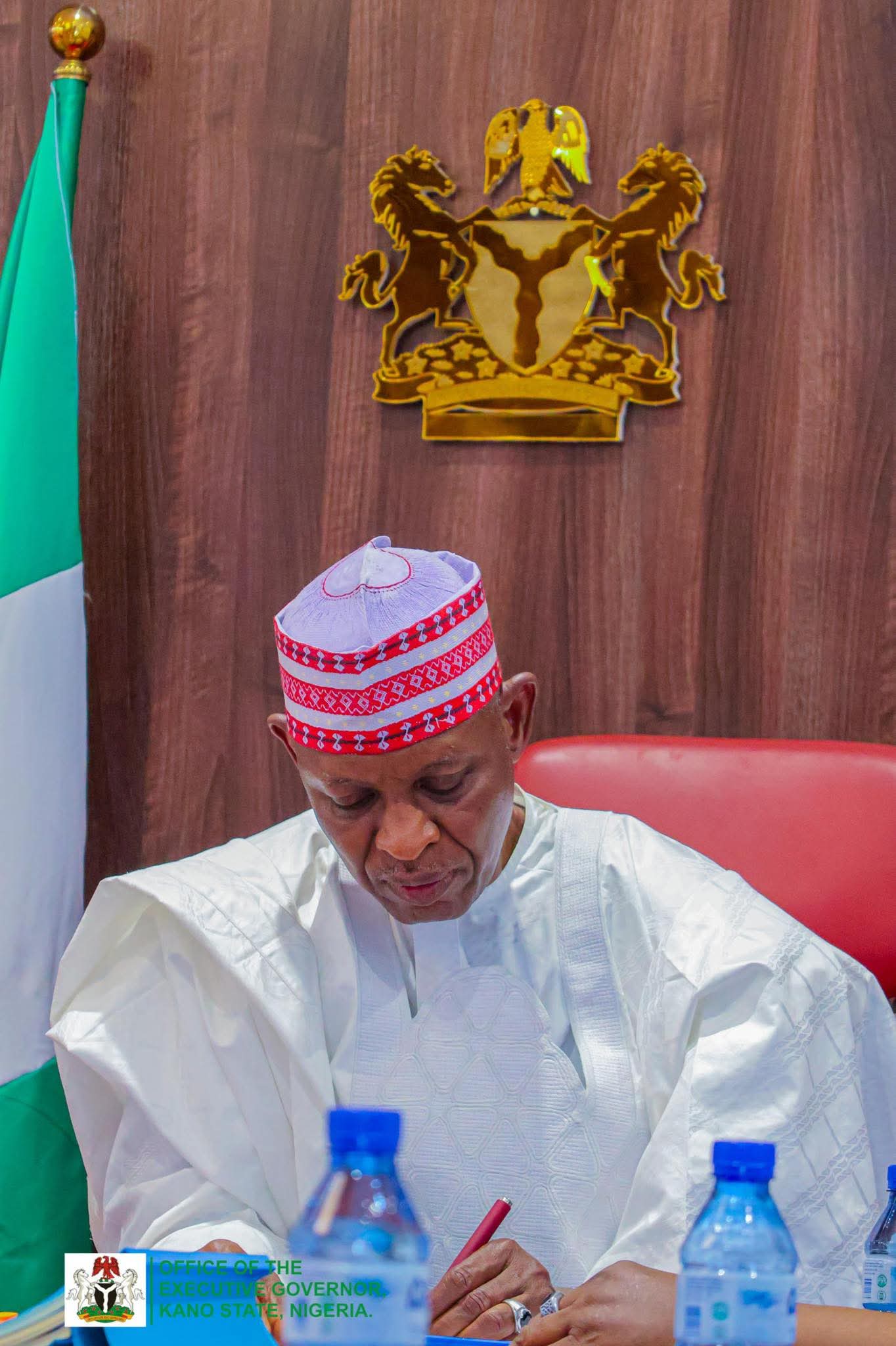
Kano State has witnessed yet another powerful demonstration of leadership as Governor Alhaji Abba Kabir Yusuf made a bold move to strengthen security operations across the state with the release of 10 vehicles and 50 motorcycles to the Joint Task Force (JTF).
The gesture, though simple in appearance, reflects a deeper commitment: a governor fully aware of the security realities confronting his people and fully determined to confront them head-on.
Governor Yusuf has consistently placed security at the center of his administration’s priorities.
Those close to him often describe his approach as proactive, people-focused, and deeply empathetic.
He is known to receive security briefings late into the night, scrutinizing reports, asking questions, and pushing for solutions that will have direct impact on vulnerable communities.
This latest intervention equipping the JTF with new mobility assets showcases the seriousness with which he views emerging threats, especially in frontline Local Government Areas such as Kiru, Tsanyawa, Kunchi, Ghari, Shanono, Tudun Wada, and Doguwa.
These regions, known for their vast farmlands and dispersed settlements, require strong, flexible, and responsive security operations.
To the governor, these areas are not just dots on a map; they are homes to thousands of families whose safety he considers a personal duty.
A Strategic Boost to Security Agencies
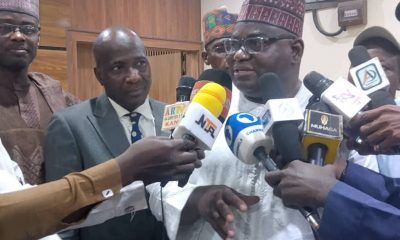
The handover ceremony at Government House, Kano, brought together representatives of the state’s top security institutions.
The presence of officials from the Nigeria Police Force, Department of State Services (DSS), Nigeria Security and Civil Defence Corps (NSCDC) and several Local Government Chairmen symbolized a united security front one guided by a leader who believes that collaboration is essential to peace.
Presenting the allocation letter on behalf of the Director General, Special Services, Major General Sani Muhammad (rtd), the Director, Special Services, Umar Baba Zubairu, highlighted that the vehicles and motorcycles would significantly enhance the JTF’s mobility, visibility, and patrol capabilities.
Why This Intervention Matters Now
Security challenges across northern Nigeria continue to evolve.
Criminal elements often exploit remote terrains, poor road networks, and slow response times. In such environments, mobility is everything.
The donation of vehicles and motorcycles is therefore a strategic response to a very real operational need.
Vehicles allow for sustained patrols, transportation of personnel, and reinforcement during operations.
Motorcycles, on the other hand, can reach places inaccessible to larger vehicles narrow pathways, forest areas, and difficult terrain where criminals sometimes hide or escape through.
By providing these tools, Governor Yusuf is enabling the JTF to not only monitor and prevent attacks but also restore confidence among rural residents whose livelihoods depend on safe access to farms, markets, and schools.
A Track Record of Commitment
This is not Governor Yusuf’s first major security intervention.
In November 2024, he donated 78 operational vehicles to the state police a widely applauded move that significantly improved policing capacity across Kano.
The latest allocation to the JTF continues this pattern: a consistent, deliberate effort to empower security forces and ensure that no community feels neglected.
Under Governor Yusuf, security is not reactionary; it is continuous, targeted, and adaptive.
Bringing Government Closer to the People
Beyond logistics, the governor’s actions reflect a philosophy: governance must be felt.
Particularly in rural communities where insecurity can quickly erode trust in public institutions, the presence of patrol vehicles, motorcycles, and armed personnel reassures residents that they are not alone.
Farmers in Tsanyawa, traders in Kunchi, women and children in Tudun Wada, and the youth in Doguwa will now see increased security presence, a visible sign that their welfare matters deeply to the man leading the state.
Local leaders who attended the ceremony described the governor’s gesture as “timely, thoughtful, and deeply appreciated.”
A Governor Who Leads From the Front
Those familiar with the governor’s leadership style often highlight his hands-on approach.
He is not one to shy away from tough decisions. Whether during crises, infrastructural challenges, or strategic planning, Governor Yusuf has earned a reputation for being bold, decisive, and calm under pressure.
Security, however, is where his resolve shines brightest.
He understands that a peaceful Kano is vital not only for daily life but also for economic growth, agricultural development, and the proper functioning of schools, markets, transport services, and businesses.
A governor who cares about development must first care about safety and Governor Yusuf has embodied that principle.
Renewed Hope for Communities
For many residents of the affected LGAs, this development represents more than government support.
It is a revival of hope, hope that villages will become safer, that movement will be freer, that children can go to school without fear, and that farmers can return to their fields with confidence.
It also sends a powerful message to criminals: the state is watching, the state is capable, and the state is ready.
A Vision of a Secure, Prosperous Kano
As Kano enters a crucial phase of development, from education and healthcare reforms to infrastructure renewal Governor Yusuf is making it clear that none of these will be meaningful without peace and stability.
His efforts to strengthen the JTF fit into a broader vision of a secure, unified, and prosperous Kano.
A Kano where investors feel confident, where young people can pursue opportunities without fear, and where every citizen in the city center or at the edge of the state shares equally in the safety and progress promised by democracy.
In the end
Governor Abba Kabir Yusuf’s latest intervention is a powerful testament to his deep concern for the security challenges facing Kano State.
It reflects his unwavering resolve to confront these threats with courage, strategic planning, and sustained support for security agencies.
Through deliberate action and genuine empathy for the people he serves, the governor continues to prove that leadership is not merely about holding office it is about protecting the lives entrusted to one’s care.
With strengthened JTF operations across frontline communities, Kano is charting a clearer path toward peace and stability led by a governor truly on a mission to secure his people and rewrite the state’s security story.
Ibrahim Adam is Special Advisor to Kano governor on Information writes form Kano






Opinion
OPINION:Bauchi ,A Paradise for Immunity Seekers? How Alleged Corrupt Politicians Are Eyeing Government House
By Haroon Mustapha
For the attention of His Excellency Asiwaju Bola Ahmed Tinubu, GCFR, President and Commander-in-Chief of the Armed Forces of the Federal Republic of Nigeria
If two-term presidential politics is a game of two halves, then the first term is when a President sets direction, lays foundations, and begins to redirect the country toward a brighter future. The second term is when those gains are consolidated, the larger vision is executed, and a lasting legacy is secured. The ‘BAT’ are positioned to become the halcyon period that repositions Nigeria regionally and internationally: no longer the tired story of a nation defined only by potential, but the 21st-century story of a country that converts potential into tangible national benefit.
That is precisely why Bauchi, like every other state in the federation, must not be allowed to become a paradise for immunity seekers. Past executive failure must not be recycled. Allegations of criminality must not be politically laundered. Questions over allegedly siphoned NNPC funds, allegations of procurement abuse, and claims touching on banditry or terrorism financing must not simply be brushed aside while Bauchi misses a genuine opportunity to reposition itself as a hub for tourism, agricultural investment, and strategic solid-mineral development under your second term.
Few tactics in politics are as cynical as the rush for constitutional immunity. Under Section 308 of the 1999 Constitution, as amended, governors are protected from civil and criminal proceedings while in office. For some Bauchi politicians, the timing of their ambition raises serious questions. With lingering allegations from their time in the civil service or in federal appointments, the governorship can appear less like a platform for service and more like the ultimate constitutional shield. Reports in the public domain describe individuals investigated or charged by the Economic and Financial Crimes Commission (EFCC) or the Independent Corrupt Practices and Other Related Offences Commission (ICPC) repositioning themselves as leaders seeking the people’s mandate not necessarily to serve, but, critics argue, to evade accountability. Whatever language such actors now deploy, the public record cannot simply be wished away. This playbook risks turning Bauchi into a haven for immunity seekers, weakening public trust, undermining good governance, and damaging the wider reform legacy your administration seeks to build.
The most obvious example is the current governor, Senator Bala Abdulkadir Mohammed. Before his election in 2019, Mohammed, a former Minister of the Federal Capital Territory, had faced EFCC scrutiny. The anti-graft agency publicly stated that he “was standing trial for money laundering at the time he won election as governor of Bauchi State. Only the constitutional immunity from prosecution, which his current office attracts, has put that case in abeyance.” EFCC statements issued earlier this year reiterated that position and linked the matter to his prior public roles. More recently, his administration has also come under fresh EFCC scrutiny involving aides charged with money laundering and terrorism financing, with his name reportedly appearing in court filings. Governor Mohammed has dismissed these developments as political persecution. Critics, however, argue that his 2019 governorship bid was timed, at least in part, to take advantage of constitutional immunity. Whether one accepts the EFCC’s account or the governor’s defence of a witch-hunt, the optics remain troubling: public office appears, at minimum, to have functioned as a route away from immediate accountability.
Now a section of Bauchi’s political elite is reportedly positioning Dr Bala Maijama’a Wunti as Governor Mohammed’s preferred successor ahead of the 2027 elections. That prospect raises a profound question: is this confidence, or the entitlement of a political class that believes public memory is short and can be manipulated? In today’s world, alleged misconduct in public office does not remain hidden. It is documented, debated, and permanently available for scrutiny. Public commentary on social media, local reporting, and Wunti’s own political signals increasingly frame him as Mohammed’s preferred successor, with consultations inside APC structures reportedly already under way. Some accounts further suggest a wider political bargain in which Governor Mohammed could defect from the PDP to the APC, secure the APC senatorial ticket for Bauchi South, and see his Commissioner of Finance, Yakubu Adamu, who is currently facing EFCC charges of money laundering and terrorism financing at the Federal High Court, emerge as Wunti’s running mate. If such a transition were realised, it would align Bauchi’s leadership succession with the ruling party, smooth Wunti’s path, and preserve Mohammed’s political relevance.
Dr Wunti is a career public servant who served in the Nigerian National Petroleum Company Limited. He joined in 1994 and rose through the ranks to hold several senior positions, including Production Programming Officer, Group General Manager of Corporate Planning and Strategy, Managing Director of the Petroleum Products Marketing Company, and, crucially, Group General Manager of the National Petroleum Investment Management Services from 2020 to 2025.
In his final stint at NNPC, he served as Chief Health, Safety and Environment Officer before retiring in June 2025. Since then, he has increasingly been mentioned as a leading contender for the governorship of Bauchi State.
However, as in the case of Bala
Mohammed in 2019.
Groups such as the Concerned Citizens of Nigeria, the Community Development Committee, and the Citizens Watch Coalition petitioned the EFCC and the National Assembly for investigation, citing what they described as more than 10 incidents of fraud and abuse of office. A 2025 petition to the EFCC reportedly renewed demands for a formal probe. Wunti has not been convicted of any offence, and his defenders have dismissed the allegations as blackmail and baseless claims unsupported by probative evidence. Even so, the accumulation of petitions and media reports has kept the allegations in public view. As he is now discussed as a possible APC governorship candidate in Bauchi, critics see a familiar pattern: a senior federal technocrat under heavy public scrutiny moving toward an office that carries constitutional immunity.
Mr President, you have presented yourself as a bold reformer willing to take difficult decisions that previous administrations avoided. Your economic reforms have marked a clear departure from decades of fiscal complacency. The removal of the fuel subsidy shortly after your inauguration in 2023, though politically risky, ended a long-standing drain on public resources and will remain one of the defining decisions of your presidency.
The unification of exchange rates and the floating of the naira signalled a return to market discipline. Non-oil revenue performance, debt-service relief, GDP recovery, and rising external reserves have all been cited as evidence that your administration is pursuing a serious reform agenda. Additional efforts in civil-service reform, institutional restructuring, regional security cooperation, and infrastructure build-out have reinforced the image of a government trying to reset the Nigerian state. That is precisely why the company your administration keeps matters so much.
The people of Bauchi are tired of unrealised potential. They are tired of youth unemployment, weak primary healthcare, underdeveloped tourism assets, and a state economy that has not matched its promise. Bauchi can be a food basket for the North. It can become an engine room for value-added solid-mineral development. It can attract investment in agriculture, logistics, and tourism. These aspirations fit naturally within your stated vision of a stronger, more economically stable Nigeria built on sustainable growth, institutional integrity, and reduced corruption. But they cannot be realised if the state is captured by political actors whose primary instinct is self-preservation rather than public service.
Mr President your brand rests on reformist credibility: ending unsustainable subsidies, blocking fiscal leakages, and projecting administrative seriousness. Embracing figures with unresolved EFCC-level baggage carries obvious reputational risks. Public perception matters. Global perception matters. If Bauchi’s succession narrative hardens around Wunti amid contract-fraud petitions, and if that process is linked to a wider political accommodation involving Governor Mohammed, it will invite the charge that the ruling party is providing political cover to individuals facing grave allegations. In that scenario, isn’t Bauchi being conned once again?
Mr President, your legacy is not to be built on GDP numbers alone. It is also built on the company one keeps and the precedents one sets. Any association with politicians who appear, in the public mind, to treat the governorship as a get-out-of-jail card risks diluting the narrative of national renewal. It would also feed the perception that the APC is becoming a vehicle for elite protection rather than public service. In Bauchi specifically, the elevation of Wunti despite the allegations tied to his NAPIMS years, even if those allegations have not been proven in court, would send a dangerous signal: that political usefulness can override transparency concerns. Nigerians across the country would then be entitled to ask whether this is truly the new Nigeria your administration promises, or merely the old order dressed in reformist language.
Bauchi State’s political elite must decide whether shielding individuals facing serious public allegations serves the people or merely perpetuates a cycle of impunity. The impunity of the entitled. Mr President, you have staked your place in history on economic courage; you now face a parallel test of political consistency. Enduring legacy demands reform without selective blindness to corruption. Allowing Bauchi to become an immunity paradise would not only betray the people of the state; it could also stain the broader reform project your administration has diligently advanced. The 2027 contest will test whether substance prevails over political shelter, or whether the governorship remains a golden ticket for those with unfinished business before anti-corruption agencies. Nigerians deserve better than a state run as a refuge from accountability.
We remain guided by you, Mr President.
Mustapha, wrote from Bakin Kura Street, Bauchi
Opinion
Why All Hues, Cries Against Garo?
By Abba Anwar
First and foremost, it is against the very philosophy and principle behind the formation of All Progressives Congress (APC), from day one, an amalgamation of different political interests coming together with a common goal and purpose. To uproot the then party in power, People’s Democratic Party (PDP).
That philosophy, that principle, should be maintained across board, as the party, APC, has been on the throne for over a decade now. It was the breakaway from the original philosophy, that played an important role in pushing the party to where it is now, in Kano state.
It was made public that there were controversial allegations of diverting public funds between 2020 and 2023, totalling N57,433,981,816.00, which subsequently led to the prosecution of the former Commissioner for Local Governments and Chieftaincy Affairs, and Deputy Gubernatorial candidate for 2023 election in Kano, His Excellency Murtala Sule Garo, by the Kano State Public Complaints and Anti-corruption Commission before a Kano State High Court.
It was in the charge sheet, dated 29th July, 2024. The act, according to established laws is contrary to the provisions of Sections 97, 309 and 315 of the Penal Code (as amended), Cap. 105, Vol. 2, Laws of Kano State, 1991. And as cited by the complainant, it was a breach of Section 26 of the Kano State Public Complaints and Anti-corruption Commission Law 2008 (as amended).
Let me go to the technicalities of the matter at hand, before advancing my argument, not on the issue in court, by on the political circumstances massaging the process of our political realities here in Kano.
But before delving into that, show me a prominent politician in Nigeria, yes across all the six geopolitical zones, who has no corruption allegations hovering around his or her neck, I will show you a liar. It has been a common principle, known to all that, an accused is innocent until proven otherwise by competent court of justice.
In the Kano State High Court, before Hon Justice Sanusi Ado Magaji of High Court No. I5 Miller Road, Complex, Kano, in a ruling dated 30th June, 2025 and as issued as a True Certified Copy, also dated 4th February, 2026, on an issue before the High Court between Kano State Government as the Complainant and Murtala Sule Garo and others as Defendants, after stating the historical content of the issue at hand and after depending on several authorities, judgements /rulings in previous circumstances and references, the Hon Justice ruled that,
“I must humbly adopt the profound statement of the law as mine in respect of this instant case. I hold that the Complainant, herein cannot investigate any issue that borders on corruption or corrupt practices. Predicated of the above statement the charge herein filed by the Complainant is HEREBY STRUCK OUT (emphasis mine). The Defendants are accordingly DISCHARGED (emphasis mine).”
Though there is an appeal of the ruling by the state, but as some observers argue or assess, it could be possible and easy to say the case, as it stands before the state government, is not seriously handled. May be another way of saying, it looks as if the state is contemplating of withdrawing the case, because of reasons best known to the state. This is the legal aspect of Garo’s issue at hand.
Coming down to other aspects or areas, it still sounds odd and strange to see that, APC people or at best heavyweights in Kano, are still in the stone age of political practice. Before His Excellency the Governor of Kano State, Abba Kabir Yusuf joins APC, there were serious crises amongst leadership and followership. Within the leadership circle and within the followership circle, there were internal face-offs, fracas, which necessitated a well positioning of the party into another round of political waterloo.
I wonder the kind of hateful and destructive political practices, old APC members are engaged in. If and only if, old APC people will continue this way, what can stop Governor Yusuf from treating them as political toys. Fortunately for APC, Governor Yusuf isn’t an autocratic leader. Neither is he a dictator. If I were the governor, I will still help the party, especially the old circle, to be one and indivisible. Your Excellency Sir if you do that, history will not forget you forever.
After all the necessary assessments and closer observation of the APC juggernauts, Presidency believes that, at this era of political alignment and realignment, especially when the vacancy of a Deputy Governor, emerges in Kano, there are potential suitors, but the best of them all, is Murtala Sule Garo.
Hence, I heard it from a very reliable source that President Bola Ahmed Tinubu, GCFR, pleaded with the Governor Yusuf to accept Garo as his Deputy. If I were the Governor, henceforth I would not spend more than 24 hours without Garo’s nomination to the State House of Assembly. Presidential request na whose mate? Laughter. My able governor is aware that, he has many requests to be forwarded to Presidency from now to election period and beyond. Dabara ta rage ga mai shiga rijiya.
It sounds odd and sometimes unbelievable to say His Excellency, Deputy Senate President, Distinguished Senator Barau I Jibrin, CFR, is principally a force behind the delay. It doesn’t sound musical to ears. I said this because I knew what the relationship between Garo and the Senator was at the early days of the current political dispensation. Very cordial and healthy. From the beginning of this fourth republic, which started from 1999.
Before his Senatorial seat, Jibrin was a member House of Representatives, from Tarauni federal constituency. After that, he followed his ancestors from paternal side and traced back to Kabo local government, from where he got the right and the advantage to contest for Kano North Senatorial zone and later became a Senator of the Federal Republic of Nigeria.
When Garo was the Chairman of Kabo local government, he facilitated and issued the Senator with an indigene Certificate of Kabo local government. Since then, there was a gentleman arrangement between the two, that Jibrin would contest for gubernatorial position and Garo would contest for Senatorial seat. But as Allah planned hitherto, Jibrin contested for the Senatorial seat and won. I can still remember vividly clear that, then I was with the Hotline Magazine and Pan African News Agency.
Garo was Jibrin’s Director General of Campaign in two different elections, 2015 and 2019. So I am utterly confused when I heard that Senator Jibrin is presently against Garo’s nomination as a Deputy Governor. Looking at the antecedents, it could be much proper to see DSP in the forefront lobbying for the seat for Garo. Without even the involvement of Mr President. This should be the practice, in a normal and healthy political practice. Anything short of this, to me, is a negation of many good things. I am still in a state of mental confusion. Still asking myself, can the DSP be that low?
For the Governor, yes he has all the right to chose from many interested individuals, yet he should take it at the back of his mind that, whatever choice he makes, the result, output and repercussions, will definitely bounce back at him. He either gets apple or bitter lemon after cultivation. This is the fact and this is the comfortable or uncomfortable reality.
And the way I see it, Garo is not desperate about it. He isn’t so desperate to become a Deputy Governor. My view, I stand to be corrected. As it is now, former Governors and former Deputy Governors, are still benefiting from him, from many standpoints.
Garo, unlike former Deputy Governor and Gubernatorial candidate under the platform of APC in 2023 election, His Excellency Nasiru Yusuf Gawuna, who after he lost 2023 election was appointed, Chairman Governing Board, Bayero University, Kano and Chairman Board of Directors of Mortgage Bank, exited from APC recently to African Democratic Congress (ADC), in search of more political breathing space, Garo remains in the party without any appointment, whatsoever.
All along, nowhere was it reported that Garo was castigating the party at either state or national level. Now a vacancy arises, and the space is naturally available without any effort from anybody. Who then is in the best position to be compensated? If not Garo, who?
What I suggest our leaders should bear in mind is the fact that, so long they will continue to be in disarray, deconstructing each other, forgetting the marriage of convenience as the philosophy behind the formation of the party APC, ab initio, their political objectives and interest will remain in danger. Whatever that means.
Fruition of the relationship between and among old APC leadership and followership and that of the Governor with his new party, APC, is just like the two sides of a coin, that face different directions, but must stay together.
Anwar writes from Kano
Sunday 5th April, 2026
Opinion
The Kid with a Dream-Muhammad Abbas

By Muhammad Abbas
Once, in a land as far as you could imagine, there lived a boy called Usman. He was a thirteen-year-old boy with a strikingly handsome face and glowing eyes. Usman wasn’t just a normal kid; he was different.
At a very young age, Usman could already solve complex equations, and that made him stand out among his mates.
Usman’s father, Alhaji Sani, and his mother, Hajiya Zainab, were very rich, but Usman didn’t really care about his parents’ wealth.
Even when his parents offered to take him to school in their Rolls-Royce, he would tell them he would rather go on the bus like other students.
Usman went to one of the best schools in town called Arewa Fields Academy. It was a world-class school with some of the best facilities, such as an advanced robotics lab, digital views of space and the ocean, modern classrooms, and world-class sports facilities.
However, Usman never really liked the school very much. He preferred to go to a normal school with normal classes and live a normal life like other children.
One day, Usman’s father suddenly became very sick. It was a serious and chronic illness that needed urgent medical attention. The family rushed to find help, but there was a big problem.
Their village, called Garin Dutsi, had only one medical doctor, and unfortunately the doctor was not in town that day.
People tried their best to help Alhaji Sani, but the illness became worse. Sadly, Usman’s father did not survive.
After the funeral, Usman cried until he had no tears left. He loved his father deeply and missed him every day. But that painful moment also made him think about something very important.
He realized that if there had been more doctors in the village, maybe his father and many other people could have been saved.
That night, Usman made a promise to himself. He decided that one day he would become a doctor so that he could help people in places where medical care was difficult to find.
Years passed, and Usman worked very hard in his studies. Eventually, he finished university with a first-class degree in medicine. People admired his intelligence and his determination.
When he finally became a doctor, Usman chose to return to villages like Garin Dutsi, where many people still struggled to find medical care.
He treated the sick, helped families, and trained young health workers so that communities would never again suffer because there were not enough doctors.
Usman never forgot his father, and the memory of that difficult day always reminded him why he chose to become a doctor.
And that is the story of a kid with a dream who grew up to help others.
Muhammad Abbas is an aspiring writer, a secondary school student, and lives in Kano.

Internal Crisis Deepens in Jigawa APC as High-Profile Defections Threaten Party Cohesion

OPINION:Bauchi ,A Paradise for Immunity Seekers? How Alleged Corrupt Politicians Are Eyeing Government House

Federal Government, Pluck Global Inaugurate ₦8BN Critical Infrastructure at FGC Kano

REJOINDER: The Fallacy of the “Commander” and the Burden of Integrity

INEC Directs RECs to Suspend Plans on Voter Revalidation Exercise

ADC Leadership Crisis: State Chairmen to Elect Caretaker Committee on Tuesday

Governor Abba Kabir Yusuf Holds Exclusive Prerogative to Choose Deputy – Malam Inuwa Waya

The Governor Who Chose His People Over His Politics: Abba Yusuf and the Moral Courage Behind Kano First
Restoring the Glory That Was Always There: Governor Abba Kabir Yusuf and the Historical Vision Behind Kano First

Table Water Producers Increase New Price for Sachet Water in Kano
Internal Crisis Deepens in Jigawa APC as High-Profile Defections Threaten Party Cohesion
OPINION:Bauchi ,A Paradise for Immunity Seekers? How Alleged Corrupt Politicians Are Eyeing Government House
Federal Government, Pluck Global Inaugurate ₦8BN Critical Infrastructure at FGC Kano
REJOINDER: The Fallacy of the “Commander” and the Burden of Integrity
INEC Directs RECs to Suspend Plans on Voter Revalidation Exercise
ADC Leadership Crisis: State Chairmen to Elect Caretaker Committee on Tuesday
Governor Abba Kabir Yusuf Holds Exclusive Prerogative to Choose Deputy – Malam Inuwa Waya
The Governor Who Chose His People Over His Politics: Abba Yusuf and the Moral Courage Behind Kano First
Restoring the Glory That Was Always There: Governor Abba Kabir Yusuf and the Historical Vision Behind Kano First
Table Water Producers Increase New Price for Sachet Water in Kano
-

 Opinion4 years ago
On The Kano Flyovers And Public Perception
-

 Features5 years ago
How I Became A Multimillionaire In Nigeria – Hadiza Gabon
-

 Opinion5 years ago
Kano As future Headquarters Of Poverty In Nigeria
-

 History5 years ago
Sheikh Adam Abdullahi Al-Ilory (1917-1992):Nigeria’s Islamic Scholar Who Wrote Over 100 Books And Journals
-

 Opinion4 years ago
My First Encounter with Nasiru Gawuna, the Humble Deputy Governor
-

 History5 years ago
The Origin Of “Mammy Market” In Army Barracks (Mammy Ochefu)
-

 History4 years ago
The History Of Borno State Governor Professor Babagana Umara Zulum
-

 News4 years ago
Federal University Of Technology Babura To Commence Academic Activities September