
News
Special Report: From Ideology to Opportunism And The Erosion of Political Promises
By Yusuf Danjuma Yunusa
It’s customarily in the political sphere to, in a bid to win over supports of many eligible electorates, make a promise on things one would do as a reflection of his representation for his constituents. This act is what so many of us conventionally know as manifestos.
Politicians do make their manifestos at the wake of campaign for the support needed to pilot affairs from a certain office be it senate, house of representatives, state assemblies, governorships or presidency–in a certain community. Taking ourselves back in the past say 1950’s to 1960’s and even beyond to early 1990 one wouldn’t argue that much has changed systemically in terms of politicians keeping to the promises they make.
Revisiting The Political Ethos Of The Past
The 1950’s to 1990’s era stand in stark contrast to the later periods, where despite larger budgets, the delivery of tangible social amenities became far less efficient and impactful. The politicians of 1950-1990, for all their flaws, were fundamentally state-builders who saw the provision of social amenities as a primary duty of governance.
After the Richards Constitution of 1946, regions gained more autonomy. The fierce political competition between the three major regions North, West, and East translated into a “healthy rivalry” to provide social amenities for their people, as this was a key way to win loyalty and legitimacy.
The Western Region Under Chief Obafemi Awolowo:
Chief Obafemi Awolowo’s government was, unarguably, the most systematic and visionary in its provision of social amenities. In terms of education, this visionary leader, as at 1955, made sure the region enjoyed free primary education. It was a revolutionary policy. The Western Region became one of the first territories in Africa to introduce universal free primary education, leading to a massive explosion in literacy and creating an educated class that would dominate the civil service and professions for decades.
Similarly in the health sector of the region, the first teaching hospital in the region was established at the University College Hospital(UCH), Ibadan, which became the premier medical institution in West Africa. Also, numerous general hospitals like the famous Adeoyo State Hospital in Ibadan were built, and of course specialist hospitals as well.
Furthermore, Chief Obafemi also outstandingly Initiated the first major public housing schemes in Nigeria, such as the Bodija Estate in Ibadan, providing modern, affordable housing for the middle class.
He also built the Cocoa House in Ibadan, the tallest building in tropical Africa at the time, symbolizing progress and economic ambition. Social security was introduced for the aged. These, and among others, were how governance was in the western region in the 1950’s.
The Eastern Region Under Dr. Nnamdi Azikiwe And Later Dr. Michael Okpara:
The Eastern Region pursued a policy of “industrialization through agriculture,” using proceeds from cash crops like palm oil and cocoa to fund social development. Like the West, the East under the government of the duo mentioned above, made heavy investment in primary and secondary schools, creating one of the most literate populations in the country. The groundbreaking establishment of institutions like the University of Nigeria, Nsukka(UNN)in the year 1960, which focuses on practical knowledge, agriculture, technology, and business, was part of the reasons for such milestone.
In the same vein, prompt and focused attention was given to the health sector of the region also; with so many general hospitals established to address people’s medical complaints. The University of Nigeria’s teaching hospital was established under the regional government of this era.
Moreover, there were rural development and integration focused on building roads, providing pipe-borne water for agricultural plantation by the Okpara led government.
The Northern Region Under Sir Ahmadu Bello
The Sardauna’s government focused on a “catch-up” strategy to modernize the North while preserving its cultural heritage. The educational gap between the region and the remaining two West and East was bridged by the government of the late Sadauna with the massive and aggressive educational drive that he initiated which resulted to the establishment of hundreds of primary and secondary schools.
The famous Ahmadu Bello University, Zaria, which has now become the largest and most comprehensive university in Sub-Sahara Africa–serving the North and beyond–was founded by him in the year 1962. The Sadauna’s love for education further made him to establish the Teacher Training College aimed at producing quality teaching workforce for the region.
Additionally, major groundbreaking initiatives in the health sector was also made. From Kaduna to Kano, to Sokoto, and beyond, general hospitals were established.
To curb drought and the lack of clean water phenomenon ravaging the region, he invested heavily in water supply schemes dams and treatment plants.
Sir Ahmadu Bello developed Kaduna into a modern industrial and administrative capital, with planned residential layouts and social infrastructure.
It is evident that governance at the time of these leaders mentioned was based on ideologies centered on developmental agendas that were visionary and transformative.
The Modern Playbook: When Manifestos Become Marketing Brochures:
In a stark contrast to the analysis of the political ethos of the past, this present day politicians are more of political merchants than transformative leaders having the interest of their subjects at heart.
From presidency down to the councilorship position in the country at the moment, power brokering and political opportunism have eroded the laid down transformative ideologies foundation by the past leaders. Promises during campaigns are no longer kept.
For accountability purpose, the channels television has managed, over the years, to incorporate debates and intriguing session during political campaigns aimed at making sure that politicians keep to their promises, but all to no avail.
The basic amenities as provided by the aforementioned leaders in the past administration of this country can’t even be provided by these contemporary politicians. Worst of it all is their inability to create enabling environments for citizens willing to make these provisions available for themselves. This development has prompted the question: what has gone wrong?
The Anatomy of The Failure: Unpacking The Why
Speaking with a public policy expert and a public affairs analyst, Dr. Shamsudeen Ibrahim, he made it clear that the country can not work based on federalism which we are operating with:
“I have, for long time ago, realised that Nigeria of today cannot match up with that of the past. They are entirely two distinct ideologies being used by the leaders of the both generations.”
He continued, “while the past leaders governed based on regionalism, the present leaders are governing us based on federalism. At that time, governance was seen as a competition. Not now that it’s seen as an avenue to become wealthy overnight at the expense of the subjects.”
It was understood from Dr. Shamsudeen that the first and main problem of the mess we are into now as a country is the system of government we are operating with. After the civil war, the Federal Government, fueled by oil wealth, took a central role in providing amenities, and among other things as far as governance is concerned.
Furthermore, the analyst also disclosed that godfatherism is also contributing to the setbacks in governance which the country is suffering from:
“Most politicians don’t have a voice of their own anymore due to power brokering ravaging the political landscape of the country. So, even the ones with good intentions usually become incompetent later on in the office due to the interest of the person who handed power over to them.”
Moreover, weak institutions exhibiting indifference in the crimes of political office holders was also mentioned as one of the reasons for where we are today as a country:
“Our judges are no more the hope of a common man. That’s why you see politicians committing crime in the daytime, mocking you that challenge them by telling you to go to court. They know the judges yield to their monetary offers always, and as such pass judgements in their favor,” the analyst said.
Additionally, Dr. Shamsudeen revealed that the electorates are also part of the problem of politicians not keeping to their promises after getting into office:
“Nigerians are also part of the problem we are discussing about. Most of us don’t care about performances of politicians anymore, so far he is from your own state, community or local government, it’s fine for him to be in office and go scot-free when he commits crime.”
“Politicians are sensitive, and they don’t miss any single opportunity seen to be utilized in their favor. Hence, their nonchalant attitude to keeping to promises after getting into office because they know that their subjects don’t judge them largely on that metrics any longer,” he added.
Also, engaging with a developmental economist, Opeyemi Abdulrozak, he analysed that the political sphere of Nigeria has been maligned with a high entry cost, hence, making the recuperating process undermining the provision of basic amenities:
“Political parties now see politics as an enterprise. Check the prices of forms for each of the political offices across various political parties, then you would be perplexed by how much it actually cost to enter into politics nowadays.”
He continued, “to be very honest, would you venture into initiating any social amenities program while you are yet to recover your expenses during campaigns and electioneering processes?”
Mr. Opeyemi also asserted that another core reason behind politicians not paying attention to promises they make during campaigns is the huge part of the country’s revenue that is being budgeted for servicing of debt every year:
“From the macroeconomics standpoint, huge part of the country’s revenue that is being budgeted for debt servicing, plus the inflation as a result of the volatility of the currency, and dependency on a single source of revenue generation which is oil, are also contributing factors preventing the provision of social amenities by the government.”
The economist also disclosed that the economics of procurement in Nigeria has been corrupted and comprised; stating that contracts inflation is on the rise as a result of lack of competitive bidding which, consequently, leads to increase in the cost of projects:
“Politicians award contracts to themselves nowadays, making it almost impossible for competent experts to even have the opportunity to pitch ideas talk more of executing a project. And the most painful part is that, after budgeting huge amount from the government coffers for the execution of projects, they end up not doing it and then have the funds diverted.”
When asked what his perspective is on the failure of politicians to implement manifestos, the economist replied by saying that he sees that as a lack of political will rather than economic capacity:
“The country is endowed with numerous natural resources that can generate revenue and bring about robust economy if utilized efficiently. I see the problem as a lack of political will.”
Deducing from the submissions of the both experts, it can be said that the problem is not lack of ideas, but a systemic failure driven by perverse incentives, weak institutions, and a change of political culture.
Keeping to manifestos will not die if the subjects decide to revive it by holding political office holders to account through empowered independent institutions, a more issue-based electorates, and legal frameworks for tracking campaign promises.








News
China, Nigeria Mark Friendship with Joint Cultural Mural
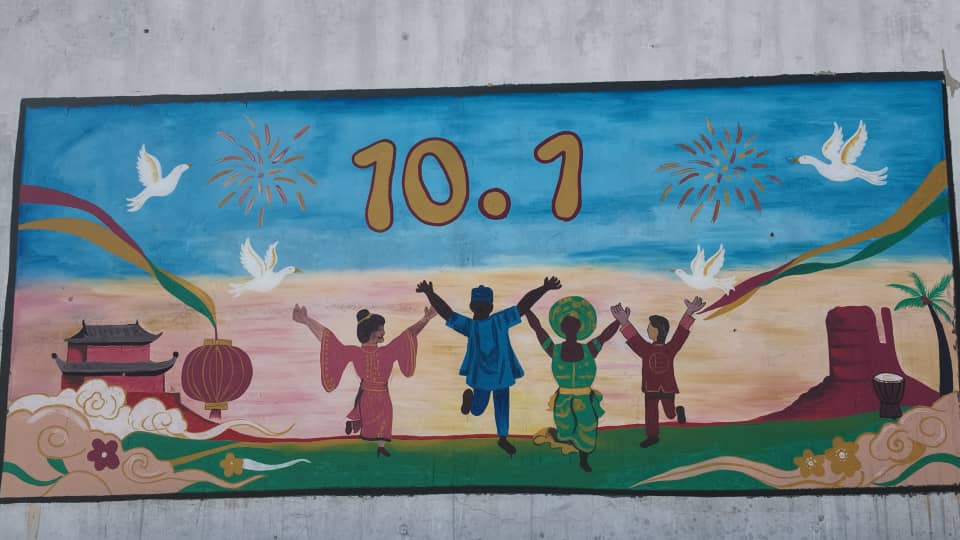
A colourful mural celebrating both China’s National Day and Nigeria’s Independence Day has been unveiled at an overseas project site, serving as a vivid symbol of the enduring friendship between the two nations.
The artwork, jointly produced by Chinese and Nigerian staff, features builders dressed in traditional Chinese costumes and Nigerian ethnic attire holding hands and dancing together.
Above them, fireworks and white doves of peace illuminate the sky, while the inscription “10.1” highlights the dual significance of October 1, the China’s National Day and Nigeria’s Independence Day.
On the left side of the mural, ancient Chinese architecture, red lanterns and auspicious cloud motifs showcase Chinese heritage.
On the right, red earth, coconut palms and African drums reflect Nigeria’s cultural identity. Flowing ribbons weave across the painting, symbolising unity and shared destiny.
Project officials described the mural as a “living testament” to cooperation at the frontline of development. They said it embodies mutual trust and support as workers from both countries overcome challenges together.
The initiative underscores cultural integration and partnership, with both sides pledging to continue working hand in hand to strengthen ties.
“Celebrating two festivals as one, we march forward with one heart,” a statement read, emphasising the commitment to write new chapters of friendship along the path of cooperation.
The mural, rooted in the overseas project site, stands as a reminder of the brotherly bond between China and Nigeria, and the shared vision of building together for a brighter future.
News
Musa Illiyasu Kwankwaso Celebrates Senator Lado @60, Says Is A Political Dogma
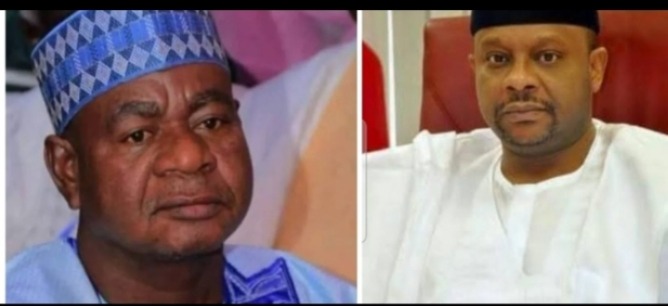
From Muhammad Kabir Kano
The spokesperson of Political Appointees Forum from Kano State, Dr. Musa Illiyasu Kwankwaso, has described Senator Basheer Lado, the Special Adviser to President Tinubu on National Assembly Matters (Senate), who also doubles as the Chairman of the Appointees, on his 60th birthday, as a Political Blog who plays the game with maturity and respect.
Kwankwaso who also describes Senator as Political Dogma, praised his contributions to democratic governance, humanitarian services and national development.
“Senator Lado is a dependable public servant and accomplished legislator whose experience had helped strengthen relations between the Executive and the Senate and also steer ship the activities of the Political Appointees with huge respect and understanding”,
He said it is on notice that Lado served in the Senate for four years before his by late President Buhari on Relief agency and subsequent appointment as Tinubu’s liaison officer in the upper chamber of the National Assembly.
Lado represented Kano Central Senatorial District in the Seventh National Assembly from 2011 to 2015, where he served as Vice Chairman of the Senate Committee on Works.
Lado facilitated several constituency projects, including the Kundila Bridge, popularly known as Gadar Lado, in Kano State. His contributions to humanitarian services through his previous roles as Federal Commissioner of the National Commission for Refugees, Migrants and Internally Displaced Persons, and Director-General of the National Agency for the Prohibition of Trafficking in Persons (NAPTIP).
He said Lado contributed to protecting vulnerable Nigerians, combating human trafficking and improving the welfare and rehabilitation of displaced persons.
Kwankwaso further commended the senator’s humanitarian initiatives through the Ladon Alheri Foundation, particularly in education, healthcare, women’s economic empowerment, rural water supply and support for disadvantaged communities.
” Lado’s contributions across public service reflected his commitment to national development and the welfare of Nigerians”, he added.
News
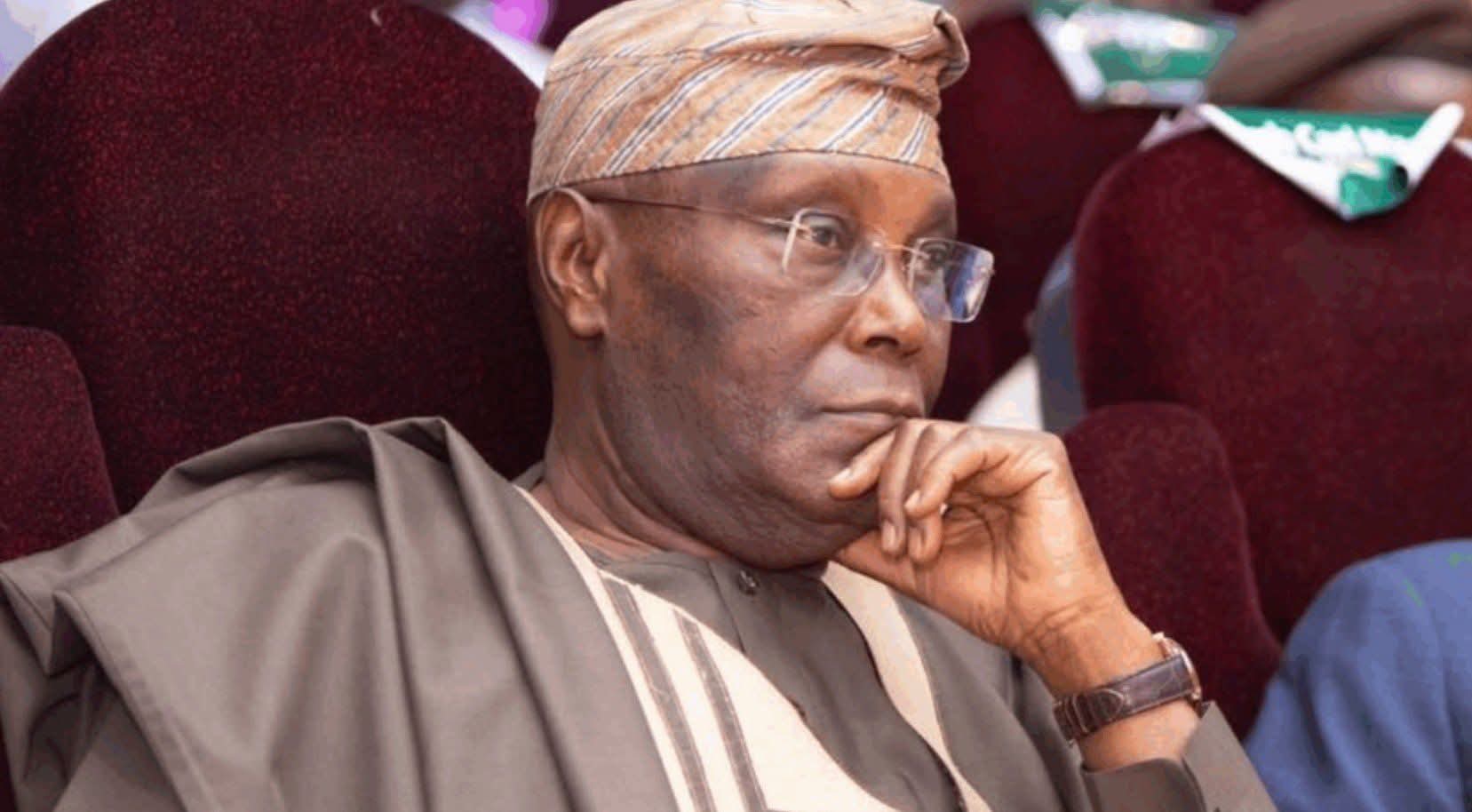
EFCC Reopens Atiku’s Alleged Financial Crimes Probe
By Yusuf Danjuma Yunusa
The Economic and Financial Crimes Commission (EFCC) has reopened its investigation into allegations against former Vice President Atiku Abubakar following a petition by former House of Representatives member, Hon. Ehiozuwa Johnson Agbonayinma, seeking his prosecution over alleged financial crimes.
The petition seeks to revive a case dating back to 2006, asking the anti-graft agency to revisit its investigation under former chairman, Mallam Nuhu Ribadu, and consider a subsequent report by a United States Senate subcommittee.
Speaking on the development, Agbonayinma said the EFCC had acknowledged his petition, dated August 27, 2026, and received on September 1. Filed through his lawyer, Chief Hannibal Egbe Uwaifo, SAN, the petition asks the commission to reactivate its earlier report and act on the allegations.
The former lawmaker appeared at the EFCC headquarters in Jabi, Abuja, where he adopted the petition and answered questions from investigators.
Agbonayinma said the matter should not be allowed to remain unresolved.
“I want to thank Nigerians, the EFCC, and those praying for me in this struggle. The laws are meant for both the rich and the poor. After the EFCC has done a fantastic job, it should not be kept under the table,” he said.
In the petition, Agbonayinma urged the EFCC to revisit its September 2006 report on Atiku and a February 4, 2010, report by the US Senate Permanent Subcommittee on Investigations, arguing that both documents should form the basis for renewed action.
The petition alleged that the EFCC had previously indicated that Atiku could face prosecution after leaving office as vice-president, when his constitutional immunity ceased to apply, but that no prosecution followed.
Agbonayinma described the alleged failure to act as a dereliction of duty and argued that pursuing the matter would demonstrate the commission’s resolve to hold politically influential figures accountable.
He also disclosed that he had petitioned US President Donald Trump over the allegations.
The EFCC spokesman, Dele Oyewale, had yet to respond to messages seeking an update on the investigation as of the time of filing this report.

Why Gov Abba Deserves Another Tenure

China, Nigeria Mark Friendship with Joint Cultural Mural

Musa Illiyasu Kwankwaso Celebrates Senator Lado @60, Says Is A Political Dogma

EFCC Reopens Atiku’s Alleged Financial Crimes Probe

APC Presidential Campaign Council: Nigerians Devoid Of Party Affiliations Endorses Tinubu’s 2nd Term-Kwankwaso

Zamfara Varsity ASUU Threatens Warning Strike Over FG-ASUU Agreement, Promotion Arrears

PCACC Arrests Man Over Alleged ₦4.5m Sale, Illegal Leasing of Kano Government Horse Stable

Goje’s Electoral War:The Confrontation With Tinubu,Governor Inuwa,Usman Kumo And APC candidates Ahead Of 2027

Prof Yusuf Adamu Delivers BUK’s 63rd Professorial Inaugural Lecture, Reflects on Medical Geography and Academic Legacy

RE:WE ARE UNDER SIEGE: TARABA MONARCH BREAKS SILENCE AS FULANI BANDITS OVERRUN THE ANCIENT KWARARAFA KINGDOM:
Why Gov Abba Deserves Another Tenure
China, Nigeria Mark Friendship with Joint Cultural Mural
Musa Illiyasu Kwankwaso Celebrates Senator Lado @60, Says Is A Political Dogma
EFCC Reopens Atiku’s Alleged Financial Crimes Probe
APC Presidential Campaign Council: Nigerians Devoid Of Party Affiliations Endorses Tinubu’s 2nd Term-Kwankwaso
Zamfara Varsity ASUU Threatens Warning Strike Over FG-ASUU Agreement, Promotion Arrears
PCACC Arrests Man Over Alleged ₦4.5m Sale, Illegal Leasing of Kano Government Horse Stable
Goje’s Electoral War:The Confrontation With Tinubu,Governor Inuwa,Usman Kumo And APC candidates Ahead Of 2027
Prof Yusuf Adamu Delivers BUK’s 63rd Professorial Inaugural Lecture, Reflects on Medical Geography and Academic Legacy
RE:WE ARE UNDER SIEGE: TARABA MONARCH BREAKS SILENCE AS FULANI BANDITS OVERRUN THE ANCIENT KWARARAFA KINGDOM:
-

 Opinion5 years ago
On The Kano Flyovers And Public Perception
-

 Features5 years ago
How I Became A Multimillionaire In Nigeria – Hadiza Gabon
-

 Opinion6 years ago
Kano As future Headquarters Of Poverty In Nigeria
-

 History6 years ago
Sheikh Adam Abdullahi Al-Ilory (1917-1992):Nigeria’s Islamic Scholar Who Wrote Over 100 Books And Journals
-

 Opinion5 years ago
My First Encounter with Nasiru Gawuna, the Humble Deputy Governor
-

 History5 years ago
The History Of Borno State Governor Professor Babagana Umara Zulum
-

 History6 years ago
The Origin Of “Mammy Market” In Army Barracks (Mammy Ochefu)
-

 News5 years ago
Federal University Of Technology Babura To Commence Academic Activities September