
News
Cover Story :Nigeria’s Rising Debt Profile And Its Implication on the Economy

Experts Profer Solutions
Story by Yusuf Danjuma Yunusa
Africa’s largest economy, Nigeria, has, since return to democracy in 1999 struggled with debt servicing. The government of former President Olusegun Aremu Obasanjo inherited a significant debt profile from the military regime. Between the 1980s and 1990s, the military regime, excluding internal debt, had accumulated external debt of over $28 billion.
The administration of former President Obasanjo was committed to tackling the debt to the barest minimum. In the spirit of that commitment, the administration entered into a debt relief agreement with the informal group of creditor nations – otherwise known as the Paris Club. This move yielded a significant result by reducing the country’s debt to $10 billion at that time.
The administration was intentional about the necessary measures employed purposely for reducing the country’s debt profile. This milestone was greatly acknowledged as the administration’s strength.
NIGERIAN TRACKER investigations understands that the manageable state of the country’s debt profile remained intact even during Yar’adua’s administration. However, under the Goodluck Jonathan-led administration, budget deficit financing and the need to tackle infrastructural deficits – mainly in the power sector – continued to plunge the country back into debts.
The 2014 oil price volatility, coupled with unnecessary recurrent government expenditures and the funding of the military to combat insurgencies at that time, also contributed to the rising debt profile of the country because all those expenditures were made through borrowing. And for the borrowed funds to be serviced, another form of expenditure was also needed. So, you see that the cycle keeps going like that. By the end of 2014 – in the last quarter – Nigeria had recorded a total public debt (both domestic and external) of ₦49.34 trillion, as reported by the Nigerian Bureau of Statistics.
By 2015, Nigeria’s external debt had increased to about $10 billion, while the composition of both domestic and external debt had risen to over $60 billion.
Under the administration of President Muhammadu Buhari, the country’s debt profile increased even more due to the continued fuel subsidy. The country recorded heavy borrowing during the administration because of the ongoing fuel subsidy. No returns were made, corruption continued to make its headway in the sector while the debt continue to skyrocket.
Also, the fight against insurgency, which was left untamed by the Jonathan-led administration, was inherited by the Buhari administration. Heavy funding of the military to decisively tackle terrorism was needed, hence another reason to borrow.
In the storm of all that, the 2016 recession hit the country. The economy suffers a serious setback. However, with the right measures employed by the government – such as the diversification of the economy to the non-oil sector, particularly agriculture – the economy bounced back significantly by 2017. This was the same year in which the Paris Club refund was mismanaged by state governors.
A total amount of ₦243.7 billion was shared among state governors in 2017, mainly for the payment of outstanding salaries. Most of the the funds was diverted and mismanaged. This act of criminality by some of those state governors depicted the dilapidated nature of the country’s economy. Because, for states to be unable to settle the burden of salary payments, and the federal government, in an attempt to address that, ended up having the funds looted for personal gain by the state governors without repercussions, explains the mess we’re in as a country.
In that same year, 2017, a total amount of ₦474.06 billion was recorded to have been utilized for the country’s domestic debt servicing alone. As we all know, debt servicing is also an expenditure. And for a government that solely relies on a single source of revenue generation, borrowing would inevitably continue. And as borrowing keeps progressing without a corresponding measure to address its servicing comfortably, a rising debt profile would also be inevitable.
In spite of all the monetary interventions received from the Obasanjo administration down to Buhari’s, the country’s debt, according to the National Bureau of Statistics, stood at ₦87.38 trillion at the end of the second quarter of 2023.
Moreover, on the eve President Tinubu’s swearing-in as the President of the Federal Republic of Nigeria, he declared that the subsidy had gone. Those who knew what that meant were excited, noting that the usual squandering on fuel subsidization from borrowed funds had stopped. Little did they know that the status quo would be maintained, if not worsened.
Recurrent government expenditures, bordering on unwarranted expenditures by the presidency, skyrocketed. The funds that were previously directed at settling the burden of fuel subsidy should have been utilized in drastically servicing the country’s debt, since he had scrapped the subsidization of fuel.
Not that there hasn’t been debt servicing – there has. But past governments also engaged in debt servicing despite their allocation of funds for fuel subsidy. So, much is expected of this very government in that regard since it decided to take an exception in the fuel subsidy saga.
According to data published by the Debt Management Office, as of June 2023, Nigeria’s external debt stood at ₦29.8 trillion. But during the last quarter of 2024, the country’s external debt had increased to ₦62.917 trillion. Within 18 months of Tinubu’s administration, a total increase of ₦33.1 trillion had been recorded for external debt alone.
On the other hand, domestic debt was at ₦48.3 trillion in June 2023. By December 2024, the debt increased to ₦70.4 trillion – a difference of ₦22.1 trillion. This brought the country’s debt to a total of ₦142 trillion by the end of 2024.
Experts have hinted that by the end of the first quarter of 2025, the country’s debt may increase to ₦150 trillion. All of this is happening despite the President promising to tackle the rising debt profile when he inaugurated the Presidential Tax Committee in August 2023.
In a quest to obtain an expert’s view on the subject matter, a lecturer and Public Sector Economist, who is an associate professor in the Economics Department of Ahmadu Bello University, Zaria, Kaduna State, shared the following:
“Nigeria’s rising debt profile is something that’s inevitable because the outputs that are usually proposed to be achieved are far from the country’s potential. Hence, the government would have to borrow in order to meet up with the said outputs.
And the saner question to be asked, if the country’s rising debt profile is inevitable as opined above, is: Shouldn’t the government then resort to borrowing responsibly?
Then we would find out that what’s responsible to the government, in the sense of borrowing, is different from what it is to ordinary Nigerians. An ordinary Nigerian always sees borrowing responsibly to be when one borrows and invests for income to be generated. But our leaders, who are serving as the government, don’t see it the same way. What is responsible to our leaders in the context of borrowing is to make sure every possible borrowing is made in order to satisfy the aggrieved Nigerians because they are so hungry for power.
None of them would want to forgo a second tenure after the first. And in order to achieve that, the demands of the citizens must be met at all costs. This is where borrowing comes in.
Another reason for its inevitability is the issue of our exchange rate. Most of these borrowings, when undertaken and when it’s time to pay them back, are not always at a time when the exchange rate remains constant. Take, for instance, the ongoing fracas between the owner of Arise Television, Nduka Obaigbena, and First Bank of Nigeria. The former borrowed money from the latter when the dollar-to-naira rate was at ₦400 to $1.
And now, when it is time to pay back, the rate has risen drastically. The investment for which the borrowing was used was in naira. In this case, which is just between ordinary Nigerians in business, servicing the debt is now a major concern to the borrower because of the prevailing rate between the currencies. What then should we think about our government?
We all know that servicing debt is another form of expenditure. The higher the debt servicing, the lower the expenses in areas such as salary payments, military funding, infrastructural development, and healthcare financing – which are very crucial in any country’s economy. So, the truth is that the rising debt profile of Nigeria, with this style of leadership, is definitely inevitable.
In light of the above, it’s obvious that the implications of such a vicious circle of the country’s debt profile on its economy will be grave.
NIGERIAN TRACKER investigations revealed that if Nigeria continues to operate in this manner, surely, a time will come when even basic government expenditures such as salary payments will be difficult to attend to because there will no longer be sufficient revenue to cater for such expenses. This, in particular, has already started to manifest, considering the huge amount of money allocated solely for debt servicing in the 2025 budget.
According to the budget, about 45% of the total is strictly directed toward settling debts. A time will come when debt servicing will gulp up to 60% if this continues.
Another ugly implication of this rising debt profile is that the country may, in the future, find itself under the dictates of any country willing to grant funds for debt settlement,” he said.
Confirming what this lecturer said, especially the last paragraph, we all remember the social media when a National Daily (Not Nigerian Tracker)reported the hidden agenda behind the SAMOA agreement that Nigeria entered with concerned nations in 2024.
Since it’s clear that the country’s rising debt profile is inevitable and its implications are grave, it’s pertinent to note that it can be tamed if the government is ready to eliminate unnecessary recurrent government expenditures, diversify the economy absolutely from oil dependency, and implement a fair, realizable, and consistent taxation system.
In the effort to further inquire about the implications of the rising debt profile on Nigeria’s economy, AbdulWahab Lukman, a final-year student from the Economics Department of Ahmadu Bello University, Zaria, told NIGERIAN TRACKER correspondent that
“The implication of the country’s rising debt profile is simply the fact that we will not be able to escape a serious rise in inflation. Because, as the government borrows money and spends it, if there’s no corresponding GDP to mitigate it, definitely there will be inflation. And, gradually, if we’re to be honest with each other, this is already manifesting.
He said Another implication is low revenue. Definitely, as we borrow, we must pay back. And the repayment is always huge compared to what was borrowed. With Nigeria operating on only one source of revenue – oil – how do we tackle this without falling short of revenue that should be directed at financing other productive sectors of the economy that could drive others along?” he asked rhetorically.
It was observed that if Nigeria leaders are ready to make a change regarding reducing borrowing and diminishing the country’s debt profile, unnecessary recurrent government expenditures must be tackled. The economy must be diversified absolutely in order to drive more revenue. Investment in productive sectors that could drive others along must be made to create jobs and boost the economy further. And lastly, a fair, realizable, and consistent taxation system must be implemented.









News
ECOWAS Court Faults Process Backed by Council of Ministers in Darma Removal Case
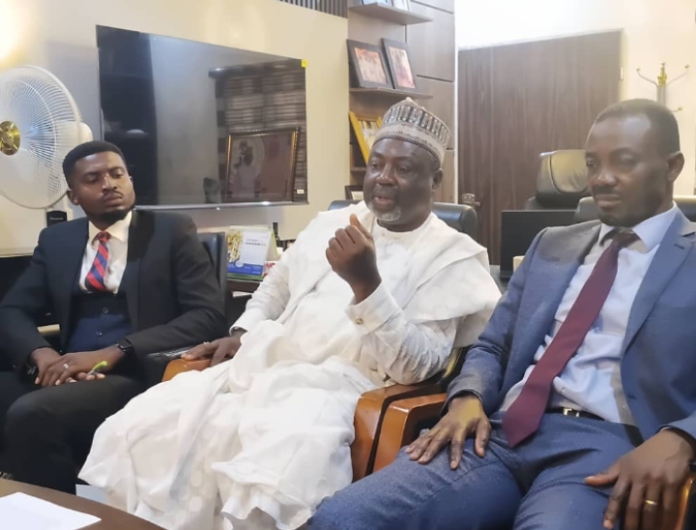
The ECOWAS Community Court of Justice has ruled that the removal and replacement of former ECOWAS Commissioner for Internal Services, Prof. Nazifi Abdullahi Darma, were unlawful, overturning a process that culminated in his replacement being formalised by the Council of Ministers.
Darma disclosed the outcome while briefing journalists in Abuja on the Court’s recent judgment.
He said the dispute arose after a memorandum dated 30 October 2025 by the then President of the ECOWAS Commission, Dr. Omar Alieu Touray withdrew responsibilities previously exercised by Darma and initiated steps that eventually led to his replacement.
While Darma challenged the actions before the ECOWAS Court on 3 November 2025, the Federal Republic of Nigeria subsequently recalled him and nominated a successor.
The Council of Ministers later formalised the replacement.
However, the Court found that the legal requirements for ending his mandate had not been satisfied.
According to Darma, the Court held that the memorandum triggering the process was based on adverse allegations that affected his responsibilities and was issued without giving him an effective opportunity to respond.
“The Court found that these actions were taken without prior notice or an effective opportunity for me to respond,” he said.
The Court further ruled that managerial powers vested in the President of the Commission could not be used to extinguish or transfer responsibilities assigned by Community law to another statutory office.
Darma said the Court also rejected the argument that Nigeria’s recall automatically ended his tenure as Commissioner.
“Once appointed, a Commissioner derives his mandate from Community law and not from the nominating Member State,” he quoted the Court as holding.
The Court consequently declared that his removal and replacement were unlawful, notwithstanding the subsequent actions taken to formalise the change in office.
The judgment ordered the payment of outstanding salaries, allowances and accrued entitlements up to the expiration of his tenure and awarded him US$50,000 in general damages.
Because his tenure expired on 31 August 2026, the Court did not order reinstatement.
Describing the ruling as significant for regional governance, Darma said it reaffirmed that ECOWAS statutory office holders can only be removed through procedures recognised by Community law.
News
Dangote Cement Gboko Commits Millions in Scholarship Scheme
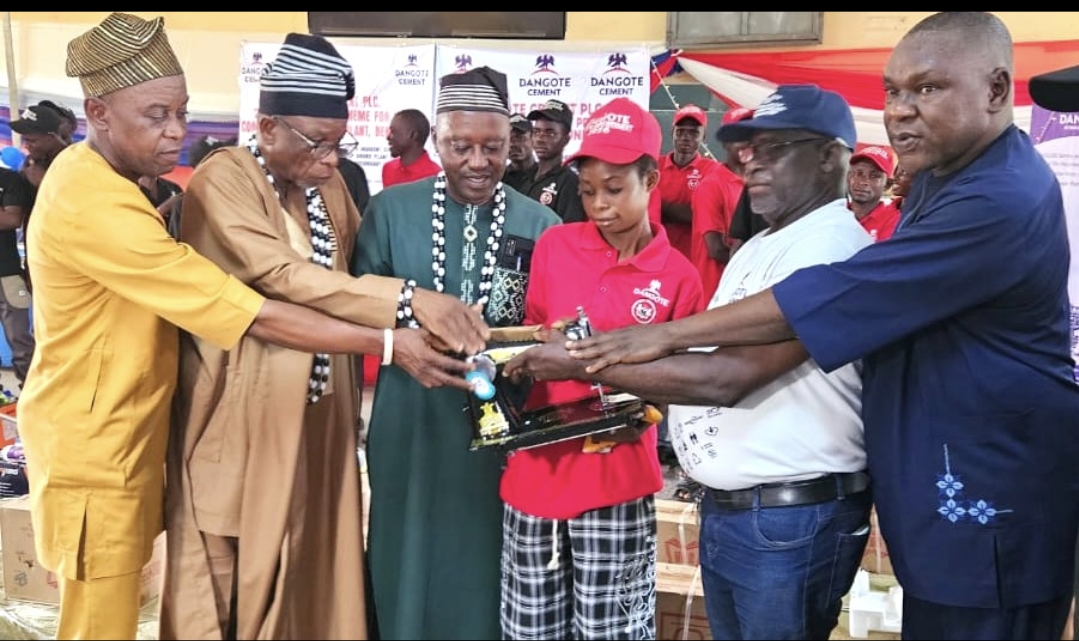
Dangote Cement Plc, Gboko Plant has awarded multi-million-naira scholarships to tertiary and secondary school students from its six host communities in Benue State.
The company also presented starter packs, working tools and certificates to graduates of its Youth Empowerment Programme to enable them to establish their own businesses, apply the skills acquired during the training and become financially reliant.
The Minister of Solid Minerals Development, Dr. Henry Dele Alake, lauded Dangote Cement Plc for its community development interventions, calling on other private sector players to adopt similar initiatives to promote socio-economic development in their host communities.
Dr. Alake, who was represented by the Federal Mines Officer of the Federal Ministry of Solid Minerals Development in Benue State, Engr. Achi Gregory, urged the company to sustain its commitment to implementing community development programmes agreed upon with its host communities.
Speaking at the official presentation ceremony, Group Head, Social Performance, Dangote Cement Plc, Mr. Wakeel Olayiwola, said the implementation of the Community Development Agreement underscores Dangote Cement’s commitment to equipping young people with practical skills and resources to promote entrepreneurship, create employment opportunities and improve livelihoods in its host communities.
Mr. Olayiwola, who was represented by the Head of Social Performance of the Dangote Cement, Gboko Plant, Dr. Johnson Kor, said the scholarship and youth empowerment programmes came against the backdrop of several other programmes recently executed by the company, which include farmers and women empowerment programmes.
The Acting Plant Director, Dangote Cement, Gboko, Engr. Arbind Singh, said: “This annual scholarship scheme for indigent students of the host communities is an indication of our company’s commitment to its Corporate Social Responsibilities (CSR).”
Engr Singh, who was represented by the company’s General Manager, Production, Engr Tabershima Soom, said: “The Gboko Plant has already launched 150 Women Empowerment Programme and 50 Farmerss Empowerment Programme where women were provided with cash to support their businesses, and farmers were supported with farm inputs.”
The beneficiary communities for these programs are: Tse-Kucha, Quarry, Amua, Mbazembe, Mbatur, and Pass Brothers.
Speaking on behalf of the Benue State Attorney-General, the Chairman of the Mineral Resources and Environmental Management Committee (MIREMCO), Barr. Dooshima Orosaga, commended Dangote Cement Plc for its compliance with the Community Development Agreement (CDA), urging the beneficiaries and host communities to maximise the benefits of the company’s interventions.
Chairman of the Gboko Local Government, Hon Yina Elias said the government will continue to provide the support needed for the company to succeed, adding that the Dangote Cement Plc is an exemplary company in Corporate Social Responsibilities programmes.
In his remarks, the District Head of Ukpekpe, Chief Tsegba Igbarumun, commended Dangote Cement Plc’s Gboko Plant for its contributions to the community, assuring the company of the community’s continued support.
He said the community valued its mutually beneficial relationship with the company and would continue to serve as its ambassadors.
A beneficiary of the Youth Empowerment Programme, Mr Ignatius Aondohemba, expressed appreciation to Dangote Cement Plc for the support, pledging to put the skills and resources provided to good use and build a business that would enable him to become an employer of labour.
News
Mass Exodus Looms in Kano APC as More Chieftains Consider Exit — Mansur Ahmed
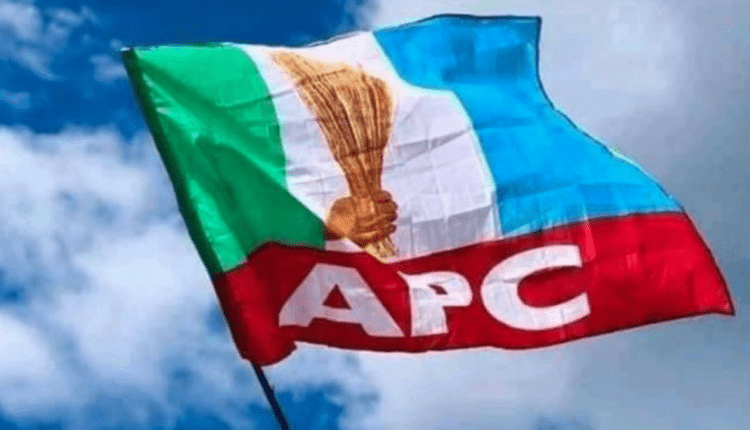
A former governorship aspirant of the Peoples Democratic Party (PDP), Engr. Mansur Ahmed, has predicted a possible mass exodus of prominent politicians and party stakeholders from the All Progressives Congress (APC) in Kano State amid persistent internal disagreements.
Ahmed made the prediction while addressing journalists following his resignation from the APC, according to a statement signed by Usman Bello on his behalf.
The former APC member described the recent resignation of party chieftain Alhaji Aminu Dabo as an indication of a deeper crisis within the party, suggesting that more prominent members could leave in the coming days.
Ahmed alleged that the Kano APC was experiencing persistent internal disputes that had continued to undermine unity among its members, with little indication that the disagreements would be resolved soon.
He further disclosed that several political leaders and stakeholders across Kano State were holding consultations over their future in the party and were considering formally resigning.
According to Ahmed, the consultations involved prominent political figures and their allies who were weighing their options before deciding on their next political destination.
Reflecting on his political career, Ahmed described himself as a former PDP governorship aspirant who also served as Deputy Coordinator of the 2015 presidential campaign in Kano.
He said he and his associates were currently consulting with political allies to determine the next direction of their political engagement following his departure from the APC.
The statement did not identify the other party leaders allegedly preparing to resign or disclose when they might announce their decisions.
It also did not indicate whether Ahmed and the politicians consulting with him had reached any agreement to join another political party.
Ahmed’s prediction comes amid continuing political realignments in Kano State as political actors assess their options ahead of the 2027 general elections.

ECOWAS Court Faults Process Backed by Council of Ministers in Darma Removal Case

Dangote Cement Gboko Commits Millions in Scholarship Scheme

Mass Exodus Looms in Kano APC as More Chieftains Consider Exit — Mansur Ahmed

Kano Donates Equipment to NDLEA

NDC Kano Asks INEC to Investigate Conflicting Primary Election Reports

PCACC Arrests Man Over Alleged ₦4.5m Sale, Illegal Leasing of Kano Government Horse Stable

Kano Monitors ₦48.9bn Projects Across Six LGAs

Goje’s Electoral War:The Confrontation With Tinubu,Governor Inuwa,Usman Kumo And APC candidates Ahead Of 2027

Kano Spends ₦10.36bn on Hospitality, Sitting Allowances, Others in Six Months

Prof Yusuf Adamu Delivers BUK’s 63rd Professorial Inaugural Lecture, Reflects on Medical Geography and Academic Legacy
ECOWAS Court Faults Process Backed by Council of Ministers in Darma Removal Case
Dangote Cement Gboko Commits Millions in Scholarship Scheme
Mass Exodus Looms in Kano APC as More Chieftains Consider Exit — Mansur Ahmed
Kano Donates Equipment to NDLEA
NDC Kano Asks INEC to Investigate Conflicting Primary Election Reports
PCACC Arrests Man Over Alleged ₦4.5m Sale, Illegal Leasing of Kano Government Horse Stable
Kano Monitors ₦48.9bn Projects Across Six LGAs
Goje’s Electoral War:The Confrontation With Tinubu,Governor Inuwa,Usman Kumo And APC candidates Ahead Of 2027
Kano Spends ₦10.36bn on Hospitality, Sitting Allowances, Others in Six Months
Prof Yusuf Adamu Delivers BUK’s 63rd Professorial Inaugural Lecture, Reflects on Medical Geography and Academic Legacy
-

 Opinion5 years ago
On The Kano Flyovers And Public Perception
-

 Features5 years ago
How I Became A Multimillionaire In Nigeria – Hadiza Gabon
-

 Opinion6 years ago
Kano As future Headquarters Of Poverty In Nigeria
-

 History6 years ago
Sheikh Adam Abdullahi Al-Ilory (1917-1992):Nigeria’s Islamic Scholar Who Wrote Over 100 Books And Journals
-

 Opinion5 years ago
My First Encounter with Nasiru Gawuna, the Humble Deputy Governor
-

 History5 years ago
The History Of Borno State Governor Professor Babagana Umara Zulum
-

 History6 years ago
The Origin Of “Mammy Market” In Army Barracks (Mammy Ochefu)
-

 News5 years ago
Federal University Of Technology Babura To Commence Academic Activities September