
News
I will not tolerate violation of human rights,Corrupt practices – Zamfara CP
By Ahmed Attahir Gusau
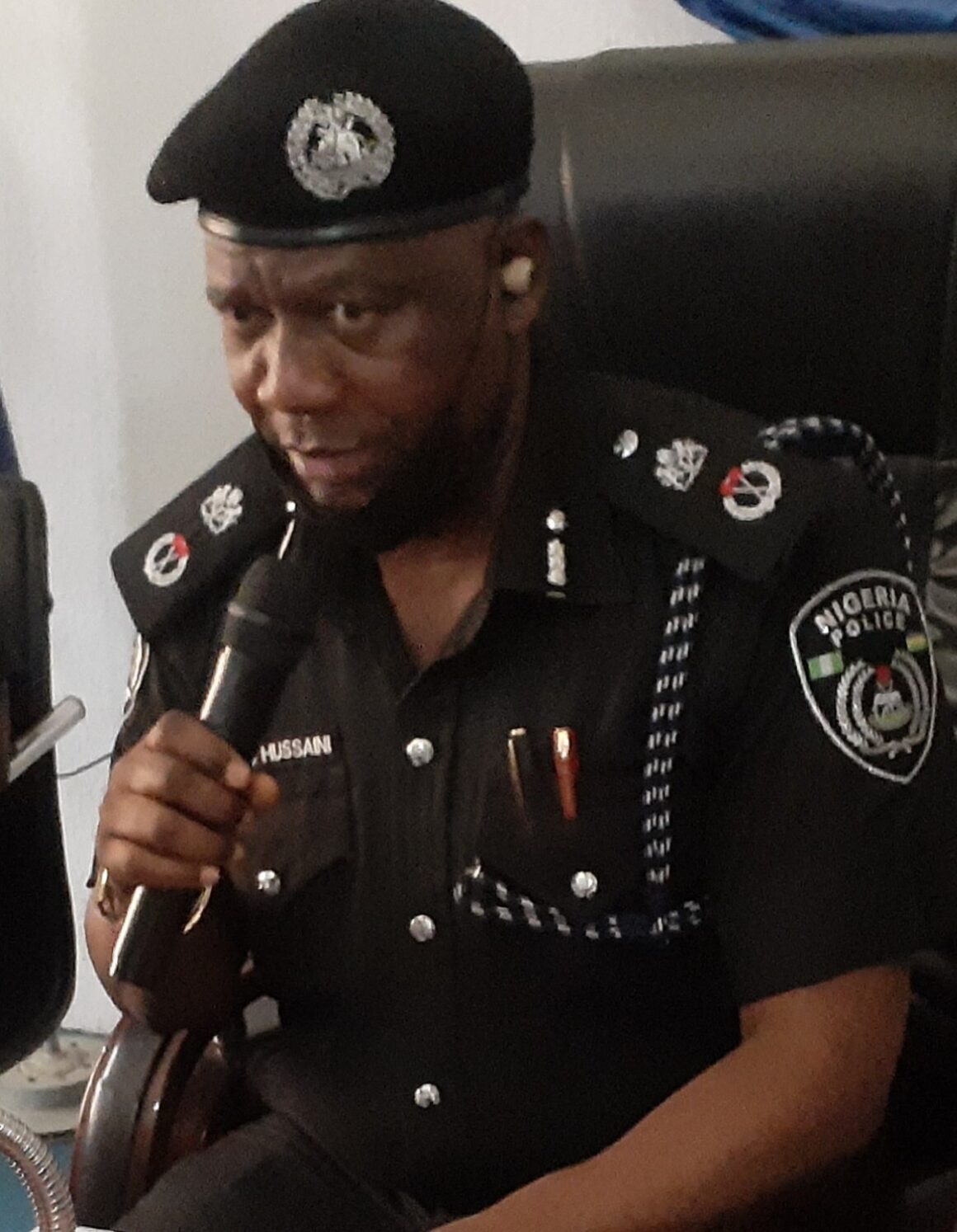
The newly deployed Commissioner of police,Zamfara State command Mr Hussaini Rabiu has assured that his leadership would not tolerate violation of human rights,Corrupt practices and unprofessional conduct in the State.
He further assured to retain the existing security architecture of the State government,warned recalcitrant bandits to key into peace dialogue,”failure for the recalcitrant bandits to key into peace process would amount to facing dare consequences”.
Addressing maiden press conference on Monday at the Police commad headquarters in Gusau,State capital,the new Zamfara CP Hussaini Rabiu said he would always remain at red alert to ensure free crimes in the State.
“This briefing is aimed at familiarising myself with you as our important Partners in our efforts to manage crimes and keep Zamfara safe,First and foremost, I have a duty to thank our Creator, the Almighty Allah (SWA) for giving me the strength and opportunity to stand before you today as the Commissioner of Police Zamfara State Command. My deep appreciation goes to the Inspector General of Police, Ag. IGP Usman Alkali Baba NPM fdc, for finding me worthy of this appointment”.
He assured that strengthening the existing excellent security architecture of the State government shall remain a primary objective of his tenure as the Commissioner of Police .
“Members of the press you are wonderful people,your contribution in the crime management and control in Zamfara State can not be over emphasized, I therefore consider it paramount to express my gratitude to all of you and urge you to do more by sustaining the spirit of partnership through enlightening, educating and informing members of the general public on exact happening in the state”
CP advised journalists to avoid fake information and rumour mongering that can create panic and apprehension in communities.
“On my assumption of duty as the Commissioner of Police on 6th May, 2021, I made a careful study of the peculiar nature of security challenges that are prevelant in Zamfara State, which are Banditry, Kidnapping, Cattle Rustling, Armed Robbery, Culpable Homicide and other related crimes. In order to stem the tide of the above security challenges”.
” I and my management team have commenced the review of the existing crime fighting strategies holistically so that we can continue from the successes recorded by my predecessor”.
Time to stop proliferation of political parties in Nigeria
He maintained that police combat readiness, determination and total commitment under his watch will be through total onslaught against vicious crimes, and that will be carried out in partnership with the State Government, other security agencies,Traditional Rulers,Community and Religious leaders.
“My Policing strategy will be an intelligence led driven and community participation and engagement which transcends law enforcement to embrace human security and development services, but necessarily require diverse expertise and whole community support”.
“Our policing has to be driven by fore knowledge and be guided by intelligence at strategic, operational and tactical levels. It should therefore be proactive, preventive in orientation and conducted within the context of public ownership, partnership, participation, problem solving and community support with a mainstream human security.”
According to him,synergy with other security agencies in the state will be enhanced to ensure the provision of an effective security service to the people of Zamfara State where atmosphere will be conducive for all and sundry.
“I want to assure members of the public in Zamfara State that the Police under my watch will discharge its mandate in line with the professional ethics of the force. Also, human right violation, currupt practices and other unprofessional conduct will not be tolerated”.
“Let me at this point use this platform to warn all the recalcitrant criminal elements in the state to key into the state government peace process programme and surrender their arms or face dare consequences, while members of the public should continue to support the Police and other security agencies with credible information on activities of criminal elements in the state.”
News
Isoko Traditional Rulers Divided Over 250 Million Offer To Confer Chieftaincy Title On Senatorial Aspirant
Isoko Traditional Rulers Divided Over 250 Million Offer To Confer Chieftaincy Title On Senatorial Aspirant
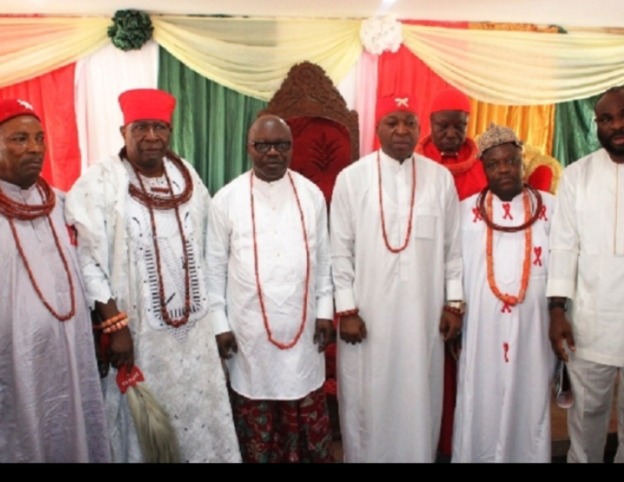
A Delta South Senatorial candidate in a desperate bid to garner endorsements has made an offer of a whopping N250 million to Isoko Traditional Rulers for conferment of an omnibus Chieftaincy Title on him, insisting that he had never had one.
The offer is however been rebuffed by some of the notable Kings, who view the offer as a “Greek gift”, and vowed to stonewall it, while the other group is desperate to have their hands in the bounty.
A traditional ruler, who crave for anonymity said: “you are offering a hefty N250 million for a chieftaincy title at the eleventh hour when in normal circumstances it should be free based on your performances while in office.
Frantic efforts are being made to get the integrity group of traditional rulers on board to grant the Senatorial Candidate his wish through intensive lobbying.
The traditional rulers are said to be consulting amongst themselves whether to accept the offer.
Isoko is made up of 17 autonomous clans, each with its own authority to confer chieftaincy on deserving sons and daughters.
Last week Saturday, Senator Joel Onowakpo Thomas, representing Delta South gathered some traditional rulers, politicians and Isoko Development Union (IDU) at his country home, Emede in Isoko South and got an endorsement for a second term come 2027.
The endorsement had not gone down well with the generality of Delta South, especially the people of the two local governments in Isokoland as it has been heavily criticized.
News
Kwankwaso, Atiku, Amaechi, Obi, Others Match-Out in Peaceful Protest at INEC’s Headquarters
By Yusuf Danjuma Yunusa
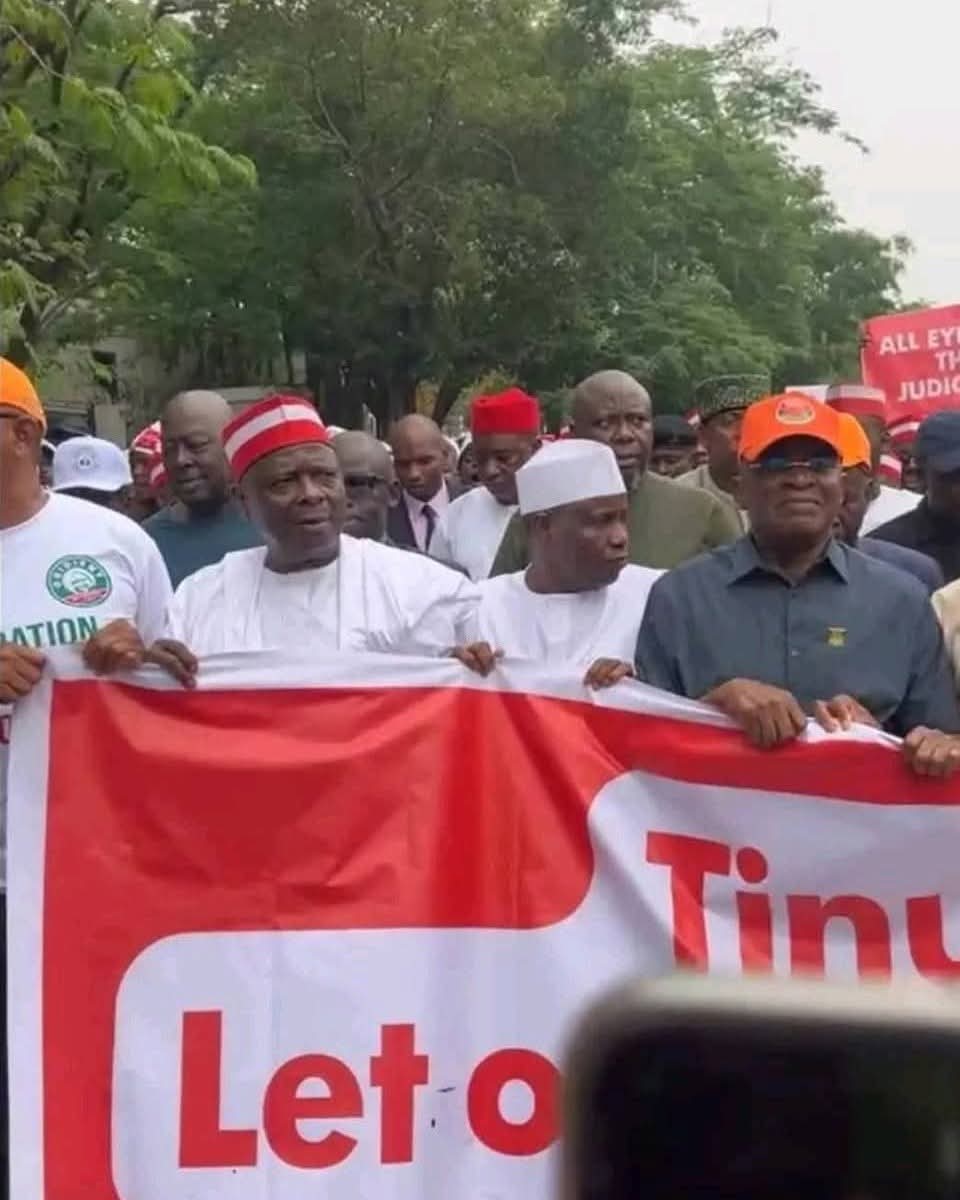
A coalition of chieftains from the African Democratic Congress (ADC), led by the party’s interim Chairman, David Mark, staged a peaceful protest at the headquarters of the Independent National Electoral Commission (INEC) in Abuja. The demonstration was in response to INEC’s recent withdrawal of recognition from the David Mark-led faction as the legitimate leadership of the party.
Prominent figures in the protest included former Vice President Atiku Abubakar, former Governors Rabiu Musa Kwankwaso and Peter Obi, as well as former Ministers Rotimi Amaechi and Rauf Aregbesola.
The leadership crisis within the ADC has deepened in recent times, with the emergence of yet another faction backed by state chairmen of the party. This group claims legitimacy over the two existing factions—one led by Nafiu Bala and the other by David Mark.
Amid this increasingly undemocratic atmosphere, the David Mark-led faction had scheduled its national convention for April 14. However, with today being April 8, questions are being raised over whether the faction can meet that deadline or if the leadership dispute will be resolved before the date.
Meanwhile, INEC has set May 10 as the final deadline for all political parties to submit the names of their flag bearers for the 2027 general election.
News
ADC Crisis: Kwankwaso Seeks Intervention of Gombe Emir
By Yusuf Danjuma Yunusa
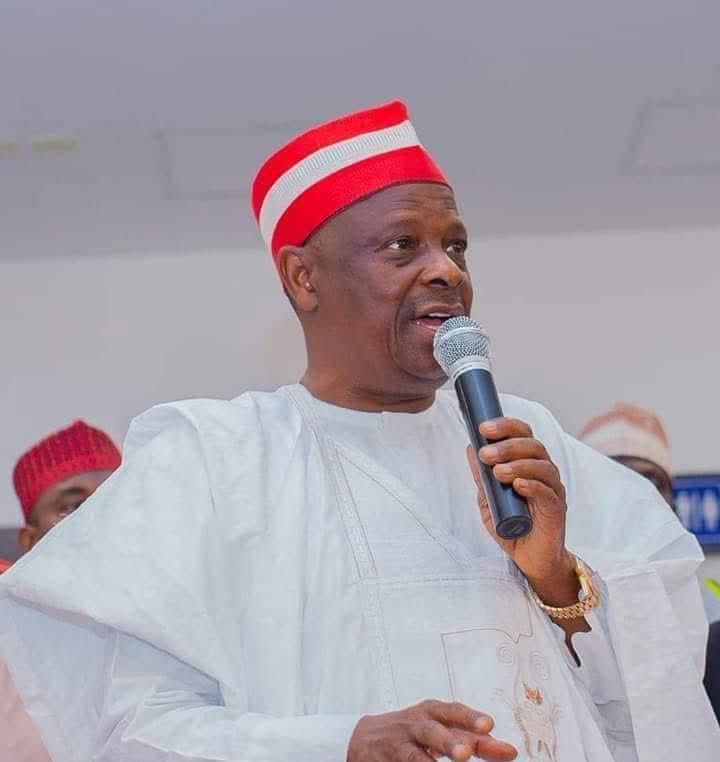
Senator Rabiu Kwankwaso, a chieftain of the African Democratic Congress (ADC), has accused Nafiu Bala, the party’s factional chairman, of acting against democratic principles.
In an interview with DCL Hausa on Tuesday, Kwankwaso revealed that he had invited Bala for a meeting aimed at resolving the party’s crisis amicably, but Bala failed to show up.
“We scheduled to meet yesterday, but despite waiting until morning, he did not come. I had been warned he wouldn’t show up, and his absence is deeply disappointing. I want to pass my message through you now, so that if you meet him, you can deliver it on my behalf,” Kwankwaso said.
He added, “Given the current situation in our country, our party and our democracy cannot afford someone who behaves like the lizard at the mouth of the water pot—blocking progress. As a leader of this movement in Nigeria, I believed that when I invited him, he would honour the request so I could advise him, as a father would a son.”
Kwankwaso noted that Bala was born in 1990 and still needs guidance as a youth. “His current actions are not only harmful to his own future, but also to the ADC and Nigerian democracy as a whole.”
He further warned, “He must recognise that millions have registered with our party. What was once a small party has grown significantly because prominent leaders joined with a mission to do what is right for this country. If he continues to stand in the way of that progress, it will become a very serious problem for him.”
The senator also called on the Emir of Gombe, other traditional rulers, and Islamic scholars (Ulamas) to intervene in the dispute.
“This is a serious matter, and he must realise his mistakes so we can resolve it. I offer this advice freely because I know it is for everyone’s benefit,” Kwankwaso concluded.

Isoko Traditional Rulers Divided Over 250 Million Offer To Confer Chieftaincy Title On Senatorial Aspirant

A Remarkable Homecoming: Kano Unites in Support of Abba Kabiru Yusuf, Signaling a Strong Endorsement for Bola Ahmed Tinubu in 2027

Kwankwaso, Atiku, Amaechi, Obi, Others Match-Out in Peaceful Protest at INEC’s Headquarters

ADC Crisis: Kwankwaso Seeks Intervention of Gombe Emir

Shekarau In APC, Morale Booster For Governor Abba

ADC Leadership Crisis: State Chairmen to Elect Caretaker Committee on Tuesday

Governor Abba Kabir Yusuf Holds Exclusive Prerogative to Choose Deputy – Malam Inuwa Waya

The Governor Who Chose His People Over His Politics: Abba Yusuf and the Moral Courage Behind Kano First
Restoring the Glory That Was Always There: Governor Abba Kabir Yusuf and the Historical Vision Behind Kano First

Table Water Producers Increase New Price for Sachet Water in Kano
Isoko Traditional Rulers Divided Over 250 Million Offer To Confer Chieftaincy Title On Senatorial Aspirant
A Remarkable Homecoming: Kano Unites in Support of Abba Kabiru Yusuf, Signaling a Strong Endorsement for Bola Ahmed Tinubu in 2027
Kwankwaso, Atiku, Amaechi, Obi, Others Match-Out in Peaceful Protest at INEC’s Headquarters
ADC Crisis: Kwankwaso Seeks Intervention of Gombe Emir
Shekarau In APC, Morale Booster For Governor Abba
ADC Leadership Crisis: State Chairmen to Elect Caretaker Committee on Tuesday
Governor Abba Kabir Yusuf Holds Exclusive Prerogative to Choose Deputy – Malam Inuwa Waya
The Governor Who Chose His People Over His Politics: Abba Yusuf and the Moral Courage Behind Kano First
Restoring the Glory That Was Always There: Governor Abba Kabir Yusuf and the Historical Vision Behind Kano First
Table Water Producers Increase New Price for Sachet Water in Kano
-

 Opinion4 years ago
On The Kano Flyovers And Public Perception
-

 Features5 years ago
How I Became A Multimillionaire In Nigeria – Hadiza Gabon
-

 Opinion5 years ago
Kano As future Headquarters Of Poverty In Nigeria
-

 History5 years ago
Sheikh Adam Abdullahi Al-Ilory (1917-1992):Nigeria’s Islamic Scholar Who Wrote Over 100 Books And Journals
-

 Opinion4 years ago
My First Encounter with Nasiru Gawuna, the Humble Deputy Governor
-

 History5 years ago
The Origin Of “Mammy Market” In Army Barracks (Mammy Ochefu)
-

 History4 years ago
The History Of Borno State Governor Professor Babagana Umara Zulum
-

 News4 years ago
Federal University Of Technology Babura To Commence Academic Activities September