
News
In 8 Month, Over 1 thousand Nigerians were Killed by Gunmen-Amnesty International

Amnesty International’s Nigeria office has described as shameful how the country’s security agencies have been handling repeated attacks by gunmen in villages across the northern region.
After speaking with residents of communities in seven northwest and north-central states, the human rights group shared its findings in a statement obtained by an online Newspaper HumAngle on Monday.
It observed that, between January and August, 1,126 civilians in the north were killed by rampaging gunmen, out of which 366 were from the south of Kaduna.
“Many of those interviewed described how security forces often arrive hours after attacks have ended, even when officers have been given information about impending attacks,” it said.
The group said it has also documented an upsetting increase in abductions in the region, with at least 380 people, mostly women and children, kidnapped this year.
Osai Ojigho, Director of Amnesty International Nigeria, stated that the failure of the security forces to take adequate steps in protecting villagers “from these predictable attacks is utterly shameful”.
“In addition to the security forces’ failure to heed warnings or respond in time to save lives, the fact that no perpetrators have been brought to justice leaves rural communities feeling completely exposed.
“The President claims he has repeatedly tasked security agencies to end the killing so that Nigerians can go to bed with their eyes closed, but clearly nothing has changed,” he added.
Witnesses in Kaduna, Plateau, and Kaduna states told Amnesty International that the attacks in their communities were well-coordinated and the invaders, who rode on motorcycles, were heavily armed. They also complained that they received little or no help from security forces even though they might have been pre-informed or called during attacks.
One resident of Unguwan Magaji, a community in southern Kaduna, said soldiers who came during an attack got intimidated after seeing the invaders’ firepower.
“Our leaders called and informed the soldiers that the attackers are in the village, so the soldiers did not waste time and they came but when they came and saw the type of ammunitions the attackers had they left. The following morning so many soldiers came with their Hilux pick-up trucks to see the dead bodies,” he reported.
Amnesty International’s release quoted the lamentation of a farmer in Kaduna whose 20-year-old son was killed in Kukum Daji.
“He had just gotten admission to the University of Jos. He was at home due to the Corona pandemic, then the attack happened,” he said.
Zamfara Banditry: Dialogue remains the best option- Government
“When I saw his dead body, my body became very weak, I started feeling dizzy, I thought I was going to fall, my whole body was on fire but there was nothing I could do, I just told myself that am leaving everything to God. I will never be happy again in this life for losing this boy. His death has really affected me.”
Ojigho observed that the series of attacks have led to massive food insecurity and the displacement of civilians. “The majority of the people in these communities depend on farming for their livelihoods, but they are now too afraid to go to their fields,” he said.
“This is pushing the region to the brink of a major humanitarian crisis. The Nigerian authorities’ failure to stem the violence is costing people’s lives and livelihoods, and without immediate action, many more lives may be lost.”
He urged government agencies against arresting critics who dared demanded adequate security. Instead, he added, the authorities “should be seeking urgent solutions to this crisis and doing all they can to prevent further attacks”.












News
Court of Appeal Reserves Judgment on El-Rufai’s Bail Appeal
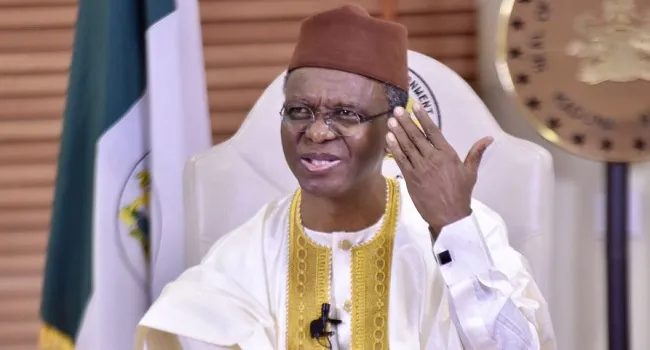
The Court of Appeal sitting in Kaduna on Monday, October 5, reserved judgment in the appeal filed by former Kaduna State Governor, Malam Nasiru Ahmad El-Rufai, challenging the ruling of the Kaduna State High Court that dismissed his bail application.
El-Rufai, who is being prosecuted by the Independent Corrupt Practices and Other Related Offences Commission (ICPC), had approached the Court of Appeal, asking it to overturn the High Court’s ruling and grant him bail.
Speaking to newsmen shortly after the proceedings, the ICPC lead counsel, Ayodeleji Adelukpe, said the former governor approached the Court of Appeal with an application challenging the ruling delivered by the trial court on his bail application.
“We oppose that because the bail application he is appealing against here, which is the ruling on the application, is the second one. They actually filed three before the trial judge.
“The first one was dismissed. They brought another one without showing any exceptional ground, so it was dismissed too. However, without relenting, they proceeded with another application, making it the third, which was also dismissed.
“Upon dismissal of the third application, El-Rufai decided to appeal the second application, which was the second ruling that led to this current appeal. That is why we are challenging the appeal.
“We are challenging the appeal because the trial judge who dismissed those applications was right. They failed to show any exceptional ground for why the second application should be granted.
“Despite this, they did not in any way inform the Honourable Court that they had filed the third application, which was also dismissed.
“In summary, our argument is that the appeal is unmeritorious,” he said.
However, lead counsel to the appellant, Paul Erokoro, SAN, expressed confidence that the Court of Appeal would grant their request and overturn the High Court’s decision on the bail application.
Erokoro described El-Rufai’s arrest and the legal battles surrounding him as politically motivated, arguing that the former governor did not commit treason or kill anyone and that the offences he is charged with are bailable.
“El-Rufai is a public figure who cannot run; he was a former governor and a former minister and is an elder statesman.
“Bail is a constitutional right. Except in capital offences, a defendant who is not on bail finds it very difficult to prepare his case.
“El-Rufai, held in ICPC custody by the agency prosecuting him, will find it difficult to access his lawyers and witnesses because he cannot be sure his communication with them is confidential.
“But with this appeal, we hope the court will take a different view and honour the bail application,” he said.
News
Rep. Abubakar Kabir Bichi Welcomes 21 Foreign Scholarship Beneficiaries, Flags Off Second Batch of 38 Students

Rep. Abubakar Kabir Bichi Welcomes 21 Foreign Scholarship Beneficiaries, Flags Off Second Batch of 38 Students
Hon. Abubakar Kabir Abubakar, member representing Bichi Federal Constituency and Chairman of the House Committee on Appropriation, has welcomed 21 beneficiaries of his foreign scholarship programme who recently returned after completing their Master’s degree programmes abroad.
He also flagged off the second batch of the programme, comprising 38 new beneficiaries who are set to travel abroad to pursue Master’s degree programmes.
The event, which took place on Monday, 5 October 2026, at the Hagagawa Mini Stadium, Bichi, Kano State, featured a welcoming ceremony for the returning scholars, as well as the flag-off and presentation of awards to the second batch of beneficiaries.
The returning beneficiaries studied various science and technology-related courses, including Cybersecurity, Software Engineering and Information Technology. Six of the beneficiaries have also secured employment with the Federal Government and are expected to commence work at any time this week.
The event was attended by members of the National Assembly, stakeholders, community leaders, representatives of dignitaries, beneficiaries and their families, as well as other invited guests.
Addressing the returning beneficiaries, Abubakar Kabir said the initiative was part of his efforts to address some of the challenges confronting the education sector and contribute to the development of human capital.
“If you remember, one and a half years ago, we gathered here to see you off as you departed for Malaysia to pursue your Master’s degree. Alhamdulillah, today we are here again to welcome you back after successfully completing your Master’s degree.”
“I was impressed by your dedication. As we can see today, you have all become high flyers in your different fields after graduation.
“This initiative is part of my efforts to address existing educational gaps and fast-track our country’s development. Globally, human capital is the number one asset, and it is against this backdrop that we have taken this step,” he said.
Speaking to the new beneficiaries, Abubakar Kabir urged them to remain good ambassadors of Nigeria while abroad. He charged them to remain focused on their studies, achieve outstanding academic results and make the country proud.
He noted that all necessary arrangements had been made to provide the beneficiaries with a conducive learning environment.
“In this regard, I feel that the best action is to support what President Bola Ahmed Tinubu and Governor Abba Kabir Yusuf are doing by providing access to education for less privileged youths,” Abubakar Kabir added.
Earlier, the Secretary of the Foreign Scholarship Committee, Dr. Ado Abdu Bichi, said the beneficiaries were selected strictly on merit after undergoing a comprehensive screening process.
He commended the initiative of Abubakar Kabir Abubakar, saying the scholarship programme would contribute significantly to producing more highly educated young people in Bichi Federal Constituency.
Also speaking at the event, Hon. Alhassan Ado-Doguwa, member representing Doguwa/Tudun Wada Federal Constituency in the House of Representatives, commended Abubakar Kabir for his commitment to empowering young people through education.
“I have spent almost over 30 years in the House of Representatives, and I have never seen a member like Abubakar Kabir Abubakar. His participation and commitment are not only in Bichi, Lagos or Enugu; they extend across Nigeria,” Ado-Doguwa said.
The event brought together lawmakers from across the country, stakeholders, representatives of dignitaries, beneficiaries and their families, community leaders and other invited guests to mark another significant phase in the foreign scholarship programme.
News
International Arabic Conference Calls for AI Integration

An international conference on Arabic language and literature held at Bayero University, Kano (BUK), has called for the integration of artificial intelligence, digitalisation and modern technology into the teaching, research and development of Arabic language studies. The recommendation was contained in a communiqué issued at the end of the conference organised by the Department of Arabic, Faculty of Arts and Islamic Studies, BUK, from September 28 to 30, 2026.
The conference, titled “Contemporary Issues in Arabic Language and Literature: Prospects and Challenges,” brought together scholars, researchers, postgraduate students, educators and officials from Nigeria and other countries, including Chad, Algeria and Egypt, according to the communiqué signed by Professor Muhammad Rabiu Auwal, Chairman of the Local Organising Committee.
The conference participants said the rapid development of artificial intelligence and digital technology had created both opportunities and challenges for the Arabic language, urging scholars and relevant authorities to develop practical approaches for advancing Arabic language teaching, learning and research in the digital era, according to the communiqué.
The participants also called on governments, educational institutions and policymakers to explore the use of Arabic in national development, particularly in education, media, translation, diplomacy, the economy and culture. The conference further recommended aligning Arabic studies with societal needs and labour market demands through research in language, literature, criticism, linguistics, translation and interdisciplinary studies, according to the communiqué.
The conference urged stakeholders to review Arabic language teaching methods and curricula, particularly for non-native speakers, while strengthening the connection between Arabic studies and modern fields such as computing, artificial intelligence, translation, media, tourism, diplomacy and the economy. The communiqué also called for collaboration between Arabic departments and departments of computer science, artificial intelligence, linguistics, translation and media.
The participants further recommended stronger academic cooperation between Nigerian universities and institutions around the world through exchange programmes, joint research projects, conferences, seminars, co-supervision of academic theses, exchange of professors and researchers, and sharing of scholarly publications and resources, according to the conference communiqué.
The conference also called for greater cultural and intellectual exchange between Arabic-speaking communities and Africa’s diverse peoples and languages, while encouraging students in higher institutions to pursue innovative research topics rather than merely repeating traditional areas of study. The participants, however, stressed the importance of preserving Arabic cultural heritage while embracing new areas of scholarship and technological development.
The opening ceremony was attended by representatives of the Vice Chancellor of Bayero University, Kano, and the Wazirin Kano, as well as the Director of the Egyptian Cultural Centre in Kano, the Vice President of the Association of Arabic Language and Literature Teachers in Nigeria, and the Deputy Vice-Chancellor of Mangal University of Technology in Chad, who delivered the keynote address, according to the communiqué.
The conference also called on governments and institutions to provide resources for Arabic-related scientific research and support academic programmes, conferences, seminars and research initiatives aimed at strengthening the language in response to contemporary challenges.

Court of Appeal Reserves Judgment on El-Rufai’s Bail Appeal

Rep. Abubakar Kabir Bichi Welcomes 21 Foreign Scholarship Beneficiaries, Flags Off Second Batch of 38 Students

International Arabic Conference Calls for AI Integration

World Teachers’ Day: NUT Urges Kano Govt to Declare October 5 Public Holiday, Advocates Special Salary Scale

Kano First Forum Petitions Police Over Alleged Inciting Statements by Aminu Babba Dan Agundi

Zamfara Varsity ASUU Threatens Warning Strike Over FG-ASUU Agreement, Promotion Arrears

Kano Chemists Threaten Warning Strike Over Alleged PCN Pressure

Per Ishaq Samaila: “Waziri” for Strategy. “Mai Jama’a” for Service. One Man. One Mission. Ibrahim Kabir Masari

Goje’s Electoral War:The Confrontation With Tinubu,Governor Inuwa,Usman Kumo And APC candidates Ahead Of 2027

PCACC Arrests Man Over Alleged ₦4.5m Sale, Illegal Leasing of Kano Government Horse Stable
Court of Appeal Reserves Judgment on El-Rufai’s Bail Appeal
Rep. Abubakar Kabir Bichi Welcomes 21 Foreign Scholarship Beneficiaries, Flags Off Second Batch of 38 Students
International Arabic Conference Calls for AI Integration
World Teachers’ Day: NUT Urges Kano Govt to Declare October 5 Public Holiday, Advocates Special Salary Scale
Kano First Forum Petitions Police Over Alleged Inciting Statements by Aminu Babba Dan Agundi
Zamfara Varsity ASUU Threatens Warning Strike Over FG-ASUU Agreement, Promotion Arrears
Kano Chemists Threaten Warning Strike Over Alleged PCN Pressure
Per Ishaq Samaila: “Waziri” for Strategy. “Mai Jama’a” for Service. One Man. One Mission. Ibrahim Kabir Masari
Goje’s Electoral War:The Confrontation With Tinubu,Governor Inuwa,Usman Kumo And APC candidates Ahead Of 2027
PCACC Arrests Man Over Alleged ₦4.5m Sale, Illegal Leasing of Kano Government Horse Stable
-

 Opinion5 years ago
On The Kano Flyovers And Public Perception
-

 Features5 years ago
How I Became A Multimillionaire In Nigeria – Hadiza Gabon
-

 Opinion6 years ago
Kano As future Headquarters Of Poverty In Nigeria
-

 History5 years ago
Sheikh Adam Abdullahi Al-Ilory (1917-1992):Nigeria’s Islamic Scholar Who Wrote Over 100 Books And Journals
-

 Opinion5 years ago
My First Encounter with Nasiru Gawuna, the Humble Deputy Governor
-

 History5 years ago
The History Of Borno State Governor Professor Babagana Umara Zulum
-

 History6 years ago
The Origin Of “Mammy Market” In Army Barracks (Mammy Ochefu)
-

 News5 years ago
Federal University Of Technology Babura To Commence Academic Activities September