
News
Breaking:ADC Reaffirms Ibrahim Khalil as 2027 Kano Governorship Candidate, Rejects Alleged Imposition
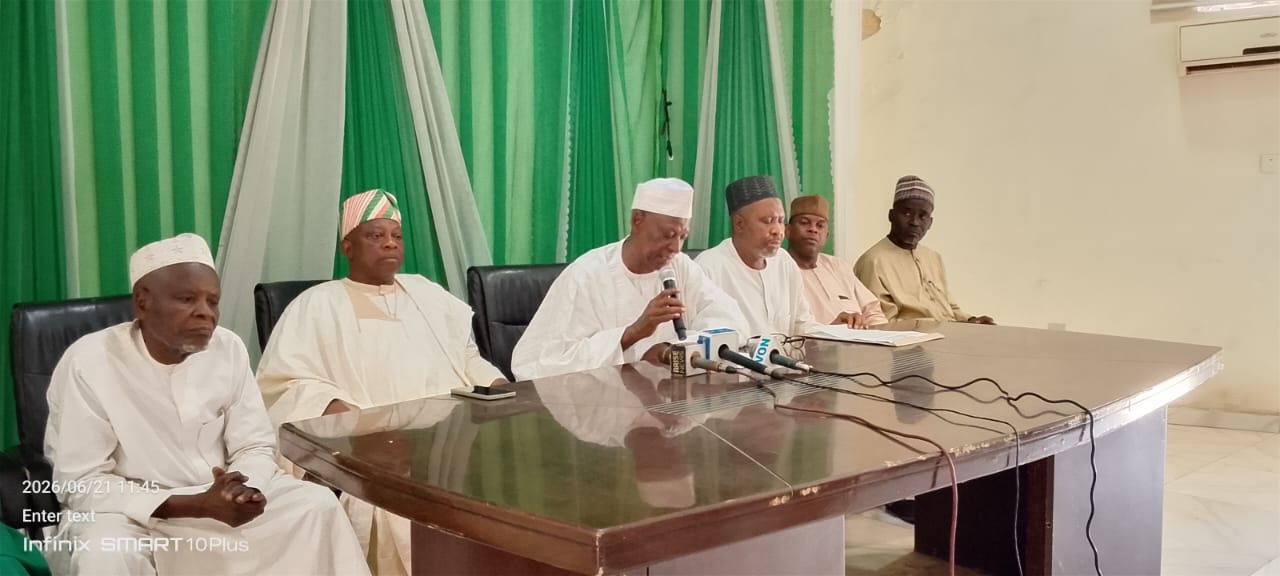
The leadership of the African Democratic Congress (ADC) in Kano State has reaffirmed Malam Ibrahim Khalil as the party’s sole and legitimate candidate for the 2027 Kano State governorship election, while strongly rejecting what it described as attempts by external forces to undermine the outcome of the party’s gubernatorial primary election.
The position was made public on Saturday at the Kano Press Centre of the Nigerian Union of Journalists (NUJ), where senior party figures addressed journalists and accused certain national actors within the party of interfering in the affairs of the Kano chapter.
Speaking on behalf of the Expanded State Interim Leadership Team (ESILT) and other stakeholders, party elder Alhaji Sulaiman Muhammad Mabo said the Kano chapter remained united behind Ibrahim Khalil and would resist any effort to alter the mandate given to him by party members.
According to the leaders, Khalil emerged victorious during the ADC gubernatorial primaries conducted on May 22, 2026, securing 55,851 votes against his closest rival, who polled 4,000 votes.
“The election was clear and decisive,” the stakeholders said in a position paper addressed to the party’s National Chairman, Senator David Mark. “There was a winner and there was a loser. The mandate freely given to Malam Ibrahim Khalil by party members must be respected and restored.”
The Kano ADC leadership argued that their endorsement of Khalil goes beyond the primary election results, describing it as a strategic decision rooted in Kano’s political significance and unique electoral realities.
They noted that Kano remains one of Nigeria’s most influential political and economic centres, particularly in Northern Nigeria, and that the state’s electoral performance often carries implications for national elections.
According to the stakeholders, Khalil’s influence among Islamic scholars and religious institutions could strengthen the ADC’s prospects across the North-West region and contribute positively to the party’s presidential ambitions in 2027.
They also highlighted what they described as his broad grassroots appeal, claiming he enjoys support across different religious groups, social classes, and demographic categories.
“Khalil enjoys widespread acceptance among women and young people, many of whom regularly follow his radio programmes,” the statement said.
The stakeholders further praised Khalil’s longstanding commitment to the ADC, describing him as one of the party’s foundational figures in Kano.
They credited him with helping establish party structures and ensuring the survival of the ADC during difficult periods, arguing that his loyalty and sacrifices positioned him as the most deserving candidate for the governorship ticket.
The statement also portrayed the Islamic scholar as a unifying figure capable of bringing together various Islamic groups while maintaining cordial relationships with Christian communities across the state.
According to the leaders, such qualities make him a credible alternative to what they called the “corrupt politics” associated with rival political forces.
A major focus of the briefing was the alleged interference of Hajiya Naja’atu Muhammed, former Deputy National Chairman (Values and Ethics) of the ADC.
The Kano stakeholders accused her of attempting to influence the conduct and outcome of the state’s primary election, including allegedly instructing the chairman of the election committee not to announce the results.
They further alleged that she had sidelined legitimate party stakeholders in favour of individuals loyal to her interests.
The leaders argued that the ADC constitution does not grant any national officer the authority to arbitrarily direct the affairs of state chapters.
“Being a national officer does not confer the power to dictate the affairs of a local chapter,” the statement declared. “The constitution clearly outlines the responsibilities of each organ of the party, and no provision empowers any deputy national chairman to superintend over state chapters.”
The Kano leadership also maintained that the office previously occupied by Naja’atu Muhammed no longer possesses substantive legal standing following constitutional amendments and decisions reached by the party’s National Executive Committee (NEC).
They described any actions taken under that authority as “unlawful and constitutionally invalid.”
Responding to concerns that Ibrahim Khalil may lack the financial resources required for a competitive gubernatorial campaign, the stakeholders pointed to Kano’s political history as evidence that electoral success in the state is not solely determined by wealth.
They cited the victories of former governors such as Muhammadu Abubakar Rimi in 1979, Rabiu Musa Kwankwaso in 1999, and Ibrahim Shekarau in 2003, arguing that each overcame financially stronger opponents through public support and credibility.
“If history teaches us anything, it is that Kano voters have consistently demonstrated a willingness to choose candidates based on character, integrity and principles rather than wealth,” the statement said.
The Kano ADC leadership concluded by urging the party’s national leadership to intervene immediately and halt what it described as continued interference in the affairs of the state chapter.
The stakeholders warned that ignoring the will of party members could trigger internal divisions and electoral setbacks, drawing parallels with challenges experienced by the former Congress for Progressive Change (CPC) ahead of the 2011 elections.
They declared that the Kano chapter remains firmly committed to defending Khalil’s mandate and would no longer cooperate with directives linked to the alleged interference.
“The Kano State ADC is firmly resolved that Malam Ibrahim Khalil’s mandate must be respected,” the leaders stated. “We will no longer tolerate interference or cooperate with any assignment connected to these actions, regardless of who issues such directives.”
The statement was signed by former Kano ADC Chairman Alhaji Musa Shu’aibu Ungogo, party elder Alhaji Sulaiman Muhammad Mabo, and the party’s Administrative Secretary, Dr. Bala M. I. Takai, on behalf of members of the Expanded State Interim Leadership Team and other stakeholders across Kano State.










News
State Police: 24 State Assemblies Approve Constitutional Amendment–Presidency

By Yusuf Danjuma Yunusa
The Presidential Working Group on the National Policing Bill says 24 State Houses of Assembly have approved the Constitution (Sixth Alteration) Bill, 2026, providing for a dual policing system.
The approval meets the constitutional threshold of two-thirds of the 36 states required for the amendment to proceed.
The Working Group commended the State Houses of Assembly for their action and acknowledged the National Assembly for passing the amendment in both chambers.
This is contained in a statement issued by Femi Gbajabiamila, Chief of Staff to the president and chairman of the Working Group, on Friday in Abuja.
“In line with Section 9 of the Constitution, the amendment can now be returned to the National Assembly for transmission to Mr President for assent.”
Mr Gbajabiamila said the approval provided constitutional backing for the policing framework outlined in the Working Group’s draft National Policing Bill, 2026.
He added that the draft bills were undergoing legislative drafting, review and validation at the Federal Ministry of Justice.
The bills are expected to be returned on or before October 30, after which the Working Group will give them final consideration before presenting them to President Bola Tinubu.
The Working Group urged stakeholders to support a smooth transition to a dual policing system aimed at improving public safety.
News
ECOWAS Court Faults Process Backed by Council of Ministers in Darma Removal Case
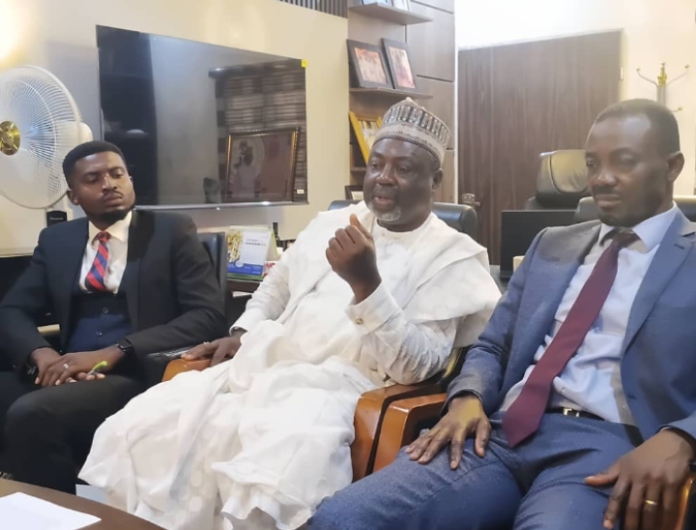
The ECOWAS Community Court of Justice has ruled that the removal and replacement of former ECOWAS Commissioner for Internal Services, Prof. Nazifi Abdullahi Darma, were unlawful, overturning a process that culminated in his replacement being formalised by the Council of Ministers.
Darma disclosed the outcome while briefing journalists in Abuja on the Court’s recent judgment.
He said the dispute arose after a memorandum dated 30 October 2025 by the then President of the ECOWAS Commission, Dr. Omar Alieu Touray withdrew responsibilities previously exercised by Darma and initiated steps that eventually led to his replacement.
While Darma challenged the actions before the ECOWAS Court on 3 November 2025, the Federal Republic of Nigeria subsequently recalled him and nominated a successor.
The Council of Ministers later formalised the replacement.
However, the Court found that the legal requirements for ending his mandate had not been satisfied.
According to Darma, the Court held that the memorandum triggering the process was based on adverse allegations that affected his responsibilities and was issued without giving him an effective opportunity to respond.
“The Court found that these actions were taken without prior notice or an effective opportunity for me to respond,” he said.
The Court further ruled that managerial powers vested in the President of the Commission could not be used to extinguish or transfer responsibilities assigned by Community law to another statutory office.
Darma said the Court also rejected the argument that Nigeria’s recall automatically ended his tenure as Commissioner.
“Once appointed, a Commissioner derives his mandate from Community law and not from the nominating Member State,” he quoted the Court as holding.
The Court consequently declared that his removal and replacement were unlawful, notwithstanding the subsequent actions taken to formalise the change in office.
The judgment ordered the payment of outstanding salaries, allowances and accrued entitlements up to the expiration of his tenure and awarded him US$50,000 in general damages.
Because his tenure expired on 31 August 2026, the Court did not order reinstatement.
Describing the ruling as significant for regional governance, Darma said it reaffirmed that ECOWAS statutory office holders can only be removed through procedures recognised by Community law.
News
Dangote Cement Gboko Commits Millions in Scholarship Scheme
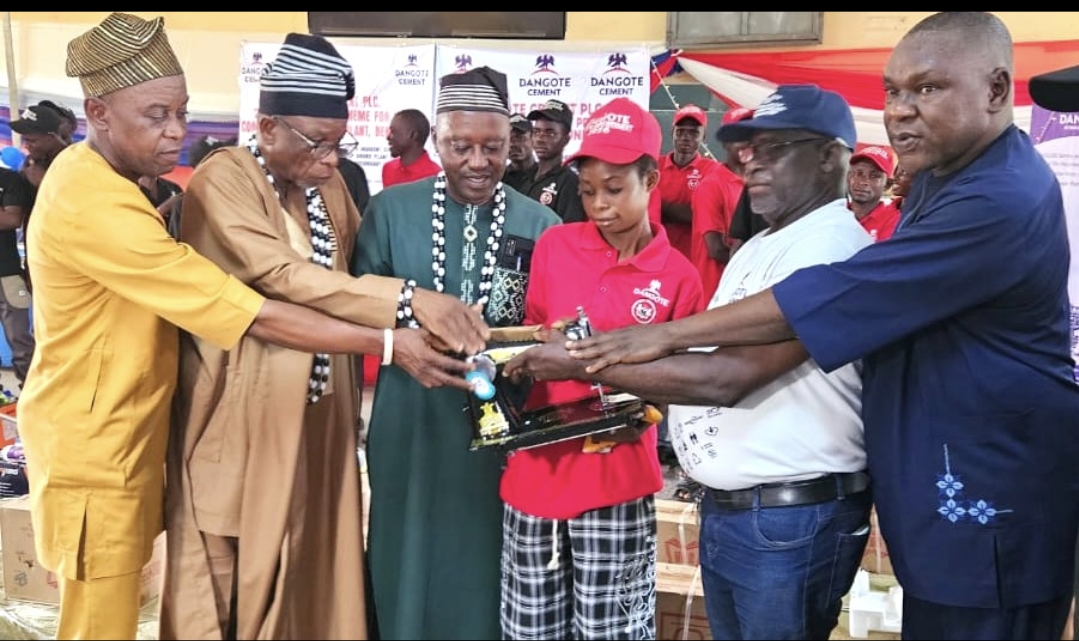
Dangote Cement Plc, Gboko Plant has awarded multi-million-naira scholarships to tertiary and secondary school students from its six host communities in Benue State.
The company also presented starter packs, working tools and certificates to graduates of its Youth Empowerment Programme to enable them to establish their own businesses, apply the skills acquired during the training and become financially reliant.
The Minister of Solid Minerals Development, Dr. Henry Dele Alake, lauded Dangote Cement Plc for its community development interventions, calling on other private sector players to adopt similar initiatives to promote socio-economic development in their host communities.
Dr. Alake, who was represented by the Federal Mines Officer of the Federal Ministry of Solid Minerals Development in Benue State, Engr. Achi Gregory, urged the company to sustain its commitment to implementing community development programmes agreed upon with its host communities.
Speaking at the official presentation ceremony, Group Head, Social Performance, Dangote Cement Plc, Mr. Wakeel Olayiwola, said the implementation of the Community Development Agreement underscores Dangote Cement’s commitment to equipping young people with practical skills and resources to promote entrepreneurship, create employment opportunities and improve livelihoods in its host communities.
Mr. Olayiwola, who was represented by the Head of Social Performance of the Dangote Cement, Gboko Plant, Dr. Johnson Kor, said the scholarship and youth empowerment programmes came against the backdrop of several other programmes recently executed by the company, which include farmers and women empowerment programmes.
The Acting Plant Director, Dangote Cement, Gboko, Engr. Arbind Singh, said: “This annual scholarship scheme for indigent students of the host communities is an indication of our company’s commitment to its Corporate Social Responsibilities (CSR).”
Engr Singh, who was represented by the company’s General Manager, Production, Engr Tabershima Soom, said: “The Gboko Plant has already launched 150 Women Empowerment Programme and 50 Farmerss Empowerment Programme where women were provided with cash to support their businesses, and farmers were supported with farm inputs.”
The beneficiary communities for these programs are: Tse-Kucha, Quarry, Amua, Mbazembe, Mbatur, and Pass Brothers.
Speaking on behalf of the Benue State Attorney-General, the Chairman of the Mineral Resources and Environmental Management Committee (MIREMCO), Barr. Dooshima Orosaga, commended Dangote Cement Plc for its compliance with the Community Development Agreement (CDA), urging the beneficiaries and host communities to maximise the benefits of the company’s interventions.
Chairman of the Gboko Local Government, Hon Yina Elias said the government will continue to provide the support needed for the company to succeed, adding that the Dangote Cement Plc is an exemplary company in Corporate Social Responsibilities programmes.
In his remarks, the District Head of Ukpekpe, Chief Tsegba Igbarumun, commended Dangote Cement Plc’s Gboko Plant for its contributions to the community, assuring the company of the community’s continued support.
He said the community valued its mutually beneficial relationship with the company and would continue to serve as its ambassadors.
A beneficiary of the Youth Empowerment Programme, Mr Ignatius Aondohemba, expressed appreciation to Dangote Cement Plc for the support, pledging to put the skills and resources provided to good use and build a business that would enable him to become an employer of labour.

State Police: 24 State Assemblies Approve Constitutional Amendment–Presidency

ECOWAS Court Faults Process Backed by Council of Ministers in Darma Removal Case

Dangote Cement Gboko Commits Millions in Scholarship Scheme

Mass Exodus Looms in Kano APC as More Chieftains Consider Exit — Mansur Ahmed

Kano Donates Equipment to NDLEA

PCACC Arrests Man Over Alleged ₦4.5m Sale, Illegal Leasing of Kano Government Horse Stable

Kano Monitors ₦48.9bn Projects Across Six LGAs

Goje’s Electoral War:The Confrontation With Tinubu,Governor Inuwa,Usman Kumo And APC candidates Ahead Of 2027

Kano Spends ₦10.36bn on Hospitality, Sitting Allowances, Others in Six Months

Prof Yusuf Adamu Delivers BUK’s 63rd Professorial Inaugural Lecture, Reflects on Medical Geography and Academic Legacy
State Police: 24 State Assemblies Approve Constitutional Amendment–Presidency
ECOWAS Court Faults Process Backed by Council of Ministers in Darma Removal Case
Dangote Cement Gboko Commits Millions in Scholarship Scheme
Mass Exodus Looms in Kano APC as More Chieftains Consider Exit — Mansur Ahmed
Kano Donates Equipment to NDLEA
PCACC Arrests Man Over Alleged ₦4.5m Sale, Illegal Leasing of Kano Government Horse Stable
Kano Monitors ₦48.9bn Projects Across Six LGAs
Goje’s Electoral War:The Confrontation With Tinubu,Governor Inuwa,Usman Kumo And APC candidates Ahead Of 2027
Kano Spends ₦10.36bn on Hospitality, Sitting Allowances, Others in Six Months
Prof Yusuf Adamu Delivers BUK’s 63rd Professorial Inaugural Lecture, Reflects on Medical Geography and Academic Legacy
-

 Opinion5 years ago
On The Kano Flyovers And Public Perception
-

 Features5 years ago
How I Became A Multimillionaire In Nigeria – Hadiza Gabon
-

 Opinion6 years ago
Kano As future Headquarters Of Poverty In Nigeria
-

 History6 years ago
Sheikh Adam Abdullahi Al-Ilory (1917-1992):Nigeria’s Islamic Scholar Who Wrote Over 100 Books And Journals
-

 Opinion5 years ago
My First Encounter with Nasiru Gawuna, the Humble Deputy Governor
-

 History5 years ago
The History Of Borno State Governor Professor Babagana Umara Zulum
-

 History6 years ago
The Origin Of “Mammy Market” In Army Barracks (Mammy Ochefu)
-

 News5 years ago
Federal University Of Technology Babura To Commence Academic Activities September