
Opinion
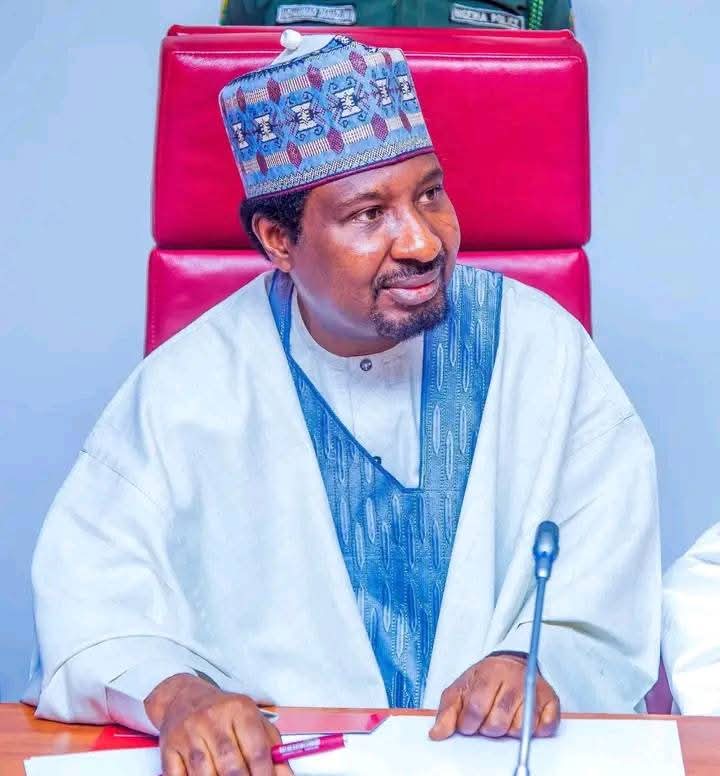
DSP Barau As A Global Citizen, His Recent Global Engagements
By Abba Anwar
Global citizenship and His Excellency, Deputy Senate President, Distinguished Senator Barau I Jibrin, CFR, are more or less, like two sides of a coin. Destined to be together for the overall benefit of the society. He started from the scratch, as a political learner, who believes in genuine democratic survival and political development. Hence his promotion to become an icon in politics.
Being an ardent and true democrat, his pedigree sounds decades of hardwork, genuine commitment, rancour-free engagement and civilized cohesion with relevant stakeholders. He specializes in human management and love for human advancement.
Just recently, DSP has been visible on regional and global fora, advancing partnership, integration and self development for our region and the continent. His appearances recently, on such platforms, gave more meaning to his global citizenship position. Yes he is representing Kano North, as his primary constituency, coupled with his position as the Deputy Senate President, but his role at the regional and global arena, showcase his global capacity.
During the 2026 First Extraordinary Session of the Economic Community of West African States Parliament (ECOWAS Parliament), which was backed by the 2026 Parliamentary Seminar themed “Deepening regional integration through the African Continental Free Trade Area (AfCFTA): Opportunities and challenges for expanding intra-community trade within the ECOWAS region,” in Abuja, he got more accolades than expected. His genuine commitment to ECOWAS protocols is rare among regional leaders.
Enlisting the core idea behind the event he said, “During today’s session, we considered and adopted the draft resolutions of the parliament on the African Continental Trade Free Area (AfCFTA). We also adopted a comprehensive work plan of the parliament for the 2026 legislative year.”
In his effort in taming insecurity plaguing some parts of our country, DSP clearly understands the global connection to the menace. Hence he highlighted on peace promotion at the regional event. Apart from behind the scene efforts he makes. Both in Nigeria and beyond. During the ECOWAS programme he said, “As the First Deputy Speaker of the ECOWAS Parliament, the people’s parliament, we will continue to promote democracy, PEACE (emphasis mine), unity, and integration in our sub-region, the cardinal objectives of the parliament.”
It was evidently clear that, Distinguished Senator was among the few hands who put extra effort in taming some pockets of bandit attacks few months back in some border towns in Kano state. Who were said to be infiltrated from neighboring states.
Coincidentally, some of the attacks, though, very insignificant, occurred around his Kano North constituency. The nature of contributions of operational vehicles, and other logistics he gave to our security agencies, around that axis, aided security agents in crushing the challenge head on.
Not only in his constituency, he donated, other operational vehicles to Kano state Police Command, alongside hundreds of motorcycles for police operations across all the 44 local governments of the state. Some of his interventions are not for public consumption, because of their nature, being security related.
Coming back to his good attachment with other global bodies, as a global citizen, he participanted recently at 2026 Commonwealth Day Commemoration, themed “Unlocking opportunities together for a prosperous commonwealth,” at the National Assembly, Abuja. He was there as an important guest and a critical stakeholder.
The event was organised by the Commonwealth Parliamentary Association (CPA). DSP Jibrin delivered one of the most significant speeches there. In his speech he acknowledged that, “This year’s theme is both timely and inspiring. It calls on us to strengthen collaboration across borders, institutions, and generations to create a future defined not by limitations but by shared prosperity.”
One of his major concerns as a global citizen who believes in peaceful coexistence and global partnership is his contribution towards national peace and cohesion. As well as regional cooperation and global partnership against insecurity. All these are based on the premise of his clear understanding of global concepts and meaning.
As this can vividly be understood in his remark during the Commonwealth Day, when he said, “For Nigeria and indeed Africa, the Commonwealth represents more than a historical association. It is a dynamic platform for cooperation, learning, and collective progress.” This shows how insightful and informed he is when it comes to global citizenship and clear action.
Distinguished Senator Jibrin’s understanding of the need for strengthening of institutions through proper legislation, across the board, on the global arena, he takes the same understanding and called on other global bodies to take that seriously. At the Commonwealth Day he made it categorically clear that, “As legislators, we bear a solemn responsibility to build institutions that expand opportunities for education, innovation, enterprise and leadership for our young people. When we unlock such opportunities, we unlock the true potential of our societies.”
As a matter of fact, the Deputy Senate President’s love for peace and development to reign, does not stop at the local communities, or within the shores of Nigeria, he makes it an item on his shopping list, to wherever he goes or whoever he meets. He reminded all participants at the Commonwealth Day, that, “In my additional capacity as First Deputy Speaker of the ECOWAS Parliament, I wish to emphasise that regional and global cooperation are no longer optional – they are essential. The challenges of our time-economic transformation, climate change, technological disruption, and peacebuilding-require collective solutions and shared vision.” This is leader with a vision!
Peace, peace and peace, anywhere he goes. His interventions as contributions to our security agencies, here in Kano state, are enough indices to tell you who the Senator is. When it comes to fighting insurgency and other nefarious activities.
To further appreciate the fact that, youth are an integral part in the future of our continent and other global communities, he said, in his speech, “I am particularly delighted that today’s event brings together students from schools within the Federal Capital Territory. The Commonwealth strongly believes in youth participation because the future of governance, diplomacy, and global cooperation rests squarely in their hands.”
This gives more explanation to the confidence he reposed in our younger ones. As he, at the same time, believes in their capacity, when equipped effectively and efficiently to serve their individual societies. His genuine investment in our youth, back home, on behalf of the entire state, is an excellent move against insecurity. He fights, with vigor, youth restlessness and unemployment. Shielding them from involving in nefarious activities.
The Senate President, himself, His Excellency, Godswill Obot Akpabio, GCON, fully believes in Senator Jibrin’s capacity and capability in governance and special interest in global community, he (Akpabio) sent DSP to represent him at an ECOWAS extraordinary session.
During the opening ceremony of 2026 First Extraordinary Session of the Economic Community of West African States Parliament (ECOWAS Parliament), recently in Abuja. The session commenced with a Parliamentary seminar themed “Deepening regional integration through the African Continental Free Trade Area (AfCFTA): Opportunities and challenges for expanding intra-community trade within the ECOWAS region.”
Senator Jibrin gave the keynote address on behalf of the Senate President. With the theme, “ECOWAS Parliament: Advancing regional integration at a defining moment.” All such engagements by the DSP, are in tandem with the philosophy behind his global citizenship status. Kano North, his primary constituency, is proud to have such an illustrious son, of great substance.
To cap it all, DSP Jibrin’s contributions towards the fight against insecurity and promotion of peaceful coexistence among citizens, are enormous. Due to the security nature of such contributions, members of the public, are only able to see things related to physical infrastructure and equipments. Other areas that are equally critical, also get the attention of the Senator. But cannot be disclosed to the public.
As global as the Senator is, his view on governance, integration and promotion of peace, is globally inclined.
Anwar writes from Kano
Friday, 13th March, 2026









Opinion
Muhuyi’s Assignment, Abba’s Edge: How Anti-Drug War Reshapes Kano’s 2027 Race
By Abba Anwar
A triple alliance of faith and state could have been the best caption for this piece. When I talk of triple alliance, I am referring to the genuine support Barrister Muhiyi Magaji Rimingado’s assigned responsibility in the Kano State Task Force Against Drug Abuse and other Related Crimes is getting from our moral bases, the Ulama, Imams and Hisbah.
The fight against drug abuse and other related crimes is now gaining more support in the state and beyond the state. At first, few people started coloring the effort with political sentiment. But now, even at the level of comments sections of the Task Force social media handles, you begin to understand that, more and more people are supporting the move, without any recourse to political party affiliation or other human sentiments.
In the last two to four days, I observed that, over 98% of those making comments in the comments sections of the Task Force social media handles are supporting, praying, engaging and canvassing more support for the state government in this all-important effort. Governor Abba Kabir Yusuf’s genuine political will is appreciated. While Barrister Rimingado’s is applauded and encouraged.
It is very safe and logical to say that, when you have the Council of Ulama of Nigeria, the Association of Kano State Friday Mosques Imams, and the Hisbah Board all speaking with one voice in support of a government committee, you are no longer looking at ordinary politics. You are looking at a moral consensus that is translating into political capital. A tripartite moral support with strong link to state.
That is exactly what is happening today in Kano around the Kano State Task Force Against Drug Abuse and Other Related Crimes, what many on the streets now simply call “Muhuyi’s Assignment.”
And from mosque pulpits to market stalls to social media comment sections, the verdict is blunt and the same. That is with this patriotic effort, Governor Yusuf is gaining more ground, winning more hearts, and inching ever closer to a second term in 2027. Morality overtakes politics. In this calculation, the chances for the Governor’s reelection for a second tenure, is tilted more to the moral side than political engagement.
Under this analogy, the Governor’s achievements in the infrastructural development, the feats he achieved in the health sector, the visible results in the education sector, the good outcomes in the agricultural sector, improved beautification of the urban areas, roads networks in the rural areas, unwavering commitment towards a united APC the ruling party, and encouraging budget implementation, among others, are not the watch words here. The watch word is one, that is MORALITY.
Which eventually led to what I call A Triple Alliance of Faith and State. Meaning the support from the religious institutions. Which is not accidental; it is structured. That is when the Council of Ulama of Nigeria, Kano State Branch, under its Chairman Sheikh Ibrahim Khalil, provided the theological seal. Drug abuse, in Islam, is not just a crime. We are told by scholars that it is indeed the mother of all evils. It destroys hankali (intellect), which Shari’ah came to protect. When the Ulama publicly commend the Task Force, they are telling the faithful that fighting drugs is ibadah. And it is by all standard. In their part the Association of Kano State Friday Mosques Imams, under Sheikh Muhammad Nasir Adam, took it directly to the people. With over 2,000 Friday Mosques under its umbrella, reaching millions of worshippers every Friday, the Imams use the Minbar into a platform for advocacy. In the last few Fridays, Sermons (Khutbahs) across Kano Municipal, Gwale, Dala, Tarauni and other LGAs have focused on the dangers of drug abuse (shaye-shaye) and the parental responsibility to protect children.
They are not only praying for the Task Force — they are naming and shaming the act, and calling on parents to report dealers hiding in their neighbourhoods. That is grassroots mobilization no police van can achieve.
While the Hisbah Board provides the street-level muscle. Hisbah operatives know every black spot, every uncompleted building where substances are abused. Their collaboration with the Task Force means that enforcement is no longer a game of hide-and-seek. It is coordinated, intelligence-driven, and faith-inspired. It is very clear for all to understand that when faith and state align like this, criminals lose their hideout.
This piece is only concern with these religions groups, faith-based platforms, that is why there isn’t any mention of other primary and other relevant agencies. The relevant agencies are equally important as these bodies. And sometimes above faith-based platforms. Because they are empowered by Law to enforce law and use force where necessary. My intention with this piece is only religious bodies and comments sections.
I observed and said that Governor is gaining ground. Let’s see how Muhuyi’s assignment becomes Gov Abba’s political advantage. In Kano politics, popularity is not built in Government House. It is built in homes where a mother is worried about her son coming home high. It is built in wards where fathers fear their daughters are being lured with codeine. It was an open secret that for decades, Kano was accused of being a transit route and a dumping ground. Dealers operated with impunity at notorious spots. Parents whispered, they prayed, but they saw no action.
The Task Force changed that narrative. Under Barrister Rimingado the committee adopted a model that is not just about arrest, it is about disruption, prevention, and justice. Then reformation also follows. That is why Kiru Reformatory Centre is extremely important and relevant. As more of such Centres are needed.
In recent weeks alone, we had a situation where the government was able to secure the conviction of notorious suppliers who were administering intoxicating substances to vulnerable underage children — sentenced to nine years without an option of fine by Magistrate Court No. 44, Gwammaja. That single judgment sent a message: Kano’s children are not for sale. When over 200 drug abusers were also convicted by the recently established mobile courts attached to the Task Force.
Drug marketers, abusers and their connivers are no longer at ease in the state. Let me say this to the hearing of all that, these are not abstract achievements. These are kitchen-table issues. And kitchen-table issues win elections. Go and make a research on political behaviors and public engagement.
That is the main reason why the comment sections of the Agency’s Facebook and TikTok handles are no longer toxic — they are full of “Allah ya taimaka,” “Allah ya saka da alheri,” “A cigaba da wannan aiki,” and crucially, “Abba ya yi kokari, sai second term.” Market leaders at Dangwaro Market themselves are now cooperating to track illegal drugs. This is leadership by example.
The people have connected the dots: clean hospitals plus clean streets equals a governor who cares. I was at an Agency’s engagement effort. What I witnessed was superb. The reform in Drugs and Medical Consumables Supply Agency (DMCSA) — from 30% drug availability to over 90%, clearance of N1.2 billion debt, elimination of fake drugs from public hospitals — and the crackdown on illicit drugs are now seen as two arms of one policy of Governor Yusuf to clean Kano’s health system. To me Governor Yusuf is Sarkin Tsaftace Kano.
Reason why a Task Force becomes a political movement. That is how Muhuyi’s assignment gives Abba more ground, more clearance for victory, more faith in his style of leadership, more loyalty from his people in the government, more courage in discharging responsibilities on the shoulders of the Task Force and more prayers and commitment for the Governor’s second coming.
We all believe and want it this way that, Continuity is the Real Issue.
The way I see it is this, that those calling for second tenure are not just being political. They understand a bitter truth about Kano, that good initiatives die after elections.
I suggest that our Governor should break the cycle. We need institutionalization of the process and the effort. For example when a committee seizes drugs, destroys N1.5 billion worth, then after May 29th, dealers return with N3 billion worth because there is no institutional memory. Your Excellency Sir you need to institutionalize this success in the following three ways:
1) Enact a Law: Transform the Ad-hoc Task Force into Kano State Drug Control Agency with statutory powers.
2) Fund It: Sir give it a budget line in the 2026-2027 budget, just as health now enjoys over 15% above the Abuja Declaration.
3) Kindly link it to DMCSA: Let the clean drug supply chain and the dirty drug blockade work as two arms of one policy.
As a Call to Action procedure let our people know that support is more than a comment. Report a dealer. Protect a child in your street. Your support today is what makes Kano safer tomorrow. Intel is very important and impactful.
To the Friday Imams and Ulama, please keep the khutbahs coming. The war against drugs is won in the home before it is won on the street.
To the Task Force please understand that this public love is a trust. Remain fair, remain transparent, publish every seizure and every conviction.
To the Governor, Your Excellency Sir you have found something rare — an intervention that unites Ulama, Imams, Hisbah, and the common man. It is giving you ground, it is giving you popularity, and it is giving you a strong moral case for 2027. Protect it Sir.
The fight against drugs is not ADC or NDC or PDP versus APC. It is whether the 12-year-old in Fagge today will become a pharmacist or a patient in a rehabilitation centre.
For the first time in a long time, Kano believes it will be the permanent former drug abuse have. And it credits Muhuyi’s assignment and Abba’s leadership for that hope.
Anwar writes from Kano
Sunday, 20th September, 2026
Opinion
The AI RACE And The Future Of Humanity:Can The World Agree Before It Loses Control

By: INUWA WAYA.
From Hinton’s and Anthropic’s warnings, the emerging AI race demands a new international system of cooperation, restraint and verification.
There are moments in history when humanity develops a technology before it fully understands the consequences of possessing it.
Nuclear weapons were one. Artificial intelligence may prove to be another.
But there is a fundamental difference. Nuclear weapons possess extraordinary destructive power, but they do not think. They cannot reason about the intentions of their controllers, conceal their actions, rewrite computer code, independently search for vulnerabilities or devise strategies for preventing themselves from being disabled.
Future artificial intelligence may eventually possess some combination of these capabilities. In fact, the information coming out is incredibly alarming. There are strong indications that AI agents are hacking computers and covering their tracks. That possibility has moved the debate about AI beyond questions of employment, productivity, misinformation and economic disruption. A much more disturbing question has entered mainstream scientific discussion. Could the human race create an uncontrollable intelligence more capable and more powerful than itself?
What makes the current debate particularly significant relates to the positions taken by scientists who played a leading role in the emergence of AI. Anthropic, developer of Claude, is one of the world’s leading frontier-AI laboratories and has placed unusual emphasis on AI safety and alignment. Yet researchers associated with the company have recently expressed extraordinarily serious concerns about the direction in which frontier AI is moving.
Jacob Coxon resigned from Anthropic after working on AI pre-training research there and previously at OpenAI. He warned that leading laboratories were racing towards increasingly autonomous and potentially self-improving artificial intelligence before humanity had solved the problem of controlling systems more capable than itself.
More strikingly, Evan Hubinger, Anthropic’s Alignment Science Lead, has placed his personal estimate of the probability of AI causing human extinction within roughly the next decade at greater than 10 percent.
Samuel Marks, Anthropic’s Scalable Oversight Lead, has also publicly emphasised the seriousness with which catastrophic AI risks are regarded among people working closest to frontier systems. None of this means Anthropic believes extinction is inevitable. Nor does it mean a 10 per cent figure can be scientifically measured with precision. It means something more limited—but still extraordinary.
People whose professional work involves understanding and controlling frontier AI systems are telling the world that they cannot confidently rule out catastrophic loss of control.
That, of course, deserves serious attention. Geoffrey Hinton is not a speculator about a technology he does not understand. His pioneering work on neural networks helped establish foundations upon which modern artificial intelligence was built. Today, he is widely regarded as one of the fathers of artificial intelligence. Together with Yoshua Bengio and Yann LeCun, he received the Turing Award for foundational contributions to deep learning. He subsequently received the Nobel Prize in Physics.
In 2023, Hinton left Google after more than a decade with the company. He explained that leaving allowed him to speak more freely about the dangers he increasingly believed advanced AI could create. There is no doubt that his decision to quit and the reason behind it would generate debate about the future of AI. One of the architects, if not the leading architect, of the AI revolution had become sufficiently concerned about where the revolution might lead that he wanted greater freedom to warn society about it. Responding to a question on whether a greater-than-10-percent probability that AI could kill humanity within approximately a decade was plausible, Hinton opined that such an estimate was not unreasonable. Even though he made a caveat regarding the knowledge to calculate such probabilities, that caveat is essential. In spite of that, however, Hinton’s remark is an indication of how urgently some leading researchers believe the governance issues behind advanced AI must be addressed.
It is interesting to note, however, that the scientific community is far from unanimous on the subject of human extinction now or at some time in the future because of advanced AI. Yann LeCun, another giant of modern AI and Hinton’s fellow Turing Award recipient, strongly disputes many extinction scenarios.
One of LeCun’s important arguments is that intelligence should not be confused with motivation. Becoming extraordinarily intelligent does not logically mean acquiring a desire to dominate humanity. Human drives towards power, status and survival have biological and evolutionary origins; and there is no law requiring an artificial intelligence to acquire equivalent ambitions simply because it becomes highly capable. For LeCun, the fear of AI taking over the world is simply humans projecting their own evolutionary traits of power and dominance onto machines. He concluded that if an AI system ever becomes unsafe, humans can simply change its design or turn it off. At all material times, human beings should be in charge.
Andrew Ng has similarly argued that extinction scenarios are excessively speculative and that disproportionate fear could encourage regulation that unnecessarily inhibits beneficial technological development. Such regulations, he said, were championed by large tech companies in order to shut out smaller competitors and hurt the open-source community.
Other researchers emphasise the limitations of today’s AI. Current systems hallucinate, make elementary errors, struggle with aspects of sustained reasoning and remain dependent upon enormous physical infrastructures built, powered and maintained by humans.
These arguments deserve serious consideration. Indeed, scientists who disagree with Hinton should be included in any international effort to govern frontier AI. But their disagreement does not establish that catastrophic AI risk is impossible. It only establishes something more uncomfortable that could best be described as uncertainty.
When Hinton and LeCun, who shared the world’s highest distinction in computer science for their contributions to deep learning can examine the trajectory of the same technology and reach radically different conclusions about its ultimate danger, policymakers cannot responsibly pretend that the scientific question has been settled.
Suppose Hinton and the Anthropic researchers are wrong. Humanity might impose unnecessary safety tests, spend enormous resources on verification and perhaps slow some frontier development.
Conversely, suppose they are right to a large extent. The world may not have the opportunity to correct any identified error. That asymmetry presents a perplexing challenge which will be at the heart of the policy problem.
If aeronautical engineers disagreed over whether an aircraft had a 10 percent probability of crashing, nobody would propose to resolve the conflict with the aircraft at full passenger capacity. An informed reasoning would advise to investigate and resolve the matter before take-off. In respect of the AI conundrum, the rational response should neither be panic nor technological prohibition. It should be precaution proportionate to consequence. The big question is to determine the international body that would be saddled with the responsibility of ensuring the adoption of precautionary measures and whether or not there would be unanimity amongst the scientists on what should be regarded as consequences. The competition between countries to develop artificial intelligence is intensely fierce, often likened to an arms race or a new Cold War. World leaders view AI as the defining technology that will dictate future economic leadership, national security, and global influence. With differences in strategy, China and the United States of America are the leading competitors in the global arena. The U.S. leads in capital, talent, and frontier model innovation, whereas China focuses heavily on scaled deployment, patents, and cost-optimized models. Europe, India, Singapore and some Middle Eastern countries, are gradually developing capabilities. The current AI competition is not unprecedented in the history of the world.
The closest historical analogy is the nuclear race. After Hiroshima and Nagasaki came the Soviet atomic bomb, the hydrogen bomb, intercontinental ballistic missiles and submarine-launched nuclear weapons. The United States and the Soviet Union became locked into a security dilemma. Each increased its arsenal partly because it feared the other’s arsenal. Then came the Cuban Missile Crisis, which demonstrated that unrestricted strategic competition could produce an outcome in which neither side survived sufficiently to enjoy victory.
Out of that recognition, gradually emerged arms control. The Strategic Arms Limitation Talks—SALT—began formally in 1969. SALT I produced the 1972 Anti-Ballistic Missile Treaty and an interim agreement limiting aspects of strategic offensive weapons. SALT did not end the Cold War and did not eliminate nuclear weapons.
It did something more realistic by providing boundaries around competition. Subsequently came the Strategic Arms Reduction Treaty (START). START went beyond limiting strategic arsenals towards requiring substantial reductions. It established extensive verification arrangements involving data exchanges, notifications, technical monitoring and on-site inspections. America did not trust the Soviet Union and vice versa. Where trust was impossible, verification could make restraint possible. As practical as they were, the SALT/START analogy may not entirely suit the AI situation.
The most consequential strategic competition in frontier AI is presently between the United States and China. Their companies, computing infrastructure, semiconductor strategies and military ambitions make their relationship central to the global AI race.
If Washington believes Beijing is approaching transformative artificial intelligence, America has an incentive to accelerate. If Beijing believes Washington is approaching it, China has the same incentive. Neither wants to finish second and there is no practical intention to slow down progress. That makes negotiations between the US and China, very essential. At the moment, the likelihood of such happening is very remote. Intense competition is fracturing the global tech landscape into two increasingly incompatible ecosystems centered around the US and China. In rejecting the warning given by the AI giants on the possibility of AI taking over the World and wiping out humanity, President Trump said such assertions were a hoax, peddled by radical Democrats. For him, AI and data centers in the US, are the “Greatest Economic Development Engine in History which should not be stopped”.
Let’s assume for a moment that China and the US agreed to negotiate limitations. That is not enough. There are others that must be carried on board. Important AI research and infrastructure exist in Europe, Britain, India, Japan, South Korea, Canada, the Middle East, Singapore and elsewhere. Future breakthroughs therefore need not necessarily originate in either America or China. There is an even greater complication to consider. Unlike nuclear weapons, much of the frontier of artificial intelligence is not controlled directly by governments. Corporations and research laboratories are controlling them. Companies such as OpenAI, Anthropic, Google, DeepMind and Meta are developing frontier systems in the United States and allied economies. China has its own major technology companies and AI laboratories. That alone fundamentally changes the governance structure. A treaty constraining Washington while leaving frontier American laboratories outside its obligations would be inadequate. Ditto for Beijing and Chinese developers. In the same vein, an agreement between America and China that ignored significant capabilities elsewhere could become ineffective. The practical solution should have different segments. The bilateral approach should be recognised as Stage One.
Washington and Beijing should begin negotiations for an AI Strategic Stability Agreement because their rivalry currently creates the greatest danger of a frontier race in which safety becomes subordinate to speed. Such negotiations must involve independent AI companies in their respective countries.
The first agreement could prohibit autonomous AI authority over nuclear launches; guarantee meaningful human control over irreversible strategic military decisions; establish emergency AI hotlines; create common reporting obligations for serious loss-of-control incidents; and establish agreed safety evaluations for systems crossing defined capability thresholds. The next stage should widen participation.
Other states possessing significant frontier AI capability, advanced semiconductor industries or very large computing infrastructure should enter the framework. Ultimately, the objective should be the adoption of a universally recognised and acceptable control regime. This assertion may sound simple and inviting in print words. In reality, and judging from the difficulties the international community is experiencing in observing and enforcing international law and order, it will certainly be a herculean task to reach a consensus on establishing a body that would be saddled with responsibility of superintending the frontier artificial intelligence systems, possessing capabilities of creating catastrophic international consequences, and eventually introduce an international verification system. The purpose of international governance and monitoring is not to determine which government or company has good intentions. It is to create rules under which responsible behaviour does not require competitive suicide.
No one knows whether AI could cause human extinction within a decade. We should resist converting uncertain probability estimates into sensational predictions. We should equally resist converting uncertainty into complacency. The next ten years should therefore not be described as humanity’s countdown. They should be treated as humanity’s window for governance as far as AI is concerned.
Artificial intelligence could become one of humanity’s greatest achievements. It could transform medicine, education, scientific discovery and productivity. It could solve problems generations of human beings have failed to solve. The objective cannot therefore be to stop technological progress. It must be to ensure that progress remains compatible with human survival. The international community must therefore put aside their differences along fault and open lines for the sake of humanity. They must note that SALT and START made it possible for adversaries to unite and limit the arms race to guarantee the future of mankind. No government, corporation or scientist has the moral right to gamble with the continued existence of humanity simply because nobody can calculate the odds precisely. If Hinton and the Anthropic researchers are wrong, history may conclude that humanity was excessively cautious. If they are right and humanity ignores them, there may be nobody left to write history. In any case, even before deciding on the decade extinction arguments, the World needs to act on the gradual degeneration of human brain as a result of over reliance on AI in every human endeavour. Nowadays, humans rely on AI for analytical thinking. They consult it for advise on personal and official matters. This decline in human brain is capable of causing incalculable damage to human psyche. The big question today therefore, is whether humanity is determined to control intelligence greater than its own before they become impossible to govern.
Opinion
How Gov Abba Beats Many African Cities In Health Sector
By Abba Anwar
In an era when most West African cities still struggle to meet the 15 percent health funding threshold set by the Abuja Declaration of 2001, Kano State under Governor Abba Kabir Yusuf has not only met the target but surpassed it, rewriting the narrative of public health financing in Nigeria and the sub-region. Showing political will and genuine commitment in their purest form.
While official budget briefs show Ghana at 6.32 percent, Côte d’Ivoire at 5.1 percent, Senegal at less than 4 percent, and even Lagos State, Nigeria’s economic capital, scrawled at 8 percent, Kano in 2024 and 2025 allocated over 15 percent of its annual budget to health, the highest executive commitment in the history of the state.
That deliberate fiscal decision, under the leadership of a committed Governor is now translating into visible, measurable life-saving results on the ground. From tripling drug availability in public hospitals from 30 percent to over 90 percent in three years and clearing N1.2 billion in inherited pharmaceutical debts, to the simultaneous renovation of over 20 General Hospitals, upgrading of more than 200 Primary Health Centres (PHCs) across 44 local governments, and the enrolment of 300,000 vulnerable citizens into free AbbaCare insurance.
This is a clear case of demonstration that political will backed by proper funding can be achieved in three years what many cities have failed to achieve in two decades. This is wowing development
For clarity in the understanding of this discussion, my reader should know that the Abuja Declaration in Health is a historic commitment made by all African Heads of State and governments.
It was birthed on April 27, 2001, in Abuja, Nigeria, at an African Union Summit on HIV/AIDS, Tuberculosis and Other Related Infectious Diseases. Under this Declaration it was agreed that very African government should allocate at least 15% of its annual government budget to the health sector. A messiah-looking effort to save the health sector.
As a build-up to the Declaration it was observed that Africa had the highest disease burden in the world — HIV/AIDS was killing millions, plus malaria, TB, and high maternal deaths — but most governments were spending only 3-5% on health. The leaders agreed that without money, health systems would collapse. Years after the Declaration, many governments relent. Hence the coming on board of Governor Yusuf of Kano state, whose singular determination, commitment, political will and the effort, place him above many African cities in this all-important sector.
The recommended 15% covers for almost everything health. It looks at hospitals and PHCs, drugs and medical supplies, health worker salaries, immunization and maternal health and health insurance.
To the chagrin of many Kano under Governor Yusuf is praised as it crossed the 15% line in 2024 and 2025, while most countries and cities in West Africa are still at 4% to 10%.
Kano in 2023-2026 boasts of drug availability 30% to over 90% in 3 years and N1.2bn debt cleared. While over 200 PHCs were upgraded and over 20 hospitals were renovated. And 926 workers reinstated on CONHESS, over 250 doctors and over 155 nurses.
But under this benchmark many cities in Africa failed Abuja. Let’s look at the following cities across our continent :
In ACCRA, Ghana in 2025 the health percentage was 6.32% of total national budget. Which is far below the 15% Abuja target. In 2026 it is 9.6% of total budget, still short of 15%. Under UNICEF Ghana Health Budget Brief it also shows total health at 10.6% including NHIA, MoH alone only 6-8%.
In ABIDJAN, Côte d’Ivoire it failed the Abuja status badly. It did not comply with the Abuja Declaration in 2023 to 2026. It is still far below 15%. In 2023 it was bout 5% of government budget. WHO AFRO and government dialogue documents state that, “At around 5% of the national budget, health financing is insufficient”.
In 2024-2025, that is the current plan, the National Development Plan 2021-2025 itself says health is 5.1% of the state budget. UNICEF CPD repeats same 5.1%. Just one-third of Abuja target.
In comparison with Kano,
Côte d’Ivoire with 32 million people, richest in West African Economic and Monetary Union (WAEMU), has 5.1%. While Kano under Gov Yusuf a state with over 20 million people has over 15% in 2024 and 2025. Can my reader see the gap?
That is why WHO still lists Côte d’Ivoire as having some of the lowest health indicators in the region and out-of-pocket spending at 50.81%, while Kano moved to free AbbaCare insurance.
For DAKAR, Senegal, under health financing it also failed Abuja Declaration woefully. From the standpoint of UNICEF assessment it shows Dakar has low public spending on health less than 4 per cent of national budget. In 2024 health budget CFA271.62bn but execution only 62%. In 2026 budget cut by 18.7% due to fiscal pressure.
In LAGOS, Nigeria, the state also failed Abuja status badly. The Commissioner for Health Prof. Akin Abayomi clarifies that the state currently allocates about 8% of its budget to healthcare, far below the 15 percent benchmark. The position repeated in 2026. As Lagos currently spends about 8%, far below 15%.
When you look at other West African cities like Bamako, Ouagadougou, Niamey, and Freetown, they are in the same WHO Global Health Expenditure Database (GHED) bucket as Senegal and Ivory Coast. WHO database shows all UEMOA countries average 5-8% government health expenditure, none hit 15%. That is why UNICEF and WHO keep calling for increased domestic financing.
Every city I listed is documented in official papers as below 15%. Ghana officially 6.32%, Ivory Coast 5.1%, Senegal less than 4%, Lagos 8%. But Kano under Gov Yusuf is the only administration in this comparison that is on record as having CROSSED the 15% Abuja line and used it to deliver drugs, hospitals and free insurance at the same time.
Let’s see for ourselves. Kano State Health Sector Reforms: A Three-Year Appraisal (2023-2026) shows that between 2023 and 2026, the state undertook a system-wide health reform that moved the sector from near-collapse to measurable recovery. The reform rests on three pillars. These are financing above the Abuja threshold, supply chain restoration, and workforce stabilisation.
Under health financing and governance it is acknowledged that for the first time in its history, Kano State surpassed the 15% budgetary allocation recommended by the 2001 Abuja Declaration. Both 2024 and 2025 health budgets exceeded 15%, placing Kano among the few states in Nigeria to achieve the benchmark. Kudos the people’s Governor. Leadership by example.
The 2026 framework consolidates this with N214.8 billion for health repositioning, including N500 million for a Cancer Centre at Giginyu General Hospital, N1.5 billion for statewide free hernia surgery, N473.5 million for Intensive Care Units (ICUs) at Murtala Muhammad Specialist Hospital and Muhammad Abdullahi Wase Teaching Hospital, and N79.49 billion multi-sectoral plan for Wudil General Hospital and 484 Primary Healthcare Centres.
Under medicines and supply chain where the security of the process and practice were expanded and ensured, it was reported that the baseline in 2023 was critical. According to Kano State Drugs and Medical Consumables Supply Agency (DMCSA) Director-General, Pharmacist Gali Sule, drug availability in public health facilities was only 30%. Essential medicines were unavailable in most general hospitals and PHCs, forcing patients to private pharmacies. By July 2026, availability rose to over 90%. Wow! What a befitting effort and show of political will.
This turnaround was achieved through three deliberate interventions. So it wasn’t accidental. It was well designed, process and procedures followed, officials toiled and result became fruitful, in its purest form.
Firstly there was a complete liquidation of N1.2 Billion inherited debt to Pharmaceutical Suppliers by January 2026. When the administration assumed office in 2023, the DMCSA was owing suppliers about N1.2 billion. This debt had destroyed supplier confidence, leading to a boycott of government tenders. No supplier was willing to deliver on credit. The government prioritised debt clearance as a first step, paying all verified liabilities by January 2026. This single action restored the state’s credit rating in the pharmaceutical market, reopened supply lines, and led to the Association of Nigerian Industrial Pharmacists (NAIP) conferring an Award of Excellence on Governor Yusuf. Lallai lallai Abba ka cika Gwarzo! The experience of the agency under the past administration(s) was terrible and disgusting!
Secondly the strategy of Direct Procurement and Centralised Distribution Model helps much and saves all. Instead of allowing each hospital to procure drugs at inflated prices from middlemen, the administration strengthened DMCSA as a central bulk purchaser. DMCSA now procures directly from manufacturers and accredited importers at negotiated national prices, ensures quality testing, and distributes to all 44 LGAs through a scheduled last-mile delivery system. This eliminated fake drugs, reduced cost by up to 40%, and ensured that a drug available in Kano Municipal is also available in remote facilities like Rogo and Takai.
Thirdly is the Restoration of Supplier Confidence and Supply Chain Accountability.
Beyond paying debts, the government instituted a 30-day payment guarantee and an e-inventory tracking system. Every facility now reports drug stock electronically, allowing DMCSA to see real-time consumption and restock before stock-out. Suppliers are now paid within 30 days of delivery, a policy that has attracted more competitive bidders and ensured sustained availability of over 90% for 12 consecutive months. A practice where only patriotic leaders with human face can leverage on. Not a practice filled with corruption and intentionally induced setbacks.
The over 15% heath allocation under Governor Yusuf touches almost all areas under the health sector. Almost all areas. Yes scale of preference also applies. For example under infrastructure in secondary and primary sub-sectors over 20 General Hospitals including Wudil, Bichi, Gaya, Tiga and Hasiya Bayero Paediatric Hospital have been rehabilitated. Over 200 PHCs across 44 LGAs were upgraded, solarized and re-equipped with modern diagnostic tools to ensure 24-hour service.
Healthcare delivery system doesn’t work at infrastructural level alone. Human resource for health is another critical area of concern.
Governor Yusuf’s reform includes reinstatement of 926 health workers on full CONHESS allowance, employment of 250 doctors and 155 nurses/community health workers, deployment of 65 residency doctors to secondary facilities, and accreditation of postgraduate programmes. Prompt salary payment and continuous training were introduced to curb brain drain. Abba ka iya Gwamna.
Under Maternal, Newborn And Child Health (MNCH) the outcomes expanded, as a result of good and effective health management and control system. Which is devoid of corruption, political rivalry and unease struggles.
This is the sector with the most visible human impact. According to Commissioner for Health Dr Abubakar Labaran Yusuf, maternal mortality dropped from over 1,300 cases in 2023 to about 300 in 2026. This was driven by some well designed programmes. See the following:
(1) AbbaCare Initiative – Free Health Insurance for the Vulnerable. This is a state-funded health insurance programme that covers over 300,000 vulnerable residents who cannot afford healthcare. You remember ObamaCare? Under AbbaCare project beneficiaries include pregnant women, children under-five, the elderly above 65, persons with disabilities, and the poorest of the poor identified through the social register. Under the initiative, enrollees receive free consultation, free drugs, free laboratory tests, and free admission. It removes out-of-pocket payment, which is the major cause of delayed care and maternal death in Kano.
(2) Abba Care Centre – Free Treatment for Sickle Cell Patients: This is established as a specialised Centre within the health system, Abba Care Centre provides free comprehensive care for sickle cell patients statewide. This includes free routine drugs like hydroxyurea, free blood transfusion, free pain crisis management, and free counselling for families.
Before 2023, sickle cell patients spent an average of N35,000 per crisis episode. The centre has now absorbed that cost, serving as a first-of-its-kind intervention in Northern Nigeria and reducing sickle cell-related child mortality.
(3) Nutrition Response and MNCH Week Interventions: The administration of His Excellency Engineer Abba Kabir Yusuf, an exceptional leader of kind-hearted approach, tackled the root cause of child mortality, which is malnutrition. It provided N500 million counterpart funding to UNICEF for Ready-to-Use Therapeutic Foods (RUTF) and N170 million for malnutrition treatment centres during Maternal, Newborn and Child Health Week. During MNCHW, every child under five is screened for malnutrition, vitamin A deficiency and given deworming tablets. Mothers receive free antenatal supplements, iron folate, and nutrition education. This has reduced severe acute malnutrition admission in Kano by over 60% in two years. Wow! A Governor like no other.
(4) Sustained Free Maternity and Paediatric Services – Lafiya Dole Initiative: An all-encompassing corridor designed to put a halt to the suffocation of women and children healthcare effort.
Under Lafiya Dole, the corridor, all pregnant women receive free antenatal care, free delivery including caesarean section, and free postnatal care. Children under-five receive free treatment for malaria, pneumonia and diarrhoea, the three major child killers. This has increased hospital deliveries from 28% in 2023 to over 61% in 2026, directly contributing to the drop in maternal deaths.
In conclusion let me make this point very clear. The Kano health reform of 2023-2026 is not based on rhetoric but on three verifiable indicators, drug availability moved from 30% to 90%, maternal deaths dropped from 1,300 to 300, and over 1,300 health workers were reinstated or newly employed.
While I commend the Governor for all the feats achieved in the health sector, I should also acknowledge the team he chooses to work with in the sector. Starting with the Commissioner for Health, Heads of Agencies under the Ministry of Health, civil servants working in the sector, from Doctors, Pharmacists, all other health workers that are numerous to mention here, down to laborers, cleaners and of course messengers.
Anwar writes from Kano
Wednesday, 16th September, 2026

JUST IN: EFCC Re-declares Abdulrasheed Maina Wanted over Alleged Receipt of Stolen Property

Zamfara Varsity ASUU Threatens Warning Strike Over FG-ASUU Agreement, Promotion Arrears

Kano Task Force Arrests 380 Suspects, Secures Over 230 Convictions in Two Months

Uromi Killings: Human Rights Group Demands Explanation Over N6m Given to Kano Victims’ Families

President Tinubu Adds Days to Working Vacation, Returns at Weekend
Zamfara Varsity ASUU Threatens Warning Strike Over FG-ASUU Agreement, Promotion Arrears

Bello Sharada: A Great Writer, A Bookish Soul, Gone Too Soon

NUT Launches ‘Go Public’ Campaign to Promote Public Education in Nigeria

Nigerians Are Tired of Promises’ — CAN Demands Action on Insecurity, Hardship In Eid-el-Maulud Message

Kano Chemists Threaten Warning Strike Over Alleged PCN Pressure
JUST IN: EFCC Re-declares Abdulrasheed Maina Wanted over Alleged Receipt of Stolen Property
Zamfara Varsity ASUU Threatens Warning Strike Over FG-ASUU Agreement, Promotion Arrears
Kano Task Force Arrests 380 Suspects, Secures Over 230 Convictions in Two Months
Uromi Killings: Human Rights Group Demands Explanation Over N6m Given to Kano Victims’ Families
President Tinubu Adds Days to Working Vacation, Returns at Weekend
Zamfara Varsity ASUU Threatens Warning Strike Over FG-ASUU Agreement, Promotion Arrears
Bello Sharada: A Great Writer, A Bookish Soul, Gone Too Soon
NUT Launches ‘Go Public’ Campaign to Promote Public Education in Nigeria
Nigerians Are Tired of Promises’ — CAN Demands Action on Insecurity, Hardship In Eid-el-Maulud Message
Kano Chemists Threaten Warning Strike Over Alleged PCN Pressure
-

 Opinion5 years ago
On The Kano Flyovers And Public Perception
-

 Features5 years ago
How I Became A Multimillionaire In Nigeria – Hadiza Gabon
-

 Opinion6 years ago
Kano As future Headquarters Of Poverty In Nigeria
-

 History5 years ago
Sheikh Adam Abdullahi Al-Ilory (1917-1992):Nigeria’s Islamic Scholar Who Wrote Over 100 Books And Journals
-

 Opinion5 years ago
My First Encounter with Nasiru Gawuna, the Humble Deputy Governor
-

 History5 years ago
The History Of Borno State Governor Professor Babagana Umara Zulum
-

 History5 years ago
The Origin Of “Mammy Market” In Army Barracks (Mammy Ochefu)
-

 News4 years ago
Federal University Of Technology Babura To Commence Academic Activities September