
News
Just In:We did not Appoint Ganduje Professor-American University
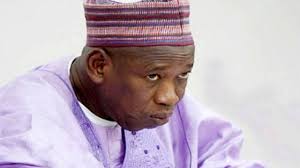
An American university has denied appointing the Kano State Governor, Abdullahi Ganduje, as a visiting professor.
SOLACebase reports that The East Carolina University (ECU) said the letter Mr Abdullahi Ganduje got from a member of its faculty was unauthorised by the appropriate officials.
The university stated its official stance in a letter sent to the Kano state governor which the university also shared with PREMIUM TIMES.
Recalls that the spokesperson of the governor, Abba Anwar, told journalists in Kano on Tuesday that the governor’s appointment was contained in a letter sent to him by the school through Victor Mbarika, a lecturer of International Center for IT and Development at East Carolina University College of Business on November 30.
The university confirmed that Mr Mbarika was its faculty member but said he had no authority to make such appointment.
Mr Ganduje was said to have been selected due to his “accomplishment in good governance and genuine investment in human capital development.”
The governor’s spokesperson also quoted the letter as saying that “Ganduje’s choice is a depiction of close monitoring of his achievements as a governor in the last couple of years. Which eventually earned him global recognition and commendation.”
“You have been a source of motivation to the Nigerian youths both at home and in the diaspora at large. We are amazed at your accomplishments both as the Executive Governor of Kano State, Nigeria; Fellow, National Association of Educational Administration and Planning, Nigeria; and your investment in Human Capital Development.
“Looking at your academic, administrative, and overall leadership record in Nigeria and Africa, you fit perfectly in East Carolina University’s goal to remain a leading research and teaching institution in the United States and beyond”, the statement quoted the letter as saying.
University Speaks
PREMIUM TIMES in an email sent to the university on Thursday asked if the institution did indeed appoint Mr Ganduje despite being allegedly caught on video in 2018 accepting a bribe.
In response to our email, the university attached the letter it sent to Mr Ganduje. The letter was signed by its Interim Provost and Senior Vice Chancellor for Academic Affairs, B. Grant Hayes.
“It has been brought to my attention that you received a letter from a faculty member dated November 30, 2020, that appeared to offer an unpaid appointment in the “International Center for IT and Development” at East Carolina University College of Business.
“I must inform you that the letter you received from Dr. Victor Mbarika, on November 30, 2020, does not convey an authorized offer of appointment or establish any position of scholar or professor at East Carolina University (“ECU”). Only the Chancellor, myself, or another official identified in ECU’s published statement on Delegation of Contracting Authority for the Division of Academic Affairs may authorize or sign appointment letters under which faculty are employed. Dr. Mbarika is not such an official,” the official told Mr Ganduje.










News
Kano Gov Abba Kabiru Yusuf bags international sports award in UK

Kano state governor, Abba Kabir Yusuf , Saturday was honoured in the United Kingdom for his commitment and support to sports development in the state.
Our correspondent reports that the award presentation ceremony took place at the Feel Good Too , Ive Farm sports arena located at the Pavilion Walk in London.
The patron W O. Sports, Moses Andishu , while making the presentation, said the award is aimed at appreciating the governor for his consistency towards the development of sports in Kano.
Moses who doubles as SWAN national patron said “this is our token way of saying kudos to mr governor and our aim is to encourage him to do more for the growth of the industry .
He added that “ we have noticed the reforms been carried out in Kano Pillars football club , we are aware of the efforts ongoing at the Kano state Sports Commission, KSSC and Kano Pillars is taking a new shape again, the state various sports teams now honor national invitations to major competitions, this is worth encouraging.
“we are very much aware of the plans by the governor, who is investing massively in the area of the provision of infrastructure, likewise we have seen investments made to renovate and upgrade major sports facilities, in the state, we just want to say thank you to his excellency and encourage him to invest more in sports
The special adviser to the governor on Youths and Sports, Sani Musa Danja , who received the award on behalf of the state governor said , “we are very delighted and happy, his excellency does not joke with anything that has to do with the development of the youths and he has always assured that he will always do everything possible to support the growth of Kano youths.
“I receive this award on behalf of his excellency with humility and honour for my governor , eng Abba Kabiru Yusuf, his works testify for his passion and commitment to sports development, his agenda is to always ensure Kano athletes competes amongst the best of the best by providing all the requirements that is needed for the state to excel in sports , and be rest assured that with my governor in charge sports development will always remain on the burner of the Kano First Agenda.
News
President Tinubu Salutes Hon. Kabir Bichi, Chair Appropriation Committee Of The House Of Representatives On His 45th Birthday
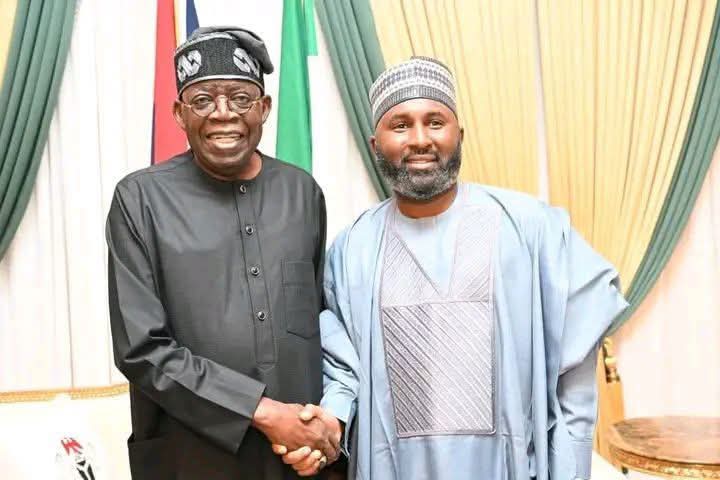
President Bola Ahmed Tinubu celebrates the Chairman, House of Representatives Committee on Appropriation, Hon. Abubakar Kabir Bichi, on his 45th birthday today.
President Tinubu describes Hon. Bichi, who represents Bichi Federal Constituency of Kano State, as a vibrant, resourceful and dedicated lawmaker whose commitment to legislative duties and national development stands out.
President Tinubu remarks: “ As Chairman of one of the most strategic committees of the House, Hon. Bichi has demonstrated uncommon capacity, grit, and leadership in steering the consideration, scrutiny, and passage of the nation’s annual budget, a role central to implementing the Renewed Hope Agenda.
“I commend him for his effective representation of his constituents and his impactful interventions in education, infrastructure, and youth empowerment, which have endeared him to his people.
“Bichi has distinguished himself since his first election to the House in 2019, where he served as Chairman of the House Committee on Works in the 9th Assembly and now as Chairman of Appropriation in the 10th Assembly.
“ As he marks his birthday today, I urge him to rededicate himself to serving his people and his fatherland.
“ And I pray to Almighty God to continue to bless him with good health, wisdom and strength.”
Bayo Onanuga
Special Adviser to the President
(Information & Strategy)
October 3, 2026
News
Yari Urges North to Respect Power Rotation, Back Tinubu’s 8-Year Presidency
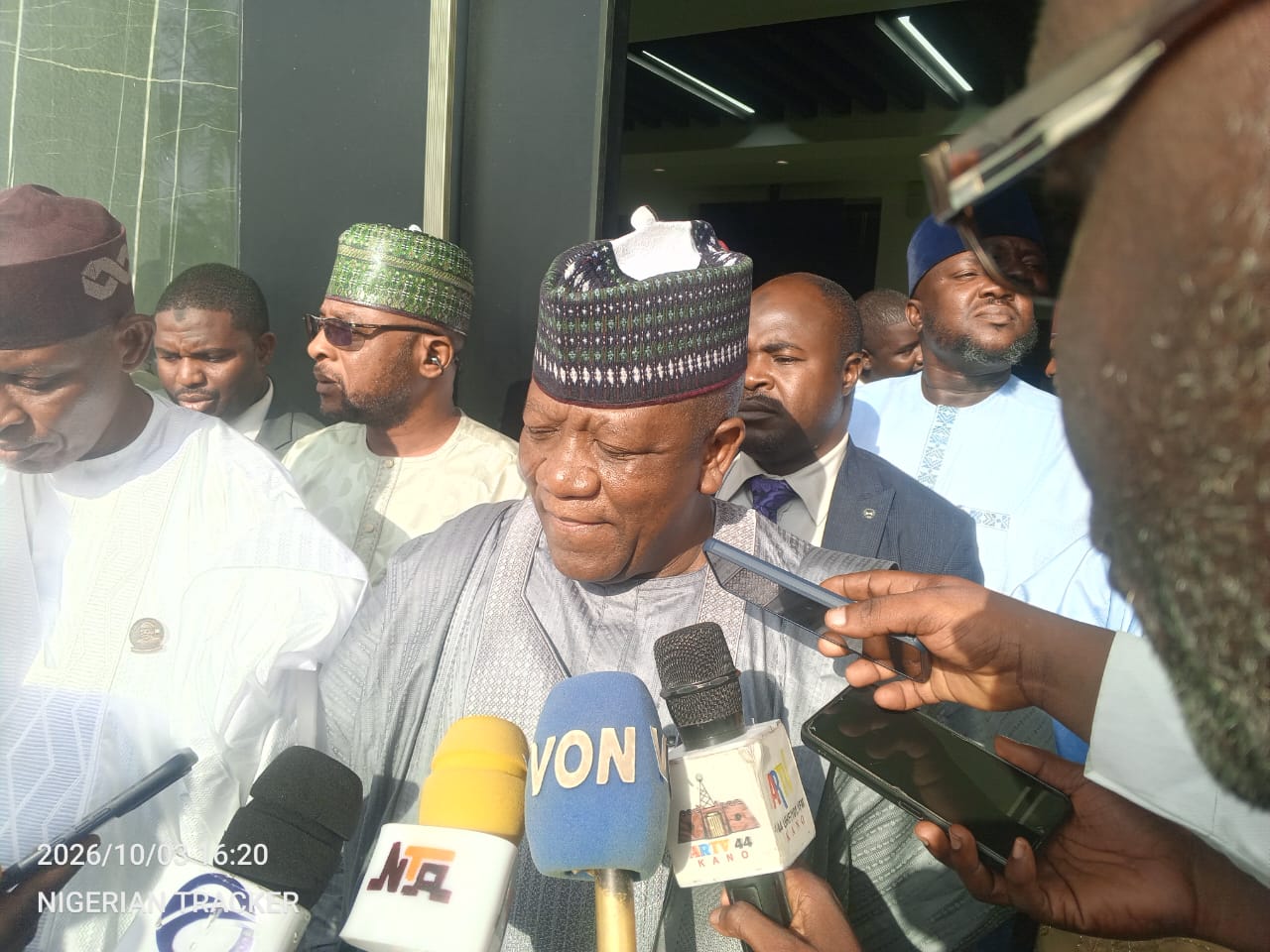
The Director-General of the APC Presidential Campaign Council, Senator Abdul Aziz Yari Abubakar, has called on Nigerians in the North to respect the informal power-rotation arrangement and allow President Bola Ahmed Tinubu to complete his constitutionally permitted eight-year tenure.
Yari made the call while addressing journalists at the Kano Government House after a meeting with Kano State Governor Abba Kabir Yusuf.
The former Zamfara State governor said the North should understand and respect the political arrangement that brought the presidency to the South in 2023, arguing that the presidency had been held by a northerner for several years before the emergence of Tinubu.
Yari said, “66 years ago since independence, the country was led by northerners for 47 years,” adding that Nigerians should recognise the importance of maintaining unity and understanding how the country’s political system operates.
According to him, Nigeria remains a country that all citizens must work together to protect, regardless of regional or political differences.
“As we love this country, we don’t have any country other than Nigeria. Nigerians should come and understand how this country works. It is also better than many nations,” Yari said.
The APC chieftain explained that his role as Director-General of the campaign council was not limited to promoting President Tinubu but also included promoting national unity and understanding among Nigerians.
Yari said the current political arrangement should be respected, noting that former President Muhammadu Buhari, a northerner, governed the country between 2015 and 2023 before power shifted to Tinubu from the South in 2023.
“Having said this, this country, Nigeria, from 2015 to 2023 was led by a northerner, and now from 2023 to 2026 it is led by a southerner,” he said.
He therefore appealed to northerners not to seek to overturn the existing zoning arrangement on the basis of the region’s population, saying the political understanding was important for national stability.
“If we say we want to uproot the zoning arrangement because of our numbers, then my call for northerners is to understand how it works. They even understand more than I do,” Yari said.
He acknowledged that President Tinubu’s administration, like every government, was not perfect, but argued that the challenges facing Nigeria should not solely be attributed to the administration.
“Nobody is perfect. The southerners have also experienced what we are complaining about today when President Buhari was in power,” he said.
Yari also argued that insecurity was not peculiar to Nigeria, saying countries across the world, including the United States, continue to grapple with security challenges despite their level of development.
“On problems, no problem of a country is solved by any government, including even in the United States. They are managing insecurity as we are managing it,” he said.
The APC campaign council director-general further cited gun violence in Chicago as an example of the security challenges faced by other countries, stressing that every nation has its own problems that require continuous efforts to address.
Turning to the economy, Yari said Nigerians should assess the Tinubu administration based on economic indicators and compare the situation at the time the president assumed office in 2023 with the current position.
“When you look at when Asiwaju Bola Ahmed Tinubu came to power in 2023, go and check what was the state of our reserves and what it is today, and what was the rate of inflation in 2023 and what it is today,” he said.
Yari maintained that the administration was making efforts to address the country’s economic and security challenges, while acknowledging that governments at both federal and state levels were working to improve the situation.
He urged Nigerians, particularly those in the North, to give the political arrangement time, arguing that the presidency would return to the region after Tinubu’s tenure if the existing rotation principle was maintained.
“I am calling on northerners to note that by the time Bola Ahmed Tinubu finishes in 2031, it will definitely come back to the North. So, this is how the arrangement is,” Yari said.
He added that federal and state governments were making efforts to address the challenges confronting the country and urged Nigerians to support measures aimed at strengthening national unity and development.

Kano Gov Abba Kabiru Yusuf bags international sports award in UK

President Tinubu Salutes Hon. Kabir Bichi, Chair Appropriation Committee Of The House Of Representatives On His 45th Birthday

Yari Urges North to Respect Power Rotation, Back Tinubu’s 8-Year Presidency

Muhuyi Raided Our Area: Encomiums, Prayers and Solidarity Trail Operation

Scrap Dealers Begin 15-Day Strike, Blame Chinese, Foreign Firms for Market Crisis

Zamfara Varsity ASUU Threatens Warning Strike Over FG-ASUU Agreement, Promotion Arrears

Kano Chemists Threaten Warning Strike Over Alleged PCN Pressure

Per Ishaq Samaila: “Waziri” for Strategy. “Mai Jama’a” for Service. One Man. One Mission. Ibrahim Kabir Masari

Goje’s Electoral War:The Confrontation With Tinubu,Governor Inuwa,Usman Kumo And APC candidates Ahead Of 2027

Prof Yusuf Adamu Delivers BUK’s 63rd Professorial Inaugural Lecture, Reflects on Medical Geography and Academic Legacy
Kano Gov Abba Kabiru Yusuf bags international sports award in UK
President Tinubu Salutes Hon. Kabir Bichi, Chair Appropriation Committee Of The House Of Representatives On His 45th Birthday
Yari Urges North to Respect Power Rotation, Back Tinubu’s 8-Year Presidency
Muhuyi Raided Our Area: Encomiums, Prayers and Solidarity Trail Operation
Scrap Dealers Begin 15-Day Strike, Blame Chinese, Foreign Firms for Market Crisis
Zamfara Varsity ASUU Threatens Warning Strike Over FG-ASUU Agreement, Promotion Arrears
Kano Chemists Threaten Warning Strike Over Alleged PCN Pressure
Per Ishaq Samaila: “Waziri” for Strategy. “Mai Jama’a” for Service. One Man. One Mission. Ibrahim Kabir Masari
Goje’s Electoral War:The Confrontation With Tinubu,Governor Inuwa,Usman Kumo And APC candidates Ahead Of 2027
Prof Yusuf Adamu Delivers BUK’s 63rd Professorial Inaugural Lecture, Reflects on Medical Geography and Academic Legacy
-

 Opinion5 years ago
On The Kano Flyovers And Public Perception
-

 Features5 years ago
How I Became A Multimillionaire In Nigeria – Hadiza Gabon
-

 Opinion6 years ago
Kano As future Headquarters Of Poverty In Nigeria
-

 History5 years ago
Sheikh Adam Abdullahi Al-Ilory (1917-1992):Nigeria’s Islamic Scholar Who Wrote Over 100 Books And Journals
-

 Opinion5 years ago
My First Encounter with Nasiru Gawuna, the Humble Deputy Governor
-

 History5 years ago
The History Of Borno State Governor Professor Babagana Umara Zulum
-

 History6 years ago
The Origin Of “Mammy Market” In Army Barracks (Mammy Ochefu)
-

 News4 years ago
Federal University Of Technology Babura To Commence Academic Activities September