
Opinion
OUR HEART GOES WITH THE “UNARMED” PEACEFUL PROTESTERS-Khalid Kani

BY: KHALID SUNUSI KANI
The tension and the pressure we are witnessing these days from the Youthfully active citizens on the Nigerian Government is so strange and weird. These eldritch actions have brought myriad positive and negative speculations in the mind of patriotic Nigerians that are trying to fully understand the scenario and navigate the outcomes of the end game.
NHRC Directs Staff to Monitor #ENDSARS Protests
As true nationalists, we must sympathize with the innocent victims of some clueless military officers that had used live on the unarmed peaceful protesters in Lagos State. It is quite saddening! And the military had shamelessly infringed on the constitutional right of Nigerians at the wrong time when the country is at its fragility and boiling point stage.
Nevertheless, there was an impregnable conjecture from some intellectuals (which I am not excluded) that believed #ENDSARS protest was built on some secret ulterior motives or mental reservations but that doesn’t shield us from voicing out the truth if Government is trying to jeopardize the rights of the people.
Generally, it is arguable that the cases of police brutality in Nigeria are as many as the stars in the sky. Which even the Inspector General of Police if asked the data, would have it a very tedious task. These uncountable cases had subsequently resulted in the accumulation of anger, grievances, hatred, and browned off the victims and their relations.
However, they (the victims) have been working silently and peacefully for decades pursuing their rights(or compensation) from the Nigerian Police Force but all the effort aborted and to no avail. The lingering uncaring attitudes from the Police led to the unanimously organized #ENDSARS Protest that we are seeing at this point.
Moreover, despite all the above mentioned points that do not mean the #ENDSARS Protest is for the amplification of Nigerians. The Protest is full of ambiguities, confusion, and misleading information. The movement is seriously lacking a genuine organogram or the leadership structure that could champion the outstanding goals of the movement which is totally in disarray with the imitated #BLACKLIVESMATTERS Protest in the United States Of America.
The major gross difference between #BLACKLIVESMATTERS and #ENDSARS are the “demands”. The first, the demands are intellectually constructed while the latter are ignorantly formed and it is because of the abysmally low legal literacy of the abstract or virtual conveners. The major demands of #BLACKLIVESMATTERS are “Take action now and call on USA authorities to make sure that all those responsible in the death of George Floyd are held accountable” while the major demands of #ENDSARS are “The disbandment of the Special Anti-Robbery Squad(SARS)” without looking into the legal consequences and lives they do (SARS) protect in different parts of the country.
Moreover, the demands of #ENDSARS protesters are increasing day by day. As a result of the movement being hijacked and impoverished by visionless and mission less abstract individuals. That’s why the movement has no specific, measurable, achievable, realizable, and timely goals.
#ENDSARS as a scalar movement, the protesters had continued propelling the protest across Southwest even after the Government had scraped the SARS Unit. Which we thought after the pronouncement of the disbanded SARS, they would periodically take off the streets for peace to reign on the planet. Some think it that the protest kept lingering because of the abstract ulterior motives they deafly dealt with the IG’s decision head-on.
Protest: Learn From Sudan and Libya’s Miserable Condition-Youth Urged
Why did #BLACKLIVESMATTERS protesters not demand the disbandment of the whole police unit? This is the critical question we should ask ourselves, now! The answer is very simple. Most Americans know their limits when it comes to security issues, possessed legal literacy, and a full understanding of their constitution that contained three irresistible words” WE THE PEOPLE”.
Nevertheless, we are not arguing that SARS is not controversially linked to extrajudicial killings, extortion, torture, framing, blackmail, kidnapping, illegal organ trade, armed robbery, home invasions, rape of men, and women, child arrests, the invasion of privacy, and many more allegations. But we are calling for all those SARS operators involved in such unscrupulous acts to be held accountable for them to face the wrath of Justice. But we are still unapologetic to the police “REFORMATION” ideology we have subscribed to.
We believe SARS, which has helped to reduce criminal activities in the country, was created as a unit in the police force with noble anti-robbery intentions. We hoped that the police authority, as promised by the IGP, will re-evaluate, restructure, rebrand, and rebuild confidence in an efficient and effective anti-robbery tactical unit in the force. And he finally came up with a Special Weapons and Tactics Team (SWAT). After consultations, in-depth analysis, and scrutinizing the building blocks of SWAT, all well-meaning Nigerians would overwhelmingly and unanimously agree to the philosophy, wisdom, and ideology behind setting up SWAT.
We do call on President Muhammad Buhari, to the inquiry committee that will investigate the unlawful act by the law enforcement officer before and during the protest. And to compensate the victims of circumstances for pacification coexistence in our beloved Nation.
And finally, I would like to conclude by saying antagonizing the Government ceaselessly is not activism but rather recidivism. We do hope the Government will protect the lives of Nigerians without hurting their lives at the same time. Our Heart Goes With The Unarmed Peaceful Protesters!
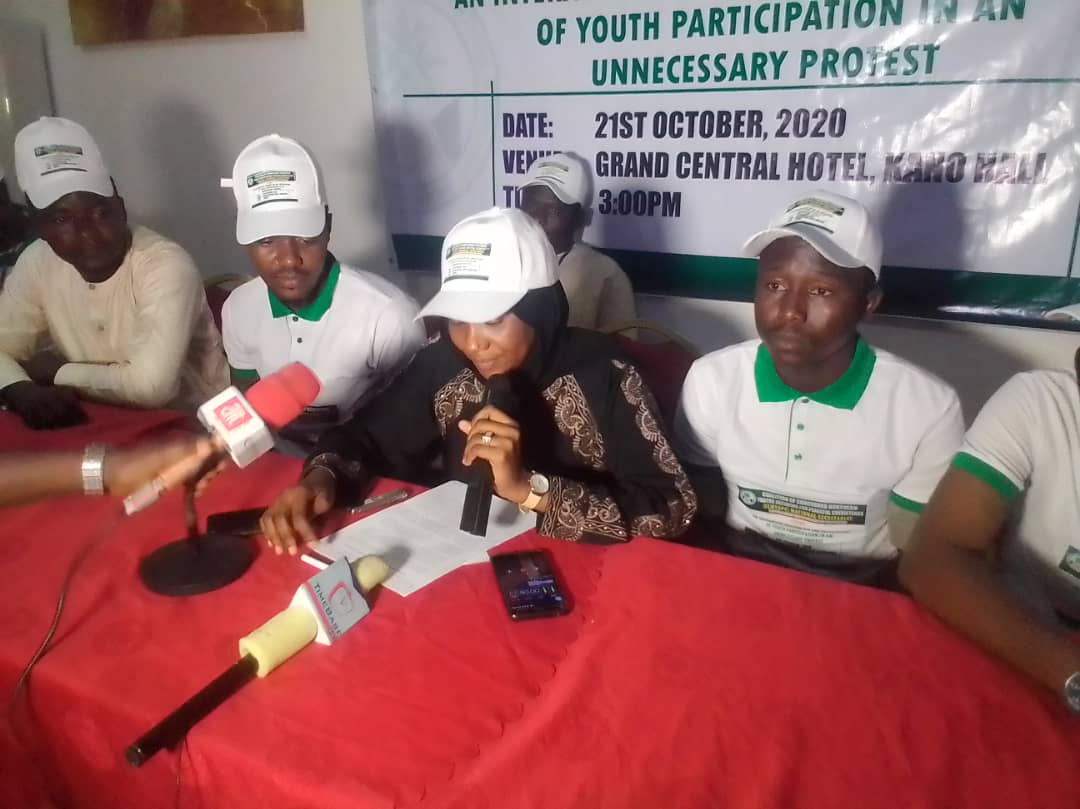
Khalid Sunusi Kani
is a public affairs analyst and
National Coordinator Of Kano State Coalition Of Youth Groups. Can also be reached through drkani001@yahoo.com, 07030631259.









Opinion
Muhuyi Raided Our Area: Encomiums, Prayers and Solidarity Trail Operation

By Abba Anwar
A few days ago, Sheikh Salga Street, the stretch from Goron Dutse to Jakara, was a haven for Yandaba and drug addicts. They terrorized residents in broad daylight without fear, and at night, it was even worse. The Jakara Divisional Police did their best to curb the menace, but the challenge was beyond a single station.
The real game-changer came when the Inter-Agency Task Force Against Drug Abuse and Other Related Crimes, under the fearless Barrister Muhuyi Magaji Rimingado, stormed the area. It was a thorough, house-to-house operation that combed every nook and cranny.
This is my area. I was born and raised in Bakinruwa quarters, and I have friends across all the adjoining neighborhoods. When Barrister Rimingado led his men in a Rambo-style raid, calls started coming in. Many residents told me that this single operation alone has convinced every right-thinking person in the area to vote for the present administration under His Excellency, Governor Abba Kabir Yusuf, in the 2027 election.
Interestingly, a greater percentage of those I spoke to do not belong to the ruling party, the All Progressives Congress, APC. Yet they insisted that this intervention is the best thing that has happened to them in recent times. They promised to pay back with their votes in 2027.
Politics aside, when these criminal elements forced people to run for their lives, they did not ask whether you wereAPC, ADC or any other party. Several people were severely injured. Some were alleged to have lost their lives.
What made this raid more strategic and successful was how the Task Force worked hand-in-hand with traditional community leaders, the Masu Unguwa. These are leaders who know the suspects by name, who know their parents, their houses and their hideouts. That is why the operation succeeded.
This is a smart application of community policing. Beyond intelligence from security agencies, bringing in community leaders was a vital, creative and strategic move by the Chairman of the Task Force.
The raid was not a one-day show. It continued up to yesterday. Coincidentally, there was a Maulud gathering on the road between Durumin Kaigama and Yar Kasuwa. I learnt that immediately after the Maulud, a special prayer session was held. They prayed for Governor Yusuf to secure another term, and they prayed for Allah’s protection and guidance for Barrister Rimingado and his dedicated team.
What the Task Force did was appreciated by thousands of residents. From what I gathered, some youth have even started organizing a movement to support Governor Yusuf’s re-election bid. The movement, I learnt, has nothing to do with party affiliation.
I was briefed that youth from all walks of life are involved – students, artisans, members of community-based organizations, business people, women groups and civil servants.
What Barrister Rimingado did has opened the eyes of many apolitical people. These are hundreds of people who do not belong to any political party, but who have now resolved to do everything possible to ensure Governor Yusuf returns in 2027.
This vindicates what I wrote earlier, that politics aside, if properly handled, the activities of the Task Force could be one of the most fundamental efforts capable of giving APC more votes in Kano in all elections, especially the gubernatorial contest.
Alhamdulillah, rules of engagement were professionally adhered to during the raid. About 80 suspected criminals were arrested. Some fled out of the state, but I was reliably informed they will be trailed to wherever they hide. This is what we call patriotic commitment.
Let me use this platform to convey the thank-you message of our people to the Governor of Kano State and the Task Force under Barrister Rimingado for this timely intervention and show of concern and seriousness.
One Malam Ahmad Dahawi, who leads an umbrella body of community associations in the area with thousands of members, confirmed that peace has now returned to the affected areas. He assured that although their umbrella body comprises people across different political parties, they have resolved to support Governor Yusuf in 2027, while members are free to vote for whoever they like in other elections.
More grease to your elbow, the people’s Governor. More courage and fearlessness to Barrister Rimingado and his unwavering team. With this kind of teamwork and community support, the days of these criminals are numbered.
What is most interesting is the political will of the Governor and his unwavering support for cleansing our state of criminal activities.
I suggest other areas within the metropolis and rural communities, should copy from our people in supporting the operation of the all-important Task Force. It is for the good of all of us.
Anwar writes from Kano
Saturday, 3rd October, 2026
Opinion
Muhuyi and the Fight for Kano’s Future-Ismail Auwal
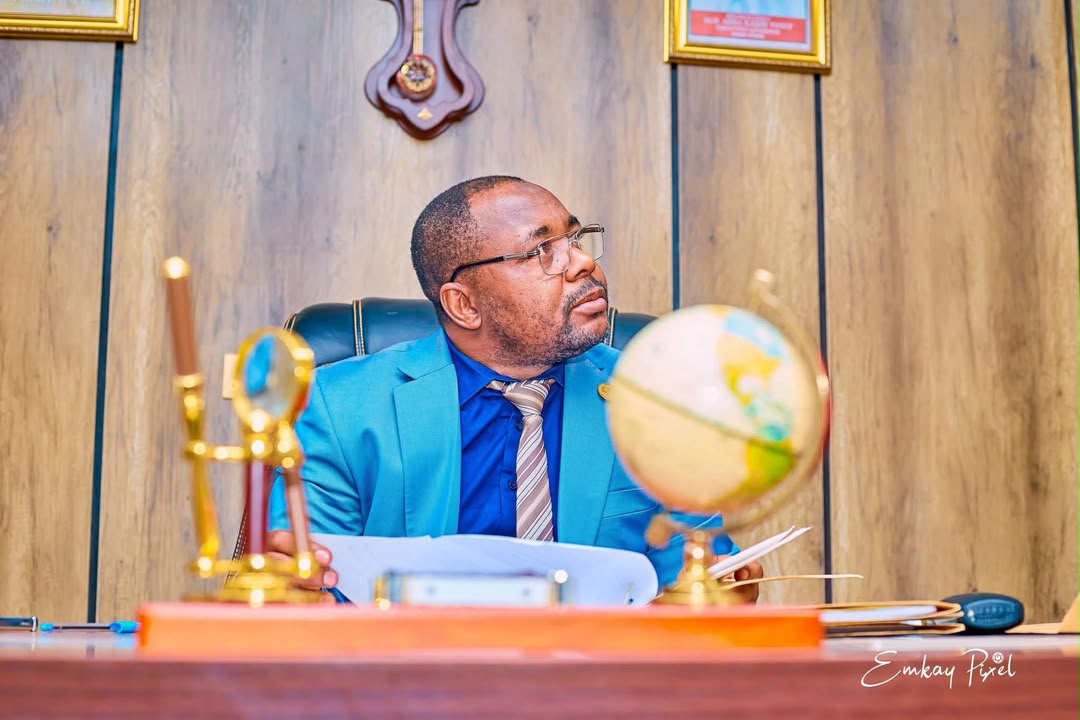
By Ismail Auwal
I knew Muhuyi Magaji Rimin Gado had capacity. His work at Kano’s Public Complaints and Anti-Corruption Commission had established that much. But watching the pace of his present assignment, I have had to revise my expectations upward. I did not imagine he would bring this much energy to the task.
The operations have kept coming: arrests, investigations and court proceedings. Alongside them are plans for rehabilitation and skills training. What has emerged is a public official taking responsibility for an assignment whose consequences reach far beyond his office and into the homes and neighbourhoods of Kano.
Within 45 days, the task force reportedly conducted more than 200 raids and secured more than 200 convictions, with four mobile courts handling the cases. Those figures remain reported results. They nevertheless describe an early pace of enforcement that deserves attention, and the leadership sustaining it deserves recognition.
Consider the work behind an operation. Information arrives and must be assessed. Someone decides what requires investigation and brings the relevant agencies together. Officers are deployed, evidence is gathered and records are prepared. After an arrest, the responsibility continues through the preparation and handling of a case.
Maintaining that effort across repeated operations requires organisation and follow-through. This is where Muhuyi’s energy becomes significant. He has taken on a responsibility that demands sustained attention, and the accounts emerging from Kano suggest he is giving the assignment precisely that.
The arrests sit at the centre of this effort because they make government action visible. For residents who have reported suspected criminal activity, an operation can show that their information reached someone prepared to respond. It can begin to restore a connection between public complaints and public action.
That connection matters. When people believe a complaint will go nowhere, they may stop making it. They find ways to live around the problem, avoid certain places or carry their concerns privately. An institution that responds gives them a reason to participate again and demonstrates that their knowledge of their community has value.
Muhuyi’s task force has an opportunity to strengthen that relationship with every operation properly investigated and every case properly followed. His leadership deserves commendation for pursuing the work through institutions, bringing enforcement and court proceedings into the same understanding of public responsibility.
For Kano, the stakes are personal. A family dealing with harmful drug use may find its plans gradually displaced by the next crisis. Schooling is interrupted, money intended for other needs goes towards seeking help, and relationships come under strain. Parents try to understand what is happening while worrying about what might happen next.
These are the lives behind the assignment. A response that reaches them can change what they expect from government. It can provide somewhere to seek assistance and a reason to believe that the burden they have been carrying is receiving attention beyond the household.
That is why I have followed Muhuyi’s work with growing interest. The task force is addressing a problem whose effects can spread through generations. Protecting a young person’s opportunity to learn, work and contribute has consequences for an entire family. It also influences the kind of Kano that will emerge in the years ahead.
Muhuyi brings experience suited to these demands. At the Public Complaints and Anti-Corruption Commission, he worked where citizens’ grievances met the machinery of government. Complaints had to be received, records examined and investigations pursued. Public expectations had to be translated into administrative and legal action.
His contribution included work on the institution itself. In April 2025, the commission published an account of commendations from the Civil Society Legislative Advocacy Centre. CISLAC recognised developments under his leadership, including an anticorruption strategy, operating guidelines for government institutions and offices across Kano’s 44 local government areas.
There is substance in that record. Extending an institution’s presence makes it easier for people to approach it. Establishing procedures gives staff a framework for handling complaints. Setting a strategy helps work continue across competing demands. These are foundations on which visible results depend.
For a resident seeking assistance, the difference can be practical: an office within reach, a process that can be understood and an official assigned to follow the matter. Such arrangements give public service a form people can use. Muhuyi’s experience developing them is an asset to his present responsibility.
The commission’s engagement with CISLAC also involved cooperation on asset tracking and recovery. That experience points to another quality relevant to the task force: understanding that institutions can accomplish more when they combine expertise and establish clear arrangements for working together.
Drug enforcement brings together responsibilities held by different bodies. Reporting on the task force’s maiden meeting described participation by the NDLEA, police, Department of State Services and other public institutions. Their involvement provides a basis for coordinated work, while leadership keeps that cooperation active after the meeting ends.
Information must move to those able to assess it. Evidence must reach those preparing proceedings. Responsibilities must be understood well enough to prevent a case from losing momentum between institutions. Muhuyi’s role is to help make these connections work, and the reported activity gives reason to recognise his commitment.
Governor Abba Kabir Yusuf also deserves credit for establishing the platform and giving the assignment political backing. Placing an experienced official at its head was a consequential decision. Muhuyi’s response has given that decision operational meaning through the task force’s reported activities and developing partnerships.
The governor’s support and the chairman’s drive can reinforce each other. Public backing enables institutions to commit resources, while operational leadership directs those resources towards the work. Kano benefits when both remain focused on the people the assignment is meant to serve.
The effort has attracted recognition from other institutions. Reports of an August visit said the NDLEA’s Zone 5 Command named Muhuyi a War Against Drug Abuse ambassador, citing cooperation, awareness and community mobilisation. In September, the North-West Development Commission also commended the task force and expressed interest in collaboration.
Such recognition can open opportunities for assistance and shared expertise. It also encourages the personnel carrying out the work. Officers, investigators and administrative staff all contribute to the results associated with a chairman’s name. Their effort deserves recognition alongside the leadership coordinating it.
The ambition to help people rebuild their lives after enforcement is equally important. Muhuyi has reportedly outlined plans for skills training reaching 10,000 people, with a role envisaged for the Kiru Reformation Centre. That number is a proposed target, and its direction is encouraging: rehabilitation has a place in how he understands the assignment.
A young person returning home may need treatment, an opportunity to resume education or help acquiring a skill. The family may also need guidance. Recovery can involve a series of steps, each requiring someone to remain involved after the immediate crisis has passed.
Including rehabilitation recognises that public responsibility continues through those steps. It gives the campaign a purpose that families can understand: helping a person regain the ability to participate in everyday life. That ambition deserves support because its benefits can extend well beyond the individual receiving assistance.
A young person who resumes school recovers an opportunity to prepare for adulthood. Someone who acquires a useful skill has a basis for pursuing a livelihood. A household that receives help can begin making plans again. Through these changes, an intervention becomes an investment in Kano’s future.
The support of religious scholars, Friday mosque imams and Hisbah can strengthen this effort. These institutions have relationships with communities that government agencies can work alongside. Their participation can encourage discussion, prevention and assistance in places where families already seek guidance.
Muhuyi deserves credit for leading an assignment that is developing these connections. Public engagement helps build the cooperation on which sustained progress depends. Families need to know where to seek help, and communities need to understand how they can contribute to protecting young people.
The task force’s developing approach brings these responsibilities into the same conversation. Operations address suspected offences, court proceedings carry cases forward, rehabilitation plans look towards recovery, and community partnerships create opportunities for prevention and support. Together, they provide a basis for recognising the leadership behind the effort.
I have followed Muhuyi’s work with an existing appreciation of his capacity. What I now appreciate more fully is his willingness to apply it with urgency. He has brought energy to an assignment that requires people to keep showing up, keep coordinating and keep following the work. That commitment deserves commendation.
Kano’s future will be shaped partly by what happens to its young people today. Every opportunity preserved, every family assisted and every community able to obtain a response contributes to that future. Muhuyi has taken on a responsibility that reaches directly into those possibilities.
The arrests have made the effort visible, and his leadership is giving it momentum. With sustained support, the work can leave its strongest record in the lives of people who find a way forward: young people returning to education and employment, families receiving assistance and communities gaining confidence in the institutions serving them.
Opinion
Dry Taps Gone, Kano Flows Again: The Abba Yusuf Water Comeback By Abba Anwar
By Abba Anwar
It is evidently clear and on record to understand that Kano thirsty decade is ending, as how His Excellency the Governor of Kano State, Eng Abba Kabir Yusuf is turning 95 years of ruin into a N21.3 Billion revival. This is leadership, commitment, display of patriotic political will and understanding of complexities and peculiarities of human existence.
What Kano is experiencing now, in terms of redirecting the water industry into human face, calls for global gist and account. For example in Cape Town, they called perennial shortage of water Day Zero – the day the taps would run dry.
In Flint, Michigan, history tells us that it was a lead poisoning crisis that shocked America. While in Kano, Africa’s most populous city, situated in Northern Nigeria, it was slower, quieter, and more painful. Very pathetic and heartbreaking, for over ten years, the taps simply stopped. No announcement. No Day Zero. Just air.
The history of Kano water sector reveals that the city needs 700 million litres of water every single day to survive. Until last year, it was getting less than 300 million. A deficit of 400 million litres. That is not a shortage; it is a systemic collapse. Mothers woke up at 4 a.m. to queue at boreholes. Children trekked kilometres with jerry cans. Industries shut down. Cholera whispered in the background.
Identification of problem didn’t match with problem diagnosis. For years, successive administrations applied plaster to a cancer. The current administration of Governor Yusuf has chosen to perform open-heart surgery. A better and neater option. Surgical operation not plaster application. Which catches and punches the right button.
And the heart is now beating again as the Governor means business and genuine service delivery.
Kano’s 95-year-old legacy, which I term as The Soul of a City, is a deliberate presentation for proper
understanding of the magnitude of what is happening now. Hence we must understand what was lost.
Kano’s water story did not start yesterday. It started in 1927, when the British colonial administration, under Emir Abdullahi Bayero, broke ground for what would become the first waterworks in Northern Nigeria – the Challawa Water Works. Completed in 1930, with a modest 20 million litres per day, it was an engineering marvel of its time. It supplied Dorayi, Kabuga, Kofar Fanfo, Jan Bulo, Rijiyar Zaki, and even the Army Barracks in Janguza. It ran non-stop for 86 years.
Then came its younger brothers. The Old Tamburawa in 1986 – 9.6 million litres, later upgraded to 20 million. Then the New Tamburawa, a behemoth with a 150 million litre per day capacity. And anchoring them all, the legendary Goron Dutse reservoirs – five massive underground and surface reservoirs built between 1930 and 1974, with a combined storage of over 40 million litres. They were the lungs of Kano’s distribution.
By whatever standard and estimation this was a system built by visionaries, with clearly defined vision. But it was, unfortunately, killed by neglect. Year in year out all the donkey years witnessed terrifying reality when city’s lifeline was utterly and irresponsibly looted.
To tell my reader that, that experience was worrying our Governor deeply even before he came on board, before he took the oath of office on May 29, 2023, he set up a powerful Committee of Experts to look into the perennial nature of the water industry. Immediately after he came on board his engineers gave him a report on water that read like a war zone assessment.
Since then, when I discussed the concern with a friend from Darmanawa he quickly commended the effort and called for public support of the entire process and procedures.
It was fundamentally clear that in Challawa, the scene was “pathetic and disheartening,” in the official words of the Ministry. Out of six giant industrial generating sets that power the entire plant when the national grid fails, only two were limping. Water Works No. 1 and No. 2 were dead. No. 3 was gasping at 30% capacity. A call for action at whatever rate.
Worse than decay was destruction. Raw water pumps were gone. Electrical starters ripped from control rooms. Underground electrical facilities stolen. And in an act that shocked even veteran engineers, a 15-kilometre, 15.6 kilometre underground transmission pipeline – the artery that feeds Challawa – was excavated and stolen. Not vandalised. Stolen. Some individuals even walked into the premises claiming the federal government had sold the waterworks to them. A brazen dishonesty of the highest order.
At Goron Dutse, the story was even more symbolic. The reservoirs that had quenched Kano for nearly a century had not received a single drop of water for over ten years. Ten years! They were dry, cracked, and filled with silt. As bad as economies during conventional wars. Abandonment amid need for attention.
The total cost of decay was put at over N30 billion. An administration in the past had spent N5.6 billion in just 11 months for “maintenance” but it was maintenance without a soul. As pipes were not replaced, reservoirs were not desilted, pumps were not procured. The result? Tamburawa, designed for 150 million litres, was doing 27%. Challawa, designed for 220 million, was doing less than 30%. Together, they should produce 370 million litres. They were producing less than 90 million.
To revive just Challawa, an official told journalists that the state would need $3.5 million, later revised to over $10 million, because the 1930-era machines have to be custom-built in Europe on demand. They are not on any shelf in the world.
This is the rot Governor Yusuf inherited. To me, Governor Yusuf’s political will is doctrinal with no match in sight. Unmatched political will. It is glaring for all to know that great cities are not revived by press releases. They are revived by political will. This is where His Excellency separates himself from every administration in the last decade.
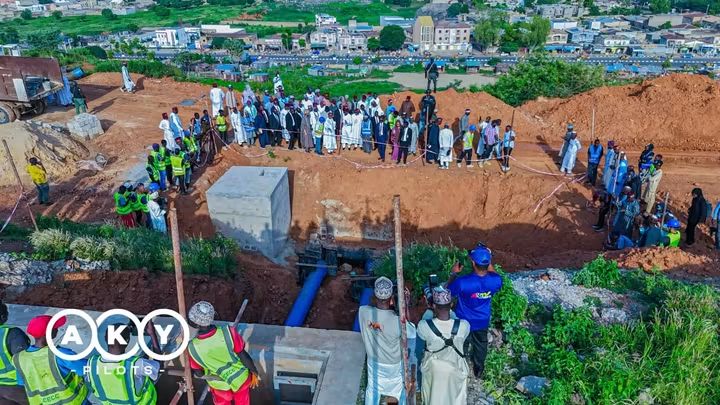
He did not send a committee. He went himself. Since from the start of the good re-engineering touch of the water facilities. For example just yesterday, he and his able Deputy H.E. Murtala Sule Garo alongside other top government functionaries visited water projects that are almost ready for good operations.
In a now-famous inspection tour, Governor Yusuf, in rain boots, walked the length of Challawa and Tamburawa with engineers from CGC Nigeria Limited and CCECC Nigeria Limited – the same Chinese engineering giants building Africa’s biggest dams and railways. He saw the leaking pipes. He saw the obsolete clarifiers. He saw the dead high-lift pumps. And there, on the spot, he made a decision that will define his legacy.
He approved without any hesitation, the sum of N21.29 billion. Wow! the single largest water investment in Kano in 15 years. Leadership by example. Viva our dear Governor Viva.
Not N21.89 billion in rumour. N21.29 billion in signed contracts. With N9.9 billion to CGC Nigeria Limited for the total rehabilitation of Tamburawa Water Treatment Plant and its raw water pump station. The sum of N11.39 billion to CCECC Nigeria Limited for the rehabilitation of Challawa Raw Water Pump Station, its treatment plant, and the total restoration of the Goron Dutse reservoirs. Action! Action!! Action!!!
This is not rehabilitation on paper. This is what is happening on the ground right now, as confirmed by Dr. Dahiru Muhammad Hashim, Acting Commissioner for Water Resources, Environment and Climate Change. That:
1. The critical 15.6-kilometre transmission line to Goron Dutse has been restored with modern ductile steel pipes, replacing the 1970s asbestos pipes that were poisoning the system.
2. Goron Dutse reservoirs have been fully desilted and repaired.
3. Clarifiers, filtration units, manifolds, and high-lift pumps have been restored.
4. Ten high-capacity 110-kilowatt pumps have been procured.
5. A full test run was completed in mid-September.
And beyond the metropolis, the Governor is doing what no one did – reviving the dead. Nine out of Kano’s 19 dormant regional water schemes are under restoration. Guzugu in Kabo is flowing. Joda in Gabasawa is flowing. Wudil Waterworks, dead for years, is alive. For the first time, rural Kano is part of the water equation. Government for all sections of the state.
On September 21, 2026, the Ministry officially announced: expanded distribution of potable water would commence within few days to come. All are waiting patiently Your Excellency Sir!
Why Kano must attract global communities? From London to Lagos, water is politics. The UN says water scarcity will displace 700 million people by 2030. What Governor Yusuf has done is a case study in how to reverse it without World Bank loans, without privatising your heritage.
He did not outsource the problem. He funded the solution. He did not blame the past. He fixed the future. Sometime in the past I spoke to Malam Musa in Tarauni, he was lamenting all over. When asked again, now, he simply smiles that Governor Yusuf is on the top of the situation. This is courageous.
When the taps in Kofar Mata sputter and then gush, when a child in Dala drinks from the tap for the first time in his life, when Goron Dutse reservoirs hold water again after a 10-year drought, Kano will not just be celebrating water. Kano will be celebrating a Governor who proved that a 95-year-old dream, buried under silt, stolen pipes, and failed promises, can still flow.
That is not just governance. That is unmatched and unwavering political will in action.
KANO FLOWS AGAIN UNDER GOVERNOR YUSUF!
Viva Kano. Viva Abba Gida-Gida.
Anwar writes from Kano
Tuesday, 29th September, 2026

Court of Appeal Reserves Judgment on El-Rufai’s Bail Appeal

Rep. Abubakar Kabir Bichi Welcomes 21 Foreign Scholarship Beneficiaries, Flags Off Second Batch of 38 Students

International Arabic Conference Calls for AI Integration

World Teachers’ Day: NUT Urges Kano Govt to Declare October 5 Public Holiday, Advocates Special Salary Scale

Kano First Forum Petitions Police Over Alleged Inciting Statements by Aminu Babba Dan Agundi

Zamfara Varsity ASUU Threatens Warning Strike Over FG-ASUU Agreement, Promotion Arrears

Kano Chemists Threaten Warning Strike Over Alleged PCN Pressure

Per Ishaq Samaila: “Waziri” for Strategy. “Mai Jama’a” for Service. One Man. One Mission. Ibrahim Kabir Masari

Goje’s Electoral War:The Confrontation With Tinubu,Governor Inuwa,Usman Kumo And APC candidates Ahead Of 2027

PCACC Arrests Man Over Alleged ₦4.5m Sale, Illegal Leasing of Kano Government Horse Stable
Court of Appeal Reserves Judgment on El-Rufai’s Bail Appeal
Rep. Abubakar Kabir Bichi Welcomes 21 Foreign Scholarship Beneficiaries, Flags Off Second Batch of 38 Students
International Arabic Conference Calls for AI Integration
World Teachers’ Day: NUT Urges Kano Govt to Declare October 5 Public Holiday, Advocates Special Salary Scale
Kano First Forum Petitions Police Over Alleged Inciting Statements by Aminu Babba Dan Agundi
Zamfara Varsity ASUU Threatens Warning Strike Over FG-ASUU Agreement, Promotion Arrears
Kano Chemists Threaten Warning Strike Over Alleged PCN Pressure
Per Ishaq Samaila: “Waziri” for Strategy. “Mai Jama’a” for Service. One Man. One Mission. Ibrahim Kabir Masari
Goje’s Electoral War:The Confrontation With Tinubu,Governor Inuwa,Usman Kumo And APC candidates Ahead Of 2027
PCACC Arrests Man Over Alleged ₦4.5m Sale, Illegal Leasing of Kano Government Horse Stable
-

 Opinion5 years ago
On The Kano Flyovers And Public Perception
-

 Features5 years ago
How I Became A Multimillionaire In Nigeria – Hadiza Gabon
-

 Opinion6 years ago
Kano As future Headquarters Of Poverty In Nigeria
-

 History5 years ago
Sheikh Adam Abdullahi Al-Ilory (1917-1992):Nigeria’s Islamic Scholar Who Wrote Over 100 Books And Journals
-

 Opinion5 years ago
My First Encounter with Nasiru Gawuna, the Humble Deputy Governor
-

 History5 years ago
The History Of Borno State Governor Professor Babagana Umara Zulum
-

 History6 years ago
The Origin Of “Mammy Market” In Army Barracks (Mammy Ochefu)
-

 News5 years ago
Federal University Of Technology Babura To Commence Academic Activities September