
News
Dangote Cement Re-trains Hundreds of Truck Drivers to Boost operational efficiency

















News
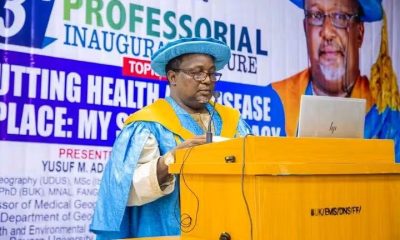
Prof Yusuf Adamu Delivers BUK’s 63rd Professorial Inaugural Lecture, Reflects on Medical Geography and Academic Legacy

By Abbas Yushau Yusuf
Professor Yusuf Adamu, a scholar of Medical Geography at Bayero University Kano (BUK), has delivered the university’s 63rd Professorial Inaugural Lecture, reflecting on his academic journey, research, mentorship and contributions to the development of health and medical geography.
Professor Adamu delivered the lecture under the theme, “Putting Health and Disease in Place: My Story and Legacy,” where he traced the evolution of his interest in geography, his transition into medical geography and the research contributions of his students and collaborators.
Speaking during the lecture, Professor Adamu described medical geography as a sub-discipline of geography concerned with understanding the spatial dimensions of health, disease and healthcare, noting that scholars in the field are sometimes known by different professional descriptions.
According to him, human beings should be regarded as citizens of the world from the perspective of physical and natural processes because health and disease are influenced by the environments in which people live.
Professor Adamu said BUK has emerged as an important centre for the study and development of Medical Geography, attributing the progress to sustained research, teaching, mentorship and collaboration among scholars and students.
Reflecting on his childhood and early intellectual development, the professor said his earliest geographical thoughts were connected to ideas about heaven and earth, before his interest gradually expanded to physical geography and the natural environment.
He said he remained fascinated by physical geographical features, including landforms, rivers and valleys, which later contributed to the development of his broader interest in the relationship between people, places and health.
Professor Adamu also recalled that his father worked with the World Health Organisation (WHO) between 1967 and 1970, saying his early exposure to health-related issues contributed to the intellectual environment that shaped his later academic interests.
The professor said his academic journey also took him to Ibadan, where he produced his first research paper on Dakin Duhu, or “The Dark Room,” while his Master’s research focused on eclampsia, a serious pregnancy-related medical condition.
Speaking on his research into maternal health, Professor Adamu explained that maternal morbidity and mortality should not be treated as fixed phenomena because their patterns can change across time and locations.
He cited data from his research to illustrate fluctuations in maternal health indicators, noting that figures recorded in 1992 were different from those recorded in 1993, demonstrating the importance of examining health conditions spatially and over time.
According to him, his research also examined the differences between urban and rural health challenges, including issues surrounding eclampsia and anaemia epidemics.
Professor Adamu argued that health geography must move beyond a narrow concentration on hospitals and healthcare facilities to examine the wider social, environmental and economic factors that influence people’s health.
He said gender analysis should also form an important part of health geography, while challenging researchers to examine how social and spatial conditions affect men and women differently.
On his role as an academic mentor, Professor Adamu disclosed that he had supervised more than 200 undergraduate students during his career and had also supervised seventeen PhD students between 2010 and 2026.
He said some of his doctoral students had expanded their research beyond conventional health geography, working on subjects including depression and anxiety, medical tourism and other emerging areas of health research.
Professor Adamu said his philosophy of mentorship was centred on producing competent medical geographers who could eventually conduct independent research and mentor others.
He described himself as a demanding supervisor, saying his students were aware of his high expectations, but added that he also gave them choices, made himself available to them and provided access to his office at virtually all times when they needed academic guidance.
The professor said he also referred students to experts in specialised areas whenever such external expertise was necessary, adding that compassion remained an important part of his relationship with students.
Professor Adamu paid tribute to the late Zainab Bello, one of his students who worked on low vision, describing her contribution as part of the academic legacy of the students he had mentored.
He said his collaborative research network had continued to grow, adding that he had worked with 16 students on published research papers as part of his effort to expose young scholars to collaborative academic research.
According to him, the ultimate measure of mentorship is not simply the number of students supervised but the quality of work produced by those students and their ability to become independent researchers and mentors themselves.
Professor Adamu said many of his former students had now begun producing independent research, with some focusing on diseases such as malaria and meningitis.
He described the work as part of a sustained research tradition, stressing the importance of building academic capacity that would continue beyond the careers of individual scholars.
The professor also spoke about the development of a school of Medical Geography in Kano, describing it as part of the continuing institutionalisation and expansion of health and medical geography research in the North.
Looking into the future, Professor Adamu outlined the vision and prospects of health and medical geography, saying the discipline has an important role to play in identifying health problems and understanding their geographical distribution.
He noted that marginalised communities should not be regarded as simply missing from health statistics, but should be deliberately identified and studied to understand the factors responsible for their exclusion from healthcare and other social services.
Professor Adamu highlighted the practical value of medical geography, including the identification of disease hotspots, analysis of access to obstetric care, modelling and the use of empirical studies to support better understanding of health challenges.
He called on medical geographers to intensify their research and ensure that their findings contribute to solving real-world health problems.
The professor said the fight against disease had not yet been won, but maintained that researchers and policymakers were now better equipped to locate disease patterns, understand their causes and develop approaches capable of addressing them.
In his welcome address, the Vice-Chancellor of Bayero University Kano, Professor Haruna Musa, described Professor Adamu as a scholar who had spent more than three decades teaching, researching and contributing to the development of the university.
Professor Musa said the inaugural lecture provided an opportunity for Professor Adamu to showcase his intellectual journey and contributions to academia, adding that the professor was not only an academic but also a poet and novelist.
The Vice-Chancellor called on other professors who had not yet delivered their inaugural lectures to take advantage of the opportunity, saying the university was working to revive its culture of professorial and academic lecture series.
According to Professor Musa, the university would continue to organise lectures and other intellectual programmes that would provide opportunities for academics to share their knowledge and research with the wider university community.
Also speaking, the Dean of the Faculty of Earth and Environmental Sciences, Professor Abdulaziz Raji, described Professor Yusuf Adamu as a distinguished scholar whose academic career had made significant contributions to the university and the field of Medical Geography.
Professor Raji said Professor Adamu was born in March 1968 in Katsina and progressed through his academic career before attaining the rank of professor in 2010.
He said Professor Adamu’s academic development was strengthened by his international scholarship at the University of Alabama in the United States, where he studied from 2001 to 2003 under a Fulbright scholarship programme.
Professor Raji said the professor’s academic and mentorship contributions had helped produce a large body of scholarly work, with his students and collaborators contributing to more than 230 publications.
He added that Professor Adamu himself had produced more than 135 publications, including over 40 works written in Hausa, demonstrating his contribution to both international scholarship and scholarship accessible to local audiences.
The dean said Professor Adamu’s body of work reflected a career that combined teaching, research, mentorship, international collaboration and engagement with issues affecting communities.
The inaugural lecture therefore provided an opportunity for the university community, academics, students and invited guests to reflect on the evolution of Medical Geography at BUK and Professor Adamu’s contribution to the discipline.
Professor Adamu’s lecture also underscored the importance of continuing research into the geographical dimensions of disease, healthcare access and the social and environmental factors that shape health outcomes.
News
Court Orders Fresh PDP Primary in Gombe Over Pantami’s Candidacy

By Yusuf Danjuma Yunusa
The Federal High Court sitting in Gombe has ordered the Peoples Democratic Party (PDP) to conduct a fresh primary for its governorship ticket in Gombe State.
Justice Amina Aliyu Mohammed gave the order in a suit filed by Usman Aliyu Garry challenging the emergence of Prof. Isa Ali Pantami as the PDP governorship candidate.
Garry had challenged Pantami’s emergence after the party announced him as its sole candidate on June 26, 2026, arguing that the required primary election was not conducted.
Pantami, a former APC aspirant, defected to the PDP after the APC settled on Jamilu Gwamna as its consensus candidate. He subsequently secured the PDP ticket through a voice vote during the party’s governorship primary held in May.
In its judgment delivered on Thursday, the court ordered the PDP to conduct a fresh primary election in accordance with the party’s guidelines and relevant electoral laws.
News
JUST IN: EFCC Re-declares Abdulrasheed Maina Wanted over Alleged Receipt of Stolen Property

By Yusuf Danjuma Yunusa
The Economic and Financial Crimes Commission, EFCC, has declared former Chairman of the Presidential Task Force on Pension Reforms, Abdulrasheed Abdullahi Maina, wanted over an alleged case of receiving stolen property.
Mr Maina, 61, was listed in a wanted notice issued by the anti-graft agency, which described him as an indigene of Biu, Borno State.
The EFCC urged members of the public with information about his whereabouts to contact any of its offices across the country or provide information through its designated telephone line and email address.
The commission said information on Mr Maina could be passed to its offices in Ibadan, Uyo, Sokoto, Maiduguri, Benin, Makurdi, Kaduna, Ilorin, Enugu, Kano, Lagos, Gombe, Port Harcourt and Abuja.
It also advised members of the public to contact the nearest police station or other security agencies with any useful information.
The notice was signed by the EFCC Head of Media and Publicity, Dele Oyewale.
The latest development comes against the backdrop of Mr Maina’s long-running legal troubles over allegations relating to pension funds.
Mr Maina was previously declared wanted by the EFCC after he failed to appear for his trial in a case involving alleged N2 billion fraud linked to the pension reform programme.
He was subsequently arrested in Niger Republic in 2019 and brought back to Nigeria to face trial.
In November 2021, a Federal High Court in Abuja convicted Maina and sentenced him to eight years in prison for money laundering offences. Reports on the case said the prosecution had linked him to the handling of funds allegedly derived from unlawful activities.
The Nigerian Correctional Service later disclosed that Mr Maina was released from custody on February 25, 2025, after serving part of his sentence.
The service attributed his release to good conduct in prison and said the decision was made in accordance with applicable laws and regulations.
More recently, investigations by the Platform to Protect Whistleblowers in Africa, PPLAAF, the Organised Crime and Corruption Reporting Project, OCCRP, and Premium Times linked properties in the United States and Dubai to Mr Maina.
The investigation reported that some of the properties were acquired between 2010 and 2013.
A separate investigation published in September 2026 also identified Mr Maina among former Nigerian officials linked to properties in the United States.
The report said 61 current and former Nigerian officials, their families, associates and affiliated companies were connected to 284 properties valued at nearly $271 million.
However, the EFCC’s latest notice specifically identifies the allegation for which Mr Maina is currently wanted as receiving stolen properties.
The commission did not disclose in the notice the value or nature of the property allegedly received by Maina, nor did it state when the alleged offence occurred.
The EFCC appealed to anyone with credible information that could assist in locating him to contact the commission through its hotline, 08093322644, or email, info@efcc.gov.ng.
The agency’s official website also provides channels for members of the public to submit petitions and other information to the commission.

Prof Yusuf Adamu Delivers BUK’s 63rd Professorial Inaugural Lecture, Reflects on Medical Geography and Academic Legacy

Court Orders Fresh PDP Primary in Gombe Over Pantami’s Candidacy

JUST IN: EFCC Re-declares Abdulrasheed Maina Wanted over Alleged Receipt of Stolen Property

Zamfara Varsity ASUU Threatens Warning Strike Over FG-ASUU Agreement, Promotion Arrears

Kano Task Force Arrests 380 Suspects, Secures Over 230 Convictions in Two Months
Zamfara Varsity ASUU Threatens Warning Strike Over FG-ASUU Agreement, Promotion Arrears

Bello Sharada: A Great Writer, A Bookish Soul, Gone Too Soon

NUT Launches ‘Go Public’ Campaign to Promote Public Education in Nigeria

Nigerians Are Tired of Promises’ — CAN Demands Action on Insecurity, Hardship In Eid-el-Maulud Message

Kano Chemists Threaten Warning Strike Over Alleged PCN Pressure
Prof Yusuf Adamu Delivers BUK’s 63rd Professorial Inaugural Lecture, Reflects on Medical Geography and Academic Legacy
Court Orders Fresh PDP Primary in Gombe Over Pantami’s Candidacy
JUST IN: EFCC Re-declares Abdulrasheed Maina Wanted over Alleged Receipt of Stolen Property
Zamfara Varsity ASUU Threatens Warning Strike Over FG-ASUU Agreement, Promotion Arrears
Kano Task Force Arrests 380 Suspects, Secures Over 230 Convictions in Two Months
Zamfara Varsity ASUU Threatens Warning Strike Over FG-ASUU Agreement, Promotion Arrears
Bello Sharada: A Great Writer, A Bookish Soul, Gone Too Soon
NUT Launches ‘Go Public’ Campaign to Promote Public Education in Nigeria
Nigerians Are Tired of Promises’ — CAN Demands Action on Insecurity, Hardship In Eid-el-Maulud Message
Kano Chemists Threaten Warning Strike Over Alleged PCN Pressure
-

 Opinion5 years ago
On The Kano Flyovers And Public Perception
-

 Features5 years ago
How I Became A Multimillionaire In Nigeria – Hadiza Gabon
-

 Opinion6 years ago
Kano As future Headquarters Of Poverty In Nigeria
-

 History5 years ago
Sheikh Adam Abdullahi Al-Ilory (1917-1992):Nigeria’s Islamic Scholar Who Wrote Over 100 Books And Journals
-

 Opinion5 years ago
My First Encounter with Nasiru Gawuna, the Humble Deputy Governor
-

 History5 years ago
The History Of Borno State Governor Professor Babagana Umara Zulum
-

 History5 years ago
The Origin Of “Mammy Market” In Army Barracks (Mammy Ochefu)
-

 News4 years ago
Federal University Of Technology Babura To Commence Academic Activities September