
News
Senate rejects President Tinubu’s request for military intervention in Niger Republic; Calls for political resolution instead
The Nigerian Senate has rejected the request by President Bola Tinubu to allow him send Nigerian troops to Niger Republic to restore democracy rule in the country.
Tinubu had written the Senate for their approval for a military action in Niger following a military coup in the country.
Some of the senators argued that the United States African command already had a base in Niger Republic and there was no need for Nigeria to deploy troops “to please Americans and other Western countries.”
SaharaReporters earlier exclusively reported that an insider in the session confirmed that the senators were against both the deployment of soldiers and the power supply cut-off already implemented against Niger Republic by the Nigerian government.
The Senate President at an open session told journalists that the lawmakers believed that the Niger political impasse should be addressed politically rather than using military action.
He said, “At our executive session, the Senate condemned in totality the coup that took place in Niger Republic. The Senate commends President Bola Ahmed Tinubu and other Heads of State of ECOWAS on their prompt response.
“The Senate recognises the fact that President Tinubu, by the virtue of his correspondence, has not asked that we should approve a request to go to war, but he expressed a wish to solicit support in the successful implementation of the ECOWAS communique.
“The leadership of the Senate is mandated to further engage the President on how best to engage and resolve the issues.”
Akpabio noted that the Senate was calling on Tinubu, as the Chairman of ECOWAS, to further engage leaders to strengthen political options in resolving the political situation in Niger.









News
Kano First Forum Petitions Police Over Alleged Inciting Statements by Aminu Babba Dan Agundi
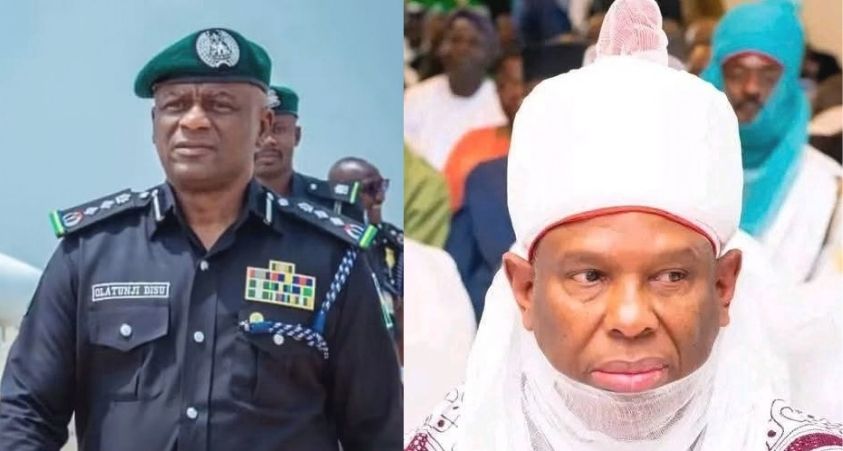
The Incorporated Trustees of the Kano First Forum have petitioned the Kano State Commissioner of Police over alleged public statements by Alhaji Aminu Babba Dan Agundi which the organisation said could heighten tension and threaten public peace in the state.
The petition, signed by the Forum’s solicitor, Barrister Badamasi Suleiman Gandu, urged the police to conduct a discreet, impartial and comprehensive investigation into the statements allegedly made by Dan Agundi during a press briefing on October 1, 2026.
According to the petition, the press briefing followed the participation of Khalifa Muhammadu Sanusi II, the Emir of Kano, in the Independence Day celebration and touched on issues surrounding the reported use of a horse by the monarch during the event.
The Forum alleged that the issue was particularly significant because of an existing directive by the Kano State Government concerning the use of horses, adding that the circumstances surrounding the Emir’s participation in the celebration had generated public discussion.
Kano First Forum, however, said its major concern was a statement allegedly made by Dan Agundi during the briefing in which he was quoted as telling the people of Kano State to “await their return and await further directives from them.”
The organisation described the statement as sensitive in view of the longstanding disagreements surrounding the Kano Emirate and urged security agencies to establish the context and intention behind the words.
According to the Forum, leaving members of the public to speculate about who would return, what such a return would mean and what the reference to “further directives” entailed could create unnecessary fear, anxiety and tension among residents.
The Forum said its decision to petition the police was motivated by the need to prevent statements or actions that could potentially escalate existing disagreements into confrontation.
It stressed, however, that its intervention should not be interpreted as an attempt to suppress legitimate political expression, traditional disagreements, criticism or other lawful forms of public discourse.
Rather, Kano First Forum said its objective was to ensure that disagreements concerning the Kano Emirate were addressed through lawful and peaceful channels without exposing residents to unnecessary tension or the risk of conflict.
The organisation therefore called on the Kano State Police Command to examine the circumstances surrounding the alleged statements, establish their full context and determine whether they amounted to any breach of the law or conduct capable of disturbing public peace.
The Forum also appealed to political, traditional, religious and community leaders in Kano State to exercise restraint in their public communications, particularly when commenting on sensitive matters relating to the Kano Emirate.
It maintained that Kano occupies an important commercial, social and political position and that any development capable of undermining peace in the state could have consequences for millions of residents.
The organisation consequently urged all stakeholders to place the safety and security of residents above personal, political or institutional interests.
“Whatever differences may exist concerning the Kano Emirate, they must be resolved through the courts and other lawful institutions, rather than through statements that could be interpreted as threats, directives or calls for confrontation,” the Forum stated in the petition.
Kano First Forum further said it remained committed to the protection of peace, public safety and the rule of law, explaining that the petition was filed in an effort to prevent avoidable conflict and protect lives and property.
The petition was addressed to the Commissioner of Police, Kano State Command, while copies were also forwarded to the Inspector-General of Police and the Department of State Services for their attention.
The Forum subsequently appealed to the security agencies to independently assess the allegations and take any lawful measures considered necessary to preserve peace and prevent developments that could threaten public order in Kano State.
News
Kano South Senator Constructs Over 6,000 Tube Wells, Unveils 102 Projects Since Election
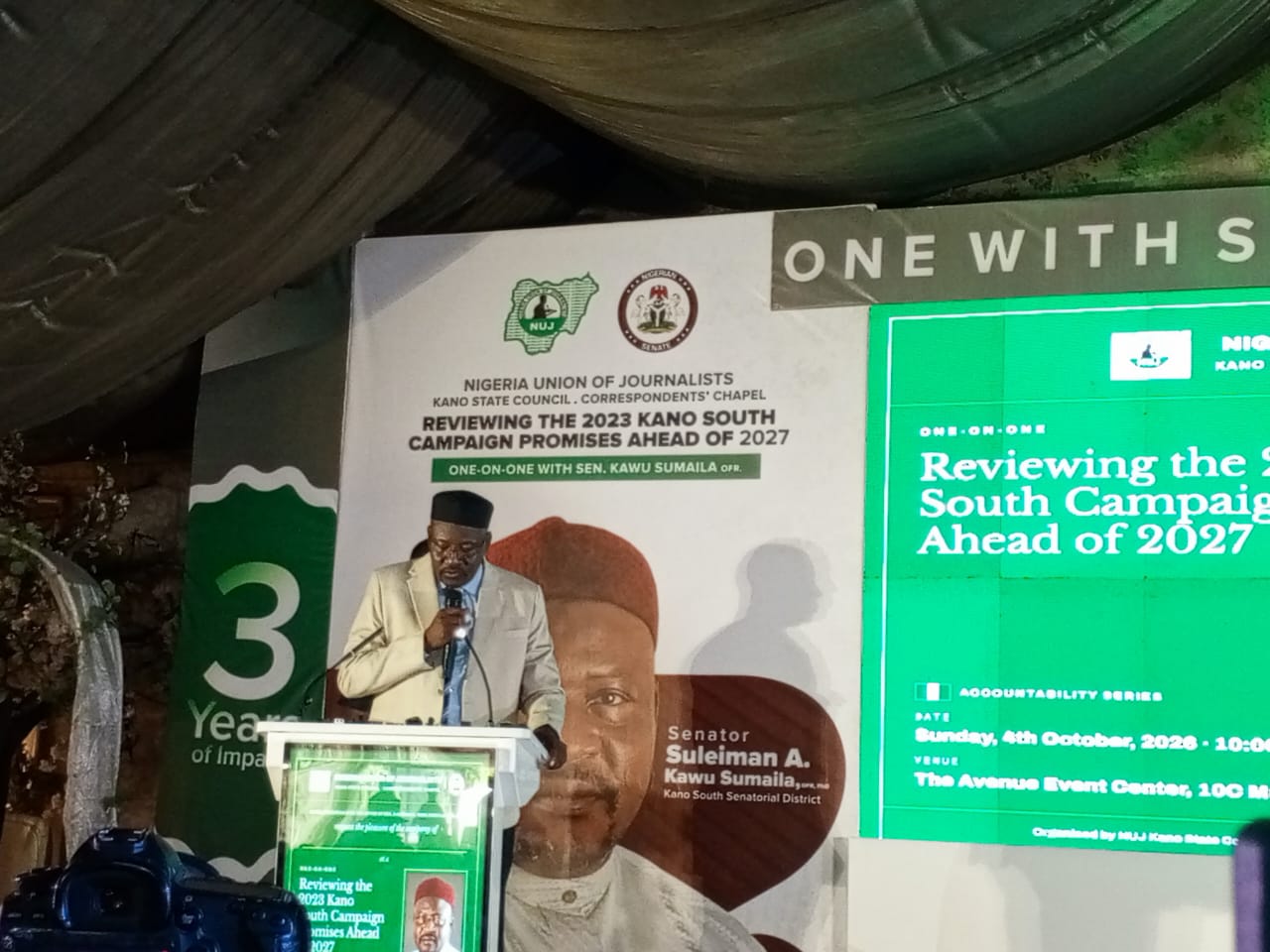
The Senator representing Kano South Senatorial District, Abdurrahman Kawu Sumaila, has said he has constructed more than 6,000 tube wells across the district as part of efforts to boost irrigation farming and improve the livelihoods of rural communities.
Sumaila disclosed this during an interactive session with members of the Nigeria Union of Journalists (NUJ) in Kano, organised to review his performance and assess the implementation of his campaign promises ahead of the 2027 general elections.
The interactive session, titled “Reviewing the 2023 Kano South Campaign Promises Ahead of 2027,” provided an opportunity for the senator to highlight what he described as key legislative interventions, constituency projects and community development initiatives undertaken since his election to the Senate.
Sumaila, who represents Kano South, described the district as the largest senatorial district in Nigeria, comprising 16 local government areas, and said the size of the constituency had made it necessary for him to focus on projects capable of directly improving the lives of constituents.
The senator said the construction of more than 6,000 tube wells across Kano South was one of his major interventions, particularly because of the importance of irrigation to agricultural production in the largely agrarian communities of the district.
According to Sumaila, the tube wells were provided to expand access to water for irrigation and enable farmers to cultivate their land throughout the year, rather than depending solely on rainfall.
He said his interventions were not limited to irrigation infrastructure, stressing that his record since 2023 included a combination of legislative activities, educational projects, road interventions and other constituency development programmes.
Sumaila said he had unveiled a total of 102 projects and interventions since his election to the Senate, adding that the projects were spread across the 16 local government areas that make up Kano South.
The senator also highlighted his legislative efforts, saying that in 2023 he participated in efforts that led to the reversal of the concession of the Mallam Aminu Kano International Airport (MAKIA).
He said he also sponsored a motion backing the resolution on constituency projects, which he described as an important mechanism for ensuring that elected representatives could attract development projects to their constituencies.
On foreign policy, Sumaila said he opposed any military intervention in the Niger Republic, arguing that Nigeria should prioritise diplomatic and peaceful solutions to regional political crises.
He also said he moved a motion calling for an end to the Israel-Hamas war and the killings of civilians in Gaza, stressing the need for the protection of innocent civilians and respect for international humanitarian principles.
The senator said he sponsored a bill in 2024 seeking the creation of Tiga State, arguing that the proposed state would bring governance and development closer to the people in the affected areas.
Sumaila also said he sponsored a motion seeking an investigation into suspected budget padding and multiple overlapping budgets, stressing the need for greater transparency and accountability in the management of public resources.
He said he also moved a motion calling for the completion of the Kano-Maiduguri Road, with particular emphasis on the Wudil-Gaya axis, which he described as an important road corridor for Kano South and the wider region.
On the persistent farmer-herder conflict, Sumaila said he made contributions on the floor of the Senate towards finding lasting solutions to the crisis, particularly through measures aimed at promoting peaceful coexistence between farming and pastoral communities.
The senator said he also sponsored a bill seeking the establishment of a Federal University of Agriculture in Kura, Kano State, saying the institution would strengthen agricultural education, research and human capital development in the state.
Sumaila further disclosed that he sponsored a motion seeking stronger legislative action against drug abuse and trafficking, which he said had become a serious concern, particularly among young Nigerians.
He said he also moved a motion urging the Federal Government to condemn and investigate the killings of Kano indigenes in Uromi, Edo State, stressing the importance of ensuring accountability whenever lives were lost through violence.
The senator also listed among his legislative initiatives a bill seeking the establishment of a Federal College of Education (Special) in Karaye, saying the institution would expand access to teacher education and support the development of specialised education.
Sumaila said he had also moved a motion calling on the Senate to invite the service chiefs to brief lawmakers on the state of insecurity in the country and the measures being taken by security agencies to protect citizens.
Beyond legislative activities, the senator said his constituency interventions included educational infrastructure, road construction and support for students.
He disclosed that arrangements had also been made for the payment of student hostel rent, describing education as one of the key areas requiring sustained intervention to reduce the financial burden on students and their families.
Sumaila also listed the Rimi-to-Magami-to-Sumaila road project among the interventions associated with his representation, saying road infrastructure remained critical to the movement of people, agricultural produce and commercial activities across the district.
He further said classroom blocks had been constructed as part of his educational interventions, including the construction of six classrooms to improve the learning environment for pupils and students.
The senator also said he had undertaken the general renovation of Almajiri schools as part of efforts to improve facilities and create a better learning environment for children enrolled in the schools.
Sumaila said his record in the Senate and his constituency development initiatives should be the basis upon which his constituents assess his performance ahead of the 2027 elections.
“I want my constituents to re-elect me based on my performance,” Sumaila said, urging voters to evaluate his representation based on the projects delivered and legislative interventions made since he assumed office.
He said the interactive engagement with journalists was intended to provide the public with an opportunity to scrutinise his activities and compare his 2023 campaign promises with what had been achieved so far.
Sumaila added that he remained committed to representing the interests of Kano South at the National Assembly and ensuring that the district continued to benefit from government projects and interventions.
News
Kano, IBP sign MoU on health financing transparency dashboard
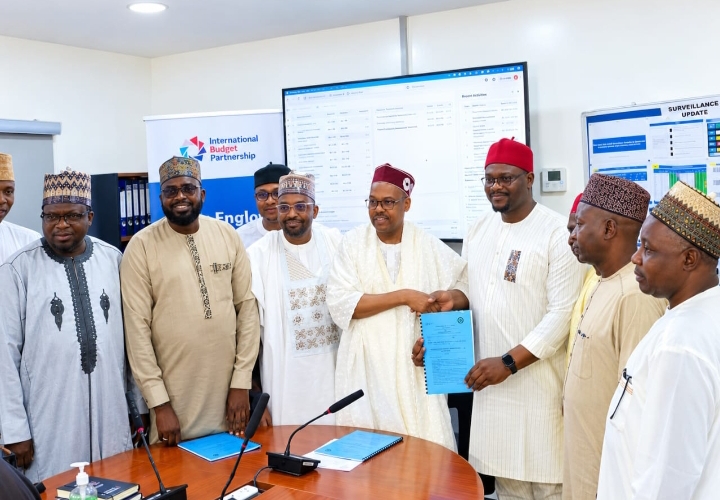
The International Budget Partnership (IBP), Nigeria, and the Kano State Government on Saturday in Kano signed a Memorandum of Understanding (MoU) to strengthen transparency and accountability in health sector financing.
The partnership will support the development of a health financing dashboard to enable stakeholders monitor budget planning, releases, expenditure and performance across health sector agencies in the state.
The Commissioner for Health, Dr Abubakar Labaran, said the partnership had brought significant improvements in budget planning, execution and tracking in the ministry.
Labaran said the dashboard would enable the ministry to monitor the performance of its various units and agencies in real time.
He said the state government would continue to work with IBP and other partners to improve budget performance, releases and other issues relating to health financing.
IBP Country Director, Dr Olayinka Babalola,
said the dashboard was aimed at improving transparency around health budgeting and providing a comprehensive picture of expenditure.
Represented by Policy and Strategy Lead, Onyekachi Chukwu, said Kano was already making significant investments in the health sector alongside development partners, but tracking where the funds were going had been a challenge.
According to him, the MoU will support the state in developing a health financing dashboard that will enable stakeholders to monitor expenditure by various agencies in the health sector.
He said the dashboard would also provide information on the full range of investments in the sector and show where the funds were being spent.
Babalola, said the platform would help stakeholders track reasons why certain health services were not being delivered.
He said the information would enable relevant authorities to identify gaps in service delivery and take appropriate measures to address them.
Dr Shamsuddin Sani, State Representative of the Gates Foundation in Kano, said the foundation was supporting the initiative to address longstanding challenges in monitoring fund flow within the health sector.
Sani said the project would particularly focus on primary healthcare service delivery and provide clearer information on resources coming into the sector.
He said over the years, the health sector in Kano had faced challenges in tracking the amount of funding coming into the system, how much was being spent and how much was not reaching the intended areas.
According to him, government and development partners working in the sector have not had a clear picture of the resources coming into the health system and how they are being utilised.
“With this project, we want to close that gap by ensuring that we know exactly how much resources are coming into the primary healthcare system and the broader health sector in the state,” he said.
Sani said the initiative would also help determine the resources required by the sector and compare government funding with contributions from development partners.
He said the grant for the project was conceived to address the identified gaps, adding that implementation began earlier in the year.
The dashboard is expected to provide stakeholders with timely information on health financing and expenditure to support better planning, monitoring and service delivery in the state.

Kano First Forum Petitions Police Over Alleged Inciting Statements by Aminu Babba Dan Agundi

Kano South Senator Constructs Over 6,000 Tube Wells, Unveils 102 Projects Since Election

Kano, IBP sign MoU on health financing transparency dashboard

Kano Gov Abba Kabiru Yusuf bags international sports award in UK

President Tinubu Salutes Hon. Kabir Bichi, Chair Appropriation Committee Of The House Of Representatives On His 45th Birthday

Zamfara Varsity ASUU Threatens Warning Strike Over FG-ASUU Agreement, Promotion Arrears

Kano Chemists Threaten Warning Strike Over Alleged PCN Pressure

Per Ishaq Samaila: “Waziri” for Strategy. “Mai Jama’a” for Service. One Man. One Mission. Ibrahim Kabir Masari

Goje’s Electoral War:The Confrontation With Tinubu,Governor Inuwa,Usman Kumo And APC candidates Ahead Of 2027

Prof Yusuf Adamu Delivers BUK’s 63rd Professorial Inaugural Lecture, Reflects on Medical Geography and Academic Legacy
Kano First Forum Petitions Police Over Alleged Inciting Statements by Aminu Babba Dan Agundi
Kano South Senator Constructs Over 6,000 Tube Wells, Unveils 102 Projects Since Election
Kano, IBP sign MoU on health financing transparency dashboard
Kano Gov Abba Kabiru Yusuf bags international sports award in UK
President Tinubu Salutes Hon. Kabir Bichi, Chair Appropriation Committee Of The House Of Representatives On His 45th Birthday
Zamfara Varsity ASUU Threatens Warning Strike Over FG-ASUU Agreement, Promotion Arrears
Kano Chemists Threaten Warning Strike Over Alleged PCN Pressure
Per Ishaq Samaila: “Waziri” for Strategy. “Mai Jama’a” for Service. One Man. One Mission. Ibrahim Kabir Masari
Goje’s Electoral War:The Confrontation With Tinubu,Governor Inuwa,Usman Kumo And APC candidates Ahead Of 2027
Prof Yusuf Adamu Delivers BUK’s 63rd Professorial Inaugural Lecture, Reflects on Medical Geography and Academic Legacy
-

 Opinion5 years ago
On The Kano Flyovers And Public Perception
-

 Features5 years ago
How I Became A Multimillionaire In Nigeria – Hadiza Gabon
-

 Opinion6 years ago
Kano As future Headquarters Of Poverty In Nigeria
-

 History5 years ago
Sheikh Adam Abdullahi Al-Ilory (1917-1992):Nigeria’s Islamic Scholar Who Wrote Over 100 Books And Journals
-

 Opinion5 years ago
My First Encounter with Nasiru Gawuna, the Humble Deputy Governor
-

 History5 years ago
The History Of Borno State Governor Professor Babagana Umara Zulum
-

 History6 years ago
The Origin Of “Mammy Market” In Army Barracks (Mammy Ochefu)
-

 News4 years ago
Federal University Of Technology Babura To Commence Academic Activities September