
News
We won’t fix petrol prices again – NMDPRA
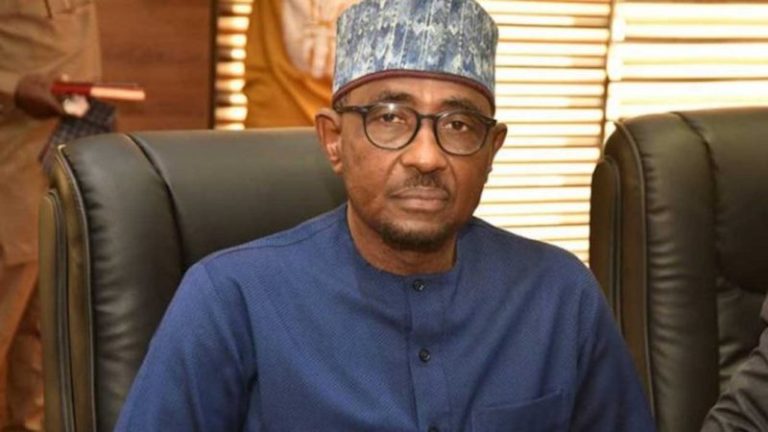
The Nigerian Midstream and Downstream Petroleum Regulatory Authority (NMDPRA) says it will no longer fix prices or release templates for Premium Motor Spirit (PMS).
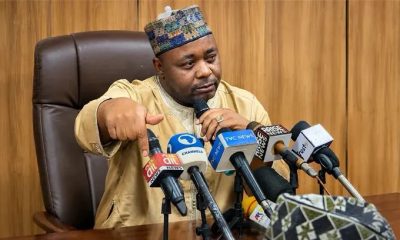
Authority Chief Executive (ACE), Mr Farouk Ahmed, who said this at a news conference in Abuja on Friday, said that market forces would henceforth dictate prices under the liberalised market.
“As far as we are concerned in the NMDPRA, this is not like before when the PPPRA fixes the price; in a deregulated market, it is the market force that dictates the price,” he said.
The News Agency of Nigeria (NAN) reports that the development was sequel to the removal of subsidy on PMS known as petrol.
President Bola Tinubu had in his inaugural speech on Monday said fuel subsidy regime had ended with the commencement of his administration.
Nigeria’s Dangote Refinery Will Transform our Downstream Sector, Says Ghana Petroleum Authority
Ahmed, however, said the market was now open for everybody that would import as far as they met all the requirements.
“So, it is not about the Nigerian National Petroleum Company Limited (NNPC Ltd) alone.
“We put the regulation in place, we make sure quality control is complied with, we make sure the product is there and we give licence to prospective importer.
“We make sure we guide the operations of everyone in the sector whether at the depot or wherever the product is but we will not put a cap to say this is what the price must be,” he said.
According to Ahmed, the role of the NNPC is to fix prices of the petrol it imported and not take over the responsibilities of the Authority.
“In the case of the NNPC, the organisation is the sole importer at this point. We told the NNPC to recover its costs because they know how much it cost them to import the product and sell it.
“Of course, we also know how much shipping, offshore, ex-depot and ex-pump are. But we cannot tell them to sell at a price because the market is deregulated,” he added.
The NMDPRA boss also disclosed that the Federal Government has officially scrapped petroleum equalisation as well as the national transport allowance.
He said the NMDPRA, the federal government and Consumer Protection Commission (FCCPC) would mount aggressive monitoring of activities in the downstream sector to prevent profiteering by petroleum marketers.
Ahmed further disclosed that marketers are now free to source their foreign exchange anywhere around the world to import petroleum products and recover their costs without impediments.
On where the importers will source their forex from, Ahmed said the CBN would not give dollar to anyone because of open market, adding that anyone willing to import should get the dollars from anywhere to import.
According to him, anyone willing to open a letter of credit from any part of the world can do that to import.
“That marketers can source their forex from anywhere is the beauty of the liberalised market that the NMDPRA has introduced based on the provision of the law”.
Ahmed said that the market would henceforth be modulated to allow the fluidity of prices, adding that though no template spelt out the pricing components of petrol price.
He said that, “based on this, the price would no longer be static rather depend on the international price of the gasoline market.
“This did not imply that marketers could sell at any price”.
According to him, the NMDPRA and FCCPC will collaborate to curb excesses if certain prices were way above the expected profit margin.
“The market structure will dictate the price swings at every point in time,” he said.
Ahmed cautioned against optimism for cheap petroleum products, saying products may not be cheaper because the company would be buying crude oil at the international price.
“Dangote Refinery is a game changer in terms of accessibility. By the time the NNPC refineries and other modular refineries across the country come on stream, Nigeria will be a net exporter of petroleum products,” he said. (NAN









News
Arewa Youths Merger Group APC Raises Alarm Over Kachalla Maha,Seeks Barracks In Kano
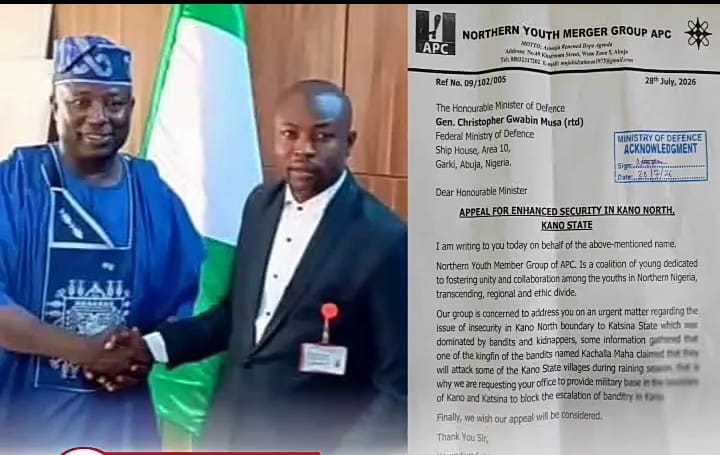
Coordinator, Comrade Musa Mujahid Zaitawa, has lodged a formal complaint with Nigeria’s Minister of Defence, Christopher Musa, requesting the urgent establishment of a military barracks in Northern Kano, particularly in communities along the Kano-Katsina border.
This was contained in a statement signed by the National Coordinator and issued to the press.
Comrade Zaitawa said the request follows publicized security threats in the area, including threats attributed to a notorious bandit leader, Kachalla Maha, who was reported to have threatened to infiltrate parts of Kano State.
“Establishing a forward military base in this corridor will strengthen the efforts of President Bola Ahmed Tinubu and our security agencies to deter criminal activity, improve response time, and protect farming communities and travelers,” Comrade Zaitawa said.
The group also expressed concern about the political environment ahead of the 2027 elections. In the statement, the group said it has observed activities that it believes could undermine peaceful elections in Kano if not addressed. It called on the Presidency, the Office of the National Security Adviser, the National Assembly, and security agencies to ensure that all political actors and security personnel operate within the law and remain neutral.
The Arewa Youths Merger Group further noted an incident involving the arrest of its spokesperson, Mustapha Dan Muhammad, by security operatives. The group called for due process and respect for the rights of citizens and civic groups.
The group reaffirmed its commitment to supporting peace and democracy. It said it is engaged in voter education, campaigns against thuggery and drug abuse, and youth empowerment through skills training in Kano.
“We support the federal and Kano State governments in their efforts to secure the state. We urge all stakeholders to ensure a level playing field and a peaceful electoral process in 2027,” the statement added.
News
Okonjo-Iweala to Tinubu: Borrow Cautiously, Reforms Should Create Jobs for Nigerians
By Yusuf Danjuma Yunusa
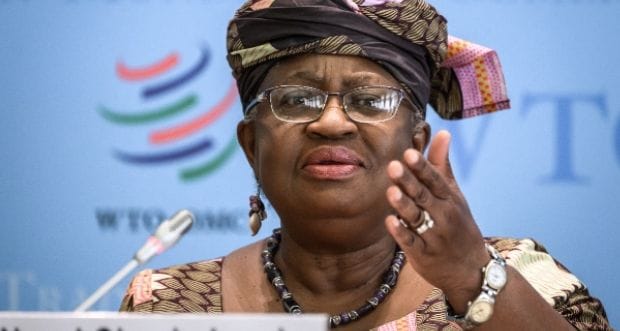
The director-general of the World Trade Organisation, Ngozi Okonjo-Iweala, has urged the Nigerian government to be careful about borrowing and managing the country’s debt, saying economic reforms must improve the lives of ordinary Nigerians.
She also called on the government to sustain ongoing reforms while creating more jobs and economic opportunities for the country’s growing youth population.
Mrs Okonjo-Iweala spoke on Wednesday at the seventh Africa Emerging Markets Forum in Abuja.
Commending the Central Bank of Nigeria for its monetary and foreign exchange reforms, Ms Okonjo-Iweala urged Nigeria to continue broader economic reforms while remaining disciplined in managing its finances.
“Nigeria needs to continue the work on overall macroeconomic reforms with a careful approach to fiscal issues, contracting of debt and debt management,” the WTO chief stated.
According to the latest data from the Debt Management Office, Nigeria’s total public debt stood at N159.28 trillion at the end of December 2025, rising by N14.61 trillion, or 10.10 per cent, from N144.67 trillion recorded at the end of 2024. The figure covers the debt owed by the federal government, the 36 states and the Federal Capital Territory. The government is also expected to continue borrowing this year to finance its 2026 budget deficit.
Mrs Okonjo-Iweala said the success of Nigeria’s reforms should not be measured only by improvements in economic indicators. Instead, she said Nigerians must begin to experience better living conditions through more jobs and opportunities.
“Above all, Nigeria needs to focus on creating jobs and economic opportunities for a young and hungry population. Nigerians have to feel the dividends of reform in the real economy,” noted the WTO chief.
Nigeria has one of the world’s youngest populations, with millions of young people joining the labour market every year. However, many struggle to find decent jobs, making employment one of the biggest economic challenges in the country.
Since President Bola Tinubu assumed office in May 2023, his administration has introduced major reforms, including the removal of petrol subsidy and the liberalisation of the foreign exchange market.
The policies have pushed up the cost of living, with many Nigerians facing higher prices for food, transport and other essentials. Although inflation has slowed in recent months, prices remain high.
The National Bureau of Statistics said Nigeria’s headline inflation rate eased slightly to 15.91 per cent in June 2026 from 15.93 per cent in May. Food inflation, however, increased to 17.52 per cent, showing that many households are still paying more for basic food items.
For opportunities, Ms Okonjo-Iweala said countries that maintain stable economic policies and improve their business environment will be better placed to benefit from changes in global trade.
She noted that companies are increasingly looking for new places to invest and diversify their supply chains, creating opportunities for countries that can offer stability and predictable policies and urged Nigeria to continue strengthening its economy so it can attract long-term investment and create more jobs for its people.
News
U.S. Discontinues Routine Visa Services in Abuja, 24 Other African Cities
By Yusuf Danjuma Yunusa
The U.S. government says routine visa services in Abuja and 24 other African cities will end on August 1.
“Effective August 1, 2026, the Department of State will realign routine visa services in Antananarivo, Abuja, Asmara, Bamako, Banjul, Brazzaville, Bujumbura, Conakry, Cotonou, Durban, Freetown, Gaborone, Harare, Juba, Libreville, Lilongwe, Lusaka, Maputo, Maseru, Mbabane, N’Djamena, Niamey, Nouakchott, Ouagadougou, and Windhoek to a regional visa hub,” the agency stated.
It noted that citizens and residents of the affected countries who wish to apply for a visa on or after August 1, 2026, must schedule an appointment and pay the required visa fee at the appropriate designated non-immigrant visa locations or designated immigrant visa locations.
From August 1, Nigerians who want to process a U.S. visa would have to travel to the U.S. consulate in Lagos.
According to a statement on July 23 by the agency, the move is “realigning visa operations in Africa to regional hubs, part of a long-standing Department practice that strengthens national security by promoting more uniform screening, vetting, and adjudication standards, as well as improves efficiency”.
Last June, reports had it that Abuja was missing from President Donald Trump administration’s shortlist of 20 African cities where foreigners seeking to travel to the U.S. can process visa applications.
The U.S. currently has around 50 embassies and consulates across Africa that process visa applications, but the new move by the State Department will slash that number to 20 amid Mr Trump’s crackdown on immigration.

Arewa Youths Merger Group APC Raises Alarm Over Kachalla Maha,Seeks Barracks In Kano

Okonjo-Iweala to Tinubu: Borrow Cautiously, Reforms Should Create Jobs for Nigerians

U.S. Discontinues Routine Visa Services in Abuja, 24 Other African Cities

Breaking:Sardaunan Sokoto Alhaji Abubakar Alhaji Is Dead

ADC Youths Call on Atiku to Intervene Over Allegations of Injustice in Primary Elections, Demand Resignation of David Mark

Alhaji Tijjani Rabiu Spikin: A Neighbour, Philanthropist, and Friend of Children

What Saheeba Taught Me About Waiting for Love

Is N100,000 Worth the Risk?’ Nigerians React to Soldiers’ Salary Increase

Goodwill, Visibility, and Operational Security: A Strategic Communication Reading of Senator Ahmad Lawan’s DIA Post

MAAUN Clarifies Status of Former Visiting Lecturer, Reaffirms Zero-Tolerance Policy on Sexual Harassment
Arewa Youths Merger Group APC Raises Alarm Over Kachalla Maha,Seeks Barracks In Kano
Okonjo-Iweala to Tinubu: Borrow Cautiously, Reforms Should Create Jobs for Nigerians
U.S. Discontinues Routine Visa Services in Abuja, 24 Other African Cities
Breaking:Sardaunan Sokoto Alhaji Abubakar Alhaji Is Dead
ADC Youths Call on Atiku to Intervene Over Allegations of Injustice in Primary Elections, Demand Resignation of David Mark
Alhaji Tijjani Rabiu Spikin: A Neighbour, Philanthropist, and Friend of Children
What Saheeba Taught Me About Waiting for Love
Is N100,000 Worth the Risk?’ Nigerians React to Soldiers’ Salary Increase
Goodwill, Visibility, and Operational Security: A Strategic Communication Reading of Senator Ahmad Lawan’s DIA Post
MAAUN Clarifies Status of Former Visiting Lecturer, Reaffirms Zero-Tolerance Policy on Sexual Harassment
-

 Opinion4 years ago
On The Kano Flyovers And Public Perception
-

 Features5 years ago
How I Became A Multimillionaire In Nigeria – Hadiza Gabon
-

 Opinion6 years ago
Kano As future Headquarters Of Poverty In Nigeria
-

 History5 years ago
Sheikh Adam Abdullahi Al-Ilory (1917-1992):Nigeria’s Islamic Scholar Who Wrote Over 100 Books And Journals
-

 Opinion5 years ago
My First Encounter with Nasiru Gawuna, the Humble Deputy Governor
-

 History5 years ago
The History Of Borno State Governor Professor Babagana Umara Zulum
-

 History5 years ago
The Origin Of “Mammy Market” In Army Barracks (Mammy Ochefu)
-

 News4 years ago
Federal University Of Technology Babura To Commence Academic Activities September