
News
SPECIAL REPORT:“Nigeria’s Democracy and the Endless Cycle of One-Party Dominance”
A historical analysis reveals how Nigeria’s democracy repeatedly succumbs to one-party dominance, with the current regime being worst as it perfects the playbook of past eras.
By Yusuf Danjuma Yunusa
Dominant-party politics—where one party consistently controls political power while opposition exists but faces significant systemic disadvantages—has manifested at various points in Nigeria’s political history. While the current situation under President Bola Tinubu’s APC-led administration is evidently worst as it shows concerning trends toward a total dominance, historical precedents exist, particularly during the First Republic and the prolonged military eras that indirectly shaped party systems.
In The First Republic(1963-1966)
Nigeria’s first experiment with multiparty democracy effectively functioned as a “three-dominant-party system” at the regional level:
If checked critically in the Northern region as at that time, the Northern People’s Congress (NPC) held virtually unassailable dominance, leveraging the feudal structure, ethnic solidarity (Hausa-Fulani), and control of Native Authority police and taxation. Opposition parties like the Northern Elements Progressive Union (NEPU) were systematically marginalized.
While in the Western region, the Action Group (AG) under Chief Obafemi Awolowo dominated until the 1962–63 crisis, which split the party and led to a federal government-backed takeover by the Nigerian National Democratic Party (NNDP).
In the Eastern region the National Council of Nigerian Citizens (NCNC) held sway, though with more competitive politics than the North.
It’s worth noting that this was regionalized dominance rather than a single nationwide dominant party. The federal government was a fragile NPC-NCNC coalition.
In The Second Republic(1979-1983)
The National Party of Nigeria (NPN) emerged as a nationwide dominant party in the second republic.
It won the presidency with Shehu Shagari as its candidate without a clear popular majority. But through patronage, co-optation of opponents (“boarding the bus”), and control of federal resources, the NPN gained “surprise” gubernatorial victories and parliamentary seats, particularly in the 1983 elections—which was widely viewed as heavily rigged.
It used federal might to unseat opposition governors, a good example of it which is the Ondo State saga, through controversial judicial processes.
National Party of Nigeria(NPN) had a parallel mode of operations to today’s administration of President Tinubu. The party was also a broad, pragmatic coalition of elites from multiple regions–like the APC–using control of the petroleum boom economy to reward loyalty and fellowship.
In the military era, there usually would be nothing as party politics. Military rule suppressed party politics entirely but orchestrated networks and a centralized federal might that later shaped civilian dominant-party tendencies.
This was evident in the 1989–1993 two-party experiment (SDP and NRC) imposed by Gen. Babangida. It was an artificial, state-created duopoly—not genuine multiparty competition.
The Fourth Republic(1999-Present Day)
The Peoples Democratic Party(PDP) was the first national dominant party in the history of Nigeria.
The party held the Presidency, National Assembly majority, and most governorships for 16 consecutive years.
It employed massive patronage, control of INEC and security forces, and corruption of electoral processes especially under the 2007 election, described as “do-or-die” by President Obasanjo.
Opposition victories were rare to see with only Lagos, ANPP strongholds as the opposition voice. Although victories were possible, just that there were rare, it showed that the system was competitive, authoritarian rather than full one-party rule.
Dominance ended in 2015 due to internal fragmentation (the 2013–14 defection of the “nPDP” bloc to APC) and widespread public discontent over insecurity and corruption, not via a level playing field.
In 2015, APC’s era came and won the presidency (Buhari) and, by 2023, controlled 22 of 36 states.
By 2024 till this very moment in 2025, the ruling APC has been massively receiving politicians from the main opposition PDP and others into its fold. The most recent of it was the defection of governor Fubara of Rivers State.
The tsunami has left the PDP with just 5 governors now: governor Fintiri of Adamawa State, Dauda Lawal of Zamfara State, Caleb Muftwang of Plateau State, governor Seyi Makinde of Oyo State, and Bala Mohammed of Bauchi State.
Governor Agbu Kefas of Taraba State and governor Adeleke of Osun State would have been the sixth and seventh governors for the party respectively, but reports have it that the former has also defected to the APC. Although, official declaration for that is yet to happen as it has been scheduled to hold next year January, 2026.
While governor Adeleke has officially joined the Accord Party and has picked the gubernatorial form for his second tenure.
Reports also have it that governor Caleb Muftwang of Plateau State is one step away from joining the ruling All Progressives Congress, citing heightened differences between him and some of the state executives of APC as the impediment to his official alignment.
The party, APC, now commands a supermajority capable of constitutional amendments without opposition support with 73 Senators and 175 Representatives.
It has also 28 governors in total, leaving the opposition parties with 8.
5–for PDP
1–for LP
1–for NNPP
1–for Accord Party
The Mechanisms of Dominance
Speaking with a public affairs analyst and political scientist, Austin Patrick, he shared that history has shown that financial advantage has been the tool in which ruling party use to dominate since democratic era.
“The control of oil revenues, state contracts, the capture of NNPC, CBN, and other agencies; alleged use of anti-graft agencies to pressure opponents are different mechanisms in which the ruling party use to dominate.”
He continued, “we all know that the Okowa case with the EFCC will no longer come to the public after his defection to the APC.”
Mr. Austin also emphasized on the judicial favouritism which the country has been witnessing in recent times, citing the position of court as the final arbiter in recent times.
“Courts now play an unprecedented role in determining election winners—over 80% of petitions in the 2023 cycle were dismissed on technicalities rather than merits,” he said.
On the other hand, Dr. Kabir Sufi, who is also a political analyst, opined that the APC’s dominance is largely attributed to structural advantages and the factions in the opposition parties.
“Well, the combination of the APC’s usage of structural advantages and fragmentation of the opposition contribute to how bigger and wider the ruling party has become.”
He also highlighted on the rumor by many Nigerians that the said fragmentation and weakness of the opposition is largely the orchestration of the APC itself.
The Dangers Of One-Party System
Dr. Sufi asserted that the dangers of one party system is largely on democracy itself rather than intergovernmental relations and federalism spirit.
“The implications are mostly for democracy itself, it’s not allowing the opposition to thrive.”
“The advantages in which oppositions are to enjoy are not actually realistic,” he added.
Although Dr. Sufi acknowledged that there are a lot of factors that have allowed the situation to become what it is today.
Meanwhile, Mr. Austin was of the opinion that the danger of one party system is ultimately accountability erosion.
“Weak opposition breeds legislative and fiscal oversight.”
He noted that with no external threat, APC may become more autocratic, stifling pragmatic democracy.
Mr. Austin also stated that one party dominance contributes to voter apathy among citizens.
“The belief that elections don’t change outcomes may depress turnout and fuel political violence.”
Moreover, Dr. Sufi, when asked if the opposition have any chance to unsit the APC in the coming 2027 presidential election, said that:
“With the wave of defections to the APC, the task may be getting harder for the opposition unless if there’s an implosion within APC.”
Summarily, while it’s evident that Nigeria is on the verge of becoming a one-party nation, it’s worth noting that it’s not yet completely a one-party state. Multiple parties still exist and compete, but it exhibits clear dominant-party authoritarian characteristics similar to the PDP’s peak (2003–2011).
The difference is that the current opposition is more fragmented and demoralized than in the past.
A thorough examination will reveal to one that dominant-party politics in Nigeria follows a cyclical pattern: a party gains power, uses state resources to entrench itself, becomes corrupt and fragmented, then collapses from internal splits rather than electoral defeat. The APC appears to be in the entrenchment phase, Nigerian Tracker News observed.
Yusuf Danjuma Yunusa is a freelance journalist and a reporter with the Nigerian Tracker News. He can be reached via: theonlygrandeur@gmail.com or 07069180810











News
China, Nigeria Mark Friendship with Joint Cultural Mural
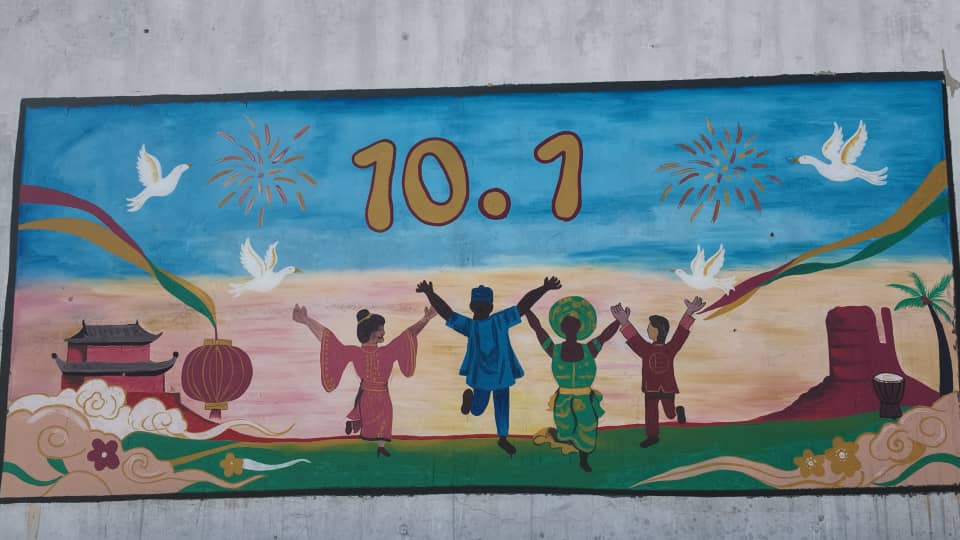
A colourful mural celebrating both China’s National Day and Nigeria’s Independence Day has been unveiled at an overseas project site, serving as a vivid symbol of the enduring friendship between the two nations.
The artwork, jointly produced by Chinese and Nigerian staff, features builders dressed in traditional Chinese costumes and Nigerian ethnic attire holding hands and dancing together.
Above them, fireworks and white doves of peace illuminate the sky, while the inscription “10.1” highlights the dual significance of October 1, the China’s National Day and Nigeria’s Independence Day.
On the left side of the mural, ancient Chinese architecture, red lanterns and auspicious cloud motifs showcase Chinese heritage.
On the right, red earth, coconut palms and African drums reflect Nigeria’s cultural identity. Flowing ribbons weave across the painting, symbolising unity and shared destiny.
Project officials described the mural as a “living testament” to cooperation at the frontline of development. They said it embodies mutual trust and support as workers from both countries overcome challenges together.
The initiative underscores cultural integration and partnership, with both sides pledging to continue working hand in hand to strengthen ties.
“Celebrating two festivals as one, we march forward with one heart,” a statement read, emphasising the commitment to write new chapters of friendship along the path of cooperation.
The mural, rooted in the overseas project site, stands as a reminder of the brotherly bond between China and Nigeria, and the shared vision of building together for a brighter future.
News
Musa Illiyasu Kwankwaso Celebrates Senator Lado @60, Says Is A Political Dogma
From Muhammad Kabir Kano
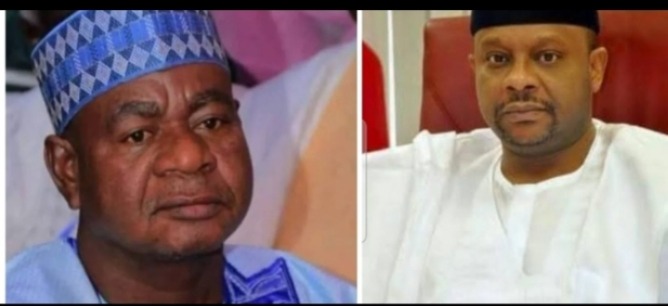
The spokesperson of Political Appointees Forum from Kano State, Dr. Musa Illiyasu Kwankwaso, has described Senator Basheer Lado, the Special Adviser to President Tinubu on National Assembly Matters (Senate), who also doubles as the Chairman of the Appointees, on his 60th birthday, as a Political Blog who plays the game with maturity and respect.
Kwankwaso who also describes Senator as Political Dogma, praised his contributions to democratic governance, humanitarian services and national development.
“Senator Lado is a dependable public servant and accomplished legislator whose experience had helped strengthen relations between the Executive and the Senate and also steer ship the activities of the Political Appointees with huge respect and understanding”,
He said it is on notice that Lado served in the Senate for four years before his by late President Buhari on Relief agency and subsequent appointment as Tinubu’s liaison officer in the upper chamber of the National Assembly.
Lado represented Kano Central Senatorial District in the Seventh National Assembly from 2011 to 2015, where he served as Vice Chairman of the Senate Committee on Works.
Lado facilitated several constituency projects, including the Kundila Bridge, popularly known as Gadar Lado, in Kano State. His contributions to humanitarian services through his previous roles as Federal Commissioner of the National Commission for Refugees, Migrants and Internally Displaced Persons, and Director-General of the National Agency for the Prohibition of Trafficking in Persons (NAPTIP).
He said Lado contributed to protecting vulnerable Nigerians, combating human trafficking and improving the welfare and rehabilitation of displaced persons.
Kwankwaso further commended the senator’s humanitarian initiatives through the Ladon Alheri Foundation, particularly in education, healthcare, women’s economic empowerment, rural water supply and support for disadvantaged communities.
” Lado’s contributions across public service reflected his commitment to national development and the welfare of Nigerians”, he added.
News
EFCC Reopens Atiku’s Alleged Financial Crimes Probe
By Yusuf Danjuma Yunusa
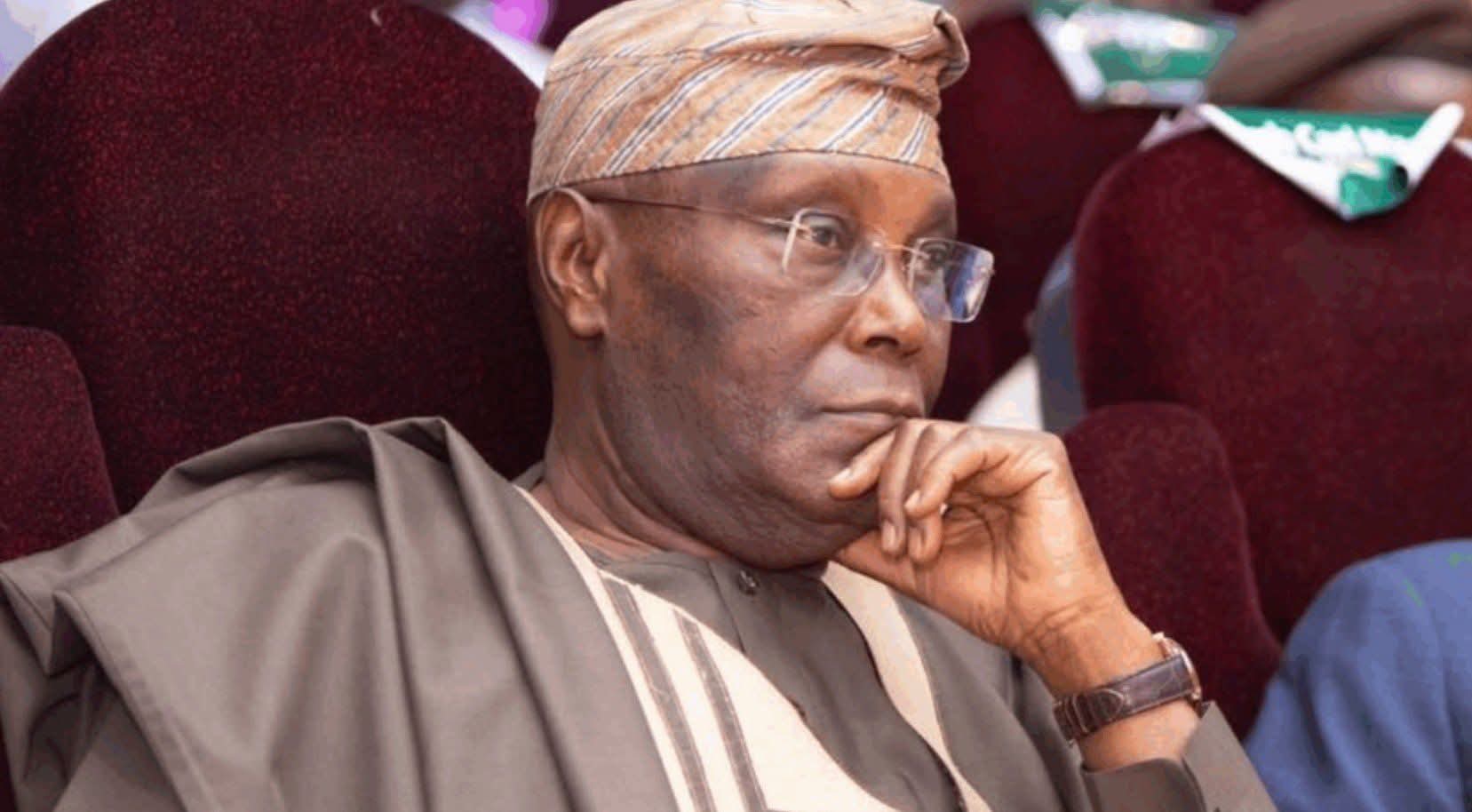
The Economic and Financial Crimes Commission (EFCC) has reopened its investigation into allegations against former Vice President Atiku Abubakar following a petition by former House of Representatives member, Hon. Ehiozuwa Johnson Agbonayinma, seeking his prosecution over alleged financial crimes.
The petition seeks to revive a case dating back to 2006, asking the anti-graft agency to revisit its investigation under former chairman, Mallam Nuhu Ribadu, and consider a subsequent report by a United States Senate subcommittee.
Speaking on the development, Agbonayinma said the EFCC had acknowledged his petition, dated August 27, 2026, and received on September 1. Filed through his lawyer, Chief Hannibal Egbe Uwaifo, SAN, the petition asks the commission to reactivate its earlier report and act on the allegations.
The former lawmaker appeared at the EFCC headquarters in Jabi, Abuja, where he adopted the petition and answered questions from investigators.
Agbonayinma said the matter should not be allowed to remain unresolved.
“I want to thank Nigerians, the EFCC, and those praying for me in this struggle. The laws are meant for both the rich and the poor. After the EFCC has done a fantastic job, it should not be kept under the table,” he said.
In the petition, Agbonayinma urged the EFCC to revisit its September 2006 report on Atiku and a February 4, 2010, report by the US Senate Permanent Subcommittee on Investigations, arguing that both documents should form the basis for renewed action.
The petition alleged that the EFCC had previously indicated that Atiku could face prosecution after leaving office as vice-president, when his constitutional immunity ceased to apply, but that no prosecution followed.
Agbonayinma described the alleged failure to act as a dereliction of duty and argued that pursuing the matter would demonstrate the commission’s resolve to hold politically influential figures accountable.
He also disclosed that he had petitioned US President Donald Trump over the allegations.
The EFCC spokesman, Dele Oyewale, had yet to respond to messages seeking an update on the investigation as of the time of filing this report.

Why Gov Abba Deserves Another Tenure

China, Nigeria Mark Friendship with Joint Cultural Mural

Musa Illiyasu Kwankwaso Celebrates Senator Lado @60, Says Is A Political Dogma

EFCC Reopens Atiku’s Alleged Financial Crimes Probe

APC Presidential Campaign Council: Nigerians Devoid Of Party Affiliations Endorses Tinubu’s 2nd Term-Kwankwaso

Zamfara Varsity ASUU Threatens Warning Strike Over FG-ASUU Agreement, Promotion Arrears

PCACC Arrests Man Over Alleged ₦4.5m Sale, Illegal Leasing of Kano Government Horse Stable

Goje’s Electoral War:The Confrontation With Tinubu,Governor Inuwa,Usman Kumo And APC candidates Ahead Of 2027

Prof Yusuf Adamu Delivers BUK’s 63rd Professorial Inaugural Lecture, Reflects on Medical Geography and Academic Legacy

RE:WE ARE UNDER SIEGE: TARABA MONARCH BREAKS SILENCE AS FULANI BANDITS OVERRUN THE ANCIENT KWARARAFA KINGDOM:
Why Gov Abba Deserves Another Tenure
China, Nigeria Mark Friendship with Joint Cultural Mural
Musa Illiyasu Kwankwaso Celebrates Senator Lado @60, Says Is A Political Dogma
EFCC Reopens Atiku’s Alleged Financial Crimes Probe
APC Presidential Campaign Council: Nigerians Devoid Of Party Affiliations Endorses Tinubu’s 2nd Term-Kwankwaso
Zamfara Varsity ASUU Threatens Warning Strike Over FG-ASUU Agreement, Promotion Arrears
PCACC Arrests Man Over Alleged ₦4.5m Sale, Illegal Leasing of Kano Government Horse Stable
Goje’s Electoral War:The Confrontation With Tinubu,Governor Inuwa,Usman Kumo And APC candidates Ahead Of 2027
Prof Yusuf Adamu Delivers BUK’s 63rd Professorial Inaugural Lecture, Reflects on Medical Geography and Academic Legacy
RE:WE ARE UNDER SIEGE: TARABA MONARCH BREAKS SILENCE AS FULANI BANDITS OVERRUN THE ANCIENT KWARARAFA KINGDOM:
-

 Opinion5 years ago
On The Kano Flyovers And Public Perception
-

 Features5 years ago
How I Became A Multimillionaire In Nigeria – Hadiza Gabon
-

 Opinion6 years ago
Kano As future Headquarters Of Poverty In Nigeria
-

 History6 years ago
Sheikh Adam Abdullahi Al-Ilory (1917-1992):Nigeria’s Islamic Scholar Who Wrote Over 100 Books And Journals
-

 Opinion5 years ago
My First Encounter with Nasiru Gawuna, the Humble Deputy Governor
-

 History5 years ago
The History Of Borno State Governor Professor Babagana Umara Zulum
-

 History6 years ago
The Origin Of “Mammy Market” In Army Barracks (Mammy Ochefu)
-

 News5 years ago
Federal University Of Technology Babura To Commence Academic Activities September