
News
SPECIAL REPORT: The Return of GC Musa and the Challenges Ahead
By Yusuf Danjuma Yunusa
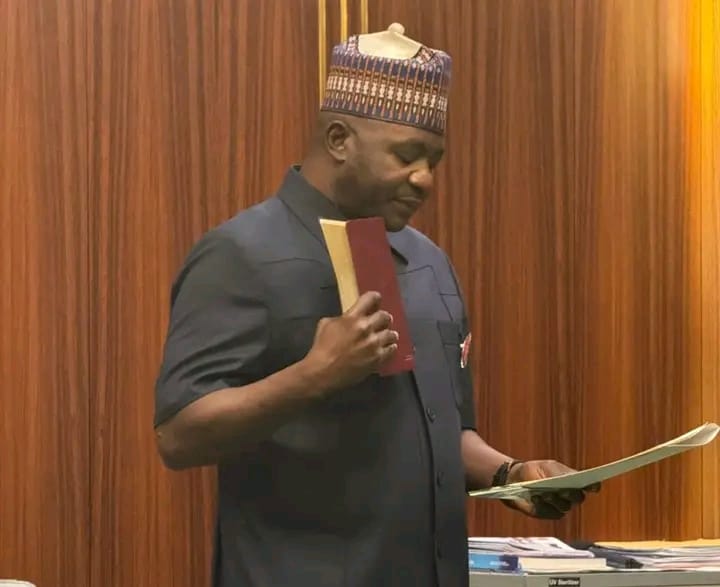
On Friday, 24th October, 2025, the President announced sweeping changes in the military hierarchy.
A statement by the Special Adviser to the President on Media and Public Communication, Sunday Dare, named General Olufemi Oluyede as the new Chief of Defence Staff, replacing General Christopher Musa.
It added, “The new Chief of Army Staff is Major-General W. Shaibu; Air Vice Marshal S.K. Aneke is Chief of Air Staff; while Rear Admiral I. Abbas is the new Chief of Naval Staff. Chief of Defence Intelligence, Major-General E.A.P. Undiendeye, retains his position.”
The development came barely a week after an online media platform, Sahara Reporters, published a story alleging that some military officers plotted to remove President Tinubu.
Hence, the citizens summarily adjudged that General Christopher Musa was sacked on that note.
While on the other hand, Nigerians differ on his leadership role as the Chief of Defence Staff:
a. Some Nigerians are of the opinion that GC Musa did extremely well in the fight against insurgencies while serving as the CDS, stating that he intensified kinetic operations across multiple fronts, leading to the death of several high-value terrorist/bandit leaders.
b. Others opined that he performed poorly, citing the unending cases of terrorism and the reinforcement of its leaders who had been sent into exile previously.
In an extremely shocking wave, a month and some days after the relinquishment of GC Musa as the Chief of Defence Staff, news broke that he had been picked as Abubakar Badaru’s replacement, who had resigned as the Minister of Defence on health grounds.
Again, the public was thrown into another round of debate:
a. Who was sacked from office as CDS cannot be appointed as Minister for that same ministry.
b. GC Musa’s appointment is timely and meritorious.
The new Defence Minister was celebrated across all social media platforms by the latter group of Nigerians, while the other group expressed disbelief.
Well, the new Minister has assumed office and has started hitting the ground running from Friday, December 5, 2025.
However, a security analyst reached out to by this newspaper believed there is more to the going and coming of General Christopher, but which cannot be explained at the moment:
“Well, at this point, no one can really say much about the reason why he was sacked. If it was based on incompetence, then why is he back?” Mr. Yakubu said.
“Or could it be that he was sacked in order to prepare him for this current position?” our correspondent asked, and he replied, “No one can say.”
—
The Challenges Ahead For GC Musa
Speaking further with the security expert, Yakubu Mohammed, he noted that although the new Defence Minister had stated that he cannot afford to fail Nigerians as they are expecting much, it is a no-brainer that Nigeria’s security issue is complex and dynamic—rooted in a deep interplay of historical grievances, economic marginalization, ethno-religious tensions, poor governance, and environmental pressures.
He mentioned that each of the factors listed above has its challenges, and as such, Nigerians are beginning to ponder how GC Musa will handle them.
Ultimately, Mr. Yakubu asserted that:
“The chief architect of those factors that birthed insecurity is CORRUPTION. If GC Musa can conquer the corruption that awaits him in the Defence Ministry, he might get it right.”
He continued, “Some of the key layers of corruption and systemic issues that can cripple effectiveness are obviously poor equipment, leaked intelligence, and poor leadership (from bought promotions) leading to battlefield losses and inability to secure territory. Emphasis on the leaked intelligence.”
When asked to shed more light on the emphasis about leaked intelligence, Mr. Yakubu categorically stated that selling operational intelligence to insurgents or criminal gangs for personal gain severely compromises missions and endangers lives, and that boils down to “operational failure.”
The security analyst also mentioned that GC Musa needs serious reforms in the ministry in order to prevail, but which will not be feasible if senior military and civilian officials within the establishment who are vested in the existing corrupt system, sabotaging reform efforts to protect their interests, are not stopped.
Most importantly, Mr. Yakubu recommended that for the success of GC Musa, the Minister of State for Defence, Bello Matawalle, must be sacked.
“That former governor of Zamfara State serving alongside GC Musa must go.”
“People like Bulama Bukarti and Aliyu Ibrahim Gebi should serve alongside General Christopher,” he added.
When asked what his reasons are for recommending the sacking of Bello Matawalle, the analyst, without mincing words, said that Matawalle is an associate of some of the bandit leaders.
“Right from the time he served as Zamfara State governor to now, he has repeatedly had connections with bandit leaders—questionable connections.”
“Such a personality in that ministry is capable of sabotaging efforts to combat those terrorists,” he added.
Mr. Yakubu conclusively ended the interview by asking our correspondent an intriguing question:
“Why haven’t the security operatives captured Turji—the bandit lord, yet?”
A question in which an answer truly aligns with his take on the minister.
The security expert also suggested that:
“The military’s inherent culture of secrecy can be used as a shield to block necessary civilian oversight and transparency initiatives.”
But added that it will be difficult if Matawalle continues to be in the structure.
Ultimately, as explained by the security expert, the new Defence Minister’s biggest battle may not be against external adversaries, but against the entrenched “institutional corruption” within the defence establishment itself. Success will depend less on military strategy and more on courageous governance, systemic reform, and ruthless integrity.











News
Emir Sanusi Seeks Compensation, Reallocation of Demolished Eid Ground Stalls
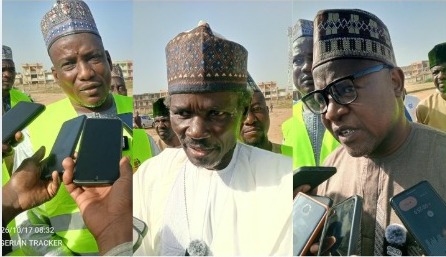
The Emir of Kano, Muhammadu Sanusi II, has appealed to the Kano State Government to compensate traders affected by the demolition of shops at the Filin Idi market in Kofar Mata, Kano, and reallocate stalls to enable them to resume their businesses.
Professor Ibrahim Muazzam Mai Bushira disclosed this during a special prayer session organised by traders affected by the demolition at the Eid Ground in Kofar Mata, where participants prayed for divine intervention and government assistance to alleviate their hardship.
According to Mai Bushira, the Emir has written to Governor Abba Kabir Yusuf, requesting compensation for the affected traders and appealing for measures to address the economic losses they have suffered following the demolition.
He expressed hope that Almighty Allah would reward the Emir for his intervention and urged Governor Yusuf to consider the demands of the traders to enable them to rebuild their businesses and restore their livelihoods.
Mai Bushira said the demolition had caused severe hardship among traders, many of whom depended on their shops as their primary sources of income. He added that some affected individuals had reportedly died, while others had developed high blood pressure following the destruction of their businesses and the resulting economic difficulties.
He explained that the prayer session was organised to seek Allah’s intervention in their predicament and pray for the restoration of their livelihoods, noting that the destruction of the shops had adversely affected the lives of many families who depended on the market for survival.
Speaking at the gathering, Professor Ahmad Muhammad of the Federal University, Dutse (FUD), described Kano as a major commercial centre and called on the Kano State Government to pay attention to the plight of the affected traders and the economic implications of the demolition.
Professor Muhammad also appealed to international entrepreneurs and investors to explore opportunities to support the development of the market, stressing that the destruction of the shops had resulted in substantial financial losses running into billions of naira.
He urged the government to consider establishing a modern market at the location, arguing that the Filin Idi market was not merely a trading centre for Kano but also an important commercial destination for traders from different parts of Nigeria and across Africa.
According to him, the market provides livelihoods for more than one million people, directly and indirectly, making its reconstruction and rehabilitation important to the economic well-being of Kano and its trading community.
The professor further stressed the need for a sustainable solution that would enable displaced traders to return to business, restore commercial activities and protect the economic interests of the large population that depended on the market.
In his remarks, the Chairman of the affected traders’ association, Auwal Said Umar, expressed appreciation to Almighty Allah and Emir Sanusi II for their support and intervention in the traders’ situation.
Umar said many of the affected traders were currently unable to engage in their usual commercial activities because their shops had been demolished, leaving them without the means to sustain their businesses and families.
He disclosed that the market previously had about 700 blocks of shops before the demolition, adding that many traders lacked the financial capacity to reconstruct their businesses without assistance from the government.
The association chairman said the government had allocated 75 stalls for reconstruction but appealed for an increase in the number to accommodate more affected traders and enable them to return to their businesses.
Umar called on the Kano State Government to provide additional support, stressing that the existing allocation was insufficient to address the needs of the large number of traders who lost their shops during the demolition.
The traders urged the government to work with their association and other relevant stakeholders to develop a lasting solution that would provide adequate trading spaces, restore commercial activities and ease the economic hardship caused by the demolition.
News
Gombe flags off the disbursement of the second batch of the AGILE Conditional Cash Transfer
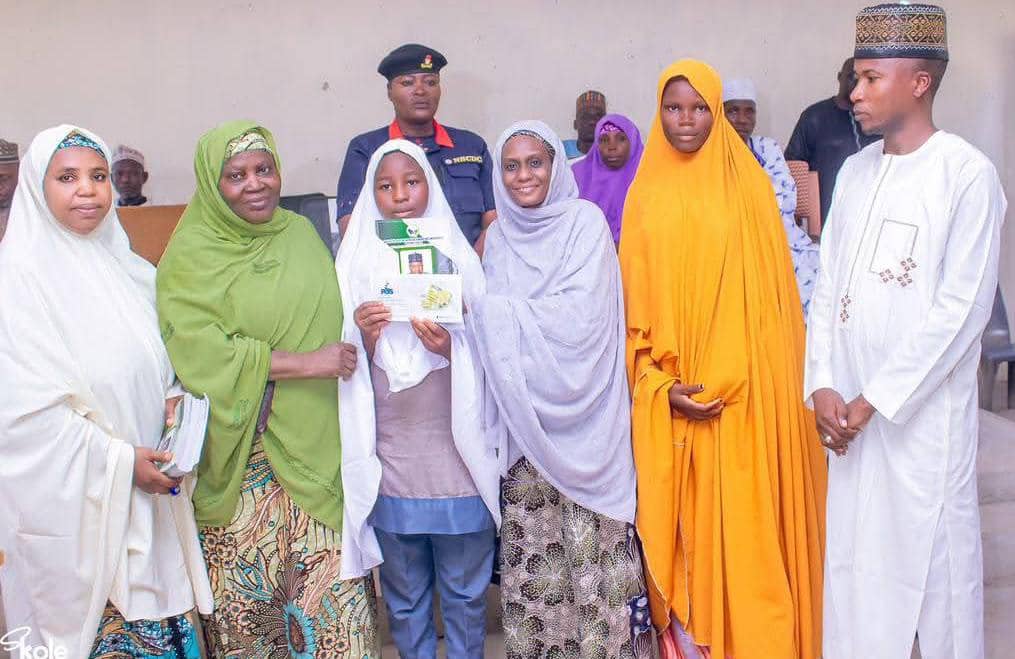
Gombe State Government has flagged-off the distribution of ATM cards to Adolescent Girls in public schools under the Conditional Cash Transfer,CCT of the Adolescent Girls Initiative for Learning and Empowerment, AGILE Project.
Speaking at the flagging off of the disbursement at Government Junior Secondary School Malamsidi central in Kwami Local Government area, the Honourable Commissioner of Education, Associate Prof Aishatu Umar Maigari said the disbursement of the CCT is part of the Governor Muhammadu Inuwa Yahaya’s zeal and passion for the girl child education in the state.
She said the concept is also geared towards supporting parents to cater for their children to remain in schools up to completion of their secondary education.
Associate Prof Aishatu Umar Maigari then assured the students that the government will continue to bring more educational policies that will further support students to pursue education with ease.
Earlier, the project coordinator of the AGILE, Dr. Amina Abdul noted that with the disbursement of the second cohort of the conditional cash transfer, the project was able to record significant improvement in enrollment and retention of students in schools across the state.
The project coordinator therefore urged parents to utilize the funds judiciously through supporting the education of their children.
News
China, Nigeria Mark Friendship with Joint Cultural Mural
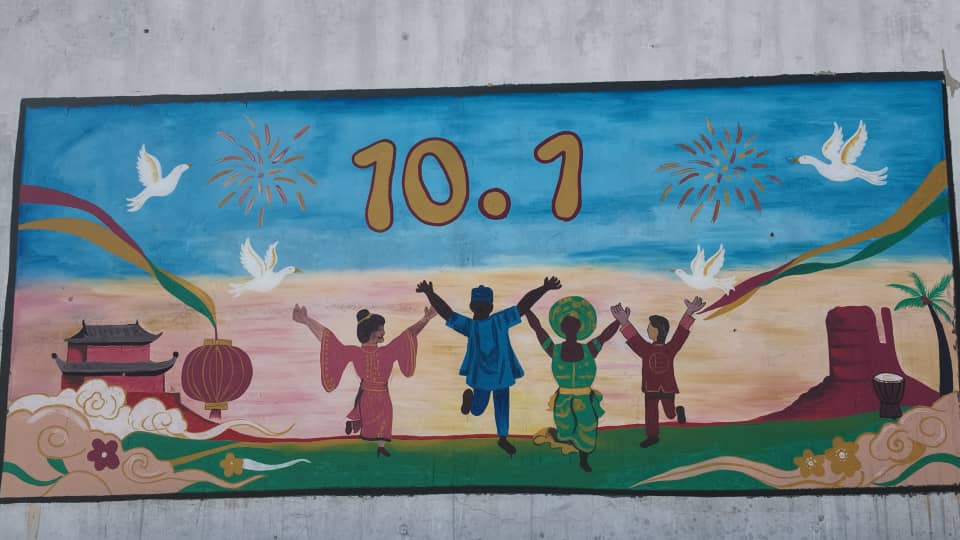
A colourful mural celebrating both China’s National Day and Nigeria’s Independence Day has been unveiled at an overseas project site, serving as a vivid symbol of the enduring friendship between the two nations.
The artwork, jointly produced by Chinese and Nigerian staff, features builders dressed in traditional Chinese costumes and Nigerian ethnic attire holding hands and dancing together.
Above them, fireworks and white doves of peace illuminate the sky, while the inscription “10.1” highlights the dual significance of October 1, the China’s National Day and Nigeria’s Independence Day.
On the left side of the mural, ancient Chinese architecture, red lanterns and auspicious cloud motifs showcase Chinese heritage.
On the right, red earth, coconut palms and African drums reflect Nigeria’s cultural identity. Flowing ribbons weave across the painting, symbolising unity and shared destiny.
Project officials described the mural as a “living testament” to cooperation at the frontline of development. They said it embodies mutual trust and support as workers from both countries overcome challenges together.
The initiative underscores cultural integration and partnership, with both sides pledging to continue working hand in hand to strengthen ties.
“Celebrating two festivals as one, we march forward with one heart,” a statement read, emphasising the commitment to write new chapters of friendship along the path of cooperation.
The mural, rooted in the overseas project site, stands as a reminder of the brotherly bond between China and Nigeria, and the shared vision of building together for a brighter future.

Emir Sanusi Seeks Compensation, Reallocation of Demolished Eid Ground Stalls

Gombe flags off the disbursement of the second batch of the AGILE Conditional Cash Transfer

Why Gov Abba Deserves Another Tenure

China, Nigeria Mark Friendship with Joint Cultural Mural

Musa Illiyasu Kwankwaso Celebrates Senator Lado @60, Says Is A Political Dogma

Zamfara Varsity ASUU Threatens Warning Strike Over FG-ASUU Agreement, Promotion Arrears

PCACC Arrests Man Over Alleged ₦4.5m Sale, Illegal Leasing of Kano Government Horse Stable

Goje’s Electoral War:The Confrontation With Tinubu,Governor Inuwa,Usman Kumo And APC candidates Ahead Of 2027

Prof Yusuf Adamu Delivers BUK’s 63rd Professorial Inaugural Lecture, Reflects on Medical Geography and Academic Legacy

Kano Monitors ₦48.9bn Projects Across Six LGAs
Emir Sanusi Seeks Compensation, Reallocation of Demolished Eid Ground Stalls
Gombe flags off the disbursement of the second batch of the AGILE Conditional Cash Transfer
Why Gov Abba Deserves Another Tenure
China, Nigeria Mark Friendship with Joint Cultural Mural
Musa Illiyasu Kwankwaso Celebrates Senator Lado @60, Says Is A Political Dogma
Zamfara Varsity ASUU Threatens Warning Strike Over FG-ASUU Agreement, Promotion Arrears
PCACC Arrests Man Over Alleged ₦4.5m Sale, Illegal Leasing of Kano Government Horse Stable
Goje’s Electoral War:The Confrontation With Tinubu,Governor Inuwa,Usman Kumo And APC candidates Ahead Of 2027
Prof Yusuf Adamu Delivers BUK’s 63rd Professorial Inaugural Lecture, Reflects on Medical Geography and Academic Legacy
Kano Monitors ₦48.9bn Projects Across Six LGAs
-

 Opinion5 years ago
On The Kano Flyovers And Public Perception
-

 Features5 years ago
How I Became A Multimillionaire In Nigeria – Hadiza Gabon
-

 Opinion6 years ago
Kano As future Headquarters Of Poverty In Nigeria
-

 History6 years ago
Sheikh Adam Abdullahi Al-Ilory (1917-1992):Nigeria’s Islamic Scholar Who Wrote Over 100 Books And Journals
-

 Opinion5 years ago
My First Encounter with Nasiru Gawuna, the Humble Deputy Governor
-

 History5 years ago
The History Of Borno State Governor Professor Babagana Umara Zulum
-

 History6 years ago
The Origin Of “Mammy Market” In Army Barracks (Mammy Ochefu)
-

 News5 years ago
Federal University Of Technology Babura To Commence Academic Activities September