
News
News Analysis:Divergent Opinions As Nigeria’s Election Calendar Faces Overhaul
By Yusuf Danjuma Yunusa
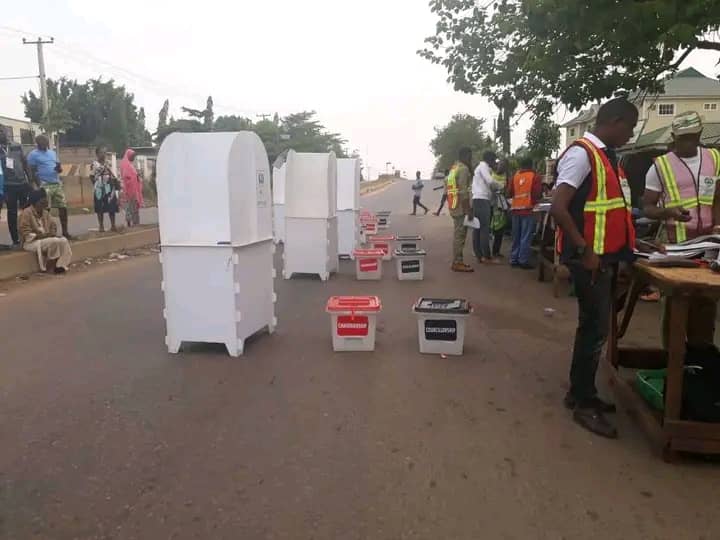
Under a new bill submitted to the National Assembly, Nigeria’s presidential, governorship, and legislative elections may be consolidated to hold in November 2026. The proposal, which aims to repeal the 2022 Electoral Act, makes this rescheduling its primary objective.
Following a one-day public hearing by the Joint Committee on Electoral Matters chaired by Senator Simon Lalong, proposing to move Nigeria’s election dates forward, widespread skepticism and acceptance have been faced at a public hearing. Electoral experts, political parties, and civil society organizations questioned and gave credence to the plan’s propriety, feasibility, and logic.
The amendment proposal was contained in the Reviewed Highlights of the Amendment of the Electoral Act during a public hearing in Abuja. It stipulates that elections into the offices of the president and governors must be conducted “not later than 185 days before the expiration of the term of office of the last holder of the office.”
According to the draft, the provision also extends to elections into the National Assembly and state Houses of Assembly, which must now be held “not later than 185 days before the date on which each of the Houses stands dissolved.”
It adds that where a vacancy occurs in any of the Houses more than 90 days before the general elections, such vacancy must be filled within 30 days of its occurrence. The amendment also seeks to align the new electoral calendar with constitutional changes to Sections 76, 116, 132, and 178, which now delegate election timelines to the Electoral Act rather than the Constitution.
Before the public hearing, it was confirmed that politicians, especially those hoping to seek elective offices in 2027, had taken it for granted that the next general elections would follow a similar pattern as previous ones, to hold either in February or March in the year of inauguration.
In the last general polls, the governorship and presidential elections were conducted in February and March 2023 respectively.
Also, part of the bill is that amendments be made to allow security personnel, INEC officials, accredited journalists, observers, ad-hoc staff to vote up to 14 days before election day.
The bill also seeks the removal of election timelines from the Constitution and their inclusion in the Electoral Act to make future adjustments more flexible.
While some are happy about the development, saying the moving of election day to 2026 will give enough time for legal issues to be settled ahead of the inauguration of new administrations, some have kicked against it, saying it would only favour incumbents, adding that it is bound to have negative effects on governance.
Chairman of the House Committee on Electoral Matters, Adebayo Balogun, said the amendment would help prevent situations where court cases linger after winners assume office.
“We are proposing that all election litigations be concluded before the swearing-in of declared winners. To achieve this, we are recommending that the current 180 days allowed for tribunal judgments be reduced to 90 days, while appellate and Supreme Court decisions should each take no more than 60 days, all within 185 days before inauguration,” he said.
In what is suspected to be a reaction to the wide interest the bill has generated, the Senate on Thursday stepped down the bill, which had earlier been slated for consideration, saying the lawmakers needed more time for wider consultations and a deeper understanding of its provisions.
The Senate President, Godswill Akpabio, who presided over the Thursday session, said sufficient details on the general principles of the bill were not given and suggested an executive session to consider it.
There were also concerns earlier raised by Senator Binos Dauda Yaroe on the procedure, wondering why a bill which has yet to scale second reading went through a public hearing.
“I support the second reading of this bill. But people will wonder. The second reading is supposed to come before the public hearing that was done last Monday. Holding a public hearing before second reading is confusing,” he said.
Following similar observations by other senators, the bill was stepped down to allow the legislators to consult widely on it.
Before then, the proposal had elicited a wide range of reactions from the political class, election monitoring bodies, and the general public.
In a statement signed by its National Publicity Secretary, Mallam Bolaji Abdullahi, the party argued that advancing the election date implies a perpetual campaign cycle, a short period for effective governance, and disruption in development planning, and further weakening of institutional focus.
“The president, ministers, governors, and other public officials vying for office or campaigning for others will shift their focus from performance to positioning. Policies will stall, projects will be abandoned, and the entire system will tilt towards 2026 instead of 2027,” part of the statement reads.
Similarly, the factions of the Labour Party differed on the proposal. While the faction led by Julius Abure said the party is fully prepared for the exercise if it holds next year, the Lamidi Apapa-led faction dismissed the idea as unconstitutional and premature.
National Publicity Secretary of the Abure-led faction, Obiora Ifoh, said the party is “100 percent ready” for any election conducted within the timeframe allowed by law. “We are ready for any election, even if it comes in November 2026. But that is not even the problem. The real issue is for INEC to put its act together and address the lapses we witnessed during the 2023 elections,” he said.
However, the coordinator of the Obidient Movement, Yunusa Tanko, faulted the proposal, saying it contradicts the constitutionally guaranteed four-year term of elected officeholders.
“Does it mean they will hold the election before the tenure of the current officeholders expires?” Tanko queried. “It’s confusing. What happens to the remaining months of their term? The constitution provides for four years, not three.”
Mr. Tanko argued that the proposal lacks its legal implications and it was “too sudden.”
Furthermore, at the time of filing this report, no reactions from the Peoples Democratic Party(PDP) as regards this issue was reported.
However, the New Nigeria Peoples Party (NNPP) spokesperson, Ladipo Johnson, also reacted to the proposal, describing it as “a good idea coming at the wrong time.”
The spokesperson of the party noted that while the intention behind the amendment could help resolve post-election litigations before the swearing-in of winners, the timing of the move would put opposition parties at a disadvantage.
The Executive Director of YIAGA Africa, Mr Samson Itodo, said the organisation is in support of the proposal because it has many advantages outside settling all disputes arising from elections.
“It provides clarity for INEC and for other institutions so that they don’t also get distracted, you know, with the whole business of settling down. It gives the institution the opportunity to conclude everything that it has to do with the post-election audit. And that can be done devoid of any sort of pressure or political interference,” he said.
Despite the interest, however, it appears that the bill will not receive an accelerated hearing now that it has been stepped down for further consultations. Added to that, a lot, Nigerian Tracker learnt, would depend on the outcome of the constitution review process which is currently ongoing.
Chairman of the House of Representatives Committee on Electoral Matters, Adebayo Balogun, in an interview with the Daily Trust correspondent, said his committee is working together with the constitution review committee to ensure synergy.
“The Electoral Act is also dragging a bit because of the constitution review. We are waiting for that because we know some of those things are still subject to the provisions of the constitution. Had it been we were not subjected to it, we would have concluded our own probably since last month. Our own does not need to go to the states. After this, we can go for third reading in the next one week and pass it, but because of their own issues, we have to slow down.”
Professor Kamilu Sani Fage, a Kano-based political scientist, in an interview with the Daily Trust also warns that, though the proposal is logical, it could tilt the playing field in favour of the ruling party, undermine democratic fairness, and expose systemic weaknesses in Nigeria’s electoral and judicial institutions.
“The idea behind the proposal is to change the timetable election period from what it used to be by six months. I think the argument they put forward is logical, the idea is that they need sufficient time so that all electoral cases will be settled before swearing in of elected people or elected leaders. I think it is a logical argument, but a wrong one,” Prof. Fage analysed.
When asked what the implications are, the professor responded thus further:
“One, it will give unnecessary advantage to the ruling party because the party that is in office will use the incumbency factor to win the election. In other words, there will be no fair level playing ground for all contestants.
Secondly, it would be a dangerous thing for the country. Imagine a situation where a ruling party fails and it remains in office for six months. Wwithin that period, it will commit all sorts of atrocities.”
If the amendment sails through, there are fears that the Independent National Electoral Commission (INEC) may find it hard to cope, given that it has lots of off-cycle elections to conduct before 2027, some of which are the Anambra, Osun, and Ekiti governorship elections as well as the FCT council elections holding next year.








News
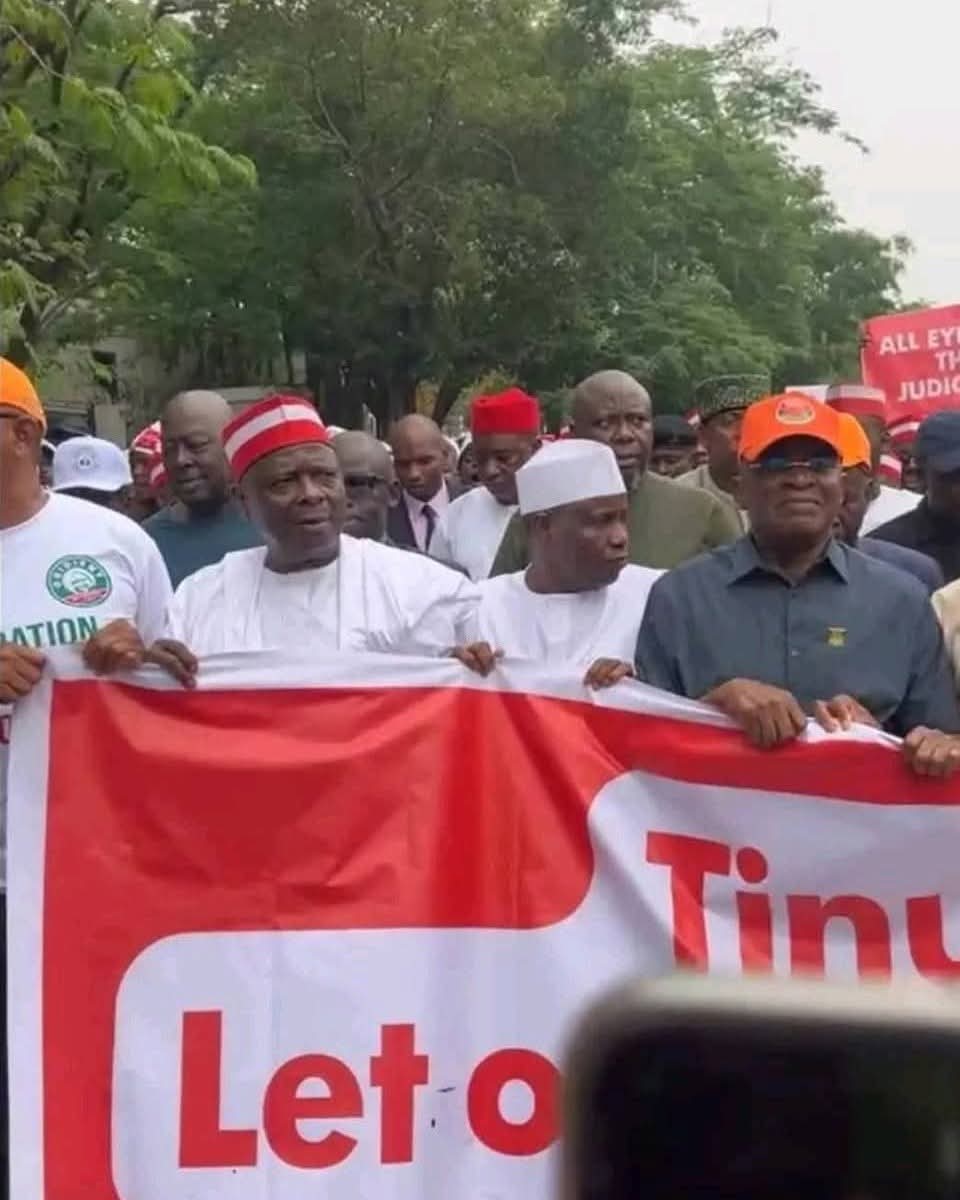
Kwankwaso, Atiku, Amaechi, Obi, Others Match-Out in Peaceful Protest at INEC’s Headquarters
By Yusuf Danjuma Yunusa
A coalition of chieftains from the African Democratic Congress (ADC), led by the party’s interim Chairman, David Mark, staged a peaceful protest at the headquarters of the Independent National Electoral Commission (INEC) in Abuja. The demonstration was in response to INEC’s recent withdrawal of recognition from the David Mark-led faction as the legitimate leadership of the party.
Prominent figures in the protest included former Vice President Atiku Abubakar, former Governors Rabiu Musa Kwankwaso and Peter Obi, as well as former Ministers Rotimi Amaechi and Rauf Aregbesola.
The leadership crisis within the ADC has deepened in recent times, with the emergence of yet another faction backed by state chairmen of the party. This group claims legitimacy over the two existing factions—one led by Nafiu Bala and the other by David Mark.
Amid this increasingly undemocratic atmosphere, the David Mark-led faction had scheduled its national convention for April 14. However, with today being April 8, questions are being raised over whether the faction can meet that deadline or if the leadership dispute will be resolved before the date.
Meanwhile, INEC has set May 10 as the final deadline for all political parties to submit the names of their flag bearers for the 2027 general election.
News
ADC Crisis: Kwankwaso Seeks Intervention of Gombe Emir
By Yusuf Danjuma Yunusa
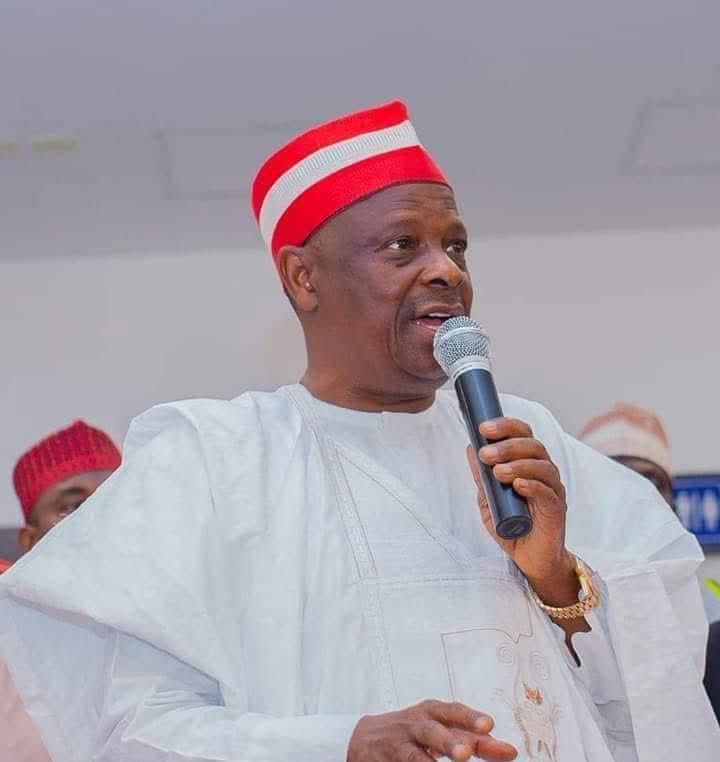
Senator Rabiu Kwankwaso, a chieftain of the African Democratic Congress (ADC), has accused Nafiu Bala, the party’s factional chairman, of acting against democratic principles.
In an interview with DCL Hausa on Tuesday, Kwankwaso revealed that he had invited Bala for a meeting aimed at resolving the party’s crisis amicably, but Bala failed to show up.
“We scheduled to meet yesterday, but despite waiting until morning, he did not come. I had been warned he wouldn’t show up, and his absence is deeply disappointing. I want to pass my message through you now, so that if you meet him, you can deliver it on my behalf,” Kwankwaso said.
He added, “Given the current situation in our country, our party and our democracy cannot afford someone who behaves like the lizard at the mouth of the water pot—blocking progress. As a leader of this movement in Nigeria, I believed that when I invited him, he would honour the request so I could advise him, as a father would a son.”
Kwankwaso noted that Bala was born in 1990 and still needs guidance as a youth. “His current actions are not only harmful to his own future, but also to the ADC and Nigerian democracy as a whole.”
He further warned, “He must recognise that millions have registered with our party. What was once a small party has grown significantly because prominent leaders joined with a mission to do what is right for this country. If he continues to stand in the way of that progress, it will become a very serious problem for him.”
The senator also called on the Emir of Gombe, other traditional rulers, and Islamic scholars (Ulamas) to intervene in the dispute.
“This is a serious matter, and he must realise his mistakes so we can resolve it. I offer this advice freely because I know it is for everyone’s benefit,” Kwankwaso concluded.
News
NCC to Enforce Subscriber Compensation for Poor Telecom Service
By Yusuf Danjuma Yunusa
The Nigerian Communications Commission has announced that its directive mandating telecommunications operators to compensate subscribers for poor service quality will take effect from this month.
The Commission disclosed this in a Frequently Asked Questions document released on Tuesday, offering clarity on how the compensation framework will work and which subscribers qualify.
According to the NCC, the directive applies specifically to Mobile Network Operators that fail to meet the required Key Performance Indicators for Quality of Service. These operators include major players such as MTN Nigeria, Airtel Nigeria, Globacom, and 9mobile, although the Commission did not specify which of them fell short of the standards.
The NCC noted that a separate compensation framework already exists for Internet Service Providers.
Under the new directive, compensation will cover service failures affecting voice calls, data services, and SMS. To qualify, subscribers must have experienced poor network service in an affected Local Government Area and must have carried out at least one revenue-generating activity—such as a billed call, SMS, or data session—within the period in question.
The Commission added that both individual and corporate subscribers are eligible for compensation.
Importantly, the NCC stated that subscribers will not need to apply to receive compensation. Instead, telecom operators are mandated to automatically identify affected customers and compensate them directly.
“The compensation framework will take effect from April 2026.
“No. The directive does not replace existing consumer protection mechanisms. It adds a direct compensation mechanism for affected subscribers. It aligns with measures set in existing legislation, such as the Consumer Code of Practice Regulations 2024 and the Quality of Service Regulations 2024,” NCC said
“Operators are required and mandated to identify affected subscribers and provide compensation directly. Only service failures that fall below the defined thresholds set by the Quality of Service Regulations will qualify,” NCC said.
However, the regulator clarified that minor or short-lived network disruptions that are quickly resolved may not meet the threshold for compensation.
The move is part of the NCC’s broader efforts to improve service delivery and hold telecom operators accountable for consistent network performance across the country.

Kwankwaso, Atiku, Amaechi, Obi, Others Match-Out in Peaceful Protest at INEC’s Headquarters

ADC Crisis: Kwankwaso Seeks Intervention of Gombe Emir

Shekarau In APC, Morale Booster For Governor Abba

NCC to Enforce Subscriber Compensation for Poor Telecom Service

ADC Leadership Tussle Worsens as Third Faction Emerges, Rejects Nafiu Camp, Mark’s Coalition

ADC Leadership Crisis: State Chairmen to Elect Caretaker Committee on Tuesday

Governor Abba Kabir Yusuf Holds Exclusive Prerogative to Choose Deputy – Malam Inuwa Waya

The Governor Who Chose His People Over His Politics: Abba Yusuf and the Moral Courage Behind Kano First
Restoring the Glory That Was Always There: Governor Abba Kabir Yusuf and the Historical Vision Behind Kano First

Table Water Producers Increase New Price for Sachet Water in Kano
Kwankwaso, Atiku, Amaechi, Obi, Others Match-Out in Peaceful Protest at INEC’s Headquarters
ADC Crisis: Kwankwaso Seeks Intervention of Gombe Emir
Shekarau In APC, Morale Booster For Governor Abba
NCC to Enforce Subscriber Compensation for Poor Telecom Service
ADC Leadership Tussle Worsens as Third Faction Emerges, Rejects Nafiu Camp, Mark’s Coalition
ADC Leadership Crisis: State Chairmen to Elect Caretaker Committee on Tuesday
Governor Abba Kabir Yusuf Holds Exclusive Prerogative to Choose Deputy – Malam Inuwa Waya
The Governor Who Chose His People Over His Politics: Abba Yusuf and the Moral Courage Behind Kano First
Restoring the Glory That Was Always There: Governor Abba Kabir Yusuf and the Historical Vision Behind Kano First
Table Water Producers Increase New Price for Sachet Water in Kano
-

 Opinion4 years ago
On The Kano Flyovers And Public Perception
-

 Features5 years ago
How I Became A Multimillionaire In Nigeria – Hadiza Gabon
-

 Opinion5 years ago
Kano As future Headquarters Of Poverty In Nigeria
-

 History5 years ago
Sheikh Adam Abdullahi Al-Ilory (1917-1992):Nigeria’s Islamic Scholar Who Wrote Over 100 Books And Journals
-

 Opinion4 years ago
My First Encounter with Nasiru Gawuna, the Humble Deputy Governor
-

 History5 years ago
The Origin Of “Mammy Market” In Army Barracks (Mammy Ochefu)
-

 History4 years ago
The History Of Borno State Governor Professor Babagana Umara Zulum
-

 News4 years ago
Federal University Of Technology Babura To Commence Academic Activities September