
News
Climate Change Captured: Sani Maikatanga’s Photo Wins Top Prize in Wiki Loves Africa 2023 Contest”

Nigerian Photographer Sani Maikatanga’s photo has won 1st prize in the international Wiki Loves Africa 2023 Competition for his photo of a man struggling in submerged flood water caused by heavy rainfall resulting from weather disturbances, deforestation, and climate change, in the Auyo community in Jigawa state, Nigeria.
The International Wikki Loves Africa 2023 theme is Climate and Weather.
This year’s theme celebrates the prevailing climates and day-to-day weather conditions of various locations on the African continent.
According to WHO, climate factors affect the social and environmental determinants of health – clean air, safe drinking water, sufficient food, and secure shelter.
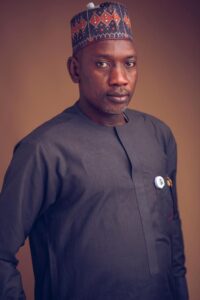
Sani Maikatanga
Celebrating the details most people overlook, the Wiki Love Africa 2023 competition has selected this year’s winners by receiving more than 13,413 images from 51 countries,where 13 international jury of photography professionals and Communists selected the winners.
In his remark one of the international jurists, Juror Michale Maggas has said that ” This striking photograph captures the stark reality of communities engulfed by floodwaters, the vibrant colors and clarity heighten the emotional intensity and visual impact of the image”
Maikatanga on his part appreciates Wikki Loves Africa for acknowledging his work, he added” Let me express that it is a true honor to attain this special recognition from you, Words cannot express enough how honored I am for this prize you have given me.
The 1st Prize for the International Wikki Loves Africa 2023 prize in the category of photography is $2000 dollars.
Sani Mohammed Maikatanga is a photojournalist and documentary Photographer who’s been working as a photographer since 1992.
WikiAfrica is an international movement that takes place on the African continent and beyond. It encourages individuals, interested groups and organizations to create, expand, and enhance online content about Africa. This involves motivating the representation of the continent’s contemporary realities and history, its peoples, and its innovations on the world’s most used encyclopedia, Wikipedia.




News
Kano Ex-Deputy Governor Gawuna Joins ADC After Resignation from APC
By Yusuf Danjuma Yunusa
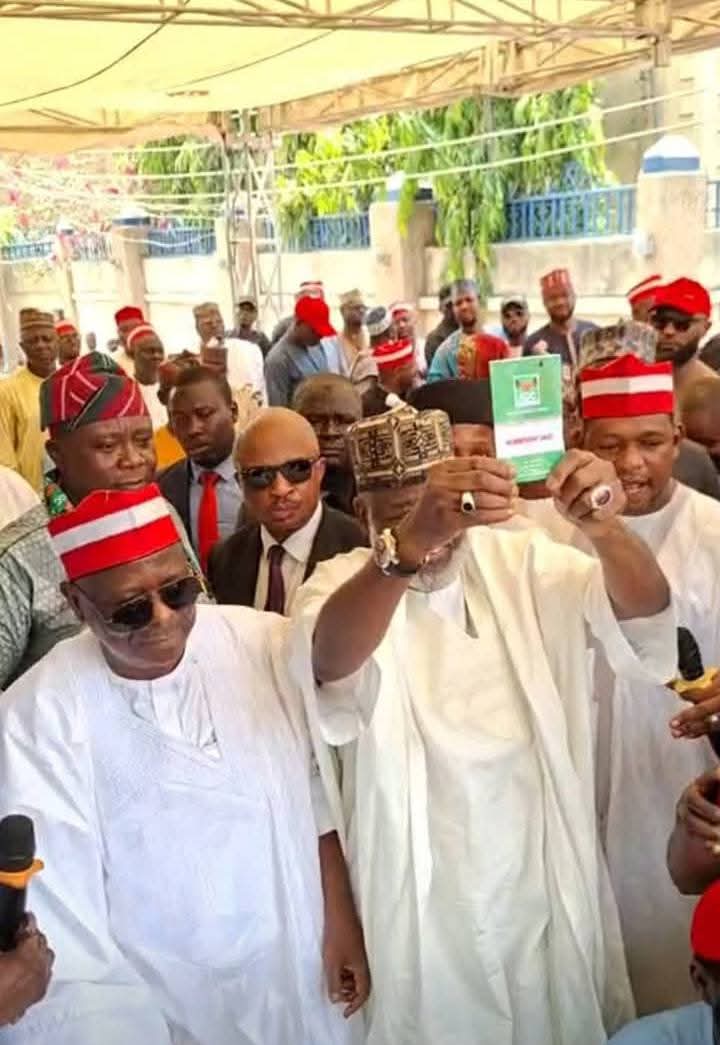
Nasiru Gawuna, the 2023 governorship candidate of the All Progressives Congress (APC) in Kano State, has formally joined the African Democratic Congress (ADC).
Gawuna, a former deputy governor of the state, received his membership card on Tuesday at his ward in Gawuna, Nasarawa Local Government Area. The event drew a large gathering of supporters and notable political figures, including former Governor Senator Rabiu Musa Kwankwaso, immediate-past Deputy Governor Aminu Gwarzo, and the state ADC chairman, Musa Ungogo.
Speaking after the registration, Gawuna thanked his supporters and party leaders, pledging his commitment to strengthening the ADC in Kano State.
His defection follows a formal resignation from the APC, which he described as a personal and voluntary decision. In a letter dated March 29, 2026, addressed to his ward chairman, Gawuna expressed appreciation to the APC for the opportunity to serve.
The move also comes after his resignation as Chairman of the Board of Directors of the Federal Mortgage Bank of Nigeria, effective March 31, 2026. His departure from the role complied with a directive by President Bola Ahmed Tinubu requiring political appointees to resign in line with the provisions of the Electoral Act.
Gawuna thanked the president for the trust reposed in him, noting it was an honor to serve in various capacities, including as Pro-Chancellor and Chairman of the Governing Council of Bayero University, Kano.
Political observers view Gawuna’s entry into the ADC as a significant boost for the party, given his political influence and strong showing in the 2023 governorship election, where he secured 890,705 votes.
The development is the latest in a series of political realignments in Kano State ahead of the 2027 general elections, signaling continued shifts in the state’s political landscape.
News
JUST IN: Senate Approves Tinubu’s $6 Billion Loan Request
By Yusuf Danjuma Yunusa
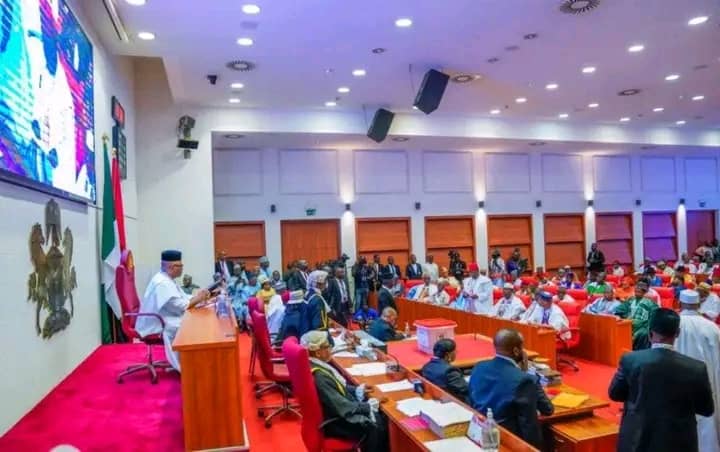
The Senate on Tuesday approved President Bola Tinubu’s request to secure $6 billion in external loans, granting legislative backing for the facilities hours after the Executive formally sought approval to finance critical infrastructure and address fiscal gaps.
The approval followed the consideration of a report submitted by the Chairman of the Senate Committee on Local and Foreign Debts, Senator Aliyu Wamakko (APC, Sokoto North).
In a letter read during plenary, President Tinubu sought approval for two separate facilities: a $5 billion loan from Abu Dhabi Bank to support budget deficit financing and meet existing debt obligations, and a $1 billion loan from UK Export Finance through Citibank London to fund the rehabilitation of the Lagos Port Complex and Tin Can Island Port.
According to the President, the port rehabilitation projects aim to address longstanding operational challenges, improve efficiency, enhance safety standards, support non-oil trade diversification, and position Nigeria as a regional trade hub.
Senate President Godswill Akpabio referred the requests to the committee for expedited consideration, a directive that culminated in Tuesday’s approval.
The latest borrowing comes amid the Federal Government’s sustained reliance on domestic and external loans to finance budget deficits. Four months ago, the National Assembly approved a separate request to raise N1.15 trillion from the domestic debt market to fund the 2025 budget deficit.
In its report, the Senate Committee on Local and Foreign Debts noted that the 2025 Appropriation Act provides for total expenditure of N59.99 trillion—an increase of N5.25 trillion from the Executive’s initial proposal—highlighting the widening fiscal gap driving the government’s borrowing strategy.
News
El-Rufai’s Bail Hearing Adjourned to Wednesday as Security Tightens Around Kaduna Court
By Yusuf Danjuma Yunusa
The Federal High Court in Kaduna has adjourned the bail hearing for former Governor Nasir El-Rufai until Wednesday, March 31. Justice Rilwanu scheduled the new date after hearing arguments from both the defense and prosecution.
El-Rufai was arraigned by the Independent Corrupt Practices and Other Related Offences Commission (ICPC) on a 10-count charge involving the alleged conversion of public property and money laundering. The former governor pleaded not guilty to all charges.
In a separate case, El-Rufai also appeared before a Kaduna State High Court on charges of abuse of office, fraud, and intent to commit fraud. The ICPC filed charge number KDH/KAD/ICPC/01/26 against him and one other defendant, Amadu Sule, from the Kaduna State Development Agency (LEDA).
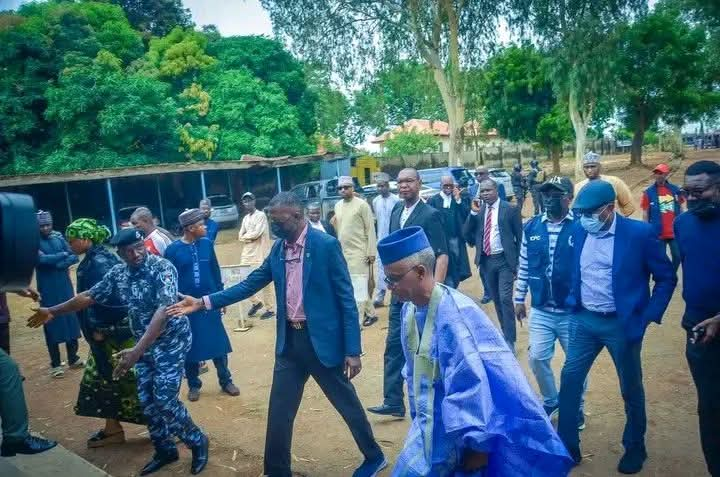
According to the News Agency of Nigeria, El-Rufai arrived at the Federal High Court premises at approximately 9:40 a.m. in the company of ICPC officers.
Security was heightened across the Kaduna metropolis ahead of the proceedings. Armed personnel from the police, the Department of State Services (DSS), and the Kaduna State Vigilance Service were deployed to strategic locations. Access to the court was restricted to accredited journalists and court officials, though media representatives were barred from entering the courtroom to cover the proceedings.
Counsel for El-Rufai, Abdul Adamu, declined to comment after the session, stating only that the case “has been adjourned till tomorrow.”

Kano Ex-Deputy Governor Gawuna Joins ADC After Resignation from APC

JUST IN: Senate Approves Tinubu’s $6 Billion Loan Request

El-Rufai’s Bail Hearing Adjourned to Wednesday as Security Tightens Around Kaduna Court

El-Rufai Taken Back To Custody

Eight Kano Rep Members Abandon NNPP for APC

The Governor Who Chose His People Over His Politics: Abba Yusuf and the Moral Courage Behind Kano First

FREEDOM OF SPEECH, NOT FREEDOM FROM CONSEQUENCE: A CITIZEN’S CALL FOR RESPONSIBLE PUBLIC COMMENTARY
Restoring the Glory That Was Always There: Governor Abba Kabir Yusuf and the Historical Vision Behind Kano First

Tinubu to Swear in Olatunji Disu as Inspector-General of Police on Wednesday

NDLEA Clarifies: Drug Case Against Abba Kyari Still Active After Court Discharge
Kano Ex-Deputy Governor Gawuna Joins ADC After Resignation from APC
JUST IN: Senate Approves Tinubu’s $6 Billion Loan Request
El-Rufai’s Bail Hearing Adjourned to Wednesday as Security Tightens Around Kaduna Court
El-Rufai Taken Back To Custody
Eight Kano Rep Members Abandon NNPP for APC
The Governor Who Chose His People Over His Politics: Abba Yusuf and the Moral Courage Behind Kano First
FREEDOM OF SPEECH, NOT FREEDOM FROM CONSEQUENCE: A CITIZEN’S CALL FOR RESPONSIBLE PUBLIC COMMENTARY
Restoring the Glory That Was Always There: Governor Abba Kabir Yusuf and the Historical Vision Behind Kano First
Tinubu to Swear in Olatunji Disu as Inspector-General of Police on Wednesday
NDLEA Clarifies: Drug Case Against Abba Kyari Still Active After Court Discharge
-

 Opinion4 years ago
On The Kano Flyovers And Public Perception
-

 Features5 years ago
How I Became A Multimillionaire In Nigeria – Hadiza Gabon
-

 Opinion5 years ago
Kano As future Headquarters Of Poverty In Nigeria
-

 History5 years ago
Sheikh Adam Abdullahi Al-Ilory (1917-1992):Nigeria’s Islamic Scholar Who Wrote Over 100 Books And Journals
-

 Opinion4 years ago
My First Encounter with Nasiru Gawuna, the Humble Deputy Governor
-

 History5 years ago
The Origin Of “Mammy Market” In Army Barracks (Mammy Ochefu)
-

 History4 years ago
The History Of Borno State Governor Professor Babagana Umara Zulum
-

 News4 years ago
Federal University Of Technology Babura To Commence Academic Activities September