
News
Shareholders associations knock Kogi Govt, say action on Dangote Cement, dangerous for investment
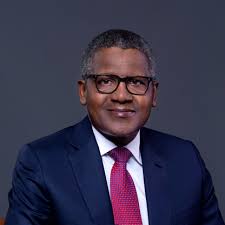
Group of Shareholders Associations in Nigeria have urged the Federal Government to urgently intervene and prevail on the government of Kogi State to stop further harassment of investors in Kogi State.
They described as barbaric the use of thugs to embarrass investors, such as meted out on Dangote cement and other companies located in Kogi State, noting that such unsavoury development will strongly discourage both local and foreign investments into the country.
It would be recalled that the Government of Kogi State last week, at the instance of the state governor, Yahaya Bello, invaded Dangote Cement, Obajana plant with over 500 armed members of the state’s security outfit, the Vigilantes, shot 27 staff and wounded several others.
President of the Association for the Advancement of the Rights of Shareholders, Dr. Umar Faruk, while speaking on the development criticised the State Government for being so insensitive to its populace, thousands of whom are depending on the Dangote Obajana plant for their means of livelihood. He said it is unfortunate that someone who has championed investment, worth billions of Naira into a state in Nigeria, is being treated this way.
Fuel scarcity: IPMAN, NNPC allay fears of Nigerians
He called on the Federal Government to, as a matter of urgency, caution the Governor of Kogi State to be more civilized and professional in its dealing with Investors in the State. According to him: “Why should the governor of a state in Nigeria, mobilized vigilantes to seal a publicly quoted company? The same Governor did exactly the same thing to First Bank, making the bank close some of its branches in the state. Is that not executive rascality, using the state assembly to commit such an atrocious act?
“Federal Government should swing into action by protecting investors, else, the efforts being made to attract both foreign and local investors will come to naught. I hope the state realizes that Dangote Cement has foreign shareholders. What impression do you want these people to have of our government? I also urge the Federal Government to fish out those thugs, used by the State, for prosecution, so as to serve as a deterrent to others…This action will lead to loss of revenue, even for the Government, in terms of taxes, and erode the shareholder’s value.”
In the same vein, founder of the Independent Shareholders Association of Nigeria (ISAN) and President of Boys Brigade Nigeria (BBN), Sir Sunny Nwosu said a reasonable state government would have gone to court against any publicly quoted company rather than resort to a barbaric and ruthless method of chasing workers with guns and cutlass in the civilized age.
“What the Kogi State Government did, honestly was very bad and disappointing. How can a state use vigilante with guns and cutlasses against a company that is feeding thousands of its people? A reasonable government should have gone to Court and not taken laws into its hands.
“This action is bad and will smear the image of both the Federal and State government. It will also affect the ranking of ease of doing business in Nigeria. Kogi is blessed with so many natural resources, but with the attitude of this government, I doubt if any reasonable investor, either local or foreign, will want to do anything with the state anymore”
The President, Pragmatic Shareholders Association, Mrs. Bisi Bakare said: “As an investor, we are not happy about the way things are going. If the State has problems with Dangote Cement on tax issues or any issue at all, there are a far better-civilized ways of handling it than sealing a factory that is contributing more than 30 percent of the cement Nigerians are consuming.
“The governor should realize that his position is transient and that the people of his state, whom he has deprived their means of livelihood will always remember him for bad! Can you imagine the number of people that will be out of jobs and the huge revenue loss to the government, the company, and us, the shareholders? The state, to me, has done a very grave mistake and the earlier the company is re-opened the better.”
Recalled that the Organised Private Sector (OPS) operators under the aegis of the National Association of Chambers of Commerce, Industries, Mines and Agriculture (NACCIMA) have lent its voice to the ongoing spat between Dangote Cement and Kogi state government which culminated into the closure of the Obajana plant of the Cement company.
NACCIMA expressed regret that the issues between the company and the state over tax disputes ought not to have led to sealing of the company but should have been resolved in a conciliatory and amicable atmosphere.
The body, in a statement signed by its Director-General, Olusola Obadimu, and issued in Lagos, said the state government should have trodden a path of caution and called for the immediate reopening of the factory for normal production activities to resume.
Obadimu stated that NACCIMA’s position was based on some key considerations bordering on the impact of the factory’s closure on the economy and thousands of people whose means of livelihood depend on the production activities of the factory.
“It is vital to note that it is a huge production plant that supplies key domestic input (cement) into the economy and employs hundreds of thousands of Nigerians, directly and indirectly. This is aside from its substantial budget for corporate social responsibility outside of taxes.
“Shutting off the factory does not necessarily help the controversial issue of compliance on tax remittable to Kogi state government. Rather a continuous operation of the plant








News
Jigawa Govt Appoints Dr. Lawan Ahmed as the 17th Emir of Gumel
By Yusuf Danjuma Yunusa
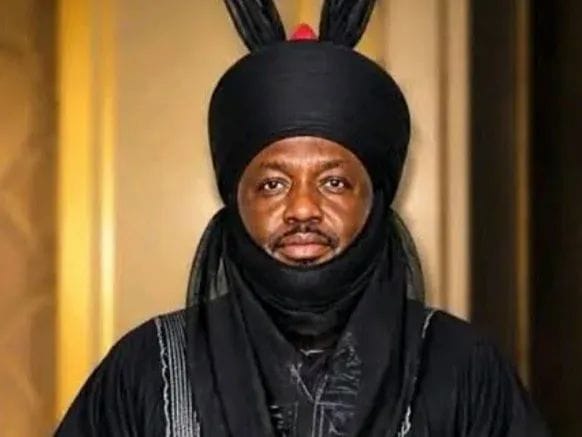
Jigawa State Governor, Malam Umar Namadi, has approved the appointment of Dr Lawan Ahmed Muhammad Sani as the 17th Emir of Gumel Emirate, three days after the demise of his father, the late Emir.
The announcement was made public by the Secretary to the State Government, Bala Ibrahim, during a press briefing on Sunday at the NUJ Jigawa State Secretariat in Dutse, the Jigawa State capital.
“Following due consultations with the Gumel Emirate Council, kingmakers, and in accordance with the Jigawa State Emirate Council Law, His Excellency the Executive Governor of Jigawa State, Malam Umar Namadi, has approved the appointment of Dr Lawan Ahmed Muhammad Sani as the new Emir of Gumel,” the SSG declared.
Ibrahim said the appointment was immediate and necessary to ensure continuity of leadership and stability in the emirate after the transition period.
“This appointment takes effect immediately in order to fill the vacuum created by the passing of His Royal Highness and to sustain peace, unity and development in Gumel Emirate,” he stated.
The SSG described Dr Lawan as a worthy successor, noting his years of service to the emirate.
“Dr Lawan Ahmed Muhammad Sani previously served diligently as the Ciroman Gumel during the reign of his late father. His experience, education, and deep understanding of the traditions of Gumel make him eminently qualified for this exalted throne,” Bala Ibrahim said.
He added that the new Emir’s background positions him to consolidate the legacies of his father.
“Having served as Ciroman Gumel, Dr Lawan is not new to the people. He understands the challenges and aspirations of Gumel and Jigawa State at large. Government is confident he will provide purposeful and exemplary leadership,” the SSG affirmed.
Governor Namadi, according to the SSG, urged the people of Gumel to rally behind the new Emir.
“His Excellency calls on all sons and daughters of Gumel Emirate to give their maximum support and cooperation to the new Emir for the overall peace and progress of the emirate,” Ibrahim quoted the governor as saying.
The SSG also prayed for the repose of the late Emir and assured the government’s commitment to traditional institutions.
“On behalf of the government and good people of Jigawa State, we pray Almighty Allah to grant the late Emir Aljannatul Firdaus. Government remains committed to preserving our traditional institutions as custodians of culture and unity,” he said.
“In due course, His Excellency will present the staff of office to the 17th Emir of Gumel in a ceremony befitting his status. We urge all stakeholders to cooperate with government for a hitch-free event,” the SSG concluded.
News
How a ‘Herbal Tea’ Businessman Used Phone Chargers to Smuggle Cocaine to Saudi Arabia – NDLEA
By Yusuf Danjuma Yunusa
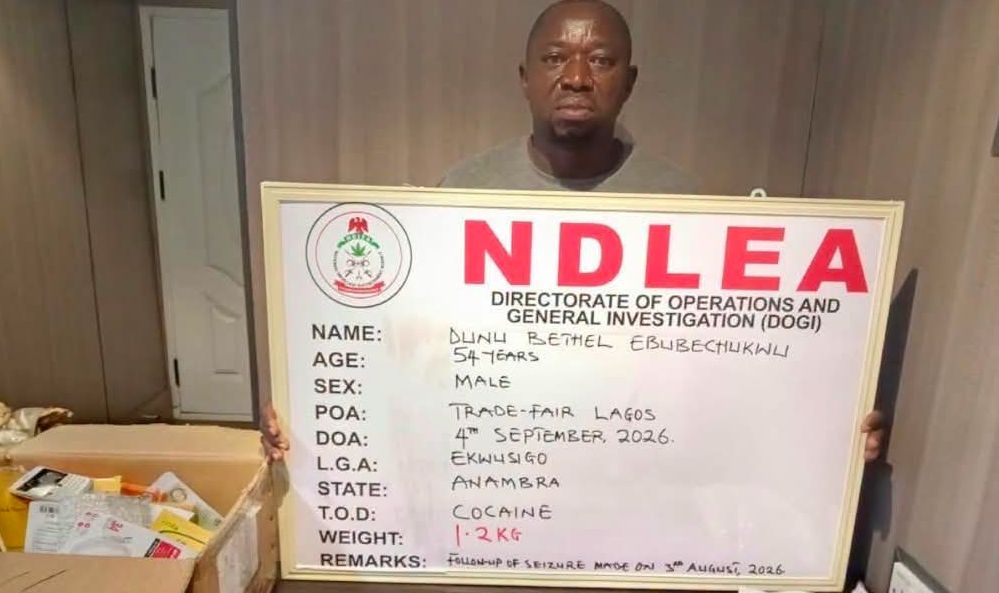
Operatives of the National Drug Law Enforcement Agency (NDLEA) have arrested a convicted cocaine trafficker who disguised himself as a herbal tea merchant in Lagos.
In a statement on Sunday, the agency said the arrest occurred weeks after it intercepted a 1.2kg cocaine consignment concealed in phone chargers and destined for Riyadh, Saudi Arabia, at a courier company in Lagos on 31st July 2026.
“The suspect, arrested in a sting operation at Article Market, opposite Trade Fair Market, Ojo area of Lagos, on Friday, 4th September 2026, while posing as a herbal tea businessman, was identified as 54-year-old Dunu Bethel Ebubechukwu.
“In his statement, he admitted being the mastermind of some illicit drug shipments in the past while stating that he discarded his telephone SIM card once he learnt his latest consignment had been intercepted by the NDLEA,” the agency stated.
According to the NDLEA, further investigation revealed the suspect is no stranger to the agency: he was first arrested in 2011 at the Murtala Muhammed International Airport (MMIA) Ikeja Lagos after ingesting 900 grams of cocaine and 130 grams of heroin in an attempt to fly to Austria under the name Dunu Chukwuyenre Enoch.
The agency disclosed that the suspect was prosecuted for the crime, convicted and sentenced to five years in jail, adding that he thereafter changed his name to Dunu Bethel Ebubechukwu and returned to the criminal trade.
“A search of his residence located at 6 Yemishola Street, Ejigbo, Lagos on Friday, 4th September led to the recovery of phone chargers similar to those used to conceal the intercepted cocaine, with their internal components removed to create space for drugs,” the NDLEA noted.
The NDLEA also said that, in another development, it chased down a 20,000-litre fuel tanker marked MKA 960 XC, notorious for evading arrest in the past, in Ondo on Friday after its driver refused to stop.
“The driver later abandoned the vehicle at a church premises in Ugbe Akoko and fled into the bush. A search of the tanker revealed a false compartment concealing 165 bags of cannabis weighing 2,145kg alongside its legitimate fuel cargo destined for Jos, Plateau State,” it added.
News
Thugs Attack Journalists During APC Rally in Kano
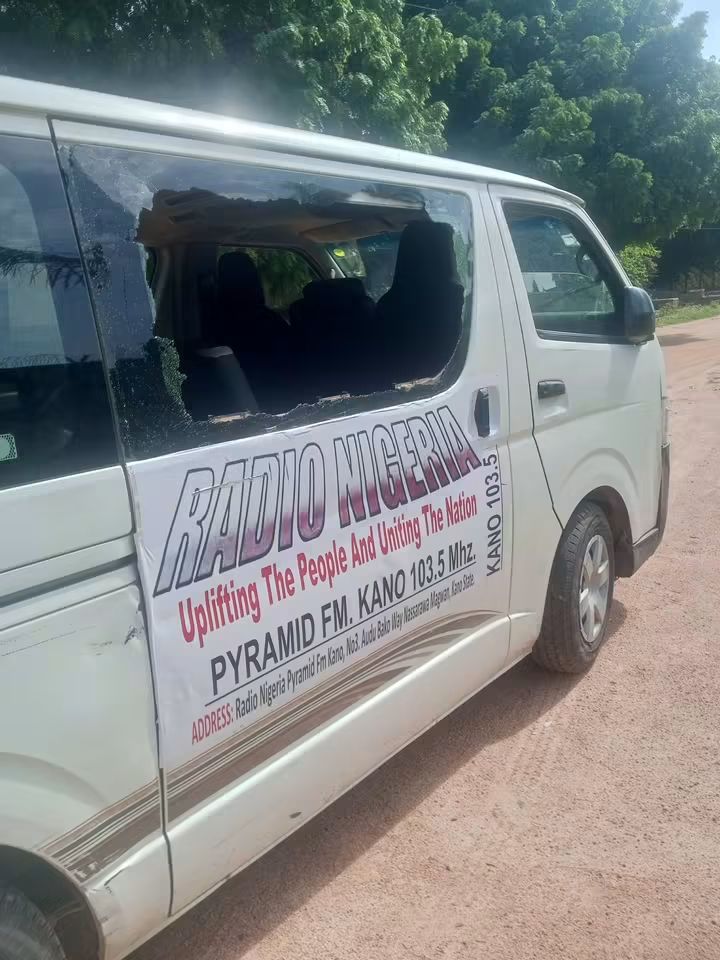
A group of suspected thugs on Saturday attacked journalists covering an All Progressives Congress (APC) rally in Kano State, smashing the windows and damaging a Radio Nigeria vehicle conveying members of the media.
The incident occurred shortly after the conclusion of a rally held at the Sani Abacha Stadium in Kano, where the leadership of a coalition of groups supporting President Bola Ahmed Tinubu was inaugurated.
According to eyewitness accounts, the thugs attacked a team of journalists who had gone to the venue to cover the event, targeting the Radio Nigeria, Pyramid FM vehicle in which some of the journalists were travelling.
The attackers reportedly used machetes and knives to strike the vehicle repeatedly, smashing its windows and damaging various parts of the bus.
Among the journalists affected in the attack were Abdulbaki Ali Ahmad Sharifai of Guarantee Radio and Yakubu Gwagwarwa of Pyramid Radio.
One of the journalists who spoke to Nigerian Tracker said the presence of security personnel inside the Radio Nigeria bus did not deter the attackers from carrying out the assault.
The journalist said the thugs continued attacking the vehicle despite the fact that security agencies were inside the bus with the journalists.
According to him, the attack created fear and confusion among the journalists, who had attended the political gathering in the course of carrying out their professional duties.
The incident has raised concerns over the safety of journalists covering political activities in Kano, particularly during large political gatherings where journalists are expected to move freely and report events without intimidation or attacks.
The motive behind the attack was not immediately clear, and it was also unclear whether any arrests had been made in connection with the incident as of the time of filing this report.
The attack comes amid increased political activities in Kano and across the country as political groups mobilise support for their respective interests ahead of future elections.

Jigawa Govt Appoints Dr. Lawan Ahmed as the 17th Emir of Gumel

How a ‘Herbal Tea’ Businessman Used Phone Chargers to Smuggle Cocaine to Saudi Arabia – NDLEA

Thugs Attack Journalists During APC Rally in Kano

Gov. Mutfwang Orders Closure of Schools Across State as Diphtheria Hits Plateau

Emir of Gumel, Ahmad Muhammad Sani, Dies After 45 Years on the Throne

From World’s 9th Most Populous City to Perfect: As Gov Yusuf Revisits Kano Master Plan

95% of Governor Abba Kabir Yusuf’s Promises Have Been Fulfilled — CPS Interview By Musa Diso, In Kano

Kano Islamic Scholar Declares Kano Widow Marriage Programme ‘Haram’, Urges Government to Stop It

We’re aware of your clandestine meetings with Lulu-Briggs, 𝐏𝐢𝐝𝐨𝐦𝐬𝐨𝐧, CRP uncovers ex-MD of NDDC, Nunieh

Between Sabotage and Scepticism: Why Nigeria’s Oil Dream Keeps Stalling
Jigawa Govt Appoints Dr. Lawan Ahmed as the 17th Emir of Gumel
How a ‘Herbal Tea’ Businessman Used Phone Chargers to Smuggle Cocaine to Saudi Arabia – NDLEA
Thugs Attack Journalists During APC Rally in Kano
Gov. Mutfwang Orders Closure of Schools Across State as Diphtheria Hits Plateau
Emir of Gumel, Ahmad Muhammad Sani, Dies After 45 Years on the Throne
From World’s 9th Most Populous City to Perfect: As Gov Yusuf Revisits Kano Master Plan
95% of Governor Abba Kabir Yusuf’s Promises Have Been Fulfilled — CPS Interview By Musa Diso, In Kano
Kano Islamic Scholar Declares Kano Widow Marriage Programme ‘Haram’, Urges Government to Stop It
We’re aware of your clandestine meetings with Lulu-Briggs, 𝐏𝐢𝐝𝐨𝐦𝐬𝐨𝐧, CRP uncovers ex-MD of NDDC, Nunieh
Between Sabotage and Scepticism: Why Nigeria’s Oil Dream Keeps Stalling
-

 Opinion5 years ago
On The Kano Flyovers And Public Perception
-

 Features5 years ago
How I Became A Multimillionaire In Nigeria – Hadiza Gabon
-

 Opinion6 years ago
Kano As future Headquarters Of Poverty In Nigeria
-

 History5 years ago
Sheikh Adam Abdullahi Al-Ilory (1917-1992):Nigeria’s Islamic Scholar Who Wrote Over 100 Books And Journals
-

 Opinion5 years ago
My First Encounter with Nasiru Gawuna, the Humble Deputy Governor
-

 History5 years ago
The History Of Borno State Governor Professor Babagana Umara Zulum
-

 History5 years ago
The Origin Of “Mammy Market” In Army Barracks (Mammy Ochefu)
-

 News4 years ago
Federal University Of Technology Babura To Commence Academic Activities September