
Politics
REJOINDER: DOSARA’S RE-THE ZAMFARA MODEL IS THE DISMAL TUNNEL SO SELF-DESTRUCTION.
BY HON. BELLO SOJA BAKYASUWA MARADUN,
NATIONAL PRESIDENT, APC RESCUE MISSION.
Before I go much further let me first of all ask Hon. Commissioner Dosara some questions;
-As a commissioner of information who claimed to know it all about the security situation in Zamfara state, kindly tell Nigerians what happened when a team of government Officials led by the Speaker of the state Assembly took those students to Jangebe? What happened with the two people that were shot dead in Jangebe that very day?
-Why do you think that the federal Government banned all mining activities in Zamfara State and placed all of you under surveillance?
-Since you claimed to know too much, Explain to Nigerians the role of various Security Agencies in the released of Jangebe Students as against the role of your so called repented bandits whom your Governor Recognized more than the security agencies?
-Since you claimed to know too much, Explain to Nigerians the role of various Security Agencies in the released of Jangebe Students as against the role of your so called repented bandits whom your Governor Recognized more than the security agencies?
-We can accept the fact that he knows all on Insecurity situation in Zamfara State, because he was the Special Adviser on Public enlightenment in the past administration. Since your boss cannot inform Nigerians nor unmask the people behind Jangebe’s Abduction and many other Attacks Within the state. You should tell us please.
-By mentioning only the guard’s man the School involved is not enough and motive behind the rejection of National Security Council resolutions By Governor Matawalle Assembly Members.
Hon. Commissioner, Zamfara state people expect answers to the above questions as soon as possible!
Now going back to your disrespectful comments to professor Jibrin Ibrahim, I must confess that I’m not surprised with your actions for obvious reasons; first you just got the job and you needed to proof to your boss that you are on top of the situation, Secondly, your Job is to depending the image of the Government no matter what the cost.
However, in case you are stuck along the way, Channels Television is a reliable media organization in Nigeria and has covered live, every inch of the events leading to the release of the students, I left some links so that you will not say I’m also relying on social media as you did to professor, who obviously the facts I enumerated herein shows that professor don’t rely on social media to comment on issues as sensitive as security.
https://www.channelstv.com/2021/02/26/zamfara-school-abduction-mob-attack-journalists/
Hon. Commissioner, Zamfara state people expect answers to the above questions as soon as possible!
Now going back to your disrespectful comments to professor Jibrin Ibrahim, I must confess that I’m not surprised with your actions for obvious reasons; first you just got the job and you needed to proof to your boss that you are on top of the situation, Secondly, your Job is to depending the image of the Government no matter what the cost.
To people like you, whatever the boss does is right and question asked, to your people, depending the image of your governor is more important than the lives of hundreds and thousands of people leaving in constantly fear at every hour, every minute and every second in Zamfara state.
Who is a Professor?
Hon. Dosara , at this point I felt I should educate more about who professor is really is and what it takes to become one In a many countries including Nigeria; the title “professor” refers to an academician who is exclusively or mainly engaged in research, and who has few or no teaching obligations.
For example, the title is used in this sense in the United Kingdom (where it is known as research professor at some universities and professorial research fellow at some other institutions) as in the case of Professor Jibrin Ibrahim who is a fellow of the Democratic Institute.
Professor is usually the most senior rank of a research-focused career pathway and the position is often held by particularly distinguished scholars; thus the position is often seen as more prestigious than an ordinary Lecturer.
The scholarly method or scholarship is the body of principles and practices used by scholars and academics to make their claims about the subject as valid and Trustworthy as possible, and to make them known to the scholarly public.
It is the methods that systemically advance the teaching, research, and practice of a given scholarly or academic field of study through rigorous inquiry. Scholarship is noted by its significance to its particular profession and is creative, can be documented, can be replicated or elaborated, and can be and is peer-reviewed through various methods.
The Scholarly Method includes the subcategories of the Scientific Method, in which scientists prove their claims and the Historical Method, in which historians verify their claims.
Originally begun in order to reconcile the philosophy of the ancient classical philosophers with medieval theology, scholasticism is not a philosophy or theology in itself but a tool and method for learning which places emphasis on dialectical reasoning.
The primary purpose of scholasticism is to find the answer to a question or to resolve a contradiction. It was once well known for its application in medieval theology but was eventually applied to classical philosophy and many other fields of study.
The historical method comprises the techniques and guidelines by which historians use primary sources and other evidence to research and then to write history. The question of the nature, and indeed the possibility, of sound historical method is raised in the philosophy of history, as a question of epistemology. History guidelines commonly used by historians in their work require external criticism, internal criticism, and synthesis.
The above classical explanation of who is really a professor and what it takes to become one, shall clearly explain to you that a professor is not your room mate or someone whom you think can just made a statements without proper research about what he is writing, he has to be absolutely sure before making it public.
Who is Professor Jibrin Ibrahim?
Prof Jibrin Ibrahim is a Senior Fellow at the Centre for Development, CDD. He was the Director of the Centre for Democracy and Development and an outstanding scholar-activist with an international reputation. Prof. Ibrahim received degrees in Political Science from the Ahmadu Bello University, Zaria, Nigeria and a doctorate in Politics from the University of Bordeaux in France. Research Professor at the Institute of Federalism in Fribourg, Switzerland among several other academic accomplishments, Prof. Ibrahim has lectured, published and consulted extensively on democratization and governance in Africa. A well-regarded leader in civil society, Prof. Ibrahim is the Chair of the West Africa Civil Society Forum. He was also a member of the Electoral Reform Committee established by President Umaru Musa Yar’Adua and has observed elections in Nigeria, Ghana, Malawi, Togo, Senegal, Cote d’Ivoire, Liberia and Guinea for the Centre for Democracy and Development, Economic Community of West African States, the Carter Centre and the Commonwealth. Prof. Ibrahim has been the founding Director of Global Rights in Nigeria – the international human rights NGO in Nigeria and served in the leadership of several national and international advocacy and research networks of constitutional reform, electoral reform and civil society strengthening.
He has published many books, monographs and articles in refereed journals and has consulted extensively for the UNDP, DFID, and FOSTER, amongst many other agencies. He runs a weekly column “Deepening Democracy” in the Daily Trust, a Nigerian daily newspaper, and has sat on many editorial boards of learned journals.
Now I find it hard to believe that someone with the above qualifications and vast of experience will defend on social media to learn about what is happening in Zamfara State with all the news reports by mainstream media organization both foreign and domestic, besides, one doesn’t need to come to Zamfara to know what is happening, the facts are everywhere Mr. Commissioner. In facts there is no single day Nigerian reliable media organizations will not give report about the situation in Zamfara.
I shall give you several examples in due course which perhaps shows a failure of your office which include monitoring all media houses in respect to issues relating to your state.
Dosara’s Pay lip service to gain acceptance
Hon. Dosara in his attempt to protect his government and his boss, denied the facts that about 60 persons were abducted nearly 24 hours after the release of the Jangebe students. In his words:
“The Professor for example, quoted a report on the abduction of 60 persons including women and children at Ruwan Tofa in Maru local government area of the state. In that report, it was alleged that 40 people were killed which is a blatant lie, but yet, the Professor went ahead to use that report in his article, without clarification.”
While this story was widely reported by mainstream media organizations in Nigeria and its really confirmed the professor’s comments as in the below link story by Channels Television which you will agree with me is the Nigeria’s most reliable news source.
https://www.channelstv.com/2021/03/04/bandits-abduct-dozens-in-fresh-zamfara-village-attack/
Dosara also desperately reacted to the ‘None fly zone’ declaration in Zamfara state by the federal government when he related it to what the professor said in his article and I quotes:
“It was recently argued by the National Security Adviser to the president that helicopters were used in supplying weapons to bandits in Zamfara, hence declared the state “None fly Zone”. Did Prof Care to question who owns these helicopters and whose responsibility it is to monitor the nation’s airspace and movement of aircrafts?”
In this, how do you expect the prof. to go about asking you people to tell him who are responsible? Even if you know Mr. Dosara would you have disclosed it to the professor? Now let assume you don’t know but your governor does, when he told the press that Nigerians will be shocked to hear those behind this act, he went to further to say he will find time to grant exclusive interview regarding the sponsors of these banditry.
At this point, I asked you again Mr. Dosara, do you expect the prof. for the sake of research to pre-empt the Governor by going around asking who owns the Helicopters, who are those the Governor is referring to? The answer is no! He has to wait since the governor has made the following commitments was aired live on Channels Television.
The above link has answered many questions raised by the Hon. Commissioner, including the issues of peace initiative or dialogue by the bandits and role played by the so called repented bandits. If you listen carefully, you will come to realized how the Matawalle led Governmeent reduced all security agencies to almost nothing when he made mention that the release of the girls was as a results of the efforts of the repented bandits as against what the commissioner of police in the state said.
Technically this tells me Dosara has little or no knowledge of what is happening within the cabinet he was appointed to serve as its image maker… what a season Journalist! Someone that ought to be providing up to date information regarding the development in the fight against banditry is busy attacking a professor who is constructively pointing out your weak points when even your Governor could not come out to reveal those behind the act despite his promises of granting exclusive interviews to mention names; of course Channels Television gave him the chance instead he was only able to revealed the involvement of the school poor security guard while deliberately neglecting the major players, if at all they exist.
As a security expert, I do believed that you don’t negotiate with criminals, negotiating with criminals means given them exactly what they wanted and by so doing you are encouraging them to carry more arms to commit more atrocities. Again here is matawalle insisting on his peace dialogue.
The Politics of Dosara!
The newly appointed commissioner also in his response to the professor, did say that he wanted the Prof. To compare the present administration of Bello Matawalle with that of Abdulaziz Yari in terms of damages course to the state owing to the banditry activities.
“I also expected that the Professor should have made a comparative study and analysis of the damages that the bandits had caused to the people of Zamfara before the coming of the present administration, with the damages incurred during the just 2 year period of the present administration.
Did Prof Cares to question how the bandits come into the country or how they are getting their weapons?”
First of all I find that politically selfish statement from someone who serve as special Advicer on public affairs to Governor Yari, in one hand, while on the other hand I could say the failure of you and your likes to offer credible advice to the then government is largely responsible for the increasing security threats if at all it’s was that serious as you are saying.
In comparison however, has there been any incident of School kidnapped during Yari? The answer is no! Has the situation escalated to the state capital? Again the answer is no! Did Abdulaziz Yari Dismantle Vigilante Group whom most communities and villages look up to as the first responders whenever they were attacked? Again the answer is no.
All the above mentioned had happened and are still happening during your new found government Mr. Dosara.
On the issue of how the bandits came into the country and how they got their weapons, I guess Hon. Commissioner is trying to deny the facts that these bandits are some kind foreigners! While in that case the answer is staying with you… You tell us since you are the ones who knows the repented bandits, you can tell us if they are Nigerians or not.
Because to me, if they not Nigerians why bother negotiating with foreign enemy whom you have no knowledge of his identity apart from the AK47 rifle he is carrying around your villages and towns?
According to the Governor, no ransom was paid for the release of the students, that wonders me how can foreign bandits cross over to Nigeria just to kidnapped innocent students and then release them free of charge.
In my experience as a security expert, there is three reasons people take a hostage; Ransom, Human shield or for leverage and these reasons forms part of their demands that most be met before the victim is release. Therefore, there is point to fool people by telling them the bandits just gave you the students because of your persuasive techniques.
Mr. Commissioner I hope you will re-think and offer unconditional apology to our respected professor who is only trying to show us a way out.
Hon. Bello Soja Bakyasuwa Maradun,
National President, APC Rescue Mission.
Politics
A Remarkable Homecoming: Kano Unites in Support of Abba Kabiru Yusuf, Signaling a Strong Endorsement for Bola Ahmed Tinubu in 2027
By: Nasiru Yusuf Gwadabe
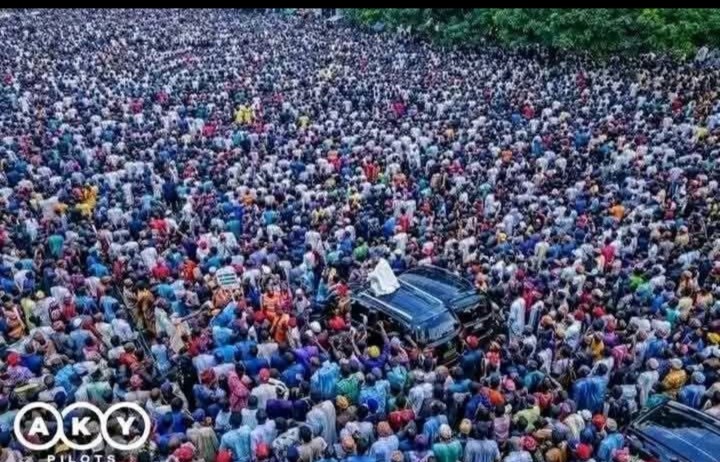
Saturday, 4th April 2026 will not fade easily from the living memory of Kano. It is a date that has already secured its place in the history of the ancient city, not through official proclamation, but through the overwhelming expression of its people. From the very moment the aircraft conveying Abba Kabir Yusuf touched down at about noon, Kano transformed into a living theatre of emotion, loyalty, and political meaning. What began as a homecoming soon evolved into something far deeper, a dual expression of confidence in state leadership and a rising chorus of national political alignment.
What followed defied imagination. The governor could barely step forward without being surrounded by a surging crowd, eager not just to see him, but to connect with him. From approximately 12 noon until about 9 o’clock, movement itself became an extraordinary challenge. It was not resistance that slowed the governor’s convoy, but an outpouring of affection so powerful that it turned a simple journey into a historic procession.
The journey from the airport to the Government House, which ordinarily takes not more than fifteen minutes, stretched into nearly ten hours. What should have been a routine drive became a prolonged passage through a sea of humanity. The motorcade moved slowly, almost ceremonially, as if guided by the collective will of the people rather than the force of engines.
At every junction, the story repeated itself. The convoy would halt, not out of necessity, but out of insistence. Citizens stepped forward to offer prayers, raising their hands and voices in supplication for the governor’s success. These were not symbolic gestures. They were deeply felt expressions of hope, trust, and shared destiny. In those pauses, the line between the leader and the people seemed to disappear, replaced by a bond rooted in mutual belief.
Kano is not a city that offers such devotion lightly. It is politically aware,
historically grounded, and known for its ability to assess leadership with clarity. Yet on this day, its verdict was unmistakable. The scale of the reception, the patience of the crowd, and the emotional intensity of the moment all pointed to one undeniable truth. Abba Kabir Yusuf is not merely occupying an office. He is occupying the hearts of his people.
To describe him as a homeboy is to capture the essence of this connection. He is seen not as a distant authority, but as one who understands the rhythm of the streets, the struggles of ordinary citizens, and the aspirations that define Kano’s future. This familiarity has translated into trust, and that trust has now found its most visible expression in the streets.
Yet beyond the celebration of a leader’s return, a second narrative steadily took shape, one that aligned Kano’s political voice with the national leadership of Bola Ahmed Tinubu. What unfolded was not only a reaffirmation of faith in the governor, but also a growing endorsement of the President, expressed through chants, symbols, and the unmistakable enthusiasm of the crowd.
What unfolded on that Saturday goes beyond spectacle. It carries deep political significance. In a system where legitimacy is often contested, moments like these serve as powerful indicators of public confidence. The crowd was not assembled. It emerged. It was not directed. It was inspired. And in its sheer magnitude, it delivered a message louder than any campaign could convey.
That message is clear. Kano believes in Abba Kabir Yusuf. Kano stands with him. At the same time, Kano is increasingly aligning with the leadership of Bola Ahmed Tinubu, projecting a unified political direction that stretches from the state to the centre.
The long hours from noon to night were not a burden to the people. They were an offering. Every minute spent waiting, every step taken alongside the convoy, every prayer raised was a contribution to a shared narrative. It was a way of saying that leadership, when it is genuine, does not stand apart from the people. It walks among them.
While addressing the mammoth gathering that thronged the streets, Governor Abba Kabir Yusuf expressed deep appreciation for the overwhelming show of love and solidarity, describing it as a clear endorsement of his administration’s direction and achievements. He noted that such a reception was not only humbling but also a powerful motivation to intensify efforts toward delivering more developmental projects across all sectors of the state.
He assured the people that their confidence would not be taken for granted, emphasizing that the administration remains committed to consolidating its gains and expanding its impact beyond 2027. In what appeared to be a pointed message to political opponents, the governor remarked that the unprecedented turnout had already sent a strong signal about the future, particularly to those suggesting that his tenure would be limited to a single term. According to him, the people of Kano have, through their actions, demonstrated where their loyalty lies.
“Today’s outing is no doubt an indication of your unalloyed support and endorsement for our administration to continue with the laudable initiatives that will make Kano greater,” he declared, while challenging any political contender to mobilize a similar organic gathering. The statement carried a clear undertone, positioning the event not just as a welcome ceremony, but as an early barometer of political strength ahead of the 2027 elections.
Importantly, the governor used the moment to reaffirm Kano State’s alignment with the Federal Government under the leadership of Bola Ahmed Tinubu. He emphasized that sustained collaboration with the centre remains vital for attracting federal interventions and accelerating development across the state.
In a more direct political appeal, he called on the people of Kano to translate their visible enthusiasm into electoral action by supporting President Bola Ahmed Tinubu in the 2027 general elections. He stressed that continuity at the federal level would not only consolidate ongoing reforms but also guarantee greater opportunities and development for Kano State.
The response from the crowd reinforced this call. From the airport through the major streets, chants in support of the President grew louder, blending seamlessly with those of the governor. Supporters waved party symbols and openly affirmed their readiness to stand with President Bola Ahmed Tinubu, turning the reception into a powerful demonstration of dual loyalty and shared political purpose.
For many observers, this was more than a moment of celebration. It was a declaration of alignment. The people of Kano, through their sheer numbers and visible enthusiasm, projected confidence not only in their governor but also in the leadership at the centre. The endorsement of President Bola Ahmed Tinubu was not staged. It emerged organically, carried on the voices of thousands who see continuity as a pathway to progress.
This groundswell of support speaks to a broader political reality. Kano remains one of the most influential political blocs in the country, and its direction often shapes national outcomes. By rallying behind both Abba Kabir Yusuf and President Bola Ahmed Tinubu, the people have signaled a convergence of interests that could prove decisive in the coming electoral cycle.
The electrifying reception, marked by chants, music, and a sea of party symbols, brought movement across key roads to a standstill as residents came out in solidarity. The massive turnout underscores the governor’s growing political influence and the deepening connection between his administration and the people. It also reflected the role of grassroots mobilization across all levels, drawing participation from party executives, political office holders, traders, youth groups, and entertainers. The crowd took nearly eight hours to escort the governor from the airport to the Government House, a journey that ordinarily lasts just fifteen minutes.
The reception stands as one of the largest in Kano’s recent political history, second only to the massive turnout recorded on 12th January 2024 following the Supreme Court judgment. In both instances, the people’s response has served as a clear signal of political direction and public sentiment.
As the governor finally made his way through the vast crowd late in the evening, the significance of the moment remained unmistakable. This was more than a return from official engagements. It was a reaffirmation of trust, a visible endorsement of leadership, and a powerful reminder of the bond between Kano and its governor.
Saturday, 4th April 2026 will be remembered not just for the crowd, but for what the crowd represented. It will be remembered as the day Kano stood still, not in silence, but in solidarity. A day when the streets spoke, when the people declared their confidence, and when a leader’s journey home became a collective experience.
And as the echoes of that historic welcome continue to ripple across the political landscape, one conclusion rises above all others. This was not merely a reception. It was a statement of strength, a public reaffirmation of mandate, and a quiet but powerful signal of what lies ahead. In the language of politics, moments like these are not accidental.
They are indicators of momentum, of acceptance, and of a growing consensus. If the future is shaped by the will of the people, then Kano has already begun to write its next chapter, one that places Abba Kabir Yusuf firmly at its center, while echoing a resounding and unmistakable endorsement of Bola Ahmed Tinubu as the path forward to 2027.
Nasiru Yusuf Gwadabe, a Veteran Journalist, retired Editor with CTV writes from Kano
Politics
REJOINDER: The Fallacy of the “Commander” and the Burden of Integrity
By Halima Isyaku Dantsoho
I read with a mix of amusement and concern the defense of Hon. Murtala Sule Garo by Hadi Abdullahi Muhammad, which attempts to frame the valid scrutiny of a public figure as a mere product of “internal power struggles.” While it is convenient to label every criticism a “media trial,” we must confront the reality that leadership is a sacred trust, not a reward for street mobilization. To suggest that Garo is the ideal choice for Deputy Governor—particularly in the wake of the recent political shift that saw Governor Abba Kabir Yusuf move to the APC—is to ignore the very “storm” the author claims to see. The vacancy in the Deputy Governor’s office exists because Kano is attempting to move past a season of distraction following the resignation of the former occupant; why then would the state replace a controversy with a liability? We are talking about a man who remains entangled in significant litigation regarding his past tenure as Commissioner, and to elevate such an individual to the second-highest office in the state would be like putting out a fire with petrol. It would lock the administration into a permanent state of legal defense, ensuring that the coming years are spent in courtrooms rather than on the construction of a better Kano.
The author praises Garo as a “Commander” of the grassroots, yet in a state as economically vital as ours, “mobilization” is not a substitute for administrative integrity. The “grassroots” of which he speaks—the traders, farmers, and youths—are the primary victims when public funds are allegedly mismanaged at the local government level. True loyalty to the base is shown through transparent governance and the systemic protection of public wealth, not through the strategic distribution of startup tools during an election cycle. If the APC national leadership and President Bola Ahmed Tinubu are truly committed to a “Renewed Hope” agenda, they must recognize that elevating a figure with such unresolved legal narratives contradicts the very integrity the party must represent in this new era. Perfection may not be the standard, but accountability is. Fairness does not mean ignoring a mountain of evidence in favor of political popularity; it means letting the courts decide a man’s fate before he is granted the prestige of high office. Kano has moved forward into a new political era, and it is time our leadership choices reflected a future built on stability rather than a return to the controversies of the past.
Halima Isyaku Dantsoho wrote from Kano.
Politics
Kano’s Quest for an Alternative with Ibrahim Ali Amin Little, By Adnan Mukhtar
My recent article titled “Ibrahim Little: The Man Fit for the Job” has opened the eyes of many young men and women, particularly those in the Gen Z category, to the personality and potential of Alhaji Ibrahim Ali Amin. He is a man of calibre and a true embodiment of competence for the enormous responsibility of leading Kano, the commercial hub of Northern Nigeria.
The quest for a credible alternative in Kano’s political space began last year when my political mentor and principal declared his intention to contest for the governorship. The name Ibrahim Ali Amin Little has, however, been a household name in Kano politics since the year 2000.
He is involved in politics not for material gain, but out of a genuine passion for investing in the lives of the people. As a businessman with a proven track record, he brings a different perspective to governance. Since 1999, most of Kano’s governors have emerged from the civil service sphere. Despite Kano’s status as a commercial centre, the state has witnessed a form of economic stagnation, largely due to insufficient emphasis on business-driven policies and economic innovation.
When I speak of an “alternative,” I refer to an independent-minded individual who is well-versed in administration and economic management.
Kano cannot be entrusted to someone who lacks a deep understanding of its economic realities. Since 1999, governance in the state has largely revolved around a single model road construction and the awarding of contracts, often without corresponding long-term economic impact.
True governance goes beyond infrastructure. It involves prioritising education by employing competent teachers, strengthening the healthcare sector especially primary healthcare centres with adequate and qualified medical personnel, and creating sustainable systems that improve the quality of life for citizens. These are the real indicators of governance. The question, however, remains: where does Kano stand in all of this?
Unfortunately, very few aspirants are addressing these critical issues except Ibrahim Little. As one of his closest aides, I can confidently say that his priorities are clear and people-oriented. His daily engagements revolve around questions such as: How can we identify and nurture talent? How can Kano become a true industrial hub? How can we establish an independent power supply for the state? And how can we revitalise and boost agricultural productivity?
These are not just talking points for him, they are guiding principles. His interest lies in the development of Kano, not in personal gain or the accumulation of state resources.
At this critical moment, Ibrahim Ali Amin Little stands as the alternative Kano needs.
Adnan Mukhtar
Is a Doctoral Candidate at Northwest University, Kano

INEC Urges Broadcasters to Uphold Fairness Ahead of 2027 Elections

Isoko Traditional Rulers Divided Over 250 Million Offer To Confer Chieftaincy Title On Senatorial Aspirant

A Remarkable Homecoming: Kano Unites in Support of Abba Kabiru Yusuf, Signaling a Strong Endorsement for Bola Ahmed Tinubu in 2027

Kwankwaso, Atiku, Amaechi, Obi, Others Match-Out in Peaceful Protest at INEC’s Headquarters

ADC Crisis: Kwankwaso Seeks Intervention of Gombe Emir

ADC Leadership Crisis: State Chairmen to Elect Caretaker Committee on Tuesday

Governor Abba Kabir Yusuf Holds Exclusive Prerogative to Choose Deputy – Malam Inuwa Waya

Restoring the Glory That Was Always There: Governor Abba Kabir Yusuf and the Historical Vision Behind Kano First

Table Water Producers Increase New Price for Sachet Water in Kano

DSP Barau As A Global Citizen, His Recent Global Engagements
INEC Urges Broadcasters to Uphold Fairness Ahead of 2027 Elections
Isoko Traditional Rulers Divided Over 250 Million Offer To Confer Chieftaincy Title On Senatorial Aspirant
A Remarkable Homecoming: Kano Unites in Support of Abba Kabiru Yusuf, Signaling a Strong Endorsement for Bola Ahmed Tinubu in 2027
Kwankwaso, Atiku, Amaechi, Obi, Others Match-Out in Peaceful Protest at INEC’s Headquarters
ADC Crisis: Kwankwaso Seeks Intervention of Gombe Emir
ADC Leadership Crisis: State Chairmen to Elect Caretaker Committee on Tuesday
Governor Abba Kabir Yusuf Holds Exclusive Prerogative to Choose Deputy – Malam Inuwa Waya
Restoring the Glory That Was Always There: Governor Abba Kabir Yusuf and the Historical Vision Behind Kano First
Table Water Producers Increase New Price for Sachet Water in Kano
DSP Barau As A Global Citizen, His Recent Global Engagements
-

 Opinion4 years ago
On The Kano Flyovers And Public Perception
-

 Features5 years ago
How I Became A Multimillionaire In Nigeria – Hadiza Gabon
-

 Opinion5 years ago
Kano As future Headquarters Of Poverty In Nigeria
-

 History5 years ago
Sheikh Adam Abdullahi Al-Ilory (1917-1992):Nigeria’s Islamic Scholar Who Wrote Over 100 Books And Journals
-

 Opinion4 years ago
My First Encounter with Nasiru Gawuna, the Humble Deputy Governor
-

 History5 years ago
The Origin Of “Mammy Market” In Army Barracks (Mammy Ochefu)
-

 History4 years ago
The History Of Borno State Governor Professor Babagana Umara Zulum
-

 News4 years ago
Federal University Of Technology Babura To Commence Academic Activities September