
News
Dangote Cement Making Measurable Impacts In Benue Host Communities — FG
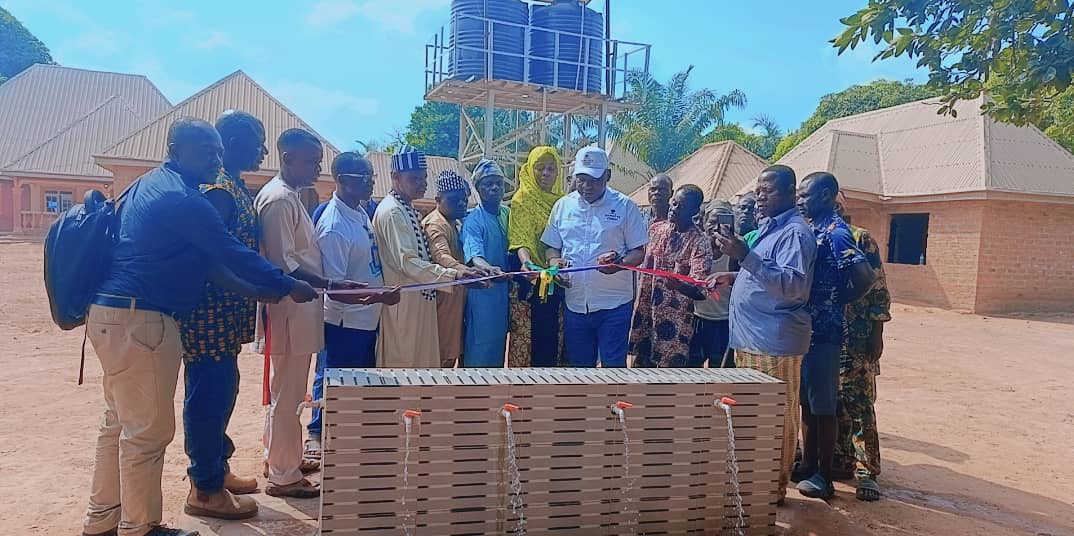
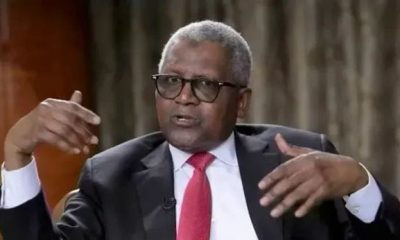
The Minister of Solid Minerals Development, Dr. Dele Alake, has said that Dangote Cement Plc is making measurable impacts in its Gboko Host Communities of Benue State.
At the commissioning of Dangote Cement’s multi-million-naira water projects, scholarship awards and youth skill acquisition programme, the minister commended the company for its impactful contributions to host communities.
He also commended the Industrial Training Fund (ITF) for partnering and supervising the training of youth during the skill acquisition programme.
Represented by an Assistant Director of Mines and Environmental Compliance, Benue State, Mrs. Adijatu Usman, the minister said Dangote Cement is meeting its obligations under the Community Development Agreement (CDA).
He said the CDA ensures that mining companies plough back part of their profits into their host communities.
He said: “I can tell you that the Dangote Cement has delivered several projects for its host communities.
“The project was a fall out of a Federal Government policy, for companies such as Dangote to give back to its host communities.
“It is a Federal Government policy for mining companies to reinvest part of their profits into host mining communities so as to impact the communities, and as a result of that policy we have had series of engagements with them.
“There are six of these communities here. We sat with them several times and these projects are certified community-based projects because the community agreed that they needed these projects. And we are here today because the projects have been completed.
“What we expect is for the communities to see these projects as their personal projects; own them, and protect them, so that they will be sustainable. That way there will be economic development within the communities.
“We share in their joy as we present these projects to them, and we think that mining will be sustainable.”
Speaking at the commissioning and handover ceremony of the projects to the communities, Head of Social Performance at Dangote Cement Plant in Gboko, Dr. Johnson Kor, stated that the projects were delivered to communities that have challenge in access to good water supply.
Dr. Kor said: “We are here today to commission CDA projects that were earmarked for these host communities since last year December 2024. We have done many of them and these are the ones that have been completed, and they are water projects among them motorized and solar powered boreholes.
“Community Development Agreement was entered in collaboration with the Federal Ministry of Solid Minerals Development and the host communities, the stakeholders and the Plant.
“It is a five-year agreement, and this is the first year and by next year we will be going into the second round and as you can see, we are also working on some electricity projects which are yet to be completed.
“These are areas where they hardly get water, despite having hand dug wells, they are perennially in need of water and some of them are using water from the streams or river because of their proximity to River Benue.
“Therefore, we felt there was need to provide water for them, and they are happy with this kind of gesture exhibited by the Dangote Cement Plc.
“The boreholes are located in Pass Brother, Mbaakpoghol-Mbatyu; Mbaswa-Mbatser and Agboghol-Amua communities.”
District Head of Mbaakpoghol-Mbatyu, Chief Kunav Anum, observed that as a community, his people were very happy to have one of the boreholes located in the community.
He said: “We are very excited. We didn’t know that this would happen so soon in this community. It came as a surprise, so we are grateful to Dangote Cement Plc for the gesture.”
The monarch said the community had accessed electricity earlier through Dangote Cement, even as he pledged that the community would continue to support the company.
A statement from the company had said: “In further demonstration of this commitment, the scholarship fund has this year been reviewed upward to ₦28,800,000.00, and its scope expanded to cover all six host communities, strictly in line with the provisions of the Community Development Agreement (CDA). This deliberate expansion reflects our desire to ensure equity, inclusiveness, and shared benefits across all our immediate communities.
“The company has executed several projects, with others still ongoing, including the Women Empowerment Programme, the Farmers Empowerment Programme and the Youth Empowerment Programme, all aimed at improving livelihoods in the host communities.”










News
Rep. Abubakar Bichi Employs 100 New Islamic School Teachers in Bichi
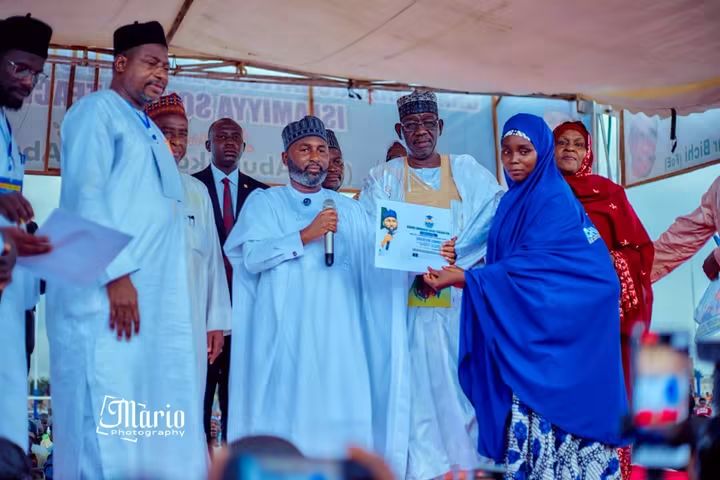
The Federal lawmaker representing the Bichi Federal Constituency, Hon. Abubakar Kabir Abubakar Bichi, has inaugurated 100 new Islamic school teachers as part of efforts to strengthen Islamic education in the Bichi Local Government Area of Kano State.
The inauguration ceremony was held on Sunday, 27 September 2026, and marked the fourth batch of School Teachers employed under the lawmaker’s initiative bringing the total of number of teachers engaged through the programme to 600.
Before their employment, the 100 teachers underwent a special examination conducted at the directive of the lawmaker. Those who obtained the highest scores across the 11 wards of Bichi Local Government Area were selected for the teaching positions.
The lawmaker had previously supported the teachers by paying their monthly allowances as volunteers before formally employing them as full-time teachers in Islamic schools across the local government area.
Prominent Islamic scholars and dignitaries attended the inauguration ceremony, including Sheikh Habibu Dan Almajiri, Chairman of the Kano State Zakkah Commission; Dr. Nazifi Ishak, former Kano State Commissioner for Religious Affairs; Dr. Zahrau Muhammad Umar, former Commissioner for Women Affairs; and Sheikh Sanusi Sharif Bichi.
Also in attendance were the Chairman of Bichi Local Government Area, Alhaji Hamza Sule Maifata; the Director-General of the APC Campaign Council in Bichi, Alhaji Sani Mukaddas, and the Kano State APC Secretary, Prof. Yusuf Muhammad Sabo.
The Islamic scholars and other dignitaries commended Hon. Abubakar Kabir Abubakar Bichi for his efforts towards improving both Islamic and modern education in the Bichi Local Government Area.
Hon. Abubakar Kabir Abubakar has also previously engaged several youths in various sectors, including healthcare, environmental services, education and other community development activities, as part of his efforts to create opportunities for young people across Bichi Federal Constituency and Kano State.
The lawmaker, who serves as the Chairman of the House Committee on Appropriation, has consistently expressed his commitment to youth development and community empowerment through various initiatives across the constituency.
News
FG Seeks Fresh $1.5bn World Bank Loans As Nigeria’s Debt Hits N166.79tn
By Yusuf Danjuma Yunusa
The Federal Government is in discussions with the World Bank for three new loans worth a combined $1.5 billion, even as Nigeria’s total public debt climbed to a record N166.79 trillion by June 2026.
The proposed facilities consist of three $500 million loans targeting climate resilience, social protection and early childhood development.
The first is an additional $500 million for the Agro-Climatic Resilience in Semi-Arid Landscapes (ACReSAL) project, which would increase its total financing to $1.2 billion. The funds are expected to support land restoration, flood and erosion control, irrigation, water management and other climate-resilience measures across northern Nigeria.
Another $500 million facility is proposed for the Household Prosperity and Empowerment-Social Protection (HOPE-SP) project. It is designed to support poor and vulnerable households through cash transfers, an improved social registry and stronger social protection systems.
The third $500 million loan would finance the Nigeria Early Childhood Development programme, covering all 36 states and the Federal Capital Territory. The programme aims to improve access to healthcare, nutrition, early learning, childcare, water and sanitation for children aged zero to five.
Meanwhile, figures from the Debt Management Office show that Nigeria’s public debt increased by N14.39 trillion , from N152.40 trillion in June 2025 to N166.79 trillion in June 2026. Domestic debt stood at N91.59 trillion, while external debt was N75.20 trillion.
Nigeria’s debt to the World Bank Group also rose to $20.73 billion by June 2026, accounting for about 38 per cent of the country’s $54.52 billion external debt.
Economist Adewale Abimbola said concessional loans could support development if properly structured and effectively utilised, stressing that the key issue was how the borrowed funds were deployed.
News
Report: Nigeria Records N166trn Public Debt
By Yusuf Danjuma Yunusa
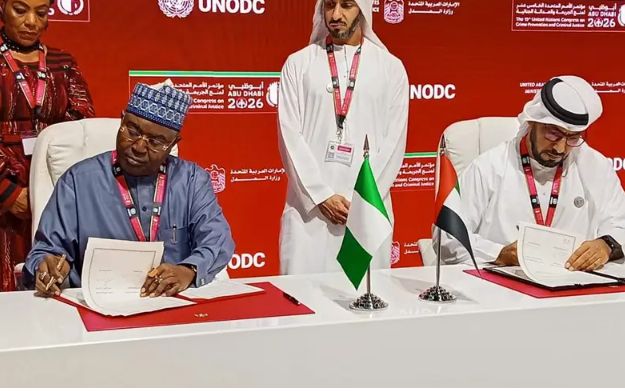
The Debt Management Office (DMO) says Nigeria’s total public debt rose to N166.79 trillion as of June 30, 2026.
The DMO published the latest public debt portfolio report on Friday.
The figure represents a 9.4 percent or N14.39 trillion increase from the N152.4 trillion recorded at the end of June 2025.
It also represents an increase of N7.44 trillion or 4.7 percent compared with the N159.35 trillion recorded at the end of the first quarter (Q1) of 2026.
According to the latest report, the debt stock comprises N91.59 trillion in domestic debt, which accounts for 54.91 percent of the total debt stock, and N75.2 trillion in external debt, representing 45.09 percent.
The debt office said domestic debt increased by N11.04 trillion (13.7 percent) from N80.55 trillion recorded in June 2025.
The office said external debt also rose by N3.35 trillion (4.7 percent) from N71.85 trillion in the same period.
According to the DMO, the federal government accounted for N152.77 trillion of the total debt stock, comprising N86.99 trillion in domestic debt and N65.77 trillion in external debt.
On the other hand, states and the Federal Capital Territory (FCT) accounted for the remaining N14.01 trillion — N4.59 trillion in domestic debt and N9.42 trillion in external debt.
In dollar terms, the agency said Nigeria’s total public debt stood at $120.93 billion as of June 30, 2026 — up from $99.66 billion recorded in June 2025.
The DMO said the Central Bank of Nigeria (CBN) official exchange rate of N1,379 per dollar as of June 30 was used to convert the external debt to naira.

Dry Taps Gone, Kano Flows Again: The Abba Yusuf Water Comeback By Abba Anwar

Rep. Abubakar Bichi Employs 100 New Islamic School Teachers in Bichi

The Tinubu Health Reset: A Consultant Examines Nigeria’s Healthcare Reforms

FG Seeks Fresh $1.5bn World Bank Loans As Nigeria’s Debt Hits N166.79tn

RE:WE ARE UNDER SIEGE: TARABA MONARCH BREAKS SILENCE AS FULANI BANDITS OVERRUN THE ANCIENT KWARARAFA KINGDOM:

Zamfara Varsity ASUU Threatens Warning Strike Over FG-ASUU Agreement, Promotion Arrears

Bello Sharada: A Great Writer, A Bookish Soul, Gone Too Soon

Kano Chemists Threaten Warning Strike Over Alleged PCN Pressure

Per Ishaq Samaila: “Waziri” for Strategy. “Mai Jama’a” for Service. One Man. One Mission. Ibrahim Kabir Masari

Education Stakeholders, SBMC Train Students on Skills for Self-Reliance
Dry Taps Gone, Kano Flows Again: The Abba Yusuf Water Comeback By Abba Anwar
Rep. Abubakar Bichi Employs 100 New Islamic School Teachers in Bichi
The Tinubu Health Reset: A Consultant Examines Nigeria’s Healthcare Reforms
FG Seeks Fresh $1.5bn World Bank Loans As Nigeria’s Debt Hits N166.79tn
RE:WE ARE UNDER SIEGE: TARABA MONARCH BREAKS SILENCE AS FULANI BANDITS OVERRUN THE ANCIENT KWARARAFA KINGDOM:
Zamfara Varsity ASUU Threatens Warning Strike Over FG-ASUU Agreement, Promotion Arrears
Bello Sharada: A Great Writer, A Bookish Soul, Gone Too Soon
Kano Chemists Threaten Warning Strike Over Alleged PCN Pressure
Per Ishaq Samaila: “Waziri” for Strategy. “Mai Jama’a” for Service. One Man. One Mission. Ibrahim Kabir Masari
Education Stakeholders, SBMC Train Students on Skills for Self-Reliance
-

 Opinion5 years ago
On The Kano Flyovers And Public Perception
-

 Features5 years ago
How I Became A Multimillionaire In Nigeria – Hadiza Gabon
-

 Opinion6 years ago
Kano As future Headquarters Of Poverty In Nigeria
-

 History5 years ago
Sheikh Adam Abdullahi Al-Ilory (1917-1992):Nigeria’s Islamic Scholar Who Wrote Over 100 Books And Journals
-

 Opinion5 years ago
My First Encounter with Nasiru Gawuna, the Humble Deputy Governor
-

 History5 years ago
The History Of Borno State Governor Professor Babagana Umara Zulum
-

 History6 years ago
The Origin Of “Mammy Market” In Army Barracks (Mammy Ochefu)
-

 News4 years ago
Federal University Of Technology Babura To Commence Academic Activities September