
News
Shehu to Jonathan: Your Claim on Buhari, Boko Haram is False

By Yusuf Danjuma Yunusa
Former presidential aide, Mallam Garba Shehu, has disputed assertions made by ex-President Goodluck Jonathan that his predecessor, the late President Muhammadu Buhari, was ever designated by the Boko Haram militant faction to act as their negotiator.
Responding to Jonathan’s observations during the public launch of a book by former Chief of Defence Staff, General Lucky Irabor (Rtd), in Abuja on Friday, Shehu characterized the declaration as inaccurate.
He stated that if Jonathan’s words were meant to serve as an early campaign platform for a potential 2027 presidential bid, then “he is making a false start.”
Shehu asserted that neither Mohammed Yusuf, the initial leader of Boko Haram, nor his follower, Abubakar Shekau, at any point selected Buhari for such a role.
On the contrary, he emphasized that Shekau persistently vilified and menaced Buhari, a consequence of their diametrically opposed beliefs.
He reflected on the 2014 incident where Buhari had a close escape from a Boko Haram detonation in Kaduna, an event that resulted in injuries to members of his staff.
“Buhari’s electoral platforms were centered on confronting Boko Haram and reestablishing national security upon his election, placing him in direct conflict with the commanders of the terrorist organization,” Shehu remarked
Shehu added that Buhari himself had disavowed any awareness of such a proposal when the matter emerged in 2011.
Referencing a subsequent declaration by Buba Galadima, then secretary of the Congress for Progressive Change (CPC), he recounted that Buhari had rejected the account as “mere conjecture,” as he had received no direct communication.
At that time, Shehu noted, Buhari affirmed that as a dedicated citizen, his continued commitment was to offer prayers for the nation’s peace.
The former aide explained that the misconception stemmed from an event where a Boko Haram splinter cell, potentially backed by Buhari’s adversaries, held a media briefing in Maiduguri. A man known as Abu Mohammed Ibn Abdulaziz asserted that the group favored Buhari, alongside other northern figures like the late Shettima Ali Monguno and Senator Bukar Abba Ibrahim, to serve as intermediaries.
Shehu underscored that Abdulaziz’s pronouncements were promptly repudiated by followers of Shekau, who stated he lacked the authority to represent the collective.
During that period, the CPC’s publicity secretary, the late Rotimi Fashekun, had also censured the Jonathan administration and the Peoples Democratic Party (PDP) for capitalizing on the alleged nomination for political advantage.
Fashekun had labeled it “the latest gambit in the desire of the corrupt PDP-led government to divert attention from the massive looting of the people’s common patrimony.”
He maintained that Buhari had never been associated with any militant activity, depicting him as an “exemplary nationalist,” while simultaneously alleging the PDP government’s own involvement in the nation’s security challenges.
News
Male Heir Not My Priority ; My Daughters Are Doing Well, Says Dangote
By Yusuf Danjuma Yunusa
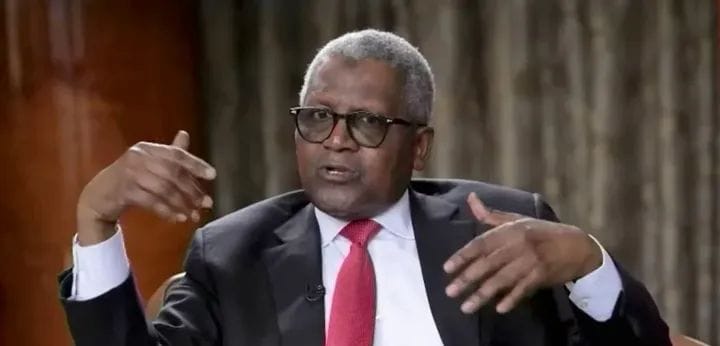
Aliko Dangote, President of the Dangote Group
Africa’s richest man, Aliko Dangote, says having a male child to sustain his family name and business empire is not his priority.
He noted that he has three daughters doing well.
Mr Dangote, 69, who is the president of Dangote Group and Dangote Refinery, made the statement during an interview on Arise TV, on Tuesday.
Asked if he was making efforts to have a son to sustain his legacy, Mr Dangote said, “That’s not really my priority. Let me say it blurntly. It is not really my priority. God controls everything. Sometimes you can pray to have a son but the son could be the one to drag the family name down.”
The Africa’s richest man further said he didn’t think a son would do better than the three girls he already has.
“Sometimes when God does give you a something don’t push it. I don’t think a son would have done better than the three girls I have,” he said.
Mr Dangote’s three daughters; Fatima, Halima and Mariya are holding key executive and leadership positions in the Dangote Group.
News
BREAKING: APC Governors Hold Closed-Door Meeting Over Wike’s ‘Rainbow Coalition’
By Yusuf Danjuma Yunusa
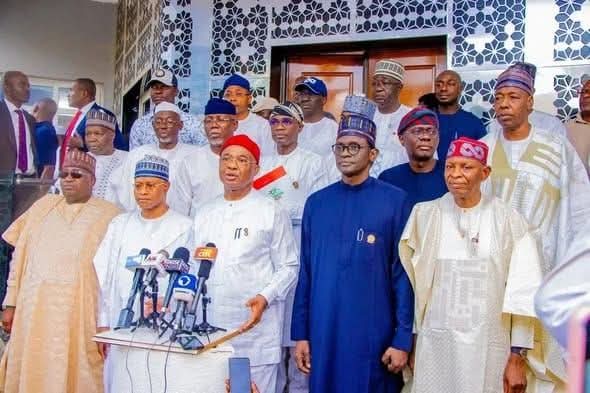
Governors elected on the platform of the All Progressives Congress (APC) are currently meeting behind closed doors at the Imo State Governors’ Lodge in Abuja, amid rising political tension over the “rainbow coalition” being promoted by the Minister of the Federal Capital Territory (FCT), Nyesom Wike.
The meeting, which began on Tuesday, is understood to be centred on recent political realignments that party leaders fear could undermine President Bola Ahmed Tinubu’s interests and weaken APC candidates at all levels.
It was gathered that the governors are expected to issue a statement distancing themselves from any political alliance or arrangement that could work against the President or the ruling party.
The move is widely seen as a direct response to Wike’s coalition, which has reportedly set some APC governors against the FCT minister. The governors are particularly aggrieved over allegations that Wike is sponsoring candidates who lost in the APC under the platform of the Peoples Democratic Party (PDP).
The APC governors are said to be determined to draw a clear line between legitimate political engagement and actions that could damage the party’s electoral fortunes.
As of the time of filing this report, the meeting was still ongoing, and no official communiqué had been issued. A statement is expected shortly.
More details later…
News
Oil Prices Rise After Saudi Pipeline Halt and Delayed Hormuz Talks

By Yusuf Danjuma Yunusa
Oil prices climbed on Monday after talks on the Strait of Hormuz were postponed and Saudi Arabia shut down a major oil pipeline.
Brent crude for November delivery gained nearly three per cent to $107.60 per barrel, approaching the $110 level.
The increase came after prices edged lower on Friday following sharp gains in the preceding days.
Oman announced on Sunday that planned talks between Iran and several Gulf States over the Strait of Hormuz had been postponed.
Omani foreign minister Badr al-Busaidi said the postponement aimed to create conditions for consensus.
Saudi Arabia, the world’s largest oil exporter, has come under pressure following disruptions to major shipping routes and attacks on its oil infrastructure.
The kingdom suspended operations on its East-West pipeline as a precaution after drone attacks in the Riyadh and Medina regions.
The pipeline carries oil from the Persian Gulf to the Red Sea and provides an alternative export route that avoids the Strait of Hormuz.
Analysts warned that any further reduction in Saudi oil exports could drive crude prices higher.
Brent crude has gained nearly 80 per cent since the start of the year, although it remains below its late-April peak of more than $126 per barrel.

Male Heir Not My Priority ; My Daughters Are Doing Well, Says Dangote

BREAKING: APC Governors Hold Closed-Door Meeting Over Wike’s ‘Rainbow Coalition’

Oil Prices Rise After Saudi Pipeline Halt and Delayed Hormuz Talks

Atiku Accuses Tinubu of ‘Economic Deception’ Over Subsidy Savings, Demands ‘Where Is the Money?’ as ASUU Threatens Fresh Strike

Al-Istiqama University to Hold Convocation, Honours Late Aminu Dantata, Sheikh Ibrahim Khalil

From World’s 9th Most Populous City to Perfect: As Gov Yusuf Revisits Kano Master Plan

95% of Governor Abba Kabir Yusuf’s Promises Have Been Fulfilled — CPS Interview By Musa Diso, In Kano

Bello Sharada: A Great Writer, A Bookish Soul, Gone Too Soon

Call Me Chairman, Not Tony!’: Elumelu’s Blunt Correction of Trainee Splits Internet as Old Video Sparks Double Standard Fury

NUT Launches ‘Go Public’ Campaign to Promote Public Education in Nigeria
Male Heir Not My Priority ; My Daughters Are Doing Well, Says Dangote
BREAKING: APC Governors Hold Closed-Door Meeting Over Wike’s ‘Rainbow Coalition’
Oil Prices Rise After Saudi Pipeline Halt and Delayed Hormuz Talks
Atiku Accuses Tinubu of ‘Economic Deception’ Over Subsidy Savings, Demands ‘Where Is the Money?’ as ASUU Threatens Fresh Strike
Al-Istiqama University to Hold Convocation, Honours Late Aminu Dantata, Sheikh Ibrahim Khalil
From World’s 9th Most Populous City to Perfect: As Gov Yusuf Revisits Kano Master Plan
95% of Governor Abba Kabir Yusuf’s Promises Have Been Fulfilled — CPS Interview By Musa Diso, In Kano
Bello Sharada: A Great Writer, A Bookish Soul, Gone Too Soon
Call Me Chairman, Not Tony!’: Elumelu’s Blunt Correction of Trainee Splits Internet as Old Video Sparks Double Standard Fury
NUT Launches ‘Go Public’ Campaign to Promote Public Education in Nigeria
-

 Opinion5 years ago
On The Kano Flyovers And Public Perception
-

 Features5 years ago
How I Became A Multimillionaire In Nigeria – Hadiza Gabon
-

 Opinion6 years ago
Kano As future Headquarters Of Poverty In Nigeria
-

 History5 years ago
Sheikh Adam Abdullahi Al-Ilory (1917-1992):Nigeria’s Islamic Scholar Who Wrote Over 100 Books And Journals
-

 Opinion5 years ago
My First Encounter with Nasiru Gawuna, the Humble Deputy Governor
-

 History5 years ago
The History Of Borno State Governor Professor Babagana Umara Zulum
-

 History5 years ago
The Origin Of “Mammy Market” In Army Barracks (Mammy Ochefu)
-

 News4 years ago
Federal University Of Technology Babura To Commence Academic Activities September