
News
Arewa Radio Sets Record For Highest Blood Donation Drive
On Saturday, June 25th, 2023 a top indigenous media organization, Arewa Radio set a record for the biggest Blood Donation Drive in Kano State to support sickle cell patients across the state and beyond, which was in commemoration of the World Sickle Cell Awareness Day 2023 as well as the World Blood Donor Donor Day 2023.
The Blood Donor Clinic of the Aminu Kano Teaching Hospital was filled to the brim from morning through evening as residents from within and outside the state came through to support those in dire need of blood, especially the Sickle Cell warriors.
At the end of the one day drive, close to 500 pints of blood were donated for this noble cause, the highest ever recorded in the history of blood donation drives in Kano, despite the high burden of the disorder in the state.
The Blood Donation Drive generated interests from as far as Katsina and even Niger Republic. A Bakori based farmer in Katsina State said he had to suspend everything to come down to Kano specifically for the cause, following the awareness campaigns that flooded Arewa Radio for the whole week.
Nigeria is said to have the highest burden of Sickle Cell Disorder in the continent and by extension, the whole world. With an annual infant death of about 150,000 representing more than eight percent (8%) of infant mortality in the country, Nigeria is regarded as the top sickle cell endemic country in Africa.
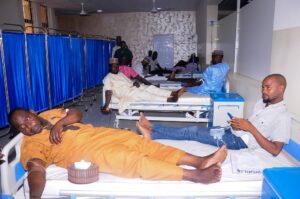
The blood donation drive
About 50 million people are living with sickle cell disease globally and Nigeria has about 4-6 million people living with the disease and annually about 300,000 newly diagnosed sickle cell children are born worldwide.
In addition, at least 100,000 babies die from the disorder in Nigeria every year according to 2014 statistics by the World Health Organisation (WHO), making it the number one sickle-cell endemic country in Africa.
Blood transfusion is one of the most important routines of managing sickle cell patients, especially during crisis. However, the acute shortage of blood in health facilities across the country has been posing a lot of threats to those living with the disorder and Kano State is not an exception.
Myths and lack of awareness have been attributed to the inadequacy of voluntary blood donors, the most reliable way to address the shortage of blood in our hospitals.
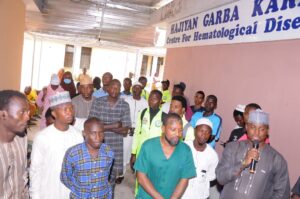
Part of the donation drive
These facts were the highlights of what motivated the Kano based radio station to explore mechanisms of solution journalism to promote engagement of stakeholders in this regard by first initiating a weeklong sensitization campaign against sickle cell and the importance of blood donation, not only to the receiver but the donor as well.
The campaign in collaboration with top civil society organizations like the Sickle Cell Trust Fund, the Sickle Cell Community, Sickle Cell Club, the Aminu Kano Teaching Hospital, Danmaliki Pharmaceuticals and Gen. Ent. Ltd, Red Cross, Novomed Pharmacy, REACH PROGRAM and other philanthropists, held several live discussion shows, featuring medical experts, patients suffering from the disorder and their care givers.
In separate interviews, presidents of the Sickle Cell Community and that of the Sickle Cell Club in Kano, Rukayyah Kamal Ibrahim and Aminu Sabitu respectively, expressed gratitude over the massive turnout, describing it as the biggest ever recorded from the inception of their associations till date.
Speaking shortly after the program, Binta Abdullahi Fulani, a broadcaster who doubles as the Corporate Liaison Officer for Arewa Radio explains that the success of the event had buttressed the point that as a powerful tool, the radio had gone beyond the conventional broadcasting and should be able to touch lives in a more direct approach, calling on other media organizations to follow suit.
“With the help and support of our partners, we were able to set a new record of close to 500 pints of blood donation for our sickle cell warriors, and this is just the beginning as we are open to more collaboration to sustain this milestone”.
She added that, “one of the biggest challenges of blood donation asides the poor level of awareness is the high cost of blood bags, as the country relies on imports from foreign countries”.
Mrs. Fulani, who spoke on behalf of the management of Arewa Radio and the other partners, gave a breakdown of the sharing formula for the donated blood, where 110 pints of blood will be allocated to the Aminu Kano Teaching Hospital, while Mohammadu Wase Teaching Hospital (Nasarawa), Murtala Specialist Hospital and Hasiya Bayero Pediatric Hospital were allotted 100 pints of the donated blood each and Dala Orthopedic Hospital will receive 25 pints.
According to the media organization, the donation is set to begin on Monday June, 26th 2023, adding that the receiving hospitals will be expected to conduct the screenings and testes as well as provide the results, which will later be distributed to the donors in due course.









News
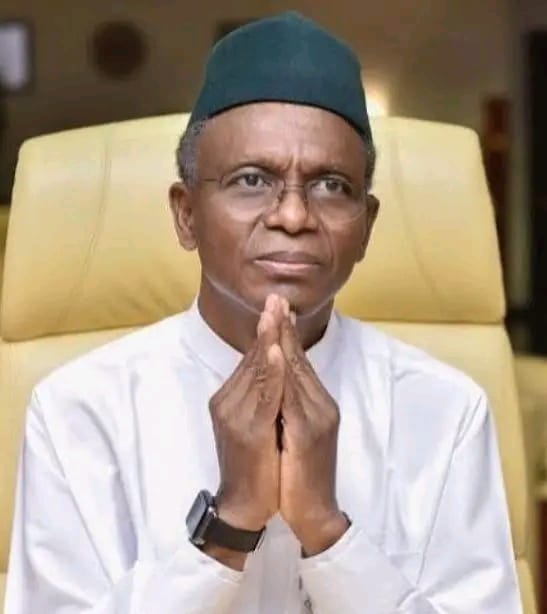
JUST IN: El-Rufai Detained as Bail Ruling Adjourned to April 14
By Yusuf Danjuma Yunusa
Operatives of the Department of State Services on Wednesday took former Kaduna State governor, Nasir El-Rufai, into custody moments after proceedings at the Federal High Court in Kaduna.
El-Rufai, standing trial over alleged corruption, had just concluded a hearing on his bail application filed by the Independent Corrupt Practices and Other Related Offences Commission when DSS operatives bundled him into a waiting vehicle and drove him away, reportedly heading to Abuja.
A heavy DSS presence around the court before the hearing had fuelled speculation that the former governor might be taken into custody.
Security sources said vehicles had been strategically positioned around the court prior to proceedings.
El-Rufai had arrived at the court at about 9:05 a.m. in a Hilux van, drawing attention from security personnel and observers.
Speaking to journalists after the proceedings, lead defence counsel, Oluwole Iyamu (SAN), confirmed that the court had fixed April 14 for ruling on the bail application.
“The bail application was argued and responded to, and the ruling has been fixed for April 14.
“We look forward to that day. We are hopeful. We have put our arguments before the court, and this is a court of justice.
“We await the decision of the court,” he added.
He also noted that the defence team is prepared for a related case scheduled for April 10 at the Federal High Court in Abuja, describing it as “a separate matter.”
“That is a separate matter. As lawyers, we are ready. We have filed all necessary processes and will be in court. That is the DSS matter,” he said.
News
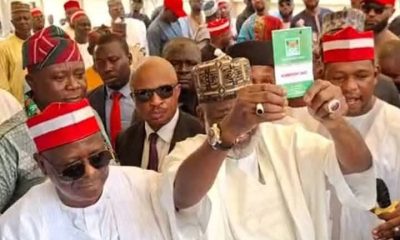
Court Ends NNPP Crisis, Restores Party Leadership to Founder
The Court of Appeal sitting in Owerri has delivered a decisive judgement in the protracted leadership crisis within the New Nigeria People’s Party (NNPP), affirming Boniface Okechukwu Aniebonam as the recognised leader of the party.
In its ruling, the appellate court set aside an earlier decision of the Abia State High Court in Uzuakoli, which had vacated its previous judgement delivered in favour of the faction led by Aniebonam.
The appellate court held that the lower court erred in granting a motion that effectively reversed its own earlier judgement, thereby upholding all three grounds of appeal filed by the Aniebonam-led faction.
The dispute stems from a November 2024 judgement of the Uzuakoli High Court in Suit No. HUZ/11/2024, which had recognised the Board of Trustees of the NNPP under Aniebonam. However, in June 2025, the same court granted an application that set aside that ruling, following a motion filed by Rabi’u Musa Kwankwaso.
Dissatisfied with the reversal, the Aniebonam faction approached the Court of Appeal in Owerri (Appeal No. CA/OW/271/2025), arguing that the trial judge lacked the jurisdiction to sit on appeal over his own judgement.
Delivering its verdict, the Court of Appeal agreed with the appellants, restoring the earlier judgement and effectively recognising Aniebonam as the legitimate leader of the party he founded in 2001.
Legal representation in the matter saw Onitsha-based senior counsel, Sir Azubike Anazor, appear for Aniebonam, while Abuja-based Eyitayo Fatogun, SAN, represented Kwankwaso.
The NNPP, which fielded Kwankwaso as its presidential candidate in the 2023 general elections, has been embroiled in internal disputes over its leadership structure, with rival factions laying claim to control of the party.
News
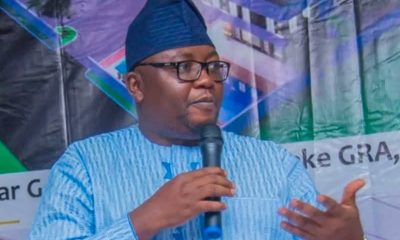
JUST IN: Adelabu Resigns as Power Minister to Pursue Oyo Governorship Bid
By Yusuf Danjuma Yunusa
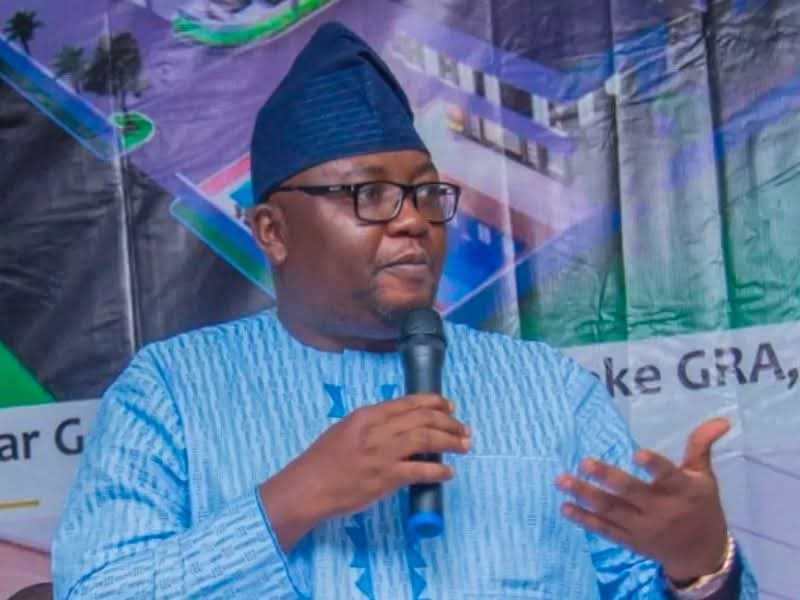
The Minister of Power, Adebayo Adelabu, has resigned his appointment to focus on his governorship ambition in Oyo State.
Adelabu disclosed this in a resignation letter addressed to the President Bola Ahmed Tinubu on Tuesday, and routed through the Secretary to the Government of the Federation.
In the letter titled “Resignation as Honourable Minister of Power”, Adelabu expressed gratitude to the President for the opportunity to serve in his administration.
He said it was a privilege to contribute to efforts aimed at strengthening Nigeria’s power sector in line with the administration’s Renewed Hope Agenda.
Adelabu added that his decision to step down was to enable him fully pursue his aspiration to contest for the office of Governor of Oyo State.
He noted that the move would allow him to dedicate his time and resources to the political ambition.
The former minister also conveyed his appreciation and respect to the President for the confidence reposed in him during his tenure.

JUST IN: El-Rufai Detained as Bail Ruling Adjourned to April 14

Court Ends NNPP Crisis, Restores Party Leadership to Founder

Why Nura Manu Soro should be APC candidate in Bauchi State come 2027

JUST IN: Adelabu Resigns as Power Minister to Pursue Oyo Governorship Bid

After Kwankwaso Joins ADC, Party Alleges Plot by APC, Senior Lawyers to Force INEC Into Illegal Takeover

The Governor Who Chose His People Over His Politics: Abba Yusuf and the Moral Courage Behind Kano First

Governor Abba Kabir Yusuf Holds Exclusive Prerogative to Choose Deputy – Malam Inuwa Waya
Restoring the Glory That Was Always There: Governor Abba Kabir Yusuf and the Historical Vision Behind Kano First

Tinubu to Swear in Olatunji Disu as Inspector-General of Police on Wednesday

NDLEA Clarifies: Drug Case Against Abba Kyari Still Active After Court Discharge
JUST IN: El-Rufai Detained as Bail Ruling Adjourned to April 14
Court Ends NNPP Crisis, Restores Party Leadership to Founder
Why Nura Manu Soro should be APC candidate in Bauchi State come 2027
JUST IN: Adelabu Resigns as Power Minister to Pursue Oyo Governorship Bid
After Kwankwaso Joins ADC, Party Alleges Plot by APC, Senior Lawyers to Force INEC Into Illegal Takeover
The Governor Who Chose His People Over His Politics: Abba Yusuf and the Moral Courage Behind Kano First
Governor Abba Kabir Yusuf Holds Exclusive Prerogative to Choose Deputy – Malam Inuwa Waya
Restoring the Glory That Was Always There: Governor Abba Kabir Yusuf and the Historical Vision Behind Kano First
Tinubu to Swear in Olatunji Disu as Inspector-General of Police on Wednesday
NDLEA Clarifies: Drug Case Against Abba Kyari Still Active After Court Discharge
-

 Opinion4 years ago
On The Kano Flyovers And Public Perception
-

 Features5 years ago
How I Became A Multimillionaire In Nigeria – Hadiza Gabon
-

 Opinion5 years ago
Kano As future Headquarters Of Poverty In Nigeria
-

 History5 years ago
Sheikh Adam Abdullahi Al-Ilory (1917-1992):Nigeria’s Islamic Scholar Who Wrote Over 100 Books And Journals
-

 Opinion4 years ago
My First Encounter with Nasiru Gawuna, the Humble Deputy Governor
-

 History5 years ago
The Origin Of “Mammy Market” In Army Barracks (Mammy Ochefu)
-

 History4 years ago
The History Of Borno State Governor Professor Babagana Umara Zulum
-

 News4 years ago
Federal University Of Technology Babura To Commence Academic Activities September