
News
Muslims Are Brothers And One Body!
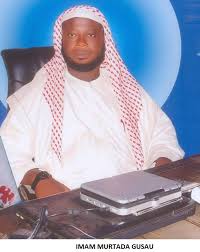
By Imam Murtadha Gusau
Friday, Jumada Al-Ula 15, 1444 AH (December 09, 2022)
In the name Of Allah, Most merciful, Most compassionate
All praise is due to Allah, the Lord of all creation—may He extol the Messenger in the highest company of Angels and send His peace and blessings upon him—likewise upon his family, Companions, and true followers.
Dear Brothers and Sisters! This week’s (Friday) piece will In Shaa Allah be on the brotherhood in Islam.
Respected servants of Allah! Wallahi, Islam has taken every necessary measure to preserve humanity from division and discord. One of these measures is the principle of brotherhood. This principle wipes away all the differences that exist between people, like lineage, wealth, and all other qualities that people use to distinguish themselves above one another.
This is brotherhood of the closest kind.
The meaning of brotherhood as I intend it is a brotherhood based on faith and respect. It is a brotherhood that exists between a large number of people who share the same beliefs and religious identity. Allah Almighty says:
“And He has brought their hearts together. If you had spent all that was in the Earth, you would not have brought their hearts together.”
And Allah Almighty describes the believers as being brothers. He says:
“The believers are but brothers.”
The reason for their being described in this way is that they: all share the same beliefs, work towards the same goals and share the same code of behaviour.
Brotherhood can be based on belief and religious identity. This is the meaning intended when speaking about faith and other related topics. Allah the Most High says:
“The Believers are but a single Brotherhood.” [Qur’an, 49:10]
And He says:
“…so you, by His grace, became brothers.”
This verse means that they became brothers by virtue of their Islam and loved one another and were united through the greatness of Allah, so they cooperated in acts of righteousness and piety. Allah’s Messenger (Peace be upon him) said:
“A Muslim is the brother of another Muslim, so he should not oppress him, forsake him or despise him.”
Dear Brothers and Sisters! Please let’s think for a moment: Why did Islam establish brotherhood on the basis of faith and not on the basis of relationship or race?
The reason why Islam did not build its concept of brotherhood on blood relationship or race is because these two things have their basis in material considerations. Consequently, they cannot bring about a strong and united community that can resist the disagreements and conflicts that might tear it apart. This is especially true if the differences are ideological in nature or are based on beliefs and methodology. It has repeatedly been seen that blood brothers can be brought to kill one another when their beliefs or interests differ (eg: Kabilah (Cain) and Habilah (Abel)). In contrast, people who share the same faith or belief system can work together even though they come from different countries, speak different languages, or have different racial backgrounds.
The concept of the Ummah (Nation), that all Muslims are linked in one community of faith and belief, is an integral part of Islam. The Islamic Brotherhood is not based on economic interests, race, or colour. It is based on something infinitely superior: rejection of falsehood and acceptance of the Truth as revealed by the One True Allah (God). Not only is this Brotherhood based on faith, it is also a part of that faith. The Prophet (Peace be upon him) said:
“You cannot enter paradise unless you become a total believer and you won’t become a total believer unless you love each other. Shall I tell you what would increase your love? Spread the salam (peace), between yourselves.”
In one of his Hadiths, our beloved Prophet (Peace be upon him) says:
“They do not do injustice to others nor do they tolerate any injustice to themselves. In their love and concern for each other, all members of this Brotherhood are one body: when any part of the body suffers, the whole body feels the pain. When one of its organs fails, the rest of the body responds and watches over it by contracting fever.” [Muslim]
It is related by Abu Musa Ash’ari (RA) that The Messenger of Allah (Peace be upon him) said:
“The connection between Muslims is like that of a strong building – one part strengthens another.” The Prophet then showed this by interlocking the fingers of one hand with those of the other (that Muslims should remain united – thereby strengthening one another). “It is sufficient evil for a Muslim that he should look down upon his brother. The life, wealth, and honour of a Muslim are inviolable by another Muslim.” [Muslim]
And in another Hadith:
“Two brothers are likened to a pair of hands, one of which washes the other.”
Hudhaifah (RA) relates that:
“The Battle of Yarmuk had just ended. I was walking over the battlefield among the martyred and injured with a pitcher of water. I was looking for the son of my uncle. I found him lying in blood on the burning sand. He was about to die. I asked him whether he wanted water. Unable to speak, he gestured that he did. I was just offering it to him when a groaning was heard: ‘Water! Water! Please, a drop of water!’ My uncle’s son, whose name was Harith, heard that and gestured that I should take the water to him. I hastened to the groaning one, who was Ikrimah. Ikrimah had not yet taken the pitcher when a similar groaning was heard. Refusing to take the water, Ikrimah wanted me to take it to the one groaning. When I got to that one, who was Iyash, he was supplicating: “O Allah! We have never refrained from sacrificing our lives for the sake of faith. Honour us with the rank of martyrdom (Shahadah), and forgive our sins!” Iyash saw the water but did not live long enough to drink it. I immediately returned to take the water to Ikrimah. However, I found Ikrimah also martyred (died). Then I hastened to Harith, my uncle’s son. Unfortunately, he too was lying dead on the burning sand. This is the most touching event I have witnessed in my life. It was their unshakable belief in Islam, which caused them to behave that way. It was Islam which created such degree of brotherhood among people.”
Anas (RA) reports that Messenger of Allah (Peace be upon him) once said:
“I swear by the Allah Almighty in whose power my life is, any one of you cannot be a true believer unless he desires for his fellow-brother what he desires for himself.”
Allah, The Almighty, says:
“And hold fast, all of you together to the Rope of Allah and be not divided among yourselves and remember Allah’s favour on you, for you were enemies one to another, but He joined your hearts together so that by His Grace you became brethren.” [Qur’an 3:103]
On another occasion the Prophet (Peace be upon him) said:
“The believer is friendly and easy to befriend. And there is no good in the person who does not befriend and does not get befriended.” (Ahmad)
Dear brothers and sisters! Another dimension of this brotherhood relies upon the idea of loving one another just for the sake of Allah. This idea can be exemplified by the words of our beloved Prophet (Peace be upon him).
The Messenger of Allah (Peace be upon him) says:
“On the Day of Judgment, seats will be placed around the Throne (Al’arsh) [of Allah] for a group of people whose faces resemble the full moon. These people shall not experience any fear or terror although all others will. They are the friends of Allah (Auliyah) upon whom there shall be no fear and who shall not be sad. It was asked, ‘Who are those people, O Messenger of Allah?’ The Messenger (Peace be upon him) replied, ‘They are the ones who love one another for the sake of Allah, The Exalted.’”
Prophet Muhammad (Peace be upon him) once said:
“A man set out to visit one of his brothers for the sake of Allah and Allah Almighty appointed an angel to watch over him. The angel asked the man, ‘Where are you going?’ The man replied: ‘I wish to visit my brother.’ ‘Do you need anything from him?’ asked the angel. ‘No,’ replied the man. ‘Then why are you going to visit him?’ inquired the angel. The man answered, ‘I love him for Allah’s Sake.’ The angel said, ‘Then know that Allah has sent me to tell you that Allah loves you because of your love for your brother and that He has decreed Paradise for you.’” [Muslim]
Prophet Muhammad (Peace be upon him) also said in a Hadith Qudsi:
“Allah, the Exalted, says ‘Indeed, My Love shall be bestowed upon the ones who visit each other for My Sake. Indeed, My Love shall be bestowed upon the ones who love one another for My Sake. Indeed, My Love shall be bestowed upon the ones who approach one another in humility for My Sake. And, indeed, My Love shall be bestowed upon the ones that rush to help one another for My Sake.” [Ahmad]
Please, I beg all my Muslim brothers and sisters to forgive me, as In Shaa Allah myself, I forgive everyone who offended me.
I conclude with this and send prayers of blessings and peace upon our Prophet as our Lord commanded:
“Indeed, Allah confers blessing upon the Prophet, and His angels [ask Him to do so]. O you who have believed, ask [Allah to confer] blessing upon him and ask [Allah to grant him] peace.” [Qur’an, 33:56]
O Allah, guide us with those whom You have guided, grant us well-being among those You have granted well-being, be an ally to us along with those whom You are an ally to, and bless what You have bestowed upon us, and save us from the evil of what You have decreed. For verily You decree and none can decree over You. He whom You support can never be humiliated. Glory is to You, our Lord, You are Blessed and Exalted.
O Allah, we ask You for all that is good, in this world and in the Hereafter, what we know and what we do not know.
O Allah, we seek refuge with You from all evil, in this world and in the Hereafter, what we know and what we do not know.
O Allah, we ask You for the good that Your servant and Prophet has asked You for, and we seek refuge with You from the evil from which Your servant and Prophet sought refuge.
O Allah, we ask You for Paradise and for that which brings one closer to it, in word and deed, and we seek refuge in You from Hell and from that which brings one closer to it, in word and deed. And we ask You to make every decree that You decree concerning us good.
Respected servants of Allah! Indeed, Allah orders justice and good conduct and giving to relatives and forbids immorality and bad conduct and oppression. He admonishes you that perhaps you will be reminded.
Remember Allah, the Great – He will remember you. Thank Him for His favours – He will increase you therein. And seek forgiveness from Him – He will forgive you. And be conscious of Him – He will provide you a way out of difficult matters.
All praise is due to Allah, the Lord of all creation; may Allah extol the mention of our noble Prophet Muhammad in the highest company of Angels, bless him and give him peace and security―and his family, his Companions and all those who follow him correctly and sincerely until the establishment of the Hour.
Murtadha Muhammad Gusau is the Chief Imam of Nagazi-Uvete Jumu’ah and the late Alhaji Abdur-Rahman Okene’s Mosques, Okene, Kogi State, Nigeria. He can be reached via: gusauimam@gmail.com or +2348038289761.
This Friday piece was prepared and sent to you from here on my admission bed in National Hospital Abuja, Nigeria. Please your kind Du’a and prayers are needed, and if Allah Almighty take my life, ask Allah please, to forgive my sins, my shortcomings and my failings, and grant me Jannatul-Firdaus.
Thanks, Wa Jazakumullah Khairan.








News
Emir Sanusi Seeks Compensation, Reallocation of Demolished Eid Ground Stalls
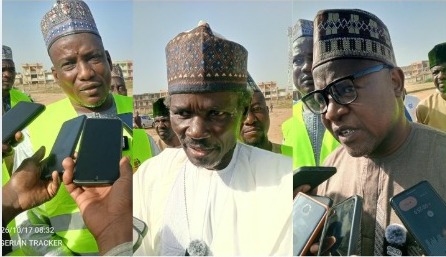
The Emir of Kano, Muhammadu Sanusi II, has appealed to the Kano State Government to compensate traders affected by the demolition of shops at the Filin Idi market in Kofar Mata, Kano, and reallocate stalls to enable them to resume their businesses.
Professor Ibrahim Muazzam Mai Bushira disclosed this during a special prayer session organised by traders affected by the demolition at the Eid Ground in Kofar Mata, where participants prayed for divine intervention and government assistance to alleviate their hardship.
According to Mai Bushira, the Emir has written to Governor Abba Kabir Yusuf, requesting compensation for the affected traders and appealing for measures to address the economic losses they have suffered following the demolition.
He expressed hope that Almighty Allah would reward the Emir for his intervention and urged Governor Yusuf to consider the demands of the traders to enable them to rebuild their businesses and restore their livelihoods.
Mai Bushira said the demolition had caused severe hardship among traders, many of whom depended on their shops as their primary sources of income. He added that some affected individuals had reportedly died, while others had developed high blood pressure following the destruction of their businesses and the resulting economic difficulties.
He explained that the prayer session was organised to seek Allah’s intervention in their predicament and pray for the restoration of their livelihoods, noting that the destruction of the shops had adversely affected the lives of many families who depended on the market for survival.
Speaking at the gathering, Professor Ahmad Muhammad of the Federal University, Dutse (FUD), described Kano as a major commercial centre and called on the Kano State Government to pay attention to the plight of the affected traders and the economic implications of the demolition.
Professor Muhammad also appealed to international entrepreneurs and investors to explore opportunities to support the development of the market, stressing that the destruction of the shops had resulted in substantial financial losses running into billions of naira.
He urged the government to consider establishing a modern market at the location, arguing that the Filin Idi market was not merely a trading centre for Kano but also an important commercial destination for traders from different parts of Nigeria and across Africa.
According to him, the market provides livelihoods for more than one million people, directly and indirectly, making its reconstruction and rehabilitation important to the economic well-being of Kano and its trading community.
The professor further stressed the need for a sustainable solution that would enable displaced traders to return to business, restore commercial activities and protect the economic interests of the large population that depended on the market.
In his remarks, the Chairman of the affected traders’ association, Auwal Said Umar, expressed appreciation to Almighty Allah and Emir Sanusi II for their support and intervention in the traders’ situation.
Umar said many of the affected traders were currently unable to engage in their usual commercial activities because their shops had been demolished, leaving them without the means to sustain their businesses and families.
He disclosed that the market previously had about 700 blocks of shops before the demolition, adding that many traders lacked the financial capacity to reconstruct their businesses without assistance from the government.
The association chairman said the government had allocated 75 stalls for reconstruction but appealed for an increase in the number to accommodate more affected traders and enable them to return to their businesses.
Umar called on the Kano State Government to provide additional support, stressing that the existing allocation was insufficient to address the needs of the large number of traders who lost their shops during the demolition.
The traders urged the government to work with their association and other relevant stakeholders to develop a lasting solution that would provide adequate trading spaces, restore commercial activities and ease the economic hardship caused by the demolition.
News
Gombe flags off the disbursement of the second batch of the AGILE Conditional Cash Transfer
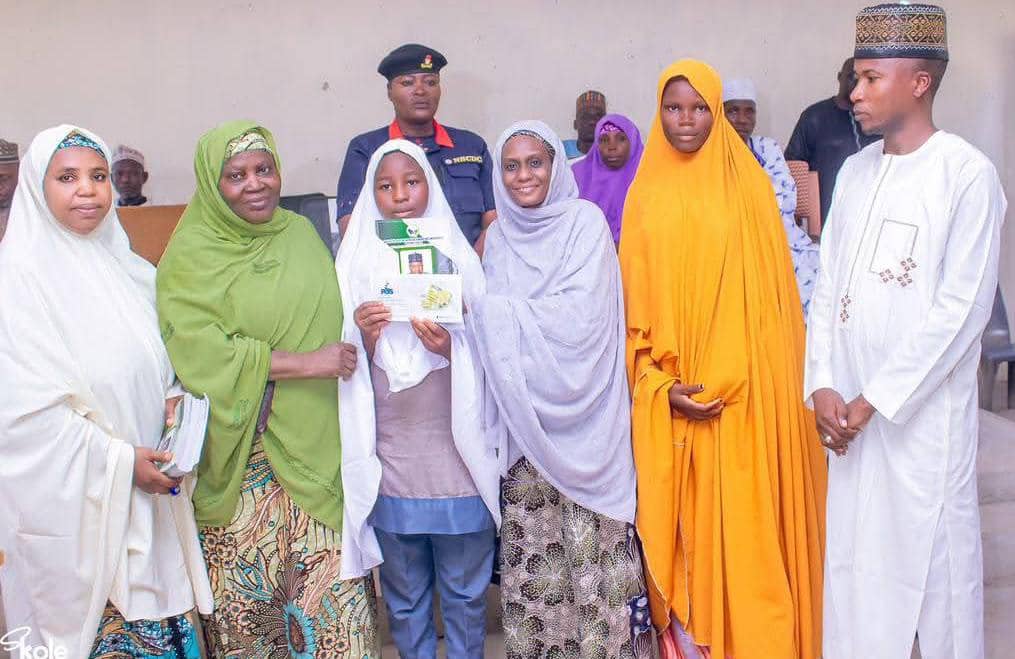
Gombe State Government has flagged-off the distribution of ATM cards to Adolescent Girls in public schools under the Conditional Cash Transfer,CCT of the Adolescent Girls Initiative for Learning and Empowerment, AGILE Project.
Speaking at the flagging off of the disbursement at Government Junior Secondary School Malamsidi central in Kwami Local Government area, the Honourable Commissioner of Education, Associate Prof Aishatu Umar Maigari said the disbursement of the CCT is part of the Governor Muhammadu Inuwa Yahaya’s zeal and passion for the girl child education in the state.
She said the concept is also geared towards supporting parents to cater for their children to remain in schools up to completion of their secondary education.
Associate Prof Aishatu Umar Maigari then assured the students that the government will continue to bring more educational policies that will further support students to pursue education with ease.
Earlier, the project coordinator of the AGILE, Dr. Amina Abdul noted that with the disbursement of the second cohort of the conditional cash transfer, the project was able to record significant improvement in enrollment and retention of students in schools across the state.
The project coordinator therefore urged parents to utilize the funds judiciously through supporting the education of their children.
News
China, Nigeria Mark Friendship with Joint Cultural Mural
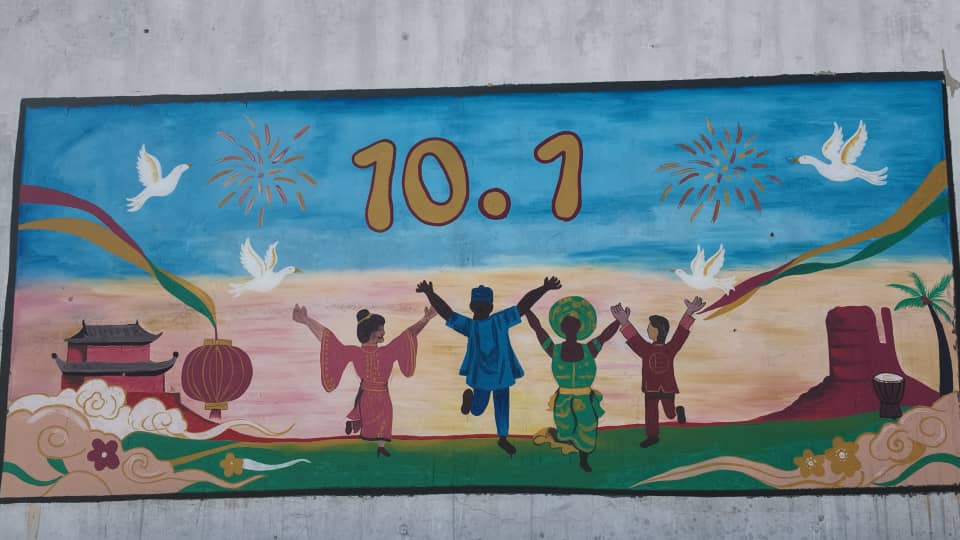
A colourful mural celebrating both China’s National Day and Nigeria’s Independence Day has been unveiled at an overseas project site, serving as a vivid symbol of the enduring friendship between the two nations.
The artwork, jointly produced by Chinese and Nigerian staff, features builders dressed in traditional Chinese costumes and Nigerian ethnic attire holding hands and dancing together.
Above them, fireworks and white doves of peace illuminate the sky, while the inscription “10.1” highlights the dual significance of October 1, the China’s National Day and Nigeria’s Independence Day.
On the left side of the mural, ancient Chinese architecture, red lanterns and auspicious cloud motifs showcase Chinese heritage.
On the right, red earth, coconut palms and African drums reflect Nigeria’s cultural identity. Flowing ribbons weave across the painting, symbolising unity and shared destiny.
Project officials described the mural as a “living testament” to cooperation at the frontline of development. They said it embodies mutual trust and support as workers from both countries overcome challenges together.
The initiative underscores cultural integration and partnership, with both sides pledging to continue working hand in hand to strengthen ties.
“Celebrating two festivals as one, we march forward with one heart,” a statement read, emphasising the commitment to write new chapters of friendship along the path of cooperation.
The mural, rooted in the overseas project site, stands as a reminder of the brotherly bond between China and Nigeria, and the shared vision of building together for a brighter future.

Emir Sanusi Seeks Compensation, Reallocation of Demolished Eid Ground Stalls

Gombe flags off the disbursement of the second batch of the AGILE Conditional Cash Transfer

Why Gov Abba Deserves Another Tenure

China, Nigeria Mark Friendship with Joint Cultural Mural

Musa Illiyasu Kwankwaso Celebrates Senator Lado @60, Says Is A Political Dogma

Zamfara Varsity ASUU Threatens Warning Strike Over FG-ASUU Agreement, Promotion Arrears

PCACC Arrests Man Over Alleged ₦4.5m Sale, Illegal Leasing of Kano Government Horse Stable

Goje’s Electoral War:The Confrontation With Tinubu,Governor Inuwa,Usman Kumo And APC candidates Ahead Of 2027

Prof Yusuf Adamu Delivers BUK’s 63rd Professorial Inaugural Lecture, Reflects on Medical Geography and Academic Legacy

Kano Monitors ₦48.9bn Projects Across Six LGAs
Emir Sanusi Seeks Compensation, Reallocation of Demolished Eid Ground Stalls
Gombe flags off the disbursement of the second batch of the AGILE Conditional Cash Transfer
Why Gov Abba Deserves Another Tenure
China, Nigeria Mark Friendship with Joint Cultural Mural
Musa Illiyasu Kwankwaso Celebrates Senator Lado @60, Says Is A Political Dogma
Zamfara Varsity ASUU Threatens Warning Strike Over FG-ASUU Agreement, Promotion Arrears
PCACC Arrests Man Over Alleged ₦4.5m Sale, Illegal Leasing of Kano Government Horse Stable
Goje’s Electoral War:The Confrontation With Tinubu,Governor Inuwa,Usman Kumo And APC candidates Ahead Of 2027
Prof Yusuf Adamu Delivers BUK’s 63rd Professorial Inaugural Lecture, Reflects on Medical Geography and Academic Legacy
Kano Monitors ₦48.9bn Projects Across Six LGAs
-

 Opinion5 years ago
On The Kano Flyovers And Public Perception
-

 Features5 years ago
How I Became A Multimillionaire In Nigeria – Hadiza Gabon
-

 Opinion6 years ago
Kano As future Headquarters Of Poverty In Nigeria
-

 History6 years ago
Sheikh Adam Abdullahi Al-Ilory (1917-1992):Nigeria’s Islamic Scholar Who Wrote Over 100 Books And Journals
-

 Opinion5 years ago
My First Encounter with Nasiru Gawuna, the Humble Deputy Governor
-

 History5 years ago
The History Of Borno State Governor Professor Babagana Umara Zulum
-

 History6 years ago
The Origin Of “Mammy Market” In Army Barracks (Mammy Ochefu)
-

 News5 years ago
Federal University Of Technology Babura To Commence Academic Activities September