
News
The Bigot In Kperogi’s Mirror
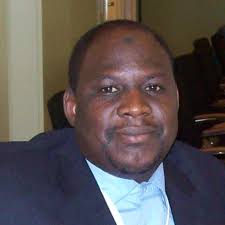
Aliyu Salisu Barau
@farooqkperogi is among the too few Nigerians who elegantly sandwiched scholarship, media, and English language expertise. On the contrary, I am neither a linguistic expert nor a political analyst. Here, I am just trying to figure out the naughtiness of @farooqkperogi’s thinking machinery. How @farooqkperogi thinks substantially determines his writings and opinions. No doubt, Kperogi’s articles are a cynosure of eyes of many Nigerians across political, cultural and social divides. Some of his Nigerian readers pluck his linguistically well-crafted and yet asymmetric views and dye them in the colours of their sentiments or ignorance. It is normal to manipulate any text on this planet. Interestingly, it is not unusual for bohemians and intellectuals to dress and feast on controversies. I see @farooqkperogi as a sort of a roller coaster dripping joyful and sorrowful moments on public sentiments and obsessions. Indeed, considering Nigeria’s contested socio-political landscapes, @farooqkperogi personifies Hankaka (a pied crow in Hausa) which they say, who sees its black must see its white too.
I am indifferent with @farooqkperogi’s criticisms of the powers that be. I don’t care about his tirades and vituperations directed at the political class who sold their moral rights at the market of failures and misgovernance. So, what’s my headache with @farooqkperogi? Well, I am deeply touched by his overriding superficiality, unidirectional views, bigotry, extremism and spider mannerisms. To be fair to Kperogi, no elites of the social and political divides of this country are immune from his pen. Nevertheless, his seamless and borderless forays are in many instances unconscionable and peddling post-truth constructs. My labelling of @farooqkperogi is based on my readings and analysis of his recent blog stuffs:
• Presidents Who’ll Make Me Renounce Nigeria (https://www.farooqkperogi.com/2022/03/presidents-wholl-make-me-renounce.html)
• Osinbajo’s RCCGification Part of Plot for Theocratic State Capture (https://www.farooqkperogi.com/2022/04/osinbajos-rccgification-part-of-plot.html)
• 10 Reasons Osinbajo Will Ignite a Religious Civil War (https://www.farooqkperogi.com/2022/03/10-reasons-osinbajo-will-ignite.html)
As a transdisciplinary environmental researcher, I always prefer wider views, co-produced, and inclusive opinions. I am diametrically opposed to ‘single story’ constructions – as Chimamanda Ngozi Adichie would say. My readings of the above articles has convinced me of Kperogi’s single story driven narrowed conclusions on crucial and critical national issues. Before I explain my points, I have tried further analysis on Kperogi’s knowledge production mannerisms to see how that fits my labelling of him. For instance, I conducted a rapid assessment of his authorship of academic works on leading research archives namely Researchgate and Google Scholar. Both repositories reveal in him a professor with a very limited network and co-authorship. By implication, any scholar with limited networking and co-authorship will have little room for alternative view, tolerance, and thorough analysis. This evidence convinces me as to why @farooqkperogi writes less holistically and cares less to get into deep layers of issues. Kperogi is a good reflection of Dubarudu- a character in one of the Hausa riddles. Dubarudu owns a mirror in a town where no one owns any. He alone uses it and no one can use it including his wife. Nigeria is a mirror that we need to share to see our faces and appreciate our different outlooks.
ASUU Strike And Posterity-Ameer Abdul Aziz
My reading of the three blog articles by @farooqkperogi leads me to carry further analysis on how this versatile writer thinks. Scholars make use of Low-Order Thinking Skills (LOTS) and Higher-Order Thinking Skills to determine thinking capacity of scholars and students. I always assume that Nobel Prize winners and other high ranking scholars utilise HOTS. Without prejudice, blog articles produced by @farooqkperogi appear to belong to low-order thinking skills. Then, how is @farooqkperogi a low thinker at least in the three articles under consideration? The answer is discernible to all his readers that care. He uses interrogatives such as ‘when’, ‘where’, ‘which’, ‘how many’ and ‘who’ inn driving his opinions in the tree articles. We could see mentions of places, names of persons, number of persons, places, when and where in his labelling of religious bigotry by VP Osinbajo. Healthy and informed minds would care only about the HOTS interrogatives such as ‘why’, ‘how’; ‘what evidence is there?’, ‘cause and consequences’ etc. Unfortunately, less informed and sentimental Nigerian readers can easily be misled by the lots of LOTS amplified by @farooqkperogi.
At this point I am bringing out my real problems with this language scholar. I really find it very nauseating and irritating when @farooqkperogi declared in his blog of March 28, 2022 that he would renounce his citizenship of Nigeria if any of the four individuals he listed in the blog would become Nigeria’s next president. The four Nigerians he condemned are Osinbajo, Tinubu, Bello and Wike. How on earth? What depth of hatred is this? What if God has decided one of them to be? To me this is an exotic bigotry, branded intolerance and egregious extremism. Where is his knowledge of the language of contestations, resistance and resilience that characterize works of Edward Said, Frantz Fanon, Michel Foucault, and Karl Marx? Maybe, I should remind him of the struggles of the Irish activists captured in Feargal Mac Ionnrachtaigh’s Language, Resistance and Revival. Such a Kperogian declaration amounts to cowardice, hopelessness, and disillusionment. How can I give up my citizenship on account of a tenured president that could be at the mercy of the judiciary, parliament, media and civil society? I never expected @farooqkperogi to easily forget how spirited men and women stood against the caudillos (strongmen of Latin America) seen in Pinochet of Chile, Stroessner of Paraguay, Somoza in Nicaragua, and Trujillo in the Dominican Republic. I wish good luck to the listed four and to Kperogi when you forsake Nigeria for America where black lives matter. The people brutalized by the Nigerian junta yesterday are princes of the Aso Rock Villa of today. That is how time works.
No little thanks to @farooqkperogi for giving us a neologism -RCCGification through his April 14th 2022 blog opinion. I was distraught reading that as I saw in it that article tight shortness of sight and breath considering it is coming from a scholar. Saying that one church denomination will overrun Nigeria is a devilish statement. Even Satan might call that the last post-truth reality. Nevertheless, I find solace in Mehdi Hassan’s response to Anne-Marie Waters during Oxford Union Debate On Islam held at the Oxford University in the UK sometime in 2015. Putting your article in the context of that debate and Mehdi’s response means @farooqkperogi is a big fanatic and bigot. Why? Because RCCGification is the same thing as Islamisation. Every time a Muslim rules Nigeria some Christian bigots use the thread of Islamisation to weave clothes of suspicion and division. So what’s the difference between the advocates of Islamisation and RCCGification? Is it not flipping sides of the same coin? I would be happier to have as leader a just Christian than unjust Muslim. RCCGification of Islam, Catholicism, Protestants, and traditional religions is a mirage. RCCGification of Nigeria is a charade since this church has not even seen intergenerational transition of itself let alone overrun others. Let us be frank to ourselves, it has been a standing tradition of Nigerian political, religious and business leaders to bring close to them the people that they know. Hence, I am unruffled by any list of political appointees associated with RCCGification agenda. I am always amused by fears of Islamisation and I always see Christians as its drivers and authors. When you insist on going on pilgrimage to Jerusalem as Muslims do in Mecca, you are just Islamising Nigeria Christianity. When you say let us block the Muslims or deny them their rights what is your name? Islamaphobe, unjust, conspirator or still a Christian? What I like most about religion is sweet taste of spirituality. Those forwarding RCCGification agenda are either mischief makers or ignorant of Nigeria’s social, historical and political institutions. When I saw the casket of Chief Odumegwu Ojukwu draped in Nigeria’s flag and carried by the Nigerian military officers, that is the day I realised that Nigeria is bigger than all its citizens. Nigeria overwhelms anybody with any hidden agenda. A critic must learn how not be like a spider. Its knowledge of design is superb and its nest is outstandingly beautiful. However, the skinny guy builds its nest on the common pathways not minding trapping everybody.
Aliyu Barau, PhD
Kano, Sunday, 11.44 AM
Twitter: @aliyubarau








News
China, Nigeria Mark Friendship with Joint Cultural Mural
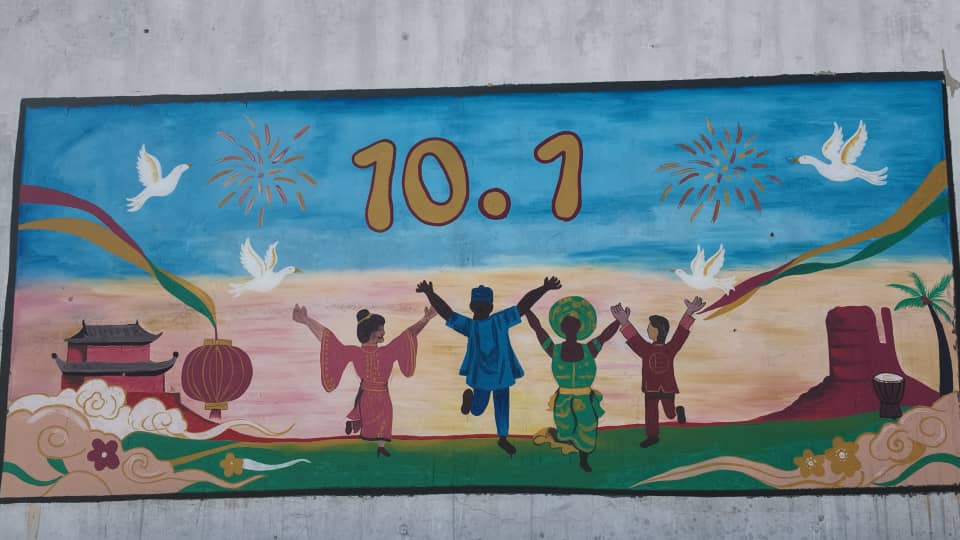
A colourful mural celebrating both China’s National Day and Nigeria’s Independence Day has been unveiled at an overseas project site, serving as a vivid symbol of the enduring friendship between the two nations.
The artwork, jointly produced by Chinese and Nigerian staff, features builders dressed in traditional Chinese costumes and Nigerian ethnic attire holding hands and dancing together.
Above them, fireworks and white doves of peace illuminate the sky, while the inscription “10.1” highlights the dual significance of October 1, the China’s National Day and Nigeria’s Independence Day.
On the left side of the mural, ancient Chinese architecture, red lanterns and auspicious cloud motifs showcase Chinese heritage.
On the right, red earth, coconut palms and African drums reflect Nigeria’s cultural identity. Flowing ribbons weave across the painting, symbolising unity and shared destiny.
Project officials described the mural as a “living testament” to cooperation at the frontline of development. They said it embodies mutual trust and support as workers from both countries overcome challenges together.
The initiative underscores cultural integration and partnership, with both sides pledging to continue working hand in hand to strengthen ties.
“Celebrating two festivals as one, we march forward with one heart,” a statement read, emphasising the commitment to write new chapters of friendship along the path of cooperation.
The mural, rooted in the overseas project site, stands as a reminder of the brotherly bond between China and Nigeria, and the shared vision of building together for a brighter future.
News
Musa Illiyasu Kwankwaso Celebrates Senator Lado @60, Says Is A Political Dogma
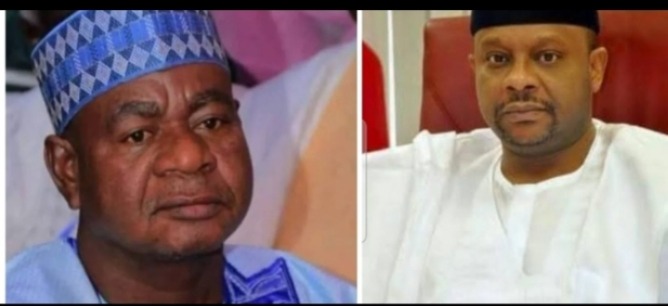
From Muhammad Kabir Kano
The spokesperson of Political Appointees Forum from Kano State, Dr. Musa Illiyasu Kwankwaso, has described Senator Basheer Lado, the Special Adviser to President Tinubu on National Assembly Matters (Senate), who also doubles as the Chairman of the Appointees, on his 60th birthday, as a Political Blog who plays the game with maturity and respect.
Kwankwaso who also describes Senator as Political Dogma, praised his contributions to democratic governance, humanitarian services and national development.
“Senator Lado is a dependable public servant and accomplished legislator whose experience had helped strengthen relations between the Executive and the Senate and also steer ship the activities of the Political Appointees with huge respect and understanding”,
He said it is on notice that Lado served in the Senate for four years before his by late President Buhari on Relief agency and subsequent appointment as Tinubu’s liaison officer in the upper chamber of the National Assembly.
Lado represented Kano Central Senatorial District in the Seventh National Assembly from 2011 to 2015, where he served as Vice Chairman of the Senate Committee on Works.
Lado facilitated several constituency projects, including the Kundila Bridge, popularly known as Gadar Lado, in Kano State. His contributions to humanitarian services through his previous roles as Federal Commissioner of the National Commission for Refugees, Migrants and Internally Displaced Persons, and Director-General of the National Agency for the Prohibition of Trafficking in Persons (NAPTIP).
He said Lado contributed to protecting vulnerable Nigerians, combating human trafficking and improving the welfare and rehabilitation of displaced persons.
Kwankwaso further commended the senator’s humanitarian initiatives through the Ladon Alheri Foundation, particularly in education, healthcare, women’s economic empowerment, rural water supply and support for disadvantaged communities.
” Lado’s contributions across public service reflected his commitment to national development and the welfare of Nigerians”, he added.
News
EFCC Reopens Atiku’s Alleged Financial Crimes Probe
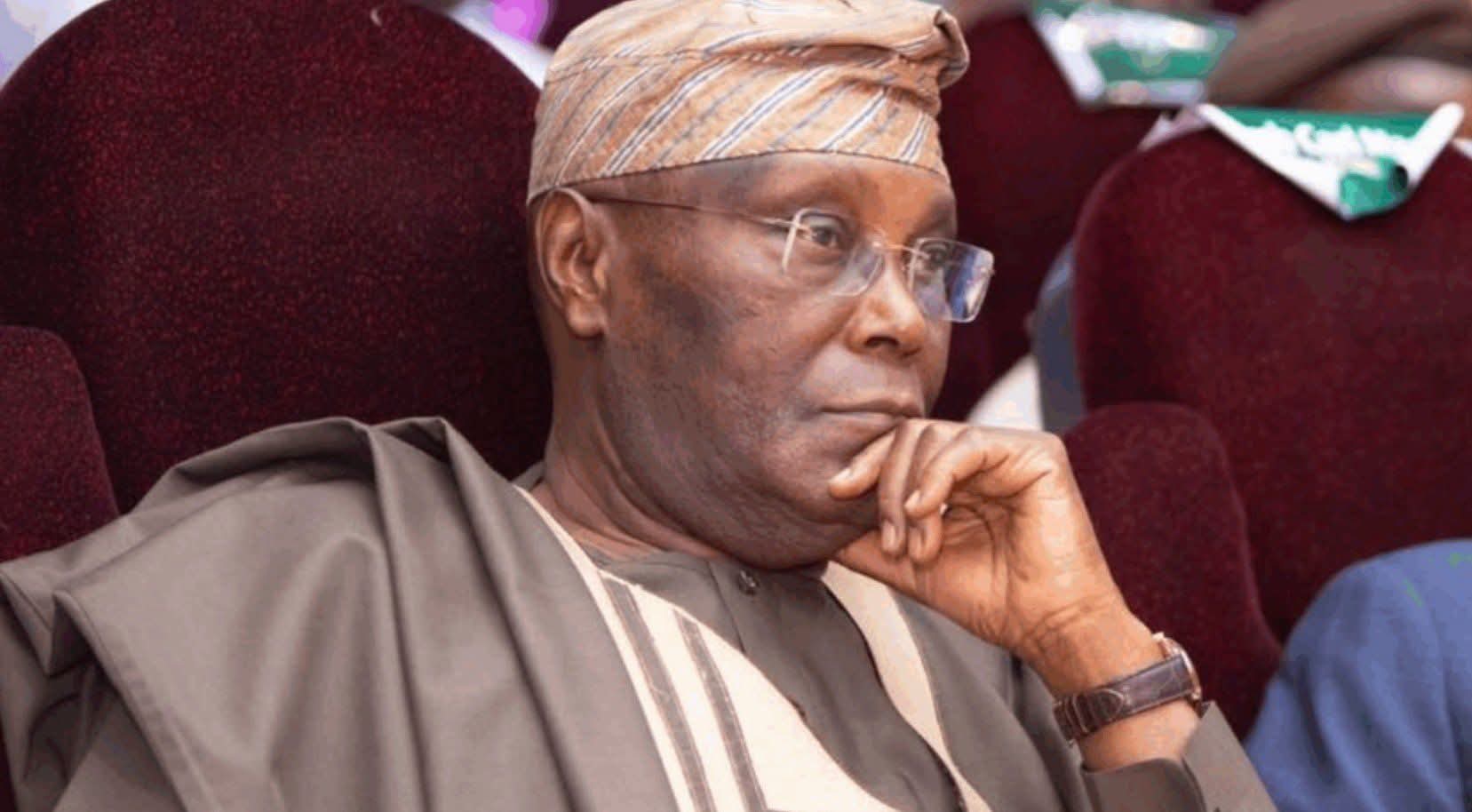
By Yusuf Danjuma Yunusa
The Economic and Financial Crimes Commission (EFCC) has reopened its investigation into allegations against former Vice President Atiku Abubakar following a petition by former House of Representatives member, Hon. Ehiozuwa Johnson Agbonayinma, seeking his prosecution over alleged financial crimes.
The petition seeks to revive a case dating back to 2006, asking the anti-graft agency to revisit its investigation under former chairman, Mallam Nuhu Ribadu, and consider a subsequent report by a United States Senate subcommittee.
Speaking on the development, Agbonayinma said the EFCC had acknowledged his petition, dated August 27, 2026, and received on September 1. Filed through his lawyer, Chief Hannibal Egbe Uwaifo, SAN, the petition asks the commission to reactivate its earlier report and act on the allegations.
The former lawmaker appeared at the EFCC headquarters in Jabi, Abuja, where he adopted the petition and answered questions from investigators.
Agbonayinma said the matter should not be allowed to remain unresolved.
“I want to thank Nigerians, the EFCC, and those praying for me in this struggle. The laws are meant for both the rich and the poor. After the EFCC has done a fantastic job, it should not be kept under the table,” he said.
In the petition, Agbonayinma urged the EFCC to revisit its September 2006 report on Atiku and a February 4, 2010, report by the US Senate Permanent Subcommittee on Investigations, arguing that both documents should form the basis for renewed action.
The petition alleged that the EFCC had previously indicated that Atiku could face prosecution after leaving office as vice-president, when his constitutional immunity ceased to apply, but that no prosecution followed.
Agbonayinma described the alleged failure to act as a dereliction of duty and argued that pursuing the matter would demonstrate the commission’s resolve to hold politically influential figures accountable.
He also disclosed that he had petitioned US President Donald Trump over the allegations.
The EFCC spokesman, Dele Oyewale, had yet to respond to messages seeking an update on the investigation as of the time of filing this report.

Why Gov Abba Deserves Another Tenure

China, Nigeria Mark Friendship with Joint Cultural Mural

Musa Illiyasu Kwankwaso Celebrates Senator Lado @60, Says Is A Political Dogma

EFCC Reopens Atiku’s Alleged Financial Crimes Probe

APC Presidential Campaign Council: Nigerians Devoid Of Party Affiliations Endorses Tinubu’s 2nd Term-Kwankwaso

Zamfara Varsity ASUU Threatens Warning Strike Over FG-ASUU Agreement, Promotion Arrears

PCACC Arrests Man Over Alleged ₦4.5m Sale, Illegal Leasing of Kano Government Horse Stable

Goje’s Electoral War:The Confrontation With Tinubu,Governor Inuwa,Usman Kumo And APC candidates Ahead Of 2027

Prof Yusuf Adamu Delivers BUK’s 63rd Professorial Inaugural Lecture, Reflects on Medical Geography and Academic Legacy

RE:WE ARE UNDER SIEGE: TARABA MONARCH BREAKS SILENCE AS FULANI BANDITS OVERRUN THE ANCIENT KWARARAFA KINGDOM:
Why Gov Abba Deserves Another Tenure
China, Nigeria Mark Friendship with Joint Cultural Mural
Musa Illiyasu Kwankwaso Celebrates Senator Lado @60, Says Is A Political Dogma
EFCC Reopens Atiku’s Alleged Financial Crimes Probe
APC Presidential Campaign Council: Nigerians Devoid Of Party Affiliations Endorses Tinubu’s 2nd Term-Kwankwaso
Zamfara Varsity ASUU Threatens Warning Strike Over FG-ASUU Agreement, Promotion Arrears
PCACC Arrests Man Over Alleged ₦4.5m Sale, Illegal Leasing of Kano Government Horse Stable
Goje’s Electoral War:The Confrontation With Tinubu,Governor Inuwa,Usman Kumo And APC candidates Ahead Of 2027
Prof Yusuf Adamu Delivers BUK’s 63rd Professorial Inaugural Lecture, Reflects on Medical Geography and Academic Legacy
RE:WE ARE UNDER SIEGE: TARABA MONARCH BREAKS SILENCE AS FULANI BANDITS OVERRUN THE ANCIENT KWARARAFA KINGDOM:
-

 Opinion5 years ago
On The Kano Flyovers And Public Perception
-

 Features5 years ago
How I Became A Multimillionaire In Nigeria – Hadiza Gabon
-

 Opinion6 years ago
Kano As future Headquarters Of Poverty In Nigeria
-

 History6 years ago
Sheikh Adam Abdullahi Al-Ilory (1917-1992):Nigeria’s Islamic Scholar Who Wrote Over 100 Books And Journals
-

 Opinion5 years ago
My First Encounter with Nasiru Gawuna, the Humble Deputy Governor
-

 History5 years ago
The History Of Borno State Governor Professor Babagana Umara Zulum
-

 History6 years ago
The Origin Of “Mammy Market” In Army Barracks (Mammy Ochefu)
-

 News5 years ago
Federal University Of Technology Babura To Commence Academic Activities September