
News
Buhari:The Basis For The Blitz Against The Baseless Bashing
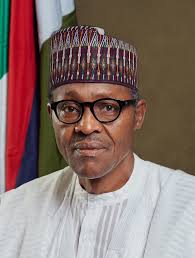
By Bala Ibrahim.
“Ya shugaba na, the defence for the Buhari Administration is too much. Universities remain closed, security issue, virtually every aspect of life has collapsed”.
The cliché above was sent to me by a very close friend, who, from our ‘aluta’ and students unionism days in the University, has unilaterally allocated to me the title of, “Ya shugaba na”, which in hausa means, oh my leader!
The friend in question is a patriot par excellence, who frowns at treachery or anything in the realms of betrayal of trust, and one that vigorously supports his country, and is prepared to defend it against any enemy or detractor. Yet, perhaps out of the feeling for the less privileged, my blue blooded friend thinks, the time has arrived for me to put a halt on the Buhari publicity blitz.
I don’t want to disagree with my cherished friend, because I know the magnitude of the negative narrative making the rounds about Buhari’s performance, and how that is having an impact on the public perception of his leadership in Nigeria. However, I wish to assure my humble friend that, the Presidency is not unaware of such slush.
Some years back, at a public lecture, titled, “The Unravelling of Boko Haram and the Rebuilding of the North-East of Nigeria’’, at the Harvard University’s Weather head Centre for International Affairs, Vice President Yemi Osinbajo, made attempt to assuage that feeling, when he said, PMB is determined to change the narrative and perception of leadership in Nigeria and Africa, because of his widely acclaimed uprightness and honesty.
On my side also, I have long developed a thick skin over the attack of being a paid agent of the Buhari administration. And I wouldn’t have bothered responding, had it not been for the fact that the comment came from a dear friend, who must have written with an honourable intention.
Yes, much as I cannot convince all the critics all the time, and at the risk of doing what I was advised to slow down upon, I want to reassure my friend and the other reasonably minded, about the merit of good intentions, and how nature has vested such virtue in President Muhammadu Buhari.
In doing that, I would publish a material copied from the Defence News Nigeria, which has this to say about the Paradox of our country Nigeria, and the way some of us think:
“We have a lot of political zealots on this page. You see them in the comment section turning every tweet and every conversation into some opportunity to slam the government. I could be making a tweet about a recent successful airstrike, and you will get them leaving comments about how the NAF bombed civilians the other day.
There used to be a time when most of us, no matter where you stand politically, you kind of want the best for the country. Today, wanting the best for the country makes you a paid propagandist.
What’s worse, they choose to display this madness by latching on any positive news about the country, forgetting we are shooting ourselves in the foot.
Over $70 billion of investment came to Africa in the last ten years. Of that figure, only $4 billion came to Nigeria. Why? The venture capital investment industry is driven by just two emotions- fear and political instability.
Over 80% of Nigeria’s industrial capacity is located in the South, the region protected from the decade long insurgency that has ravaged the north.
Industrial capacity has quadrupled in recent years. New industries have sprung up. Lagos is now the Tech start-up hub of Africa. Naturally, investors, multinational corporations are eager to tap into this dynamic market. And just about when they announce their intentions, the self proclaimed activists and their army of saboteurs swing into action, describing how evil and dictatorial the government is, manufacturing social unrest when there is non, scaring away investors into moving to safer climes, to places like Ghana and losing thousands of potential jobs.
This is the Great Paradox of Nigeria.
People want development and FDI. And when seeds of developments are sewn, the same people see it as something that will rob favourably on the government, and would rather self sabotage, than allow anything punch a hole on their narrative.
Nigeria borrowed a ton of money revamping the nations railway infrastructure. Terrorists, who cannot stand development attack these infrastructure and people rally behind the terrorists in celebration, because it’s an opportunity to show how incompetent the government is. And when the FDI needed for development is diverted to other countries, we cite it as an example of a failed government, and the vicious circle self perpetuates.
China, South Korea, Japan, Dubai developed because of Foreign Direct Investment. No government can develop a nation.
Do you think Twitter was happy basing its regional HQ in Ghana with its puny 8 million Twitter users over Nigeria with over 48 million Twitter users?
It’s tragic.
Lagos is as safe as Accra, their investment portfolio is probably even safer, but we scared them away thinking we are hurting the Buhari government.
In the West, there is a vast academic literature, known as behavioural finance, which is devoted to the topic of understanding market psychology. Their heart may be in Nigeria but they apply common sense, not emotions to decision making.
They know letting emotions govern investment behaviour often leads to irrational decision making that can cost you dearly. So they opt to play it safe and seek safer grounds.
Who lost?
Two groups lost: TWITTER and NIGERIANS.
Nigerians accuse the government of stifling free speech, TWITTER responds by attempting to censor the government’s Tweet.
The FG bans Twitter.
By now Twitter has ditched its plans to setup its Africa HQ in Lagos and moved to Ghana.
Twitter misses out on one of the world’s most dynamic market over “perceived social instability”
The thousands of jobs that could have been created for Nigerians, with its attendant trickle down economic impact is forever lost.
Who losses?
The government in Abuja?
Now here we are again.
The current geopolitical situation in Europe has made it necessary for Europe to strengthen its relations with Nigeria, especially in the supply of gas. Nigeria has suddenly become a crucial partner of the EU at a time when Europe is trying to rid itself off its dependence of Russian oil and gas. Heck a delegation from the EU visited Nigeria just last month and secured Nigeria’s commitment to step up its production.
This is the time that self proclaimed activists like and have chosen to write crazy Op-eds, claiming Nigeria is run by a mafia regime and does not have the capacity to step up production, and we have Nigerians backing them up.
How stupid can we be?
We have a rich EU ready to pump billions into Nigeria’s energy sector to help boost gas production and the self saboteur brigade, together with the brown envelop copy and paste media, are already out in force trying scare the EU away.
Who are we hurting with these senseless pessimism and activism?
Buhari or our future generation?
Nigerians have to put on their thinking hats”.







News
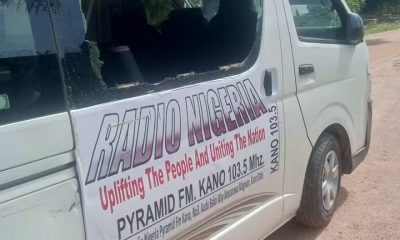
Thugs Attack Journalists During APC Rally in Kano
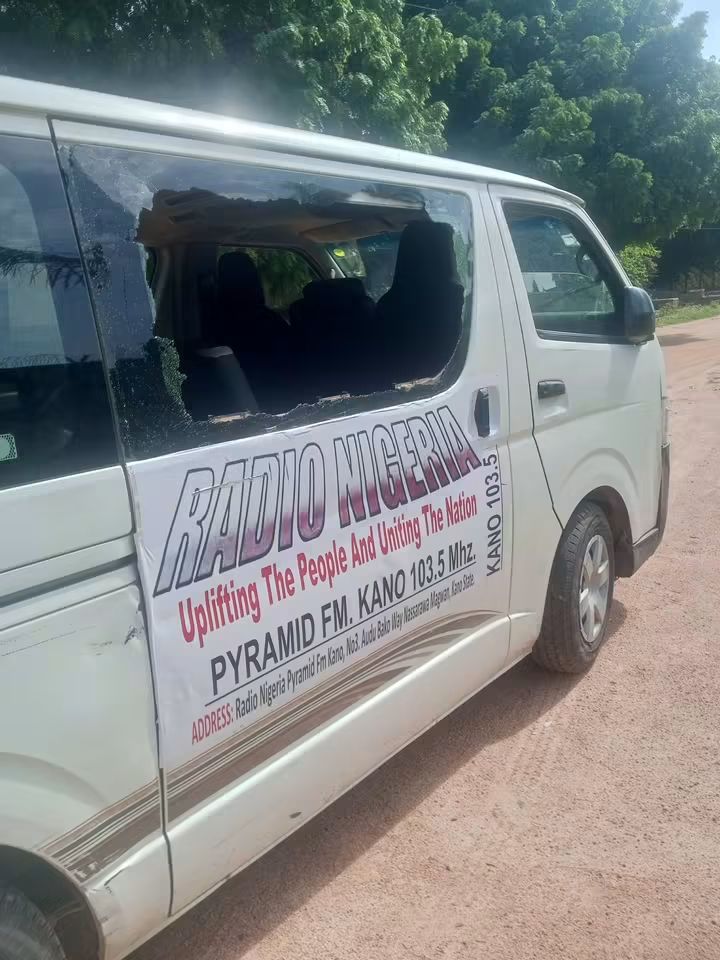
A group of suspected thugs on Saturday attacked journalists covering an All Progressives Congress (APC) rally in Kano State, smashing the windows and damaging a Radio Nigeria vehicle conveying members of the media.
The incident occurred shortly after the conclusion of a rally held at the Sani Abacha Stadium in Kano, where the leadership of a coalition of groups supporting President Bola Ahmed Tinubu was inaugurated.
According to eyewitness accounts, the thugs attacked a team of journalists who had gone to the venue to cover the event, targeting the Radio Nigeria, Pyramid FM vehicle in which some of the journalists were travelling.
The attackers reportedly used machetes and knives to strike the vehicle repeatedly, smashing its windows and damaging various parts of the bus.
Among the journalists affected in the attack were Abdulbaki Ali Ahmad Sharifai of Guarantee Radio and Yakubu Gwagwarwa of Pyramid Radio.
One of the journalists who spoke to Nigerian Tracker said the presence of security personnel inside the Radio Nigeria bus did not deter the attackers from carrying out the assault.
The journalist said the thugs continued attacking the vehicle despite the fact that security agencies were inside the bus with the journalists.
According to him, the attack created fear and confusion among the journalists, who had attended the political gathering in the course of carrying out their professional duties.
The incident has raised concerns over the safety of journalists covering political activities in Kano, particularly during large political gatherings where journalists are expected to move freely and report events without intimidation or attacks.
The motive behind the attack was not immediately clear, and it was also unclear whether any arrests had been made in connection with the incident as of the time of filing this report.
The attack comes amid increased political activities in Kano and across the country as political groups mobilise support for their respective interests ahead of future elections.
News
Gov. Mutfwang Orders Closure of Schools Across State as Diphtheria Hits Plateau
By Yusuf Danjuma Yunusa
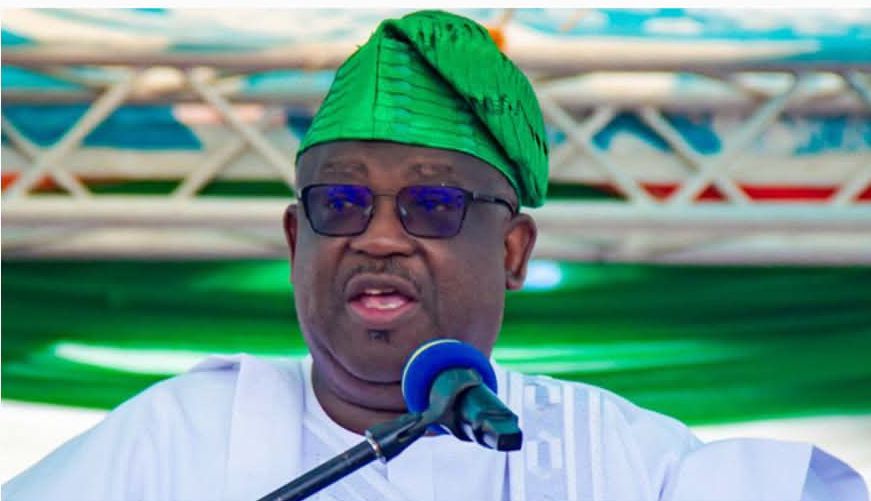
Plateau State Governor, Caleb Mutfwang, has directed temporary closure of public and private primary schools across the state over diphtheria outbreak.
The disclosure was made in a statement on Saturday by the commissioner for information and communications, Joyce Ramnap.
She stated that the directive was effective from Monday.
She noted that the government took the decision as preventive measures against the spread of the disease.
Mrs Ramnap noted that the suspected cases had been recorded in parts of Jos North, Wase, Jos South and Bassa Local Government Areas of the state.
“Accordingly, schools that have already resumed academic activities are also directed to close from Monday, September 7, 2026, and remain closed until further notice,” the statement noted.
The statement said the governor directed school proprietors, administrators, teachers, parents and guardians were to comply with the directive.
The governor also said schools should ensure that students and pupils remain at home throughout the period as part of measures to ensure their safety including the teaching and non-teaching staff during the period.
The statement added that Mr Mutfwang appreciated the stakeholders for their understanding and cooperation as the government continued to take appropriate measures in the best interest of the residents.
”Further information on the resumption of academic activities will be communicated to the public in due course,” he said.
Reports have it that 23 peoples have been killed by diphtheria in several communities, and 143 others infected in Jos North.
News
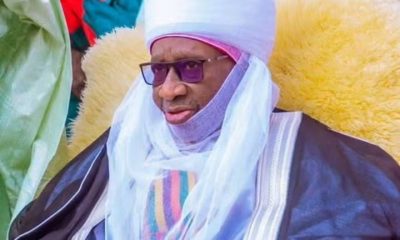
Emir of Gumel, Ahmad Muhammad Sani, Dies After 45 Years on the Throne
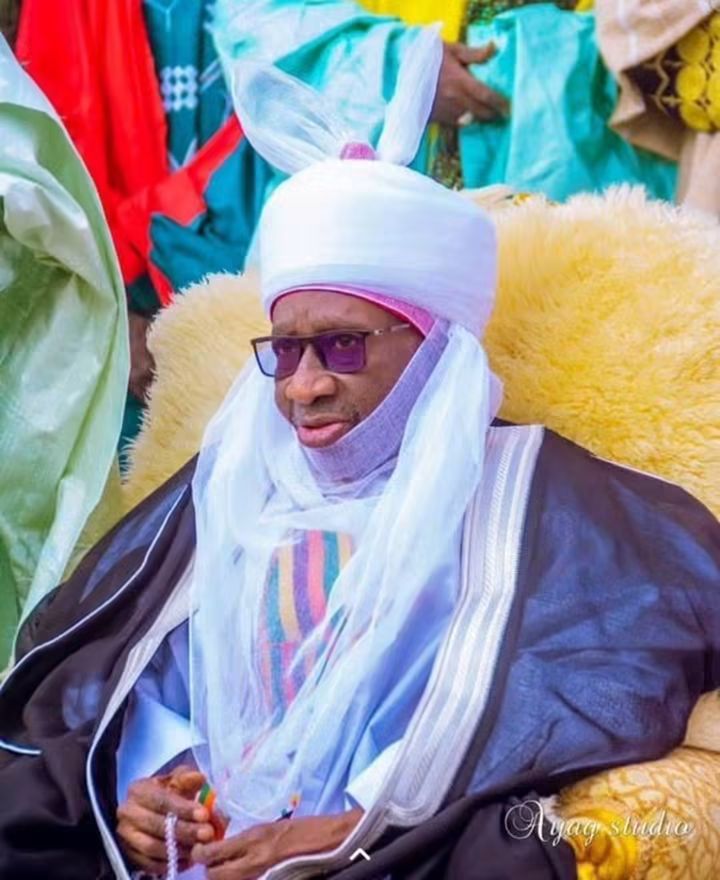
The Emir of Gumel, His Royal Highness Alhaji Ahmad Muhammad Sani II, has died after more than four decades on the throne, bringing to an end the reign of one of Northern Nigeria’s longest-serving traditional rulers.
Ahmad Muhammad Sani II, who became the 16th Emir of Gumel, ascended the throne in 1980 following the death of his father, the late Emir Maina Muhammad Sani II. He subsequently received his staff of office from the then Governor of Kano State, the late Alhaji Abubakar Rimi, in 1981.
His death marks the end of a historic reign that spanned more than 45 years and covered some of the most significant political, social and administrative changes in the old Kano State and, later, Jigawa State.
Before ascending the traditional throne, the late Emir was actively involved in public service and politics. He served as Commissioner for Information, Internal Affairs and Culture in the Kano State Government during the administration of Governor Abubakar Rimi between 1979 and 1980.
His transition from political office to the traditional institution came after the death of his father in December 1980. Historical records indicate that Ahmad Muhammad Sani was selected to succeed his father on December 16, 1980, while his formal presentation with the staff of office followed on May 29, 1981.
As Commissioner for Information, he was associated with important developments in the media sector of the then Kano State. Records indicate that during his tenure, he played a role in the establishment of Triumph newspaper and CTV67 television station, now associated with the state’s television broadcasting history, while also overseeing the expansion of Radio Kano.
His educational background was also notable. He attended Gumel Primary School and Hadejia Middle School before graduating from Kano High School at Rumfa College in 1961. He later obtained qualifications in Public Administration from the Institute of Administration in Zaria, now part of Ahmadu Bello University, and pursued further studies in Political Science and International Relations at Ohio University in the United States.
Before entering politics, Ahmad Muhammad Sani had worked with the Gumel Native Authority and later joined the Immigration Department, where he was posted to Ngamboru Ngala in present-day Borno State. He subsequently served as a senior government official in the Kazaure Divisional Office before moving into politics in 1978.
His long reign as Emir of Gumel made him one of the most experienced traditional rulers in Northern Nigeria. The Jigawa State Government describes him as the 16th Emir of Gumel and records that he had remained on the throne since 1981.
Over the years, the Emir became associated with efforts to promote peace, education, community development and the preservation of traditional values. His palace also played a role in mobilising communities around government programmes, including public health initiatives.
The World Health Organisation, for instance, previously identified the Emir of Gumel as one of the traditional rulers who played an active role in promoting immunisation activities in his emirate. The organisation reported that he publicly vaccinated his own children as part of efforts to reassure communities about the safety of polio vaccination.
Even in the later years of his reign, the Emir continued to participate in peace-building and community affairs. In 2025, he was represented at a farmers-herders peace meeting in Jigawa, where his message emphasised dialogue and mutual understanding as essential to achieving lasting peace.
In December 2025, the Emirate marked his 45th anniversary on the throne, with prominent national and traditional figures, including Vice President Kashim Shettima and the Sultan of Sokoto, participating in activities associated with the anniversary.
His death therefore comes after a reign that began in the final years of the Second Republic and continued through successive military governments, the return to democratic rule in 1999, the creation of Jigawa State and several generations of political leadership.
The Emir of Gumel’s reign also represented a unique bridge between political administration and traditional leadership. Having served as a senior political office holder before becoming a monarch, he brought extensive experience of government and public administration to the traditional institution.
With his passing, the Gumel Emirate loses a monarch whose tenure lasted more than four decades and whose public career had already begun before his accession to the throne.
Details concerning his burial arrangements, the circumstances surrounding his death and the process for selecting his successor are expected to be announced by the Gumel Emirate Council and the Jigawa State Government

Thugs Attack Journalists During APC Rally in Kano

Gov. Mutfwang Orders Closure of Schools Across State as Diphtheria Hits Plateau

Emir of Gumel, Ahmad Muhammad Sani, Dies After 45 Years on the Throne

Uber Shutdowns Operations in Nigeria

Author of ‘Rich Dad Poor Dad’ Languishes in Billion Dollar Debt

From World’s 9th Most Populous City to Perfect: As Gov Yusuf Revisits Kano Master Plan

95% of Governor Abba Kabir Yusuf’s Promises Have Been Fulfilled — CPS Interview By Musa Diso, In Kano

Kano Islamic Scholar Declares Kano Widow Marriage Programme ‘Haram’, Urges Government to Stop It

We’re aware of your clandestine meetings with Lulu-Briggs, 𝐏𝐢𝐝𝐨𝐦𝐬𝐨𝐧, CRP uncovers ex-MD of NDDC, Nunieh

Between Sabotage and Scepticism: Why Nigeria’s Oil Dream Keeps Stalling
Thugs Attack Journalists During APC Rally in Kano
Gov. Mutfwang Orders Closure of Schools Across State as Diphtheria Hits Plateau
Emir of Gumel, Ahmad Muhammad Sani, Dies After 45 Years on the Throne
Uber Shutdowns Operations in Nigeria
Author of ‘Rich Dad Poor Dad’ Languishes in Billion Dollar Debt
From World’s 9th Most Populous City to Perfect: As Gov Yusuf Revisits Kano Master Plan
95% of Governor Abba Kabir Yusuf’s Promises Have Been Fulfilled — CPS Interview By Musa Diso, In Kano
Kano Islamic Scholar Declares Kano Widow Marriage Programme ‘Haram’, Urges Government to Stop It
We’re aware of your clandestine meetings with Lulu-Briggs, 𝐏𝐢𝐝𝐨𝐦𝐬𝐨𝐧, CRP uncovers ex-MD of NDDC, Nunieh
Between Sabotage and Scepticism: Why Nigeria’s Oil Dream Keeps Stalling
-

 Opinion5 years ago
On The Kano Flyovers And Public Perception
-

 Features5 years ago
How I Became A Multimillionaire In Nigeria – Hadiza Gabon
-

 Opinion6 years ago
Kano As future Headquarters Of Poverty In Nigeria
-

 History5 years ago
Sheikh Adam Abdullahi Al-Ilory (1917-1992):Nigeria’s Islamic Scholar Who Wrote Over 100 Books And Journals
-

 Opinion5 years ago
My First Encounter with Nasiru Gawuna, the Humble Deputy Governor
-

 History5 years ago
The History Of Borno State Governor Professor Babagana Umara Zulum
-

 History5 years ago
The Origin Of “Mammy Market” In Army Barracks (Mammy Ochefu)
-

 News4 years ago
Federal University Of Technology Babura To Commence Academic Activities September