
News
Friday Sermon] The Muslim Ummah’s Predicaments And Their Solutions
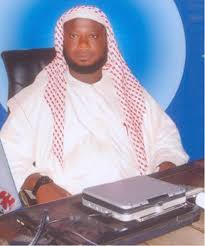
By Imam Murtadha Gusau
In The Name of Allah, The Most Merciful, The Bestower of Mercy
All praise is due to Allah, the Lord of all creation—may He extol the Messenger in the highest company of Angels and send His peace and blessings upon him—likewise upon his family, Companions, and true followers.
Dear brothers and sisters! Today, if we are to discuss the problems and issues faced by the Muslim Ummah, we shall see that many of them are related to personal lives. Collectively this is what can be observed and this is becoming the leading cause to a social decline in Muslim societies. The need of the hour is for everyone to self-introspect and rectify. At a locals, states and national levels, the leaders need to fulfill their responsibilities and roles assigned to them. Today’s sermon (Khutbah) is an attempt to highlight those areas which are leading to our destruction and decadence as an Ummah (nation).
Respected servants of Allah! When the people, especially the leaders, both individually as well as collectively begin to worry about self-analysis, weaknesses, responsibilities and how to rectify them, automatically there will be positive results that will be observed, In Shaa Allah as follows:
Dangote Fertiliser to train over 1 million farmers in three years
1. Complete Iman, Righteous Deeds, Fear of Allah and the Worry for the Day of Judgement (Akhirah):
Our beloved Prophet, Muhammad (Peace be upon him) reformed the society and raised a foundation for the Companions (Sahabas) as examples for all. This reform was of a nation who were deep in the depths of ignorance and misguidance. Murder and robbery were the norm. The society was so engrossed in the wrong that no one wanted to be their leader. Our beloved Prophet (Peace be upon him) completely reformed these people to perfect their faith, lead them to righteous deeds and the fear of Allah Almighty. He instilled in them the worry for the Day of Judgement (Akhirah). The entire society and its mindset changed. The very same people who were involved in looting and murder became leaders. Their society became an example of what was to be followed. They became successful against strong international forces such as Qaisar and Kisrah.
Whether it be our leaders or the nation, whether we speak of individuals or community as a whole, discipline is the power. The effectiveness of sound character along with the fear of Allah Almighty is the key to success. This is the sustenance that is essential. We are deprived of these basics individually as well as an Ummah (nation). The most important areas that need to be addressed are that we are far from sincerity, weakened in terms of righteous deeds and exemplary character, free from the worry of accountability and heedless of the life after death which is to follow. All of these are the very foundation, if not strengthened with Iman (faith), we cannot expect our building to be dependable.
2. The Disease of Weakness:
The Muslim Ummah today is surrounded by the whirlpool of injustice. Muslims are being massacred everywhere. Every dawn brings a greater number of chaos and problems. Our Enemies (from within and outside) are attacking the Muslims in all aspects and are bloodthirsty to eradicate the entire Muslim nation from the face of this earth. Our beloved Prophet (Peace be upon him) not only warned us of this degeneration but also gave us the reasons for this decline. In a Hadith we learn that when a nation is inflicted with a disease of “weakness,” and here ‘weakness’ is referred to the too much love of this world and the dislike of death, then such problems shall arise. This is the time when a strengthened belief, righteous deeds, fear of Allah Almighty and the worry for the Hearafter is the need of the hour. Additionally, there is a need for us to look at the lack of collective discipline within us. We have to eradicate the too much love of this world and the dislike for death as they are the foundation of all evil. Fear of death becomes a reason for a weak heart and enslavement. Once we overcome this, then we will be able to come out from many vices, In Shaa Allah.
3. Preaching Unity and Consensus:
At this time, the Muslim nations face many issues due to the lack of unity and consensus. There have formed many a groups, sects and factions based on various beliefs, geographical locations as well as cultural variances leading to hatred and enmity. The slogan of “divide and rule” has caused split in the Muslim Ummah and many walls have been erected amongst us Muslims. The link that bonded the Muslims together has been broken. We have left the teachings of the Prophet Muhammad (Peace be upon him) which has led us astray and this divide. The split into factions, prejudice and extremism has taken face which is leading to a non-ending war and corruption. If the entire Muslim Ummah comes together with unity and the end to such divides, there is no reason for problems to continue to evade us. Imagine how the world consisting of the many Muslim nations will change if it can come together as one force by holding on the rope of Allah Almighty with the prescribed instruction.
Today if the European Union (EU) exists with blocks of the European countries alleged together under a single umbrella, why cannot the Muslim nations do the same? If we continue with the divergence, problems will continue to rise.
4. Lack of concrete and strong Education:
One of the main issues faced by the Muslim nations is the lack of education. Leaders, Individuals as well as the society is to be held responsible for the lack of this. The government is also to carry this burden of responsibility. Ironically, this is the Muslim Ummah (nation) upon which the first commandment to be sent through the form of revelation was “iqra,” – read. This is the nation upon which the Prophet (Peace be upon him) was sent with the supplication:
“O Allah, increase me in my knowledge.”
This is the very nation, the identity of which is education. What a shame it is if such a nation is left behind in the race of knowledge and education.
Where the leaders are to be blamed for being negligent to provide the infrastructure for high quality education through setting an appropriate budget, the individuals are also heedless of wanting to work hard to excel in any field whether it be technology or innovation. Whether it is the field of medicine, engineering or science, we love to speak highly of the developments. Do we ever stop to think that why are Muslims no longer leaders in these fields of excellence? Why are Muslims dependent on others? Why is there a lack of literacy in the Islamic world today? Why aren’t the prestigious universities and observatories in Islamic regions?
This definitely is a time to stop and reflect. There is a dire need for us to speculate and derive some concrete conclusions leading to action plans, otherwise the future of the Muslim Ummah will continue to look darker than ever before.
5. Indolence, Sedentary Lifestyle and a Laid Back Attitude:
Our indolence is one of the prime reasons for the problems at hand. This laid back attitude is both at the individual level as well as the collective level. We prefer laziness over constructive plans and a comfortable lifestyle allowing to stay in our comfort-zones rather than “go out there and achieve” attitude. Our leaders are enjoying their royal way of life along with the politicians and head of states. The Muslim youth do not want to work hard and are happy with being sedentary. They have left the spears and arrows and found their passion in music and suchlike. All of the above has lead to the decline of the Muslim nations as a whole. We have become almost a laughing stock in front of the world. The poison of obscenity and lewdness has encompassed our generations. Wasteful and unnecessary activities and discussions have left us nowhere.
Those people who are empty of the wealth of knowledge and Iman (faith) are not promised the help of Allah. Only when people will adopt a path with a concrete direction and focus to pleasing Him, will they find success. Yet, we are deprived of this because of our own choices. We must understand and recognise this major problem and work towards trying to become more goal-oriented and productive to please Him.
6. Waste of Resources and Over-spending:
Not only do we waste human resource, but we also waste natural resources. Allah Almighty has blessed the Muslim nations with a variety of resources such as gold. We have minerals in abundance. Whether we look at it with respect to agriculture, mineral or seasonal produce, the Muslim nations have an overflowing wealth of resources. Yet, we are not able to plan the efficient use of these blessings.
The enemies have taken out oil from the Muslim countries. The contracts for gold extraction has been given to others and negotiated at a lesser value than what they are actually worth. We do not have ability to build dams on our own rivers. And the command of preparing against the enemy was given to us through these words of the Qur’an:
“And prepare against them whatever you are able of power and of steeds of war…” [Surah Al-Anfal: 60]
We are even unable to look after our own necessary resources, lest prepare against enemies!
Moreover, the waste of resources and over-spending has made us brothers to Devils (Shayatin). As it is stated in the Qur’an:
“Indeed, the wasteful are brothers of the devils (Shayatin).” [Surah Al-Isra: 27]
Our wealthiest of people are loaded with gold which is greatly manifested through ceremonies and clothing in celebrations of weddings. We are drowned under the love of material wealth and spending excessively on food to utilities as compared to an ordinary man who is unable to afford even one meal for the day. We are so occupied in spending, it is unbelievable! This is a weakness and we need to change.
Please, let’s adopt the way of Prophet Yusuf (AS) who was wise enough to teach us how to pace the spending through a mediocre way of managing the resources when he did the same for Egypt. He intelligently managed the resources for an entire nation and spread it out in to save the people of famine and provide relief. He was able to do this by adopting three (3) means. What were they?
1. Sincerity
2. Moderate Spending
3. Planning
And the nation was saved from a decline that would have finished it all.
7. Corruption and Wrong Intention:
Corruption and ill will is one of the major underlying issue. This is found at all levels of the Muslim societies. The Prophet (Peace be upon him) predicted this for the very same reason. In a Hadith we learn, the gist of which is that close to the end of times, sincerity will be lifted. People will say there is one man who is sincere and trustworthy. This implies the scarcity of both trustworthiness as well as sincerity close to the end of times. We see this happening today.
Today, if our judicial systems, societies, countries, organisations and each individual becomes free of the curse of corruption and adopts sincerity, the Muslim world will take a new order.
8. Injustice and Unfairness:
There is a famous saying of Ali (RA):
“Societies can exist with unbelief (kufr) but not with injustice.”
Today, in the Muslim countries, injustice has taken many forms. We witness the injustice of other nations upon the Muslim Ummah, but we also witness this at the position of the one in authority. The one in authority assumes power and oppresses the one below whether it be with wealth, power, status or ranks. Justice is not being served and even the concept of justice seems to be dwindling at all levels. Unless, we create a foundation of justice, our problems will not only remain unresolved, but will also grow exponentially.
9. Inferiority Complex:
Another prime reason for the issues faced by Muslim Ummah is the feeling of being inferior as compared to the rest of the world. This feeling of being lowly than others causes us to become in awe of other religions as well as nations. We become slaves to their way of life and ideologies. Unable to set our own boundaries and practice our own ways, we have allowed foreign cultures and religions to take over our very set ways of Islam. Unless we become confident that our religion provides a wonderful system of life, we will be unable to move on with grace and honour. We have only to blame ourselves, here.
10. Differences in Status:
The concept of bureaucracy is another cause of the decline of the Muslim Ummah. Today we are engrossed in the pride of our lineage, of our status, of our wealth causing a rift in the hearts and minds of people. The tribal system has taken over us and even the most educated ones fall prey to this delusion that they are “above all” and have a sense of false entitlement.
Each area has taken the authority to practice its own law with regards to reward and punishment, leaving behind the Shari’ah. The Prophet Muhammad (Peace be upon him) has warned us of such differences and told us clearly that this became the reason for the destruction of previous nations. We are strictly told to stay away from this vice.
11. Influence of the West:
Sadly, today those who call themselves activists, reformers or carry projects of philanthropy are under the influence and following of the West. The reformers are not aware of the following of Islam, rather are guiding people to the ways and thoughts of the Non-Muslims. This is taking us away from the basic teaching of character building, obedience as well as our roles as defined by the Creator.
The media, today, plays a very important role in this negative propagation and changing of mindset in the Muslim nations especially the youth. The youth are being told that whatever practice of Islam has been prescribed is backward and not for this time. There is a better way out there which needs to be adopted. Hence, Islam needs to be reformed under the current times. It is evident that the role media plays internationally is that of to demean Islam. It propagates obscenity and impermissible acts making it acceptable.
Our main problem as Muslim nations is that we do not condemn such people who are out to change the Islamic culture under the name of “modernism”, “growth” and “liberation.” We have handed over all platforms to such people and stepped back. As Muslim communities, we all need to step up, create our own way so the nations can be given a correct and true perspective of what ideologies Islam really is based upon.
12. Inability To Self-Reform:
Another area which deeply requires our attention is that we do not wish to self-introspect but continue on to rectify others. The general public speaks out against leaders. Those in position, in return, bad mouth the public. It is a vicious cycle. We need to set our priorities and focus on ourselves rather than trying to please international nations. Leaders are required to become mindful and sensitive towards the needs of their people. Let’s leave aside the “blame-game” which is not only found with regards to the general public and leaders but is also very much a part of the Muslim culture as a while. We do not mean what we say and this is a very big vice. Instead of adopting the culture of pointing fingers at the other, let us all look deep within and change ourselves. All the areas that have been highlighted above require a rectification at the level of the self as well as Muslim nations as a whole. Only then can we imagine Muslims to unite and become one body. For this, we all need to work towards betterment with sincerity and effort. We need to go ahead and invest our wealth for the Muslim nation to become what was dreamed of with the advent of Islam.
May Allah Almighty give us the ability for these changes and have mercy upon us, ameen.
Dear brothers and sisters this messages and sermons is always brought to you by Nagazi-Uvete Islamic Center.
We sincerely seek your financial support on the feeding in this blessed month of Ramadan. Your support is highly needed for Allah’s sake.
As usual, we sincerely solicit for your kind and sincere contribution towards the Ramadan feeding of our orphans, widows and less privileged; and the development of our schools and Islamic Center financially, materially and morally.
Our aim and objective always is to have a standard Islamic center and Arabic/Islamic schools for orphans and less privileged Muslims children in Nigeria.
If you want to pay your Zakah, Sadaqah, Fidyah, or Kaffarah, our great Islamic center is waiting for you. Your Ramadan donation will help distribute food packs, and iftar food for our orphans.
Remember, Ramadan will not be the same without our families, but unfortunately this is not a privilege enjoyed by everyone. This is the reason we’re steadfast in planning to provide iftar for poor people, orphans, widows, less privileged etc.
We are planning to distribute food stuff package that worth amount of to 4000 poor Muslim families and 2000 orphans In Shaa Allah.
And your contribution towards feeding the fasting souls is highly waiting as usual. May Allah rewards all your efforts and your good deeds, ameen.
Allah Almighty says:
“If you support the course of Allah, He will support you.” [Qur’an, 47: 7]
The Prophet Muhammad (Peace be upon him) said:
“Whoever relieves his Muslim brother of a hardship from the hardships of this world, Allah shall relieve him of a hardship from the hardships of the Day of Judgement. And whoever makes things easy for a person in difficulty, Allah will ease for him in this world and the Next. Allah is forever aiding a servant so long as he is in the aid of his brother.”
And he (Peace be upon him) said:
“Every act of goodness is considered as Sadaqah.” [Al-Bukhari]
We need the followings:
• Permanent buildings with many classes
• Boards, chairs and desks
• Arabic and Islamic books
• Feeding facilities
• Uniforms
• Computers
• Foodstuffs for Ramadan Iftar and clothes for orphan’s Sallah festival
Account details:
Account no. – 0048647196
Account name – Murtala Muhammed
GTBank
For more enquiries contact, Imam Murtadha Muhammad, the director and Imam Of the Center: 08038289761.
To donate foodstuffs. Contact the following Numbers: 08038289761, 08056557477
Jazakumullah Khairan as you kindly contribute.
Allah surely knows best and he is the Lords of the universe and May his peace and blessing be on his Messenger, his family, his companions and those who follow them.
I ask Allah, the Most High to grant us success and enable us to be correct in what we say and write, ameen.
Murtadha Muhammad Gusau is the Chief Imam of Nagazi-Uvete Jumu’ah and the late Alhaji Abdur-Rahman Okene’s Mosques, Okene, Kogi State, Nigeria. He can be reached via: gusauimam@gmail.com or +2348038289761.
This Jumu’ah Khutbah (Friday sermon) was prepared for delivery today, Friday, Ramadan 07, 1443 A.H. (April 08, 2022).












News
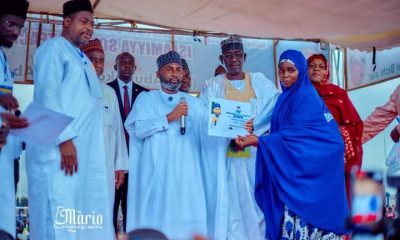
Kano Gov Abba Kabiru Yusuf bags international sports award in UK

Kano state governor, Abba Kabir Yusuf , Saturday was honoured in the United Kingdom for his commitment and support to sports development in the state.
Our correspondent reports that the award presentation ceremony took place at the Feel Good Too , Ive Farm sports arena located at the Pavilion Walk in London.
The patron W O. Sports, Moses Andishu , while making the presentation, said the award is aimed at appreciating the governor for his consistency towards the development of sports in Kano.
Moses who doubles as SWAN national patron said “this is our token way of saying kudos to mr governor and our aim is to encourage him to do more for the growth of the industry .
He added that “ we have noticed the reforms been carried out in Kano Pillars football club , we are aware of the efforts ongoing at the Kano state Sports Commission, KSSC and Kano Pillars is taking a new shape again, the state various sports teams now honor national invitations to major competitions, this is worth encouraging.
“we are very much aware of the plans by the governor, who is investing massively in the area of the provision of infrastructure, likewise we have seen investments made to renovate and upgrade major sports facilities, in the state, we just want to say thank you to his excellency and encourage him to invest more in sports
The special adviser to the governor on Youths and Sports, Sani Musa Danja , who received the award on behalf of the state governor said , “we are very delighted and happy, his excellency does not joke with anything that has to do with the development of the youths and he has always assured that he will always do everything possible to support the growth of Kano youths.
“I receive this award on behalf of his excellency with humility and honour for my governor , eng Abba Kabiru Yusuf, his works testify for his passion and commitment to sports development, his agenda is to always ensure Kano athletes competes amongst the best of the best by providing all the requirements that is needed for the state to excel in sports , and be rest assured that with my governor in charge sports development will always remain on the burner of the Kano First Agenda.
News
President Tinubu Salutes Hon. Kabir Bichi, Chair Appropriation Committee Of The House Of Representatives On His 45th Birthday
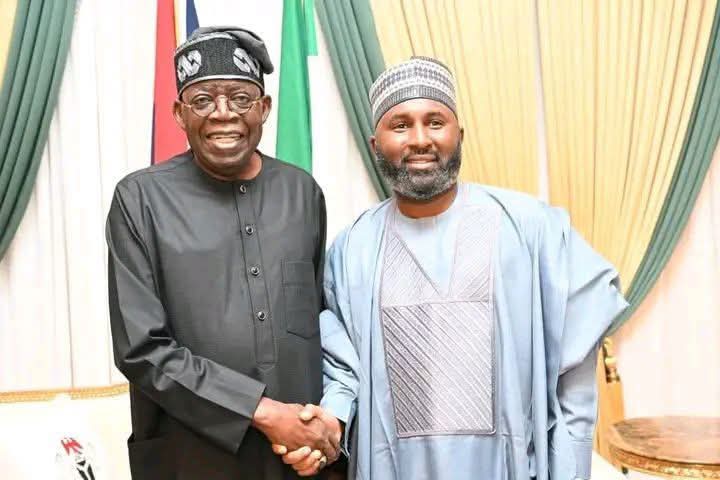
President Bola Ahmed Tinubu celebrates the Chairman, House of Representatives Committee on Appropriation, Hon. Abubakar Kabir Bichi, on his 45th birthday today.
President Tinubu describes Hon. Bichi, who represents Bichi Federal Constituency of Kano State, as a vibrant, resourceful and dedicated lawmaker whose commitment to legislative duties and national development stands out.
President Tinubu remarks: “ As Chairman of one of the most strategic committees of the House, Hon. Bichi has demonstrated uncommon capacity, grit, and leadership in steering the consideration, scrutiny, and passage of the nation’s annual budget, a role central to implementing the Renewed Hope Agenda.
“I commend him for his effective representation of his constituents and his impactful interventions in education, infrastructure, and youth empowerment, which have endeared him to his people.
“Bichi has distinguished himself since his first election to the House in 2019, where he served as Chairman of the House Committee on Works in the 9th Assembly and now as Chairman of Appropriation in the 10th Assembly.
“ As he marks his birthday today, I urge him to rededicate himself to serving his people and his fatherland.
“ And I pray to Almighty God to continue to bless him with good health, wisdom and strength.”
Bayo Onanuga
Special Adviser to the President
(Information & Strategy)
October 3, 2026
News
Yari Urges North to Respect Power Rotation, Back Tinubu’s 8-Year Presidency
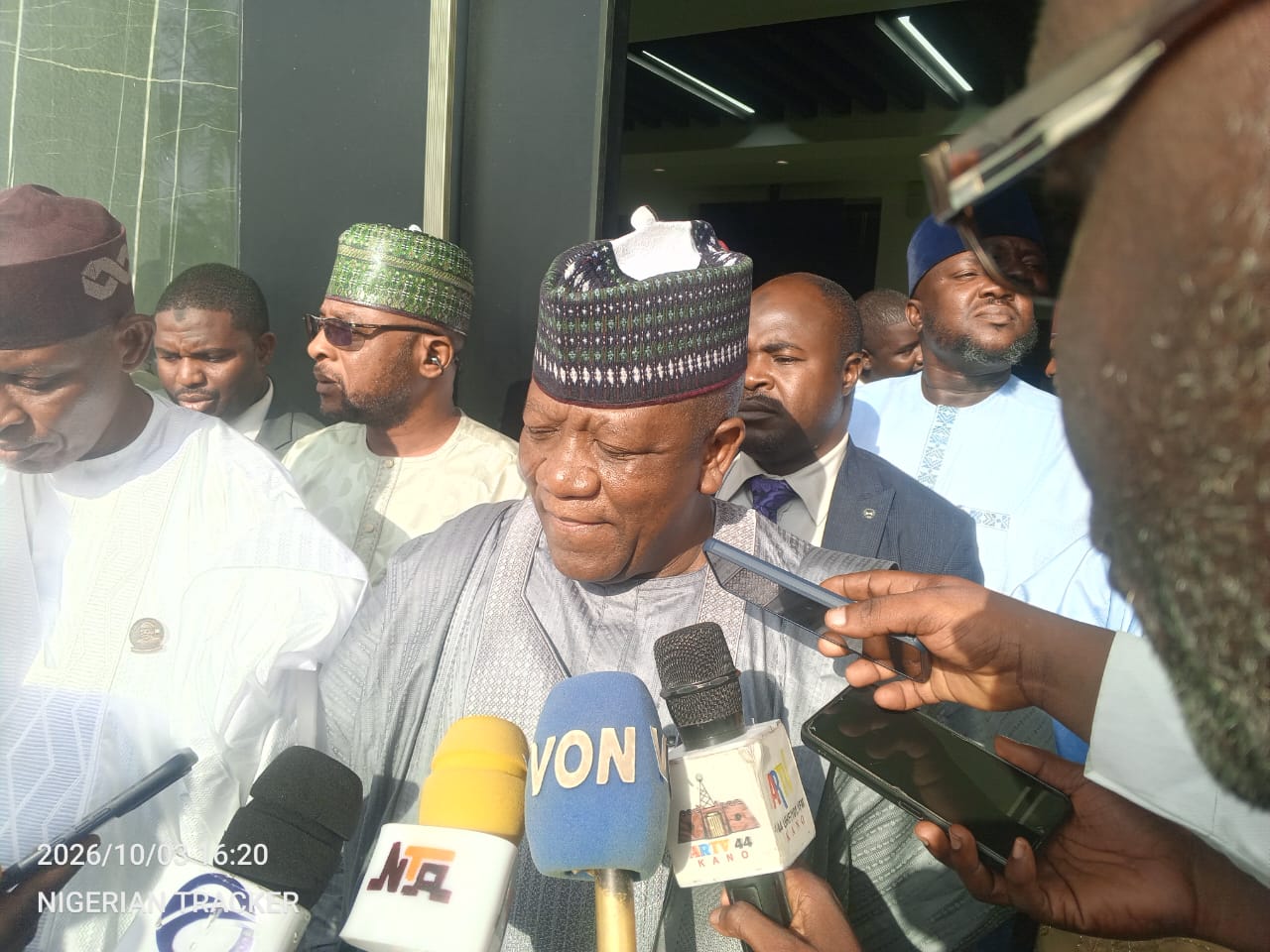
The Director-General of the APC Presidential Campaign Council, Senator Abdul Aziz Yari Abubakar, has called on Nigerians in the North to respect the informal power-rotation arrangement and allow President Bola Ahmed Tinubu to complete his constitutionally permitted eight-year tenure.
Yari made the call while addressing journalists at the Kano Government House after a meeting with Kano State Governor Abba Kabir Yusuf.
The former Zamfara State governor said the North should understand and respect the political arrangement that brought the presidency to the South in 2023, arguing that the presidency had been held by a northerner for several years before the emergence of Tinubu.
Yari said, “66 years ago since independence, the country was led by northerners for 47 years,” adding that Nigerians should recognise the importance of maintaining unity and understanding how the country’s political system operates.
According to him, Nigeria remains a country that all citizens must work together to protect, regardless of regional or political differences.
“As we love this country, we don’t have any country other than Nigeria. Nigerians should come and understand how this country works. It is also better than many nations,” Yari said.
The APC chieftain explained that his role as Director-General of the campaign council was not limited to promoting President Tinubu but also included promoting national unity and understanding among Nigerians.
Yari said the current political arrangement should be respected, noting that former President Muhammadu Buhari, a northerner, governed the country between 2015 and 2023 before power shifted to Tinubu from the South in 2023.
“Having said this, this country, Nigeria, from 2015 to 2023 was led by a northerner, and now from 2023 to 2026 it is led by a southerner,” he said.
He therefore appealed to northerners not to seek to overturn the existing zoning arrangement on the basis of the region’s population, saying the political understanding was important for national stability.
“If we say we want to uproot the zoning arrangement because of our numbers, then my call for northerners is to understand how it works. They even understand more than I do,” Yari said.
He acknowledged that President Tinubu’s administration, like every government, was not perfect, but argued that the challenges facing Nigeria should not solely be attributed to the administration.
“Nobody is perfect. The southerners have also experienced what we are complaining about today when President Buhari was in power,” he said.
Yari also argued that insecurity was not peculiar to Nigeria, saying countries across the world, including the United States, continue to grapple with security challenges despite their level of development.
“On problems, no problem of a country is solved by any government, including even in the United States. They are managing insecurity as we are managing it,” he said.
The APC campaign council director-general further cited gun violence in Chicago as an example of the security challenges faced by other countries, stressing that every nation has its own problems that require continuous efforts to address.
Turning to the economy, Yari said Nigerians should assess the Tinubu administration based on economic indicators and compare the situation at the time the president assumed office in 2023 with the current position.
“When you look at when Asiwaju Bola Ahmed Tinubu came to power in 2023, go and check what was the state of our reserves and what it is today, and what was the rate of inflation in 2023 and what it is today,” he said.
Yari maintained that the administration was making efforts to address the country’s economic and security challenges, while acknowledging that governments at both federal and state levels were working to improve the situation.
He urged Nigerians, particularly those in the North, to give the political arrangement time, arguing that the presidency would return to the region after Tinubu’s tenure if the existing rotation principle was maintained.
“I am calling on northerners to note that by the time Bola Ahmed Tinubu finishes in 2031, it will definitely come back to the North. So, this is how the arrangement is,” Yari said.
He added that federal and state governments were making efforts to address the challenges confronting the country and urged Nigerians to support measures aimed at strengthening national unity and development.

Kano Gov Abba Kabiru Yusuf bags international sports award in UK

President Tinubu Salutes Hon. Kabir Bichi, Chair Appropriation Committee Of The House Of Representatives On His 45th Birthday

Yari Urges North to Respect Power Rotation, Back Tinubu’s 8-Year Presidency

Muhuyi Raided Our Area: Encomiums, Prayers and Solidarity Trail Operation

Scrap Dealers Begin 15-Day Strike, Blame Chinese, Foreign Firms for Market Crisis

Zamfara Varsity ASUU Threatens Warning Strike Over FG-ASUU Agreement, Promotion Arrears

Kano Chemists Threaten Warning Strike Over Alleged PCN Pressure

Per Ishaq Samaila: “Waziri” for Strategy. “Mai Jama’a” for Service. One Man. One Mission. Ibrahim Kabir Masari

Goje’s Electoral War:The Confrontation With Tinubu,Governor Inuwa,Usman Kumo And APC candidates Ahead Of 2027

Prof Yusuf Adamu Delivers BUK’s 63rd Professorial Inaugural Lecture, Reflects on Medical Geography and Academic Legacy
Kano Gov Abba Kabiru Yusuf bags international sports award in UK
President Tinubu Salutes Hon. Kabir Bichi, Chair Appropriation Committee Of The House Of Representatives On His 45th Birthday
Yari Urges North to Respect Power Rotation, Back Tinubu’s 8-Year Presidency
Muhuyi Raided Our Area: Encomiums, Prayers and Solidarity Trail Operation
Scrap Dealers Begin 15-Day Strike, Blame Chinese, Foreign Firms for Market Crisis
Zamfara Varsity ASUU Threatens Warning Strike Over FG-ASUU Agreement, Promotion Arrears
Kano Chemists Threaten Warning Strike Over Alleged PCN Pressure
Per Ishaq Samaila: “Waziri” for Strategy. “Mai Jama’a” for Service. One Man. One Mission. Ibrahim Kabir Masari
Goje’s Electoral War:The Confrontation With Tinubu,Governor Inuwa,Usman Kumo And APC candidates Ahead Of 2027
Prof Yusuf Adamu Delivers BUK’s 63rd Professorial Inaugural Lecture, Reflects on Medical Geography and Academic Legacy
-

 Opinion5 years ago
On The Kano Flyovers And Public Perception
-

 Features5 years ago
How I Became A Multimillionaire In Nigeria – Hadiza Gabon
-

 Opinion6 years ago
Kano As future Headquarters Of Poverty In Nigeria
-

 History5 years ago
Sheikh Adam Abdullahi Al-Ilory (1917-1992):Nigeria’s Islamic Scholar Who Wrote Over 100 Books And Journals
-

 Opinion5 years ago
My First Encounter with Nasiru Gawuna, the Humble Deputy Governor
-

 History5 years ago
The History Of Borno State Governor Professor Babagana Umara Zulum
-

 History6 years ago
The Origin Of “Mammy Market” In Army Barracks (Mammy Ochefu)
-

 News4 years ago
Federal University Of Technology Babura To Commence Academic Activities September