
News
Man To Die By Hanging For Beheading Own Son For Money Ritual In Adamawa
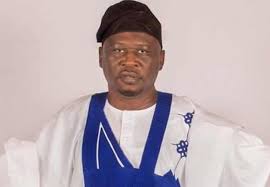
A Middle age man, Bappa Alti of Ganji village in Gombi Local Government Area, Adamawa state has been sentenced to death by hanging for killing own son, Buba Bappa for money ritual.
The state High Court VII presided over by Justice Fatima Ahmed Tafida, on Wednesday convicted Bappa for causing the death of his son by hitting him with a rearing stick and thereafter chopping off his head with a cutlass.
It was learnt that the convict was tricked by some suspected ritualists (now at large) to kill his own son in order to make money for him, the devilish idea which he consented to and started planning on how to carry out the act.
The convict and his son, late Buba went to the bush on 13th July 2013 to rear his cattle unknown to the son that his father was nursing evil plan to kill him.
A Kano School Where 560 Pupils Study In One Class Room Block
To execute his evil plan, Bappa was said to have used a stick and hit his son as a result of which the deceased fell on the ground, and later used his cutlass and cut off the head of the boy leaving him lifeless.
When the convict came back home in the evening of the fateful day, he enquired from his wife whether the late son whom he claimed to have sent to the farm had returned.
But his wife told him that the boy was yet to come back home, a situation which caused confusion and tension in the family, leading to a collective decision to launch a search in the bush.
To trace the whereabouts of the victim, the convict in the company of his brothers mobilised the community and went into the bush in search for the deceased the first day but to no avail, and decided to continue with the search the next day.
NEWS PLATFORM was told that it was during the second round of search that the lifeless body of the young man was found without the head.
The search team then became suspicious of the father and decided to apprehend him. It was at this juncture that the mater was reported to the Gombi Divisional Police headquarters who promptly arrested him and launched an investigation into the matter.
The case was later referred to Criminal Investigation Department Yola, for further investigation where the suspect and now convict confessed to had committed the offence.
In the course of an investigation, the convict led the investigative team of CID to the scene of the incident and where he buried the head and was exhumed by the police which was tendered in evidence.
The suspect and now convict was earlier arraigned before court for culpable homicide punishable with death contrary to section 221 of the penal code law.
After evaluating all the pieces of evidence which include the severed head of the deceased, the cutlass used to cut off the head, and voluntary confessional statement of the accused, the presided Judge declared that without an iota of doubt, the suspect actually masterminded the killing of his son thereby committing an offence contrary to section 221 of the penal code law and therefore sentenced him to death by hanging.
Justice Fatima Ahmed Tafida stated that the prosecution has proved beyond a reasonable doubt that the death had occurred, and it was the defendant that caused his son’s death by hitting him and subsequently beheading the deceased with a cutlass.











News
Okonjo-Iweala to Tinubu: Borrow Cautiously, Reforms Should Create Jobs for Nigerians
By Yusuf Danjuma Yunusa
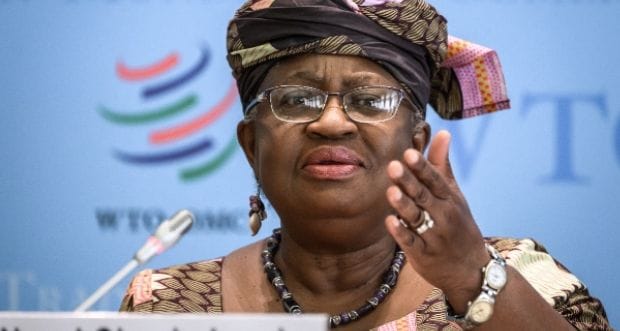
The director-general of the World Trade Organisation, Ngozi Okonjo-Iweala, has urged the Nigerian government to be careful about borrowing and managing the country’s debt, saying economic reforms must improve the lives of ordinary Nigerians.
She also called on the government to sustain ongoing reforms while creating more jobs and economic opportunities for the country’s growing youth population.
Mrs Okonjo-Iweala spoke on Wednesday at the seventh Africa Emerging Markets Forum in Abuja.
Commending the Central Bank of Nigeria for its monetary and foreign exchange reforms, Ms Okonjo-Iweala urged Nigeria to continue broader economic reforms while remaining disciplined in managing its finances.
“Nigeria needs to continue the work on overall macroeconomic reforms with a careful approach to fiscal issues, contracting of debt and debt management,” the WTO chief stated.
According to the latest data from the Debt Management Office, Nigeria’s total public debt stood at N159.28 trillion at the end of December 2025, rising by N14.61 trillion, or 10.10 per cent, from N144.67 trillion recorded at the end of 2024. The figure covers the debt owed by the federal government, the 36 states and the Federal Capital Territory. The government is also expected to continue borrowing this year to finance its 2026 budget deficit.
Mrs Okonjo-Iweala said the success of Nigeria’s reforms should not be measured only by improvements in economic indicators. Instead, she said Nigerians must begin to experience better living conditions through more jobs and opportunities.
“Above all, Nigeria needs to focus on creating jobs and economic opportunities for a young and hungry population. Nigerians have to feel the dividends of reform in the real economy,” noted the WTO chief.
Nigeria has one of the world’s youngest populations, with millions of young people joining the labour market every year. However, many struggle to find decent jobs, making employment one of the biggest economic challenges in the country.
Since President Bola Tinubu assumed office in May 2023, his administration has introduced major reforms, including the removal of petrol subsidy and the liberalisation of the foreign exchange market.
The policies have pushed up the cost of living, with many Nigerians facing higher prices for food, transport and other essentials. Although inflation has slowed in recent months, prices remain high.
The National Bureau of Statistics said Nigeria’s headline inflation rate eased slightly to 15.91 per cent in June 2026 from 15.93 per cent in May. Food inflation, however, increased to 17.52 per cent, showing that many households are still paying more for basic food items.
For opportunities, Ms Okonjo-Iweala said countries that maintain stable economic policies and improve their business environment will be better placed to benefit from changes in global trade.
She noted that companies are increasingly looking for new places to invest and diversify their supply chains, creating opportunities for countries that can offer stability and predictable policies and urged Nigeria to continue strengthening its economy so it can attract long-term investment and create more jobs for its people.
News
U.S. Discontinues Routine Visa Services in Abuja, 24 Other African Cities

By Yusuf Danjuma Yunusa
The U.S. government says routine visa services in Abuja and 24 other African cities will end on August 1.
“Effective August 1, 2026, the Department of State will realign routine visa services in Antananarivo, Abuja, Asmara, Bamako, Banjul, Brazzaville, Bujumbura, Conakry, Cotonou, Durban, Freetown, Gaborone, Harare, Juba, Libreville, Lilongwe, Lusaka, Maputo, Maseru, Mbabane, N’Djamena, Niamey, Nouakchott, Ouagadougou, and Windhoek to a regional visa hub,” the agency stated.
It noted that citizens and residents of the affected countries who wish to apply for a visa on or after August 1, 2026, must schedule an appointment and pay the required visa fee at the appropriate designated non-immigrant visa locations or designated immigrant visa locations.
From August 1, Nigerians who want to process a U.S. visa would have to travel to the U.S. consulate in Lagos.
According to a statement on July 23 by the agency, the move is “realigning visa operations in Africa to regional hubs, part of a long-standing Department practice that strengthens national security by promoting more uniform screening, vetting, and adjudication standards, as well as improves efficiency”.
Last June, reports had it that Abuja was missing from President Donald Trump administration’s shortlist of 20 African cities where foreigners seeking to travel to the U.S. can process visa applications.
The U.S. currently has around 50 embassies and consulates across Africa that process visa applications, but the new move by the State Department will slash that number to 20 amid Mr Trump’s crackdown on immigration.
News
Breaking:Sardaunan Sokoto Alhaji Abubakar Alhaji Is Dead
Abbas Yushau Yusuf
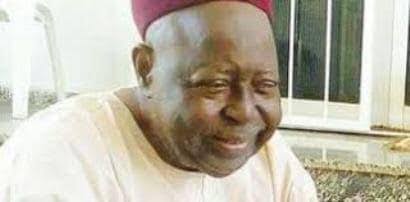
The Sardaunan Sokoto and Nigeria’s former British high commissioner Alhaji Abubakar Alhaji is dead.
A family source informed Nigerian Tracker about the passing of Alhaji Abubakar Alhaji this morning
Alhaji Abubakar Alhaji died this morning in Abuja Hospital after a prolong illness.
NIGERIAN TRACKER reports that Abubakar Alhaji is a Nigerian administrator who is a former Minister of Planning and Finance. He currently holds the title of Sardauna of Sokoto. Alhaji was a long serving Permanent Secretary who worked with various Nigerian administrations
Alhaji was born to the family of Muhammed Sani also known as Alhaji Alhaji because he was born on the day of Sallah and went on a made pilgrimage to Mecca, he was also called Dogon Daji, Sarkin Shanu.
Alhaji attended a secondary school in Kano before transferring to Katsina Government College. He later attended Bournemouth College of Commerce and University of Reading, Berkshire earning a degree in political economy.
Alhaji took courses at the Hague Institute of Social Services and the IMF Institute, Washington.
He joined the Nigerian civil service in 1964 and was an Assistant Secretary in the Federal Ministry of Finance in the late 1960s. After attending a course in Hague, he was briefly posted to the Ministry of Industries where he became a Principal Assistant Secretary. In 1971, he was posted back to the Ministry of Finance. In 1975, he became a Permanent Secretary in the Federal Ministry of Trade and was in the ministry till 1978. In 1979, he was posted to the Finance Ministry as the Permanent Secretary. In his role at the Finance Ministry, he was involved in managing Nigeria’s relationship with its external creditors and was on the Nigerian negotiating team for Lome II agreement.
Alhaji was later posted to the Ministry of Planning before Babangida upgraded his position as Minister of State, Budget and Planning in 1988. Between 1990 and 1991, he was the Minister of Finance. In the mid-1990s, he was the country’s High Commissioner to United Kingdom.
Alhaji was turbaned Sardauna in 1990, the previous title holder, Ahmadu Bello died in 1966. He is a senior brother to the late Aliyu Dasuki who was raised by Ibrahim Dasuki. He has a grandson, Ibraheem Dasuki Aminu-Alhaji.

Okonjo-Iweala to Tinubu: Borrow Cautiously, Reforms Should Create Jobs for Nigerians

U.S. Discontinues Routine Visa Services in Abuja, 24 Other African Cities

Breaking:Sardaunan Sokoto Alhaji Abubakar Alhaji Is Dead

ADC Youths Call on Atiku to Intervene Over Allegations of Injustice in Primary Elections, Demand Resignation of David Mark

Kaduna 2027: Governor Uba Sani Replaces Deputy, Names Jerry Adams as Running Mate

Alhaji Tijjani Rabiu Spikin: A Neighbour, Philanthropist, and Friend of Children

What Saheeba Taught Me About Waiting for Love

Is N100,000 Worth the Risk?’ Nigerians React to Soldiers’ Salary Increase

CBN Revokes Licences of 46 Microfinance Banks Over Regulatory Breaches

Goodwill, Visibility, and Operational Security: A Strategic Communication Reading of Senator Ahmad Lawan’s DIA Post
Okonjo-Iweala to Tinubu: Borrow Cautiously, Reforms Should Create Jobs for Nigerians
U.S. Discontinues Routine Visa Services in Abuja, 24 Other African Cities
Breaking:Sardaunan Sokoto Alhaji Abubakar Alhaji Is Dead
ADC Youths Call on Atiku to Intervene Over Allegations of Injustice in Primary Elections, Demand Resignation of David Mark
Kaduna 2027: Governor Uba Sani Replaces Deputy, Names Jerry Adams as Running Mate
Alhaji Tijjani Rabiu Spikin: A Neighbour, Philanthropist, and Friend of Children
What Saheeba Taught Me About Waiting for Love
Is N100,000 Worth the Risk?’ Nigerians React to Soldiers’ Salary Increase
CBN Revokes Licences of 46 Microfinance Banks Over Regulatory Breaches
Goodwill, Visibility, and Operational Security: A Strategic Communication Reading of Senator Ahmad Lawan’s DIA Post
-

 Opinion4 years ago
On The Kano Flyovers And Public Perception
-

 Features5 years ago
How I Became A Multimillionaire In Nigeria – Hadiza Gabon
-

 Opinion6 years ago
Kano As future Headquarters Of Poverty In Nigeria
-

 History5 years ago
Sheikh Adam Abdullahi Al-Ilory (1917-1992):Nigeria’s Islamic Scholar Who Wrote Over 100 Books And Journals
-

 Opinion5 years ago
My First Encounter with Nasiru Gawuna, the Humble Deputy Governor
-

 History5 years ago
The History Of Borno State Governor Professor Babagana Umara Zulum
-

 History5 years ago
The Origin Of “Mammy Market” In Army Barracks (Mammy Ochefu)
-

 News4 years ago
Federal University Of Technology Babura To Commence Academic Activities September