
Features
How Non-existent Water Constituency Projects Swallowed Millions Of Naira In Kano
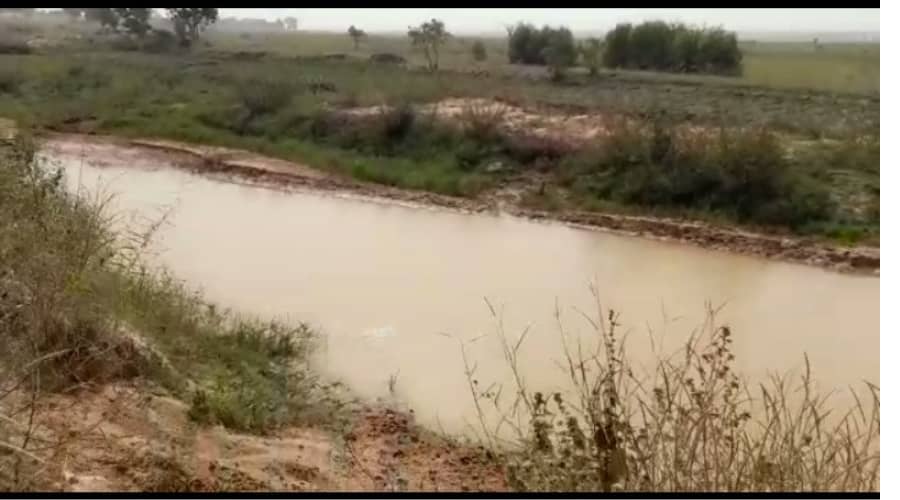
In an attempt to tackle water scarcity and provide access to safe drinking water to communities in Kano State, the Federal Government in 2019 awarded contracts to various companies for the construction of boreholes and supply of wash bores. Investigations, however, revealed that funds were released to non-existent companies leaving the projects undone.
By A’isha Ahmad Isma’il
Nine-year-old Amira Usman, a student of Kore Primary School in Makoda Local Government Area, of Kano State was seen pushing a water cart with four Jerrycans of water when this reporter met her. Amira had fetched the water from a running stream, almost 10 kilometres away from her hometown. Every morning, the nine-year-old is expected to join other children from the community, in the northwest part of Nigeria, to fetch water from the stream before heading to school. Oftentimes, they are late and school would get suspended. Speaking on the lack of portable water in the community and its multiple impact on their livelihoods, Amira’s mother, Khadija Haladu, said all her seven children now miss classes because they had to walk the long distance to get water for domestic chores.
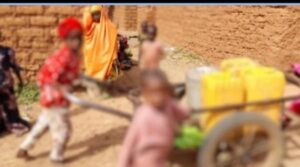
Amira Usman, pushing some of her water home.
This is despite the disbursement of over N3 million (N3,078,000.00) by the Federal Ministry of Works, Housing and Transport in the 2019 constituency project to Sabon Ruwa General Investment Limited for the supply of 40 water pumps (Honda 2 inch) to Amira’s LGA.
The project, which was said to be awarded to address the lack of portable water in many communities of the LGA, has not been executed. Residents still rely on water from nearby streams and open wells. Speaking to this reporter, a public office holder in Makoda LGA, who pleaded to remain anonymous because he was not authorised to speak, said there was only one functional borehole in Makoda ward which has been in existence for over 10 years.
“Whenever it becomes faulty, we repair it ourselves, but aside from that one, there are no water pump boreholes constructed from 2019 to date,” he said.
The source explained that all the remaining water pumps which were awarded before 2019 were abandoned halfway while others were dug but not erected. He confirmed that residents mostly rely on water from wells while those who are unable to dig wells in their homes buy from water vendors or cart pushers. The public office holder said many of the residents were at some point diagnosed with cholera and other waterborne diseases, as a result of intake of “polluted water.”
Just 20 kilometres away from Kore, in Makoda LGA, this reporter met another cart pusher in Dunawa community in Makoda local government area, fetching water from an open well. The water looked coloured and likely contaminated. But it was the best he could get in a community facing acute water scarcity. Speaking with this reporter, the Chairman of the cart pushers, Musbahu Abubakar, said he became a water vendor for two reasons; the lack of a job and poor access to potable water. But proudly, Abubakar said he does not charge much, as he sells each jerry can for N20 only.
“My cart contains 12 Jerrycans and I earn N2,400 daily to feed my family.” He said the community had a borehole constructed four years ago, which is now inoperable.
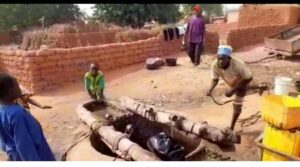
Well from which some residents of Dunawa, Makoda local government get drinking water
A distant image of the well
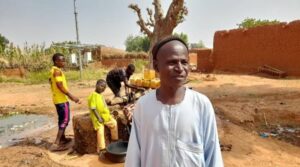
A distant image of the well
The District Head of Dunawa community, Abdullahi Usman Galadima, who is also a health worker, said the community has not benefited from any zonal intervention project since the tenure of the former House of Representative member for Makoda Federal Constituency, Umaru Inusa Mai Tsidau elapsed in 2015.
District Head Of Dubawa Abdullahi Usman Galadima
“If we can get some water pumps, we would greatly appreciate them. Now, there are communities in Makoda LGA that have no water at all, they have to come to Makoda town to get water or pay cart pushers to supply them with water, and they buy at N50 per litre due to the distance,” he said.
Galadima linked the scarcity of water in the area to increased health challenges and low economic output. He, however, said their wells are often treated with chlorine, alum,
corrosion inhibition, antifoaming and alkalinity control by the Kano State Ministry of Environment and Sanitation.
Also, at Koren Tabo in the same council area, Yusuf Ali Gatseka, an elderly resident, said they have one 35 year old borehole which sometimes requires a month’s rest. He said residents have resorted to using water from the stream which takes about 20 kilometres to the stream and back.
“On a daily basis, I use about 20 cans (50 liters per can) of water in my household, and the scarcity makes it longer to get house chores done due to the distance from Makoda town to our community,” Gatseka highlighted.
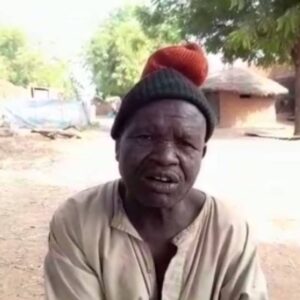
Yusuf Ali Gatseka of Koren Tabo in Makoda
Residents of Makoda LGA attribute their suffering of lack of potable water to a failed delivery of water pumps by Sabon Ruwa General Investments Limited, which received over N3 million for the contract. Sabon Ruwa General Limited is a private company which is inactive and its status remains unknown as identified by NigeriaCheck. On b2bhint, another search engine that records companies activities, Sabon Ruwa General Investments Limited is described as an inactive company.
According to the CAC, an inactive company is one that has not filed its annual returns up to date. This means award of contract to Sabon Ruwa General Investments Limited, which was incorporated on 16th July, 2018, with the RC 1510565 contravenes sections 417 – 424 of the Companies and Allied Matters Act, 2020, which states that, “every company must make and deliver their annual returns to the CAC.”
Therefore, the award of contracts to Sabon Ruwa General Investment Limited contravenes section 4.4 of the Public Procurement Act, 2007 which provides grounds for disqualifying or exclusion of bid. Section 4.4.2 (d) states that: “A bidder may have its bid or tender excluded if the bidder is in arrears regarding payment of due taxes, charges,
pensions or social insurance contributions unless such bidders have obtained a lawful permit in respect to allowance.”
An e-mail sent to Sabon Ruwa General Investments Limited using: sabonruwageneralinvest@gmail.com bounced back. The company, which has Muktar Sale and Ibrahim Muktar Sale as its directors, has no other traceable online activity. NG-Check, however, shows that the company’s office address is located at: No. 6 Kard Shops, Gandu Albasa quarters, Kano. This reporter, however, could not trace the address after several visits to the area. Other business owners in the area said they had no knowledge of such a company in the area.
On 5th, Nov 2022, this reporter subjected the stream water consumed by some residents of the Kore community in Makoda LGA to a laboratory test conducted by MAMS Consultancy Services, Kano. After three days, the results of the test showed that the water consumed by the community is unsafe, and contaminated with harmful microorganisms.
According to the test result, Psedomonas aeruginosa, one of the most dangerous bacteria known to cause inward fever, vomiting and abdominal pain was present in high proportion.
The water also contained, in high proportion, a group of microorganisms indicating amongst other things, fecal contamination and the presence of harmful, disease-causing organisms. These organisms are termed coliform.
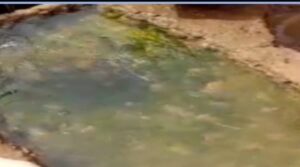
Stream water used occasionally by people of Koren Tabo in Makoda LGA
A 2019 report by the Federal Ministry of Water Resources and United Nations Children and Education Fund, UNICEF, showed that one-third of Nigeria’s population drink contaminated water while 130,000 Nigerian children die annually as a result of water-related infections.
Coliform bacteria include Escherichia coli, and Salmonella species. When these species are present in high proportion in any drinking water, they often cause life-threatening diseases such as typhoid, dysentery, and hepatitis amongst others, as explained by the examiner.
According to UNICEF, access to safe drinking water remains a huge challenge to the majority of Nigerians, especially those living in rural areas. It is estimated that about 69 million people do not have access to clean water sources and 19 million rural dwellers walk long distances to collect unsafe water from lakes, streams and rivers.
In order to tackle this problem, in the 2019 constituency projects, the Federal Ministry of Works, Housing and Transport awarded the sum of N9, 180.000 to Azaico Construction Nig. Limited for the construction of 30 water pumps of 21 inches in Fassi ward of Kibiya local government area of Kano State. This reporter found that the project was not executed.
The Village Head of Fassi, Ado Sa’adu said there were no water pump and wash bore projects in the community. Sa’adu said: “We dig wells. At some places the water is drinkable, and other places it is not, but we have drinkable ones mostly since we have a sandy soil, the water is usually good.”
He however said they would prefer a borehole adding that, “even just five boreholes would go a long way in helping the community.”
During a visit by this reporter to Kwantagi village in Fassi ward, this reporter found a similar situation, as Isa Muhammad Dauda, a resident of the community said the last borehole dug in his community was about six years back and it no longerfunctions. He said they have received borehole support from Non-Governmental Organisations to ease their water needs. Dauda, who sells tea, however, said the boreholes have not solved their water challenge, as most of the constructed ones have broken down, despite efforts at fixing them.
Checks on Azaico Construction Nig on NigeriaCheck, showed that the company’s status is registered with an address located at No. 10, Gaida Fanshekara, Kumbotso L.G.A of Kano State. However, this reporter, who visited the address on the 7th of November 2022, could not trace the company at the said address.
Residents in the area also said they have never heard of the company. The email address provided in the contact of the company on Nigeriacheck as: azaicoconstructionnigltd@gmail.com was not active as an email sent bounced back.
Checks of the company on social media platforms including LinkedIn, Facebook and Instagram came up with no results. Efforts to track the company’s directors including Ayuba Alasan Labaran, Kabiru Alh. Rimin Gado, Abdulrauf Moh’d Ibrahim were unsuccessful as they have no obvious social media presence. This reporter found Facebook accounts with the names Kabiru Rimin Gado and Labaran Ayuba Alasan but they had no details or posts.
At Bunkure LGA, contract for the construction of water pumps and wash bore was not executed, after N8,464,500 was released to Halliru Gurjiya and Sons Ltd, to construct 110 water pumps and supply 112 No. wash bore at the sum of N1,814,400.00.
Some boys getting water from a well Bono Community in Bunkure LGA
A resident of Bono community in Bunkure LGA, Sabo MaiKifi Auwal, told our reporter that they do not have a single borehole constructed as a zonal intervention project but added that the “boreholes we have were constructed by a philanthropist.”
Auwal, who is a fish seller, lamented that the lack of access to potable water was a major setback to his business, as he needs water to clean his fishes. “We are very unhappy, but we hope the government will come to our aid,” he said.
A resident of Bono Community in Bunkure LGA Sabo Mai Kifi Auwal,
Locating the contractor’s address which NigeriaCheck listed as No.1 Taura Road, opposite NNPC Hotoro, Kano, was unsuccessful as the area had only residential houses. Muhmmad Haruna, a resident of the Taura Road, who said he has lived in the area for over 20 years said he never heard of the company.
After visiting various communities in Bunkure (Bono, Agalawa, and Sabon Gari communities) to interview residents, the APC local government chairman, Rabi’u Halliru
confirmed that no water pumps and wash bore were supplied. He clarified that the water pumps in Bunkure are state projects done by the Kano State House of Assembly.
Checks on NG-Check.com shows Halliru Gurjiya and Sons Ltd, was registered on 26th August, 2004 with Registration No RC 605628. Its official address at Taura Road (1) opposite Hotoro, Kano, has also turned out blank after a visit by this reporter. However, a search on CAC says there is no matching record found for the search (using both company name and RC number).
Speaking on why intervention projects are not executed, the Advocacy and Communication Officer, Centre for Awareness on Justice and Accountability, Akibu Hamisu described such projects as ‘cash cow projects.’
Hamisu explained that as accountability promoters and part of Independent Corrupt Practices and other Related Offences Commission, Civil society members for tracking constituency projects, they had observed a lot of deviations, poor implementation and sometimes non implementation of projects mostly carried out by legislators themselves or their closed allies.
“These constituency projects are cash cow projects, although anti graft agencies, CSOs and media are doing a lot in reducing the excesses,” he said. He however said some successes have been recorded as some contractors have been called back to site or asked to replace sub standard materials supplied.
He stressed the need for a fair and competitive procurement and bidding process at all levels.
How contractor Allegedly constructed ‘shabby’ borehole in Falgore
In the 2019 zonal intervention project, a project for the construction of boreholes, was nominated by Alhassan Ado Doguwa, House of Representative member for Doguwa/Tudun Wada federal constituency, to construct over 10 solar powered boreholes at the sum N100 million.
The money was released to SAT Engine Services, through the Hadejia Jamaare River Basin Authority.
On a visit to Doguwa/Tudun Wada federal constituency, our correspondent observed that most of the boreholes in Brunburun, Bul, Falgore, Rugurugu, and Janduste are not functioning after residents claimed an alleged shoddy work was done.
A community leader at Rugurugu, Sani Umar said the borehole broke down less than four months after construction. “Up till now, it has not been fixed because we don’t have enough money to fix it,” he said.
A solar-powered borehole project at Falgore, in Doguwa LGA also packed-up barely six months after the project was handed over to the benefiting community. Residents of Falgore reported that the project was handed over to them in February 2021 and by August 2021, the taps had stopped running.
Abdullahi Aliyu, the community leader said because of this, some elders had to remove the components of the project to store them as a preventive measure against vandals.
“The borehole sank due to the soil there being too soft. Even at the initial stage of the work, we advised the contractor not to construct the borehole on that spot, but he ignored us. Barely six months after, the borehole collapsed and became non – functional,” he said.
“We tried to locate the contractor, our local government party chairman, and our representative, but all our efforts proved abortive,” he further stated.
Speaking as an expert, Kabiru Ado, a water surveyor at Munib Drilling Company in Fagge, said the major cause of such collapse in boreholes was due to shoddy works or inappropriate survey of the land. “Sometimes, the borehole drillers don’t drill to the expected metres, so it causes inflow to the water distribution,” he said.
However, a Director at SAT Engines Service, Alhaji Saminu Adamu, denied that the company executed a shoddy job. Instead, he said, the solar powered boreholes were perfectly executed. “If after the work, there is a problem, even if it is after the three month grace period, we send an engineer to help them fix it,” he said. Adamu said when they handed over the projects to the people, all the boreholes were functioning.
He added that: “The local government cannot maintain these projects, neither can the residents. I would suggest that the government hands over these projects to private individuals, who would in turn charge for the water.
This reporter also reached out to the project client, Hadejia-Jama’are River Basin Authority, which stated that the community has the full responsibility of fixing the boreholes. Mustapha Umar, the Director, Head of Water Supply, of the Authority said the boreholes have been neglected by the residents who “refused to make minor repairs.”
“Sometimes the fault is very minor, but because they don’t treat it as their property, they don’t repair them. Now we are changing our awareness approach by training some community members on how to fix the problems concerning the boreholes,” he said.
Umar promised that repairs will be made in all the affected areas where the Doguwa/Tudunwada constituency water projects have faults.
When asked to speak with the Managing Director of the agency for more information, the spokesman of the authority, Salisu B Hamza, said “he is new and answering these questions will take a very long time and procedure.”
“I am hoping the answer we provided earlier would be sufficient for now, but it would take a series of meetings with people who handled the projects about five to six years back to brief the director,” he added.
Ministry Yet To Reply FOI
A Freedom of Information Act (FOIA) was sent on 14 Nov, 2022 to the Federal Ministry of Works, Housing and Transport, to respond to issues around the contracts, but it did not respond to the FOI at the time of filing this report.
“This investigation is supported by the John D. and Catherine T. MacArthur Foundation and the International Centre for Investigative Reporting.”













Features
Why I want To Rewrite Kannywood’s Playbook – Dan Hausa

By Saif Ibrahim, Kano
Who is Dan Hausa?
I am Kamilu Ibrahim born 31 years ago, but most people know me as Dan Hausa. I was born in Fagge, Kano State, and from the very beginning I knew I wanted to tell stories that reflect the realities of my people. I trained at the High Definition Film Academy in Abuja, SAE Institute, and also took part in the U.S. Embassy’s Filmmaking for Impact program. I join the fikm making industry and started directing in 2017 because I wanted full control over how my stories are told.
Can you tell us a bit about yourself and your journey into film directing?
My journey began with a love for storytelling—I started as a scriptwriter, then worked closely with experienced filmmakers before directing my first film. Over the years, I’ve learned that directing isn’t just about cameras and lights, but about understanding people, culture, and the power of narrative.
Growing up, I saw how films could educate and inspire people. In Arewa, cinema is more than entertainment—it’s a mirror of society. I wanted to use that mirror to reflect our values, challenges, and hopes. That desire to make meaningful films pushed me into directing.
What sets your work apart in today’s Kannywood?
For me, it’s about merging modern cinematic techniques with our Hausa cultural identity. I love bold visuals and tight storytelling, but I never want to lose that traditional heartbeat of my origin. My goal has always been to raise our production quality to international standards while staying true to our roots”, proof of that is clear in my current and biggest project, “Wata Shida.
How would you describe your directing style?
I like to call my style “realism with purpose.” I focus on authenticity—every scene, every performance, every frame must feel true to life. But I also ensure that there’s always a message, something the audience can take home and reflect on.
Can you highlight some of your notable works?
Sure, there is Wata Shida which is currently airing and has an overwhelming response from the public and the likes of Lulu Da Andalu a myth-inspired adventure series showing on AREWA24 and YouTube. YouTube pushed us to think bigger in terms of story and production. Mijin Hajiya earned me Best Director at the 2024 Kano Entertainment Awards, while Tataburza made waves at film festivals. Earlier films like Bakon Yanayi (2019) and my debut Kulba Na Barna (2017) helped me define my style. My latest project, Amaryar Lalle, starring Rahama Sadau, premieres August 2025 on Sadau Pictures TV. Each project is a step forward in showing what Kannywood can achieve.
What awards and recognitions have you earned?
I have also been recognized by the Arewa5050 Awards and Kaduna International Film Festival (KIFF) for Lulu Da Andalu, which even won Best Indigenous Hausa Film. There’s also an AMVCA nomination for best Africanindigenous language , which is exciting because it means Hausa stories are getting wider attention.”
Who are your key collaborators?
Filmmaking is teamwork; TY Shaba has been a creative partner on several projects, especially on Lulu Da Andalu. I have WORKED with Rahama Sadau on Amaryar Lalle has been fantastic; she brings so much energy to the screen.”
What themes do you explore in your films?
I like telling stories where modern life clashes with traditional values—family conflict, cultural identity, gender roles. These are real issues in our society, and I try to explore them honestly but cinematically. I believe film should make people feel and also think.”
What is your next project?
I am working on Wata Shida Season 2, a story about a woman who enters a six-month sham marriage to protect her inheritance. It’s socially meaningful but also very entertaining. I will also continue with season 2 of “Amaryar Lalle.”
Can you tell us a little about your latest project?
This project is very close to my heart. It follows a young girl fighting to get an education in a society full of obstacles. Through her eyes, we see how family, tradition, and resilience collide, and how hope can survive even in the harshest situations.”
What inspired you to make this story?
Growing up, I saw so many bright young girls whose dreams were cut short just because they were girls. I felt a responsibility to tell this story—not as fiction, but as a mirror of what is happening around us.
How do you balance tradition and modernity in your work?
A: It’s about respect. I respect our traditions, but I also embrace new technology and ideas. In my films, I make sure traditional values are represented truthfully, while using modern techniques to improve production quality.
What challenges do you face as a director in Kannywood?
Budgets are often limited, and resources can be scarce. But the biggest challenge is sometimes societal misunderstanding of what we do as filmmakers. People forget that film is also an art form and a tool for change, not just entertainment.
Can you tell us your favourite project
Every project has its own special memory, but I’m proudest when a film sparks conversation or impacts people’s lives. For example, one of my recent films about youth unemployment led to community discussions and even small initiatives to help young people. That’s when I feel film is doing its job.
What advice would you give to aspiring directors?
Learn the craft—don’t rush. Watch films, study scripts, spend time on set even if it’s just to observe. Most importantly, stay humble and focused. Filmmaking is about patience, teamwork, and vision.
What should audiences expect from your upcoming projects?
Expect more powerful stories rooted in our culture, with better technical quality. I’m working on projects that tackle real societal issues, and I believe they’ll resonate with audiences not just in Arewa, but globally.
Features
Antenatal Care: Why some women misses several sessions

By Aisha Muhammad Rabiu
In many parts of Northern Nigeria, antenatal care is a vital step in ensuring the health of both mother and the unborn child. Yet, an increasing number of women are neglecting this crucial stage of pregnancy, putting themselves and their babies at serious risk, hence the high infant, mother mortality rate.
Health experts have been warning that antenatal visits help detect pregnancy complications at its early stage, provide essential supplements for healthy mother/child development, and educate mothers on safe delivery practices. But for some women, they find antenatal care as a burden either due to poverty or lack of awareness based on cultural practices and beliefs. As such antenatal remains a neglected priority.
In Kadawa, Fatima Sani, a 28-year-old expectant mother, admits she has not attended a single session of antenatal since the start of her pregnancy. she said “It’s not that I don’t want to go, but the clinic is far from my house, and my husband says we should save the transport money for delivery day. I just pray Allah protects me and my baby.”
From Dan Bare, Shago Tara precisely, Khairat a mother of 4 shares her reasons for not attending antenatal session even though she is fully aware that the session is very important to pregnant women. She said “I feel healthy, so I don’t see the need to go for antenatal. My mother gave birth to all her children at home without any clinic visits, and they all survived.”
In Rijiyar Zaki, Hadiza Mukhtar recalls her previous pregnancy, where she skipped antenatal visits entirely. “The nurses were rude to me when I first went. I decided I would not return. This pregnancy, I haven’t gone at all,” she confesses.
For Usaina Muhammad of Kurna, the problem is financial. “I can’t afford the registration fee, and I also have other children to feed. I know antenatal is important, but survival comes first.”
Meanwhile, Maryam Lawan of Layi Kaji reveals that misinformation has influenced her decision. “Someone told me that the iron tablets they give at the clinic make the babies grow too big, making delivery harder. So, I decided to avoid it altogether.”
Medical professionals emphasize that skipping antenatal care increases the risk of complications such as anemia, high blood pressure, infections, and even maternal or infant death. Dr. Ibrahim Musa, a gynecologist in Kano, warns: “We see many emergencies that could have been avoided if the mother had attended antenatal. Most of these cases arrive late, making it harder for the doctors to save lives.”
Experts and community leaders agree that raising awareness is key in addressing the matter. Antenatal care should be made more affordable, accessible, and culturally acceptable for all women. Religious leaders, health workers, and family members all have a role to play in encouraging expectant mothers to attend regular check-ups.
Neglecting antenatal care is not just a personal choice; it’s a public health concern that affects families, communities, and the future of the nation. Ensuring that every mother has the knowledge, resources, and support to seek antenatal care is a step toward a healthier society.
Aisha Muhammad Rabiu writes from Bayero University Kano (BUK) and she can be reached at Email: aishatama2020@gmail.com
Phone no.08084273341
Features
Rano’s Peaceful Legacy: More Than a Slogan, One Tragedy Won’t Define Us

For decades, Rano Garin Autan Bawo has proudly stood as a symbol of peace and harmony in Kano State. It is a place where neighbors look out for one another, where disputes are settled through dialogue, and where diversity is met with respect—not resentment. In Rano, peace is not just a slogan—it is a way of life passed down through generations.
The tragic incident that recently occurred at the Divisional Police Station in Rano Local Government has deeply shaken our community. Known for generations as one of the most peaceful and united areas in Nigeria, Rano now faces the painful reality of an attack that led to the death of a Divisional Police Officer and the destruction of police property. This senseless act of violence goes against everything our community stands for and must not be seen as a reflection of who we are.
Rano has long been recognized for its peaceful spirit, tolerance, and respect for all. People from different backgrounds, religions, and cultures have lived side by side here in harmony. This didn’t happen by chance—it is the result of years of effort by our leaders, religious figures, and ordinary citizens who believe that our strength lies in our unity and diversity.
Our respect for law and order is deep-rooted. We understand the crucial role that security personnel play in keeping our community safe. The people of Rano have always appreciated the risks and sacrifices made by the police, military, and other agencies to protect lives and property.
Respect for the law here is not just about obeying rules—it’s about a shared belief in justice, fairness, and solving problems peacefully and legally. This belief has helped build a respectful and cooperative relationship between the police and the people.
What happened at the police station is completely out of character for our community. The individuals who carried out this attack do not represent us. Their actions go against the values that have shaped Rano. We strongly condemn what they did and make it clear that their behavior does not reflect who we are.
The loss of the Divisional Police Officer is not just a blow to the Nigeria Police Force or the Kano State Police Command—it is a loss for all of us. He wasn’t just doing his job; he was part of our extended family. His death is an attack on the peace and security that we all hold dear.
We send our deepest condolences to his family. No words can ease the pain of losing a loved one in such a brutal way. Our thoughts are also with his colleagues in the police force, who have lost a brother and a friend.
We also stand with the Kano State Police Command and the Nigeria Police Force as they face this heartbreaking loss. We understand how much this affects their morale, especially at a time when their work is more important than ever.
Destroying police buildings and equipment is not just an attack on law enforcement—it’s an attack on the very system that helps keep us safe. These facilities belong to the people and serve the entire community. Damaging them harms everyone, especially the most vulnerable among us.
We urge the government and relevant authorities to investigate this incident fully and fairly. Those responsible must be held accountable. Justice must be swift and uncompromised. Our community deserves to see the law upheld and the wrongdoers brought to book.
To our young people—the future of Rano—we ask for calm and reflection. We know that you may be frustrated or angry about many issues. But violence is never the answer. Taking the law into your own hands only brings more pain and setbacks for everyone.
Instead, we encourage our youth to focus on positive, constructive paths. There are peaceful, legal ways to raise your voices and push for change. Use those channels. Help move our community forward.
Rano must now focus on healing, rebuilding trust, and recommitting to the peaceful values that have always defined us. We must come together—young and old, leaders and citizens—to ensure that such violence never happens again.
We call on traditional leaders, religious figures, community elders, youth leaders, and all residents to stand united in promoting peace and respect for the law. Let’s strengthen our partnership with security agencies and support their efforts to keep us safe, while also holding them accountable to serve with respect and dignity.
How we respond to this tragedy will shape our future. Let us choose unity over division, peace over violence, and hope over despair. The actions of a few will not define us. We will protect the legacy of peace that Rano is known for and continue working together for a better tomorrow.
Buhari Abba wrote this piece from Unguwar Liman Rano.

Kano Gov Abba Kabiru Yusuf bags international sports award in UK

President Tinubu Salutes Hon. Kabir Bichi, Chair Appropriation Committee Of The House Of Representatives On His 45th Birthday

Yari Urges North to Respect Power Rotation, Back Tinubu’s 8-Year Presidency

Muhuyi Raided Our Area: Encomiums, Prayers and Solidarity Trail Operation

Scrap Dealers Begin 15-Day Strike, Blame Chinese, Foreign Firms for Market Crisis

Zamfara Varsity ASUU Threatens Warning Strike Over FG-ASUU Agreement, Promotion Arrears

Kano Chemists Threaten Warning Strike Over Alleged PCN Pressure

Per Ishaq Samaila: “Waziri” for Strategy. “Mai Jama’a” for Service. One Man. One Mission. Ibrahim Kabir Masari

Goje’s Electoral War:The Confrontation With Tinubu,Governor Inuwa,Usman Kumo And APC candidates Ahead Of 2027

Prof Yusuf Adamu Delivers BUK’s 63rd Professorial Inaugural Lecture, Reflects on Medical Geography and Academic Legacy
Kano Gov Abba Kabiru Yusuf bags international sports award in UK
President Tinubu Salutes Hon. Kabir Bichi, Chair Appropriation Committee Of The House Of Representatives On His 45th Birthday
Yari Urges North to Respect Power Rotation, Back Tinubu’s 8-Year Presidency
Muhuyi Raided Our Area: Encomiums, Prayers and Solidarity Trail Operation
Scrap Dealers Begin 15-Day Strike, Blame Chinese, Foreign Firms for Market Crisis
Zamfara Varsity ASUU Threatens Warning Strike Over FG-ASUU Agreement, Promotion Arrears
Kano Chemists Threaten Warning Strike Over Alleged PCN Pressure
Per Ishaq Samaila: “Waziri” for Strategy. “Mai Jama’a” for Service. One Man. One Mission. Ibrahim Kabir Masari
Goje’s Electoral War:The Confrontation With Tinubu,Governor Inuwa,Usman Kumo And APC candidates Ahead Of 2027
Prof Yusuf Adamu Delivers BUK’s 63rd Professorial Inaugural Lecture, Reflects on Medical Geography and Academic Legacy
-

 Opinion5 years ago
On The Kano Flyovers And Public Perception
-

 Features5 years ago
How I Became A Multimillionaire In Nigeria – Hadiza Gabon
-

 Opinion6 years ago
Kano As future Headquarters Of Poverty In Nigeria
-

 History5 years ago
Sheikh Adam Abdullahi Al-Ilory (1917-1992):Nigeria’s Islamic Scholar Who Wrote Over 100 Books And Journals
-

 Opinion5 years ago
My First Encounter with Nasiru Gawuna, the Humble Deputy Governor
-

 History5 years ago
The History Of Borno State Governor Professor Babagana Umara Zulum
-

 History6 years ago
The Origin Of “Mammy Market” In Army Barracks (Mammy Ochefu)
-

 News4 years ago
Federal University Of Technology Babura To Commence Academic Activities September